
Mapping the Spots: Why We Need All Angles of Your Dalmatian
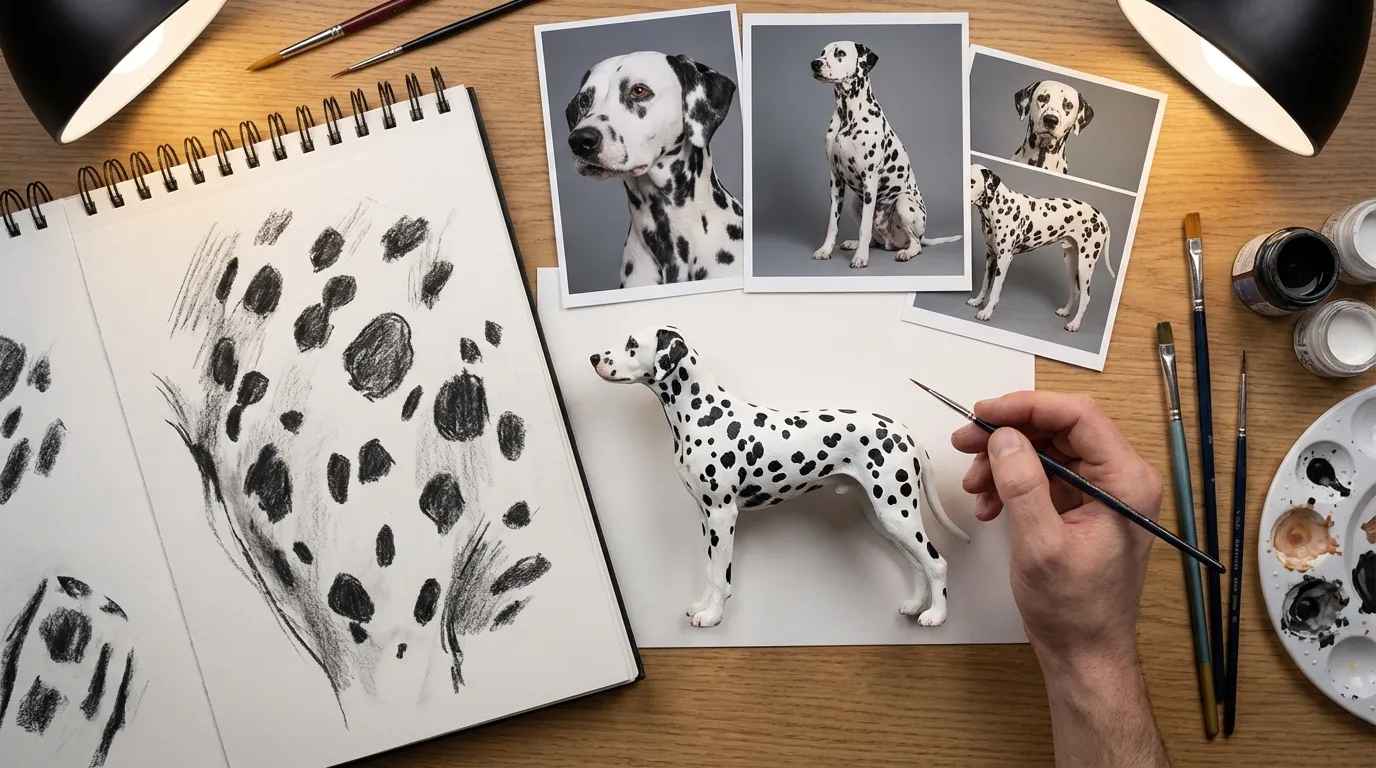
“God is in the details.” — Ludwig Mies van der Rohe
A single black spot on the left ear, shaped exactly like a thumbprint. That was the detail that made him him. When you looked at him from the right, he was a different dog entirely.
Quick Takeaways
- Dalmatians are asymmetrical — never assume the left side matches the right side patterns.
- Hidden spots matter — capture the belly and inner legs for true 3D realism.
- Lighting is critical — bright sun washes out white fur; overcast light preserves spot definition.
- Precision requires data — PawSculpt’s custom figurines rely on exact photo angles to map every unique mark.
The "QR Code" of the Dog World
In our shop, we have a saying: "Golden Retrievers are about form; Dalmatians are about geography."
When our digital artists sit down to sculpt a Golden, they are looking at the flow of the coat, the feathering on the legs, and the skeletal structure. But when we approach 3D modeling pets with complex patterns like Dalmatians, the challenge shifts entirely.
Your Dalmatian is essentially a biological fingerprint. No two are alike.
Most people don't realize that the distribution of spots isn't just "random." It follows the dog's unique biology. From an engineering perspective, we view a Dalmatian's coat as a complex texture map wrapped around a geometric form. If we miss a cluster of spots on the flank, or if we place a large spot where a small one belongs, the brain instantly rejects the figurine. It falls into the "Uncanny Valley." It looks like a Dalmatian, but it doesn't look like your Dalmatian.
"We don't just print a dog; we print a specific map of memories."
We see this often with generic store-bought statues. A customer will tell us, "I bought a figurine online, but it felt like a stranger." That’s because the specific constellation of markings—the "QR code" of your pet—wasn't there.
The 360-Degree Reality: Why One Photo Isn't Enough
Here is the counterintuitive insight that most pet owners miss: The face is the least important part of the pattern mapping process.
Humans are biologically wired to look at faces. When you scroll through your camera roll, 90% of your Dalmatian photography is likely focused on the eyes and the smile. While that captures the soul, it doesn't capture the map.
In our additive manufacturing workflow, we are building a three-dimensional object in a virtual space (ZBrush or Blender) before it ever hits the printer. We need to know what happens when the form turns.
The "Blind Side" Problem
If you send us a photo of your dog sitting and facing the camera, we can see the chest and front legs perfectly. But what is happening on the back of the neck? What is the pattern on the base of the tail?If we don't have that data, our artists have to "invent" the spots to fill the blank space. We hate doing that. We want to reproduce the specific cluster on the lower back that you scratched when they were a puppy. We want the asymmetry.
"A Dalmatian's left side is often a complete stranger to its right side."
— The PawSculpt Team
The Technical Challenge: White Fur and Bloom
From a production standpoint, Dalmatians present a specific optical challenge called "bloom."
White fur is highly reflective. In bright sunlight, it reflects so much light that it can blur the edges of the black (or liver) spots in a photograph. When we import these reference photos into our sculpting software, the boundaries become fuzzy.
The Counter-Intuitive Tip: The best photos for a custom spotted dog statue aren't taken on a sunny beach. They are taken on a cloudy Tuesday in your backyard.
Diffuse lighting (cloud cover) cuts the glare on the white fur and deepens the black of the spots. This gives our digital sculptors high-contrast "data" to work with. We can see exactly where the white ends and the pigment begins.
Capturing the "Hidden" Geography
When we prepare a model for full-color resin 3D printing, we aren't just printing the outer shell. We are printing a solid object with surface integrity. This means we need to know the pattern in places you might not look every day.
One of the most common failure points in getting a perfect likeness happens because of the "under-areas."
The Belly and Inner Legs
You might think, "The figurine will be sitting, so nobody will see the belly." But in 3D space, the geometry of the belly dictates how the legs sit. If your dog has a heavy spotting pattern on the inner thigh, that visual "weight" changes how the leg looks.Furthermore, many Dalmatians have "ticking"—smaller, flecked spots—that appear more heavily on the legs and muzzle. Capturing the density of this ticking is the difference between a cartoon dog and a realistic replica.
Photo Checklist for Maximum Accuracy
To help you get the best results, we’ve broken down the essential angles we use in the lab.
| Angle | Why It Matters for 3D Modeling | Common Mistake |
|---|---|---|
| Direct Profile (Left & Right) | Maps the main body spots. Crucial because patterns rarely match on both sides. | Taking the photo at a downward angle (foreshortening the legs). Shoot at eye level. |
| Top-Down (The "Spine Line") | Shows how spots transition from left to right across the back. | blurry photos caused by the dog moving. Use a treat to hold them still. |
| The "Tail Base" | A unique identifier area. Many dogs have specific spot clusters here. | Ignoring the tail entirely or letting it crop out of the frame. |
| Under-Chin / Chest | Defines the "front view" personality. | Shadows from the head obscuring the chest pattern. |
How We Process Your Spots (It's Not Painting)
There is a misconception that we 3D print a white dog and then hire an artist to paint spots on it with a tiny brush.
That is not how we work. In fact, hand-painting a Dalmatian often looks artificial because brushstrokes have thickness and direction that fight against the texture of the fur.
At PawSculpt, we use industrial-grade full-color 3D printing (polyjet or similar advanced photopolymer jetting). Here is the shop-floor reality of that process:
- Digital Sculpting: Our artist sculpts the fur texture digitally. Then, they "paint" the color directly onto the 3D model's surface in the software. This allows them to wrap the spots around the curvature of the muscle naturally.
- Voxel-Level Control: When we hit "print," the machine lays down microscopic droplets of resin. It mixes cyan, magenta, yellow, black, and white resins at the droplet level.
- Embedded Color: The spot isn't on the dog; the spot is the dog. The black resin is cured right next to the white resin. This creates a crisp, organic transition that mimics actual hair growth patterns, something extremely difficult to achieve with a paintbrush.
This technology allows us to capture the "ticking"—those tiny specks of pigment—with precision that human hands simply cannot replicate with a brush.
"Memory fades, but a physical object anchors it in time."
A Note on "Liver" Dalmatians
If you have a liver-spotted Dalmatian (brown spots), accurate lighting in your photos is even more critical.
Digital sensors often struggle with reddish-brown tones, sometimes interpreting them as too red or too grey. According to color theory standards used by the American Kennel Club, liver is a recessive color that requires specific genetic expression, resulting in a rich, warm brown.
To ensure we get the color right, try to include a "color reference" in one of your photos—like a standard white sheet of paper next to the dog. This helps our artists color-correct the digital model to match your dog's true hue, ensuring the final full-color resin 3D print isn't too dark or too desaturated.
The Emotional Weight of the Pattern
We had a customer recently who sent us photos of her late Dalmatian, Barnaby. She was worried because she didn't have a perfect 360-degree video, just a collection of photos from over the years.
We worked with her, piecing together the "map" of Barnaby like a puzzle. We used a photo from 2018 for the left side, a puppy photo for the tail, and a sleeping photo for the belly.
When she received the box, she wrote to us: "I knew it was him immediately. Not because of the face, but because of the heart-shaped spot on his shoulder."
That is why we nag you for photos. That is why we ask for the "boring" angles of the back and the rear. Because we know that your love for your dog is stored in those specific, random, beautiful coordinates.
Frequently Asked Questions
Can you make a figurine if I don't have photos of every angle?
Yes, absolutely. While we encourage "mapping" the dog as fully as possible, we work with memorial cases daily where new photos are impossible to take. Our artists use anatomical expertise to fill in the gaps naturally. We will focus on getting the visible spots perfect and ensuring the "hidden" side follows a natural, realistic distribution.Do you hand-paint the spots on the figurine?
No. We use advanced full-color 3D printing. The colors are printed directly into the resin material as it cures. This provides a much more realistic finish for short-haired breeds like Dalmatians, as there are no brushstrokes to disrupt the texture of the fur.My Dalmatian has a lot of tiny ticking spots. Will those show up?
Yes. One of the major advantages of our technology over traditional hand-sculpting is resolution. We can replicate the "salt and pepper" ticking on the legs and muzzle that gives your dog their unique look.How do I photograph a dog that won't sit still?
Video is your best friend. Instead of trying to snap the perfect photo, take a high-resolution video while walking slowly around your dog (or having someone distract them with a treat). We can extract high-quality still frames from the video to use as reference for the 3D model.Ready to Celebrate Your Pet?
Every pet has a story worth preserving. Whether you're honoring a beloved companion who's crossed the rainbow bridge or celebrating your furry friend's unique personality, a custom PawSculpt figurine captures those details that make your pet one-of-a-kind.
Free instant AI preview • 3D artist preview within 7 days • 5 free revisions