Resin vs. Time: The Science of Why We Choose UV-Cured Prints for Heirlooms
Sunlight hit the old bookshelf, illuminating dust motes dancing around the faded photo frame, but the figurine next to it—a small, spotted spaniel—caught the light differently. It didn't just sit there; it glowed with an inner depth, the result of millions of microscopic droplets of resin fused by ultraviolet light into something permanent.
Quick Takeaways
- UV-cured resin offers superior detail — capturing fur texture down to the micron, far beyond manual sculpting.
- Color is structural, not superficial — pigments are embedded inside the material, preventing chipping or peeling over time.
- Avoid direct sunlight — even UV-stabilized heirlooms should live indoors to maintain vibrancy for decades.
- Clear coating is critical — the final protective layer on PawSculpt's custom figurines seals the surface against humidity and oils.
The Chemistry of Memory: Why We Don't Use Clay
In the additive manufacturing world, there’s a saying we toss around the shop floor: "Clay forgets, but resin remembers."
That might sound dramatic, but when you've spent fifteen years watching materials age, you start to see the truth in it. Traditional sculpting materials—clay, wax, even certain thermoplastics—are susceptible to what we call "creep." Over years of thermal cycling (your house getting hot in summer, cold in winter), they shift. They settle. A hand-painted layer on top of a clay figure expands at a different rate than the core, leading to those hairline cracks you see on antique dolls.
We chose full-color resin 3D printing (specifically, PolyJet-style technology) for PawSculpt not because it’s faster—it’s actually quite technically demanding—but because it solves the "heirloom problem."
When we create a memorial, we aren't just making a toy. We are engineering a physical object meant to outlast the grief of the moment and become a permanent anchor for memory. To do that, we have to fight physics.
The Problem with "Hand-Painted"
Let's clear up a massive misconception in the collectible world. Most people think "hand-painted" implies higher quality. In the context of hyper-realistic pet replicas, it’s often a liability.
When an artist paints a model, they are applying a surface layer of acrylic or enamel. That layer has thickness. It fills in the tiny crevices of sculpted fur. If a sculptor creates a beautiful texture representing a Golden Retriever's feathery chest, and then someone paints three layers of white, cream, and gold over it, that detail is smoothed out. You lose the definition.
Furthermore, paint chips. It scratches. If you handle a painted figure frequently—which many grieving pet owners do—the oils from your hands eventually degrade the bond between the paint and the substrate.
Our process is different. We use a multi-material jetting process. Think of it like a standard inkjet printer, but instead of ink on paper, it jets tiny droplets of liquid photopolymer resin that are instantly cured (hardened) by a high-intensity UV light.
Crucially, the color isn't on the figurine. The color is the figurine.
"True durability isn't just about the material staying hard; it's about the memory staying sharp."
Understanding Photopolymers: The "Bone" of the Print
To understand why your figurine feels the way it does—solid, slightly cool to the touch, with a specific density—you have to understand the material science of photopolymers.
We use a composite resin formulation designed for spectral accuracy and mechanical stability. Here is the trade-off every engineer deals with:
- Hardness vs. Brittleness: Extremely hard resins capture amazing detail but shatter if you look at them wrong.
- Toughness vs. Softness: Tough resins can survive a drop, but they often look "gummy" and lose sharp edges.
We operate in the "Goldilocks" zone. Our cured resin has a Shore D hardness comparable to a hard hat or a bowling ball. It’s rigid enough to hold the geometry of a whisker (though we usually thicken those slightly for safety), but the internal structure is cross-linked tightly enough to resist warping.
The Voxel Difference
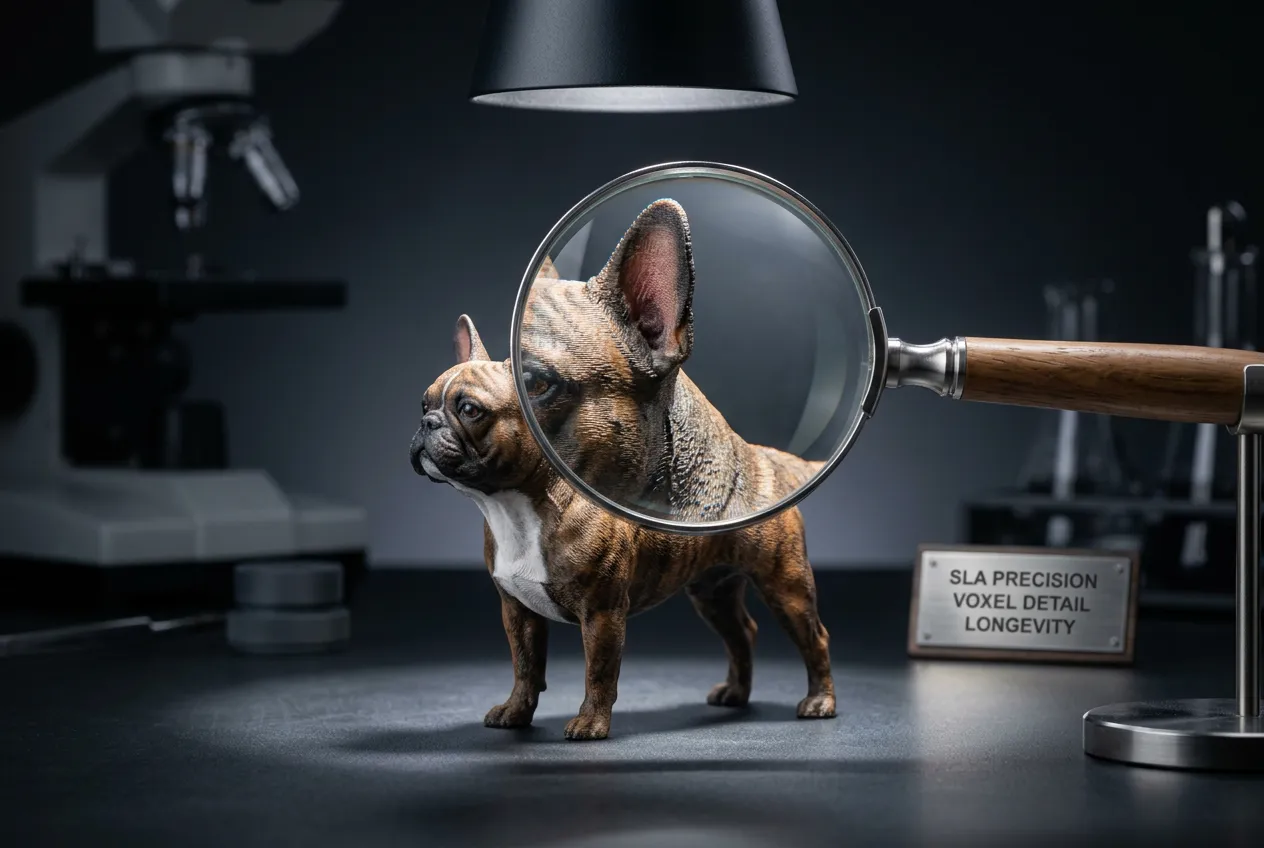
In traditional manufacturing, you fill a mold. In our process, we build with voxels. A voxel is a volumetric pixel—a 3D cube of information.When our digital artists sculpt your pet in software like ZBrush, they aren't just shaping the surface. They are defining the volume. When that file hits the printer, the machine is making millions of decisions per layer.
- "This voxel needs to be rigid white."
- "This voxel needs to be slightly flexible pink (for the inside of the ear)."
- "This voxel is support material (to be removed later)."
This allows us to achieve gradients that are impossible with a brush. The transition from the black of a dog's nose to the grey of their muzzle isn't a hard line; it's a dithering of microscopic colored resin droplets that mimics biology.
The Archival Reality: Light, Heat, and Time
I want to be honest with you about the enemies of resin. No material on earth is impervious to time—even bronze oxidizes. But by understanding the science, you can ensure your keepsake lasts for generations.
The UV Paradox
We use UV light to cure the resin. It turns the liquid into a solid. However, UV light is also the enemy of the finished product. Continued exposure to harsh UV (like direct, unfiltered sunlight on a windowsill) can cause "over-curing."Over time, this can lead to:
- Yellowing: The clear coat or white resins may take on a warm amber tint.
- Brittleness: The molecular chains continue to tighten until they have no give left, making the piece more fragile.
The Fix: We apply a UV-blocking clear coat during post-processing. Think of it as SPF 50 for your figurine. It seals the surface and filters out harmful rays. However, we always recommend displaying your custom 3D printed pet indoors, away from direct midday sun.
Humidity and "Bloom"
Resin is hygroscopic, meaning it can absorb small amounts of moisture from the air if left unsealed. In high-humidity environments, an unsealed print can develop a white, powdery residue known as "bloom."This is why we never skip the clear coat step. It creates a hermetic seal. We’ve seen competitors ship raw prints to save money, and within a year, the surface looks chalky. Our post-processing team ensures every millimeter is sealed.
| Environmental Factor | Risk to Resin | How We Mitigate It | Owner Action Required |
|---|---|---|---|
| Direct Sunlight (UV) | Yellowing, Brittleness | UV-Resistant Clear Coat | Keep away from windowsills |
| High Heat (>100°F) | Warping, Softening | High-Temp Resin Blend | Don't leave in hot cars |
| Skin Oils | Surface degradation | Clear Coat Sealant | Handle with clean hands |
| Humidity | Surface "Bloom" | Hermetic Sealing | Indoor display only |
The Post-Processing Workflow: Where Science Meets Art
While we don't hand-paint, that doesn't mean hands aren't involved. The post-processing stage is where an additive manufacturing engineer earns their keep. It’s a messy, precise, and critical phase.
1. Support Removal
When the print finishes, it’s encased in a gelatin-like support material. This material held up the overhanging parts (like the chin or tail) during printing. We use a high-pressure water jet station to blast this away. It requires a surgeon's touch—too much pressure snaps a tail; too little leaves residue.2. The Isopropyl Wash
The print is then submerged in isopropyl alcohol. This cleans off any uncured resin. If you leave a print in the alcohol too long, it turns white and cracks. If you take it out too soon, it remains sticky. We have strict timing protocols based on the volume of the model.3. The Final Cure
Even though the printer uses UV light, the model is often only about 80% cured when it comes off the build plate. We place the cleaned models in a dedicated UV oven. This final blast of light ensures the chemical reaction is 100% complete, locking in the mechanical properties.4. The Clear Coat
This is the only step that looks like traditional art. A technician applies the clear coat (matte, satin, or gloss depending on the fur type). This isn't just for looks; it wets the surface, making the colors "pop" and providing that essential protective barrier."We treat the clear coat application like a final blessing on the piece—it's the shield that protects the memory."
— The PawSculpt Team
Why Digital Sculpting is Superior for Durability
You might wonder why we don't just scan photos and print them automatically. The answer lies in structural integrity.
Photos give us the look of the pet, but they don't tell us about the physics of the figurine. A digital artist (a human being working in 3D software) understands that a dog’s tail, if printed exactly to scale, might be only 2mm thick at the tip. That’s too fragile for a keepsake.
Our artists subtly thicken these danger zones—ears, tails, ankles—without altering the visual perception of the pet. We call this "manufacturing-aware sculpting." It’s a skill that takes years to master. We are constantly balancing the aesthetic desire for realism with the engineering requirement for longevity.
If we simply used an AI to generate a blob from a photo, you'd end up with a print that snaps at the ankles the first time you dust it. By manually building the geometry, we ensure the internal lattice is sound.
Frequently Asked Questions
Will the color fade over time?
Our UV-cured prints are highly resistant to fading when kept indoors. Because the color is embedded directly into the resin material rather than painted on top, it won't flake or peel. We also apply a UV-blocking clear coat. However, like a fine watercolor painting or a photograph, direct sunlight is the enemy. Keep your figurine on a shelf away from harsh window light to ensure vibrancy for decades.Is the resin toxic?
Once the figurine has gone through our post-processing (washing, UV curing, and sealing), the material is inert and safe to handle. However, these are designed as art objects, not toys. They should not be given to children or pets who might chew on them, as ingesting small fragments of cured resin is not safe.Can I clean my figurine?
Yes, but be gentle. We recommend using a soft, dry microfiber cloth or a clean, soft makeup brush to dust the figurine. Avoid using water, soap, or household chemical cleaners. Harsh chemicals can strip the protective clear coat and eventually cloud the resin.How fragile is the material?
Think of your figurine like a ceramic mug or a high-end statue. It is rigid and solid, but it is not impact-proof. It can handle being held, moved, and touched, but if it falls onto a tile or concrete floor, it may break—especially at delicate points like pointy ears or thin tails.Ready to Celebrate Your Pet?
Every pet has a story worth preserving. Whether you're honoring a beloved companion who's crossed the rainbow bridge or celebrating your furry friend's unique personality, a custom PawSculpt figurine captures those details that make your pet one-of-a-kind.
Free instant AI preview • 3D artist preview within 7 days • 5 free revisions
The science of photopolymers is fascinating, but at the end of the day, it's just a means to an end. The real magic happens when you open the box. You aren't looking at a collection of voxels or a matrix of UV-cured oligomers. You're looking at the tilt of a head you thought you’d never see again. You're seeing the specific pattern of spots that made your dog yours.
We engineer these pieces to be tough because we know what they have to carry. They have to carry love. And that is the heaviest, most beautiful thing in the world.