Chaos to Calm: Why 3D Scans Capture the Blur of a Ferret Better Than Photos
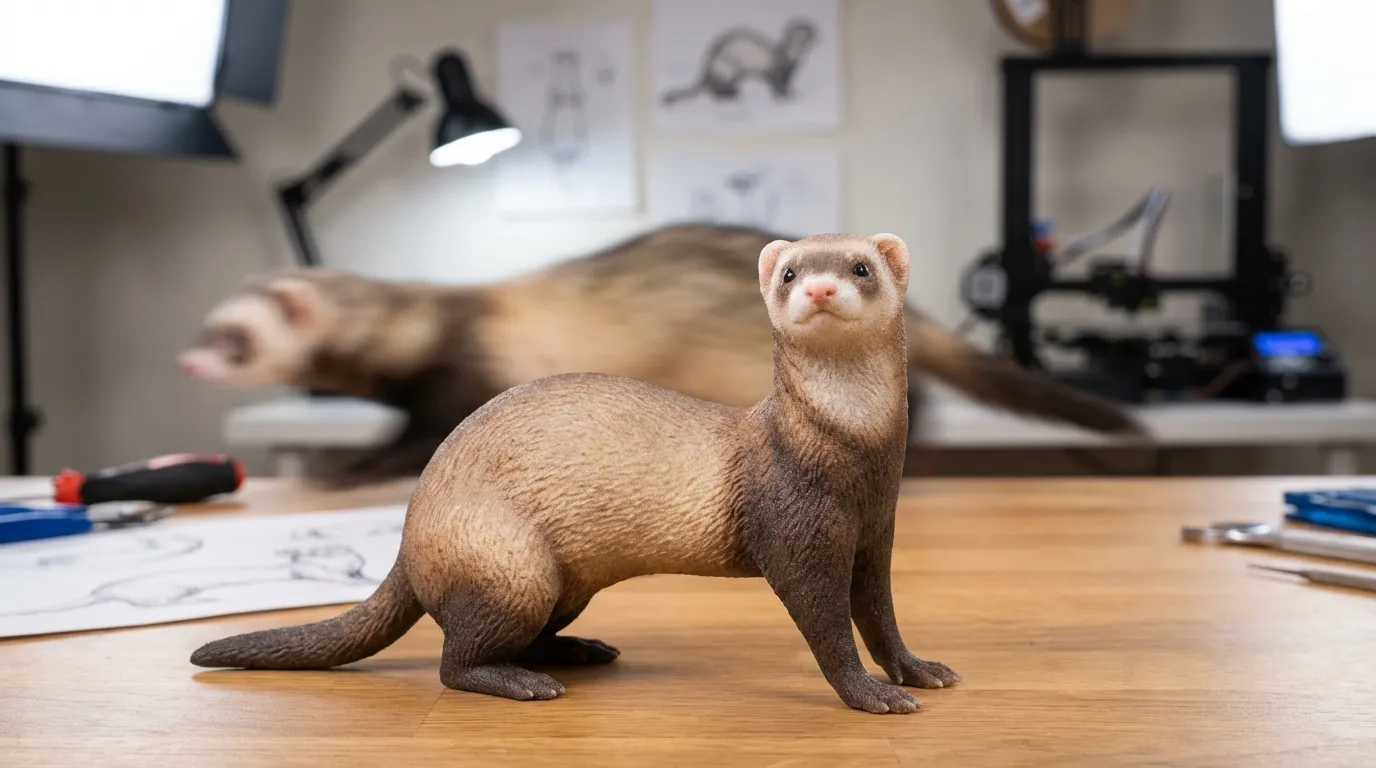
A ferret’s heart beats 200 to 250 times per minute. In the dusty light of the attic, holding his old hammock, I realized that frantic energy is exactly what a static photo fails to keep. It’s why a standard ferret memorial often feels so flat compared to the blur of life we remember.
Quick Takeaways
- Motion blur ruins photos — Ferrets rarely sit still, making 2D images poor representations of their anatomy.
- 3D captures the "slink" — Digital sculpting reconstructs the unique spinal curvature that photos flatten out.
- Gradients require technology — PawSculpt’s custom figurines use full-color printing to achieve natural fur blending, not painted brushstrokes.
- Photos are references, not the end result — You don't need a perfect photo; you need a sculptor who understands weasel geometry.
The Physics of the "Noodle": Why 2D Fails Ferrets
We call them "carpet sharks" or "noodles" for a reason. Physiologically, a ferret’s spine is incredibly flexible, allowing them to turn 180 degrees in a tunnel that is barely wider than their shoulders.
When you take a photo of a ferret, you are battling physics. Most phone cameras have a shutter speed that simply cannot freeze a creature moving that fast without introducing motion blur or requiring a flash (which washes out their coat colors). I’ve seen thousands of reference photos sent to our lab. 90% of them are just a blur of fur and a pink nose.
The Engineering Problem with 2D Images:
A photograph flattens a 3D object onto a 2D plane. For a dog sitting still, this works fine. For a ferret performing a "weasel war dance," the photo collapses their dynamic geometry. You lose the sense of the arch in the back, the specific way the neck flows into the shoulders, and the depth of their mask.
When we approach a custom pet figurine project for a ferret, we aren't just copying a photo. We are reverse-engineering the anatomy. We look at a blurry photo and ask: "Based on the skeletal structure of a Mustelid, where must that leg be?"
"Grief is love with nowhere to go. A figurine gives that love a place to land."
The Manufacturing Process: Digital Sculpting vs. The Myth of Scanning
There is a common misconception that to get a 3D figurine, you need to 3D scan the pet. Let me tell you from shop-floor experience: You cannot 3D scan a live ferret.
Lidar and photogrammetry scanners struggle with fur (it scatters light) and require the subject to be perfectly still for seconds or minutes. Try telling a ferret to freeze. It doesn't happen.
Instead, we use a process called Digital Organic Sculpting. This is where art meets additive manufacturing.
1. The Digital Clay (ZBrush/Blender)
Our artists use haptic feedback tools to sculpt the ferret in virtual space. This isn't "Photoshop for 3D." This is geometry. We build the skeleton, then the muscle mass, then the fur flow.- The Advantage: If your favorite photo of "Bandit" has his tail cut off by the frame, we don't print a cut-off tail. We reconstruct it based on anatomy.
- Fur Texture: We don't just add noise. We sculpt the "guard hairs" and the undercoat direction. Ferret fur lies differently than cat fur—it's coarser and flatter against the skin. We mimic that flow digitally.
2. Full-Color Additive Manufacturing (The Real Magic)
This is where the engineering gets interesting. At PawSculpt, we use industrial-grade full-color 3D printers (similar to PolyJet or MJF technology).Here is the critical difference that most people miss:
In traditional model making, you print a gray shape and then hand-paint it.
We do not do that.
We use a process where the machine jets tiny droplets of photopolymer resin that already contain the color. We are printing the color into the object, voxel by voxel (a voxel is a 3D pixel).
- Why this matters for ferrets: Ferret coats are complex. A "sable" ferret has a cream undercoat with dark brown guard hairs. A "silver" has a mix of white and gray hairs.
- The Hand-Painting Failure Mode: If you try to hand-paint a ferret figurine, you end up with a solid brown blob or distinct brush strokes that look unnatural.
- The 3D Print Solution: Our printers can dither colors at the micron level. We can tell the printer: "Make this square millimeter 40% cream and 60% brown." The result is a gradient that looks like real organic fur, not a painted toy.
3. Post-Processing: The Clear Coat
Once the print is finished, it undergoes a chemical bath to remove support material (the scaffolding that holds the print up). The final step is a UV-resistant clear coat. We don't touch it with paintbrushes. The clear coat seals the resin and deepens the contrast of the printed colors, making the eyes look wet and alive."Ferrets are liquid energy. Capturing that in a solid object requires understanding flow, not just shape."
— The PawSculpt Team
Photographing Small Pets for 3D Artists
You don't need a perfect photo, but better data in means better data out. If you are planning a memorial or a gift, here is how to trick your ferret into giving us the data we need.
The "Tube Treat" Hack:
The best way to get a profile shot of a ferret is to hold a tube of treat paste (ferret-safe, obviously) just out of reach or smeared on a clear surface. This stretches their neck out and aligns the spine.
What We Look For (Engineering Checklist):
- The Mask: We need one clear shot of the face pattern. Is it a T-bar? A V-shape? A full bandit mask?
- The Bib: Does your ferret have a white patch on the throat? (Very common, often missed in top-down photos).
- The Mitts: Are the feet white? Just the toes? Or fully dark?
Data Input vs. Output Quality
| Feature | 2D Photo Limitation | 3D Figurine Solution |
|---|---|---|
| Spine Arch | Often looks like a "hump" due to bad angles | Sculpted to show natural spinal flexibility |
| Coat Color | Flash causes "red eye" and washes out coat | Colors are color-matched and printed deep in resin |
| Scale | Hard to judge size without a reference object | Printed to exact scale relative to proportions |
| Texture | Fur looks like a blur | Physical texture you can feel |
The Durability Trade-off: Handling Your Keepsake
I want to be transparent about the material properties of full-color resin. This is high-end photopolymer, not the ABS plastic used in LEGO bricks.
Hardness vs. Toughness:
In materials science, "hardness" is resistance to scratching, while "toughness" is resistance to breaking upon impact. Full-color resin is hard. It holds incredible detail—we’re talking layers as thin as 25 microns (thinner than a human hair).
However, it is not "tough" like a rubber dog toy.
- The Drop Test: If you drop a resin ferret on a tile floor, it may crack, specifically at the narrow points (ankles or tail).
- UV Stability: While we use UV-resistant clear coats, all photopolymers can shift color if left in direct, scorching sunlight for years. We recommend displaying your figurine indoors, away from direct window sills.
Why "Perfect" Isn't the Goal
Here is the counterintuitive insight I’ve learned after years of manufacturing: The uncanny valley is real.
If we make a model that is mathematically perfect—symmetrical, perfectly smooth, exact geometric proportions—it looks like a robot. Living things are asymmetrical. Your ferret’s left ear might have been slightly lower than the right. He might have had a scar on his nose.
When we digitally sculpt, we intentionally introduce "organic noise." We break the symmetry. We make the pose slightly off-center. This is what breathes life into the plastic. It’s why PawSculpt’s process involves human artists using digital tools, not just an automated AI algorithm.
"We don't remember days, we remember moments. A figurine freezes the best moment forever."
Honoring the Bond
I’ve had customers tell me that they felt guilty for wanting a figurine. They felt it was "weird" to want a physical object. But as humans, we are tactile creatures. We are built to hold things.
For a dog owner, they have the collar. For a ferret owner, the collar is often tiny, or they didn't wear one. The hammock goes in the wash. The cage gets put away. The physical evidence of that chaotic, joyful life disappears quickly.
A full-color, 3D printed figurine isn't about replacing the pet. It’s about anchoring the memory. It’s a focal point for the love that remains. When you look at the shelf and see that familiar arch of the back and the specific pattern of the mask, the brain triggers the memory of the "dooking" sounds and the toe nips.
It turns the chaos of grief into a calm remembrance.
Frequently Asked Questions
Can you fix blurry photos for the figurine?
Absolutely. Since we digitally sculpt the model from scratch rather than scanning the photo, we use the images as references. If your photos are blurry, we use our knowledge of ferret anatomy to fill in the gaps. We might ask you for a description of specific markings if they are unclear.How do you get the fur colors right without painting?
We use advanced full-color 3D printing (additive manufacturing). The printer jets colored resin droplets to build the object. This allows us to create soft gradients—like the transition from a dark mask to a white face—that are extremely difficult to achieve with a paintbrush. The color is part of the material itself.Is the figurine breakable?
Yes, these are museum-quality keepsakes, not toys. The full-color resin is similar to a ceramic or porcelain in terms of fragility. It feels solid and heavy in the hand, but thin parts like tails or feet can snap if dropped on a hard floor.How long does the process take?
Quality takes time. The entire process typically takes 3-6 weeks. This includes the digital sculpting phase (where you get unlimited revisions to ensure we captured the personality), the high-resolution printing, and the post-processing curing and clear-coating.Ready to Celebrate Your Pet?
Every pet has a story worth preserving. Whether you're honoring a beloved companion who's crossed the rainbow bridge or celebrating your furry friend's unique personality, a custom PawSculpt figurine captures those details that make your pet one-of-a-kind.
Free instant AI preview • 3D artist preview within 7 days • 5 free revisions