
What Most Chihuahua Rescue Guides Won't Tell You About the First 72 Hours
A 2022 survey by the ASPCA found that nearly 40% of returned rescue dogs are brought back within the first 72 hours—and Chihuahuas, with their reputation for trembling and snapping, top the small-breed return list. Right now, somewhere in a car pulling out of a shelter parking lot, a new adopter is glancing at a shaking four-pound dog in a carrier and wondering if they've made a terrible mistake. This chihuahua rescue adoption guide exists for that exact moment.
Quick Takeaways
- The first 72 hours aren't about bonding—they're about reducing sensory overload and letting your Chihuahua's nervous system decompress in a controlled space
- Trembling doesn't always mean fear—Chihuahuas thermoregulate poorly, and misreading shivering as terror leads to counterproductive coddling
- Ignore the "let them come to you" cliché—spatial predictability (same path, same schedule, same scent) matters far more than passive waiting
- Document your rescue Chihuahua's quirks early with photos and notes; these details become invaluable for vets, trainers, and even custom pet keepsakes that capture their one-of-a-kind personality later
- Hour 48 is the real crisis point, not hour one—plan for a behavioral dip most guides never mention
The Counterintuitive Truth About Chihuahua Rescue Preparation
Most first-72-hours guides for rescue dogs give you a universal playbook: set up a crate, buy some treats, be patient. That advice isn't wrong. It's just incomplete—dangerously so when the dog weighs less than a bag of sugar and has a neurological profile that differs meaningfully from a Labrador or a Pit Bull.
Here's what gets overlooked: Chihuahuas process spatial information differently than larger breeds. Their world is architecturally overwhelming. A standard doorway is a canyon. A couch is a cliff. The distance between your kitchen island and your refrigerator—a gap you don't even think about—is a corridor they must evaluate for threats from above, below, and both sides. Rescue Chihuahuas, who've often been in chaotic multi-dog foster environments or hoarding situations, arrive with their spatial threat assessment dialed to maximum.
The counterintuitive insight? The single most impactful thing you can do before pickup day isn't buying supplies—it's mapping your home's geometry from 6 inches off the ground. Get on the floor. Literally. Crawl from the front door to the room where your Chihuahua will spend the first 48 hours. Notice what's overhead. Notice the shadows. Notice where the air vents blow. That vent you've never thought about? It's a roaring wind tunnel at Chihuahua height.
The Spatial Audit: What to Do Before You Drive to the Shelter
A day-in-the-life scenario: It's the morning before pickup. You get on your hands and knees in the designated "decompression room" (more on that shortly). You notice the floor lamp casts a sharp shadow across the dog bed you've placed in the corner. You realize the heating vent is three feet away and blowing directly at bed level. You move the bed to the opposite wall, behind the armchair, where the air is still and the light is diffused. That five-minute adjustment may prevent 48 hours of unexplained trembling.
Here's your pre-arrival spatial checklist:
| Spatial Factor | What to Check | Why It Matters for Chihuahuas |
|---|---|---|
| Overhead exposure | Open ceiling, shelves above, hanging objects | Chihuahuas are molera-prone (soft skull spot); they instinctively avoid overhead threats |
| Air currents | Vents, fans, drafty windows at floor level | Their low body mass means they lose heat rapidly in moving air |
| Shadow patterns | Sharp shadows from furniture, lamps, window blinds | High-contrast shadows can trigger startle responses in anxious rescues |
| Sound reflections | Hard floors amplify footsteps; ticking clocks echo | Tile and hardwood create a noisier environment at ground level than you'd expect |
| Escape geometry | Gaps behind furniture, spaces under doors | A stressed 4-lb dog can fit through a 3-inch gap—and will try |
Most adopters skip this entirely. They set up a Pinterest-worthy dog corner and wonder why the Chihuahua won't go near it.
The Car Ride Home: Where Most Chihuahua Rescue Guides Start Too Late
Let's rewind to the car. You've signed the papers. The shelter volunteer has handed you a trembling Chihuahua in a carrier (or, worse, just placed the dog in your arms). The drive home is the actual beginning of the first 72 hours, and most guides treat it as a footnote.
The car is your Chihuahua's first environment with you. Not your house. The car. And what happens in that 15- or 40-minute drive sets a neurological baseline that persists for days.
Three rules for the drive:
- Carrier on the floor of the back seat, not the seat itself. The floor reduces visual stimulation (no windows) and dampens vibration. Place a worn t-shirt you've slept in inside the carrier. Not a clean one—a dirty one. Your existing scent needs to be the first olfactory data point this dog collects about you.
- No music, no talking, no phone calls. This isn't about being quiet for quiet's sake. It's about reducing the number of novel auditory inputs. The engine is already one. The road noise is two. Your breathing is three. That's enough. Every additional sound is a data point their overtaxed nervous system has to process.
- Drive the speed limit on surface streets. Avoid highways if possible. The sustained high-speed vibration and wind noise of highway driving creates a low-frequency hum that's far more intense at floor level inside a carrier than you'd experience in the driver's seat.
"The first memory your rescue dog forms with you isn't a moment—it's a sensory environment. Make it a calm one."
— The PawSculpt Team
One of our customers told us she almost turned around during the drive home. Her newly adopted Chihuahua—a 6-year-old from a puppy mill seizure—was silent in the carrier. Not trembling, not whining. Just frozen. She thought something was wrong. In reality, the dog was doing exactly what a well-managed car ride should allow: shutting down non-essential processing. That freeze response, in this context, wasn't pathological. It was adaptive. The dog was conserving resources for the bigger transition ahead.
Hour Zero Through Hour Six: The Decompression Protocol Most Guides Get Wrong
You're home. You've carried the carrier inside. Here's where the standard advice—"let them explore at their own pace"—fails Chihuahuas specifically.
Chihuahuas don't explore. Not in the way a Beagle or a Golden Retriever does. Larger breeds use locomotion as investigation: they walk, they sniff, they map. Chihuahuas use observation as investigation. They sit. They watch. They catalog. Giving a rescue Chihuahua "the run of the house" doesn't empower them—it overwhelms them with an incomprehensible amount of visual and spatial data.
The One-Room Rule
For the first six hours, your Chihuahua should have access to exactly one room. Not a hallway. Not a room with an open door to another room. One enclosed space with:
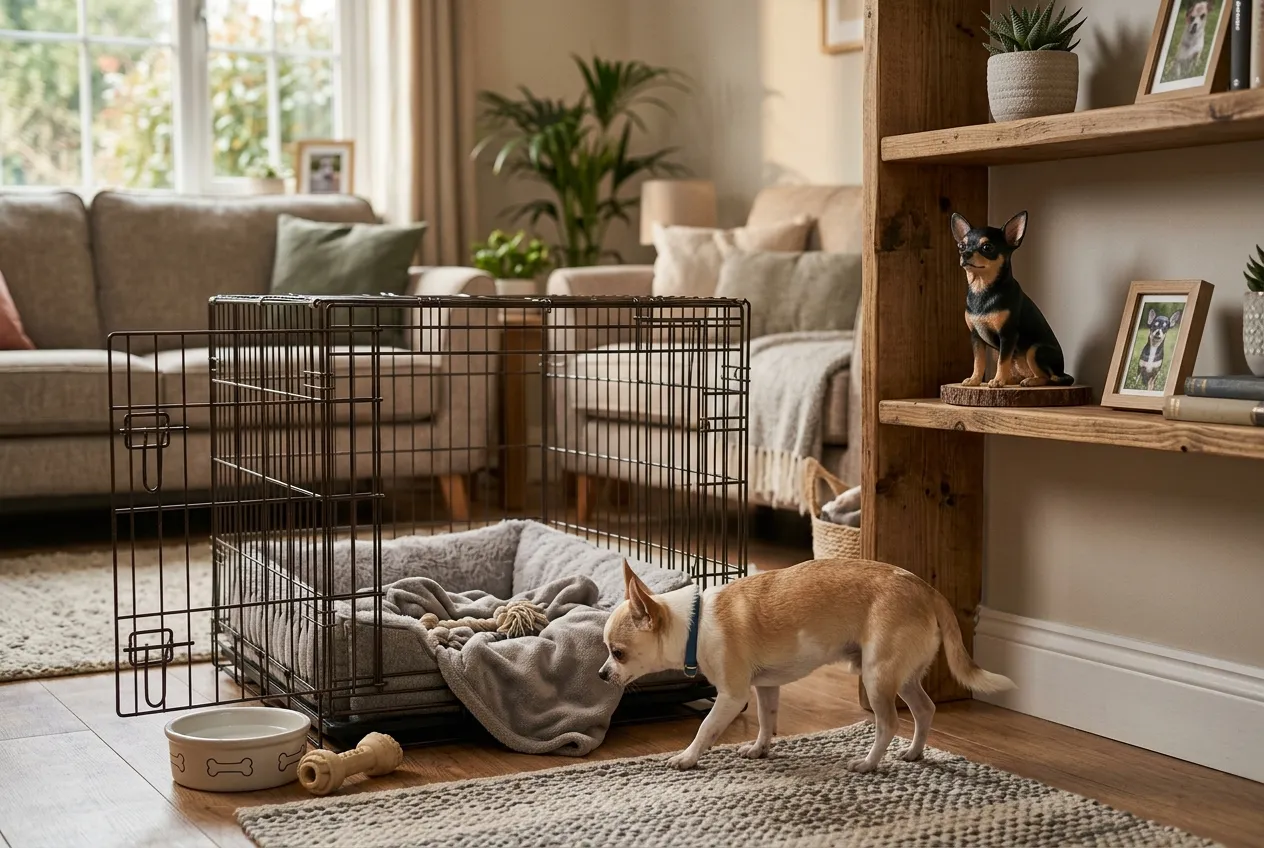
- A covered crate or enclosed bed (the "den")—positioned against a wall, not in the center of the room
- Water in a shallow, wide dish (deep bowls can startle Chihuahuas who've been in hoarding situations where water access was competitive)
- A pee pad placed away from the den and the water—at least four feet of separation
- No toys. Not yet. Toys are novel objects. Novel objects require assessment. Assessment requires cognitive bandwidth your Chihuahua doesn't have right now.
The room should be boring. Deliberately, aggressively boring. Beige walls are better than gallery walls. Closed blinds are better than a view. The goal is to reduce the number of things that require the dog's attention so their nervous system can begin downregulating from the shelter/transport stress response.
The Biggest Mistake in Hour One
Here it is, and almost every guide misses it: don't sit on the floor with your Chihuahua.
We know. Every rescue blog, every Instagram reel, every well-meaning shelter volunteer says to get on their level. And for most breeds, that's reasonable advice. But for a Chihuahua—especially one from a neglect or hoarding background—a human body on the floor is not comforting. It's a spatial anomaly.
Chihuahuas are accustomed to humans being tall. Vertical. Predictable in their verticality. When you suddenly become horizontal and ground-level, you've changed the spatial rules. You're now an unpredictable large mass at their altitude. For a dog whose primary survival strategy is reading the geometry of threats, this is disorienting.
Instead: sit in a chair. A normal chair, at normal height. Be vertical. Be predictable. Be still. Read a book. Scroll your phone. Exist in the room without making the room about the dog. Let them observe you being a boring, consistent, vertical presence.
This is the opposite of what feels right. And that's exactly why it works.
Hour Six Through Hour Twenty-Four: Reading the Signals Nobody Talks About
By hour six, you'll start seeing behaviors that most first-time Chihuahua adopters misinterpret. Let's build a framework for reading them accurately.
| Behavior | Common Misinterpretation | More Likely Meaning | Appropriate Response |
|---|---|---|---|
| Trembling while lying down | "They're terrified of me" | Thermoregulation failure; Chihuahuas shiver when their core temp drops even slightly | Add a fleece blanket to the den; check room temp (aim for 72-75°F) |
| Refusing food | "They hate the food I bought" | Stress-induced appetite suppression; normal for 12-24 hours | Leave kibble available but don't hover; try warming it slightly to release aroma |
| Lip licking with no food present | "They're hungry" | Appeasement signal; they're reading your body language and trying to de-escalate | Reduce your proximity; soften your posture |
| Staring at you without blinking | "They're bonding with me!" | Hypervigilance; they're tracking you as a potential threat | Don't make eye contact; look at your phone or a book instead |
| Sudden burst of zoomies | "They're happy and adjusting!" | Stress displacement behavior; an overflow of cortisol-driven energy | Don't encourage it; let it pass; ensure the room is safe for frantic movement |
That last one—the zoomies—is the most commonly misread. We've heard from customers who saw their rescue Chihuahua sprint around the room on night one and thought, "They're settling in!" Then they were blindsided when the dog shut down completely by hour 18. The zoomies weren't joy. They were a stress valve releasing pressure. And the shutdown that follows is the real adjustment beginning.
The Night One Protocol
Night one is where adoptions succeed or fail. Here's what to do:
Place the crate or enclosed bed next to your bed, on the floor, at mattress height if possible (a low nightstand works). Not in another room. Not in the living room. The goal isn't to "teach independence"—that comes in week three. The goal is to let the dog hear your breathing rhythm while you sleep.
Breathing rhythm is the most underrated bonding tool in early rescue adoption. Dogs synchronize their respiratory rate to nearby calm mammals. If your breathing is slow and regular (as it is during sleep), the Chihuahua's nervous system begins to mirror it. This is called respiratory entrainment, and it's one of the few processes that works even when the dog is in a high-stress state.
Don't reach into the crate. Don't whisper reassurances. Just sleep. Your unconscious breathing is doing more work than any conscious effort could.
"A rescue dog doesn't need your words on night one. They need your breathing."
Hour Twenty-Four Through Hour Forty-Eight: The Window Nobody Warns You About
Here's the section you won't find in the first five Google results for "first 72 hours rescue dog."
Hour 24 to hour 48 is the most dangerous window for adoption failure, and it has nothing to do with the dog. It has to do with the adopter's emotional arc.
The pattern looks like this:
- Hours 0-12: Adrenaline and excitement. You're hyper-attentive. Everything the dog does is meaningful. You're patient, present, and committed.
- Hours 12-24: Fatigue sets in. The dog hasn't eaten, hasn't wagged its tail, hasn't done anything "cute." You start wondering if you chose the right dog.
- Hours 24-36: Doubt peaks. The dog may have had a stress-related accident. They growled when you reached for the water dish. Your partner says, "Are you sure about this?" You Google "can I return a rescue dog" at 2 AM.
- Hours 36-48: The crisis point. You're sleep-deprived, emotionally drained, and the dog is—from your perspective—no closer to being "yours" than they were in the shelter parking lot.
This is the valley. And the thing nobody tells you is: the valley is not a sign that something is wrong. The valley IS the process.
The Chihuahua, meanwhile, is on a completely different timeline. Their cortisol levels are still elevated from the shelter-to-car-to-home transition. Their olfactory map of your home is still forming. They're not rejecting you at hour 36. They haven't even fully registered you yet. Their brain is still processing the space—the walls, the floors, the air temperature, the ambient sound profile. You, the human, are somewhere around item #15 on their sensory priority list.
What Actually Helps at Hour 36
Not talking to the dog. Not offering treats from your hand. Not sitting on the floor (still don't do that).
What helps: establishing a micro-routine.
A micro-routine is a 3-step behavioral sequence you perform identically every 4-6 hours. It should involve:
- A sound (a specific word or short phrase, said in the same tone—"okay, time" works fine)
- A movement (walking to the same spot, placing the food bowl in the same location)
- A pause (standing still for 10 seconds after placing the bowl, then leaving the room)
The content of the routine matters less than its consistency. You're building a predictive model in the dog's brain. When a Chihuahua can predict what happens next, their cortisol drops. Predictability is safety. Safety is the prerequisite for everything else—bonding, training, trust, all of it.
Day-in-the-life at hour 40: You wake up. You say "okay, time." You walk to the same corner. You place the warmed kibble in the same dish. You stand still for ten seconds. You leave the room. The Chihuahua, who yesterday wouldn't look at the bowl while you were present, takes two steps toward it before you've closed the door. That's not a small thing. That's the architecture of trust being laid, one predictable brick at a time.
Hour Forty-Eight Through Hour Seventy-Two: The First Real Signals
By hour 48, if you've followed the decompression protocol, something shifts. It's subtle. You might miss it if you're looking for tail wags and face licks (which, honestly, many Chihuahuas never offer to strangers in the first week—or ever).
The real signals at hour 48-72 look like this:
- The dog repositions to face you when you enter the room. Not approaching you. Just reorienting. This means you've been promoted from "environmental feature" to "relevant entity."
- Eating within 5 minutes of food placement (instead of waiting until you've been gone for 20+ minutes). This means the cortisol suppression of appetite is lifting.
- A single, voluntary approach. Maybe they walk to within two feet of your chair and stop. Don't react. Don't reach. Let them collect the olfactory data they came for and retreat. This is reconnaissance, not affection. Respect it as such.
- A sigh. A deep, audible exhale while lying down. This is the parasympathetic nervous system engaging—the "rest and digest" mode that's been suppressed since the shelter. It's the single most meaningful behavioral signal in the first 72 hours, and most people don't even notice it.
When Things Don't Follow This Timeline
We'll be real: not every Chihuahua follows this arc. Dogs from severe neglect, long-term puppy mill confinement, or multiple failed adoptions may take 5-7 days to reach the behavioral markers we've described at hour 48. Some may take longer.
The ASPCA's behavioral resources offer a helpful framework for identifying when stress behaviors cross into clinical anxiety territory. If your rescue Chihuahua hasn't eaten anything by hour 48, or if trembling is continuous and unrelated to temperature, consult a veterinarian. We're not vets—this guide covers behavioral adaptation, not medical diagnosis.
But here's what we want you to hold onto: the absence of visible progress is not the absence of progress. Neurological adaptation is invisible. The Chihuahua who appears unchanged at hour 60 may have already built a complete olfactory map of your home, cataloged your movement patterns, and determined that you are not a threat. They just haven't told you yet. Chihuahuas are not Labradors. They don't broadcast their internal states. They're more like cats in that way—private processors who reveal conclusions, not processes.
What to Document (And Why It Matters More Than You Think)
Starting from hour one, keep a simple log. Not for Instagram. Not for your rescue group's follow-up check. For the dog's long-term benefit.
Record:
- Time and type of eating (full meal, partial, refused)
- Elimination patterns (location, consistency, timing—yes, this matters)
- Startle triggers (what caused a flinch, freeze, or flee response)
- Voluntary approaches (when, how close, what preceded it)
- Sleep positions (curled tight = still guarded; stretched out = beginning to relax)
This log becomes invaluable in three contexts:
- Veterinary visits. Your vet can't assess behavioral baselines from a single appointment. Your log gives them a longitudinal view.
- Trainer consultations. If you bring in a behaviorist at week 3 or 4, they'll ask about early patterns. Your log provides data instead of fuzzy recollections.
- Celebrating progress. At week 6, when your Chihuahua falls asleep in your lap for the first time, you'll look back at the hour-12 entry that says "won't look at me, trembling in corner" and understand the distance traveled.
And here's a use case we see often at PawSculpt: those early photos you take for documentation? The ones where your Chihuahua is peeking out from behind the armchair, or curled in a tight ball in their den, or taking their first tentative steps toward you? Those photos capture something irreplaceable. They capture the before. Months later, when you're ready to celebrate your dog's transformation, those images—combined with the joyful, relaxed photos from later—tell a complete story. Some of our customers have used exactly these kinds of early rescue photos as references for custom 3D pet figurines that capture their Chihuahua's personality at a specific moment in time. The full-color resin printing process reproduces the exact markings, ear position, and expression from a photograph—details that carry enormous emotional weight when they represent a rescue journey.
"Every rescue has a before and after. The most powerful keepsakes capture both."
The Commonly Overlooked Chihuahua-Specific Challenges in the First 72 Hours
Let's address the breed-specific factors that generic rescue guides gloss over entirely.
Hypoglycemia Risk
Chihuahuas under 5 pounds are prone to hypoglycemia (dangerously low blood sugar), especially under stress. A rescue Chihuahua who hasn't eaten in 12+ hours and is burning calories through sustained trembling is at real risk. Symptoms include lethargy, glassy eyes, uncoordinated movement, and in severe cases, seizures.
Keep Karo syrup or Nutri-Cal paste on hand during the first 72 hours. If your Chihuahua shows signs of hypoglycemia, rub a small amount on their gums and contact your vet immediately. This isn't optional preparation—it's essential for small-breed rescue adoption. The American Kennel Club's Chihuahua breed page notes this vulnerability explicitly.
Dental Pain as a Behavioral Confounder
Rescue Chihuahuas frequently arrive with severe dental disease—fractured teeth, infected gums, loose molars. A dog who "refuses to eat" may not be stressed. They may be in oral pain. If your Chihuahua approaches food, mouths it, then drops it and walks away, dental issues should be your first suspicion, not anxiety.
Schedule a veterinary dental exam within the first week. Many rescue organizations cover initial vet visits—check your adoption agreement.
The Lap Dog Myth
Here's the thing nobody says out loud: not all Chihuahuas are lap dogs. The breed's reputation as a cuddly purse companion is a marketing artifact, not a behavioral guarantee. Many rescue Chihuahuas—especially those from neglect backgrounds—are touch-averse. Some remain touch-averse permanently. Adopting a Chihuahua with the expectation of a lap dog and getting a dog who prefers to observe you from across the room is one of the top reasons for adoption returns.
If your rescue Chihuahua doesn't want to be held at hour 72—or at week 72—that's not a failure. That's a dog with boundaries. And honestly? Respecting those boundaries is a deeper form of love than insisting on the cuddle you imagined.
| Expectation | Reality for Many Rescue Chihuahuas | Healthy Reframe |
|---|---|---|
| Will sit in my lap immediately | May avoid physical contact for weeks | Proximity without contact is still connection |
| Will bond with the whole family | May attach to one person exclusively | Single-person bonding is normal and healthy for the breed |
| Will be playful and energetic | May be subdued, watchful, cautious | Observation IS engagement for Chihuahuas |
| Will sleep in bed with me | May prefer their own enclosed space indefinitely | Choosing their own sleep spot shows trust in the environment |
| Will stop trembling once "safe" | May tremble intermittently for life (thermoregulation) | Trembling ≠ fear; it's often just physiology |
Building the Bridge: From Surviving to Thriving After Hour 72
The 72-hour mark isn't a finish line. It's a foundation. What you've built in those three days—spatial safety, predictable routines, non-invasive presence—is the infrastructure on which everything else gets built.
Here's what the next phase looks like, briefly, so you know where you're headed:
Days 4-7: Begin expanding the accessible space. Open one additional room. Let the dog discover it on their own schedule. Don't carry them to it.
Days 7-14: Introduce one novel object per day. A toy. A different texture of blanket. A puzzle feeder. One thing. Not five.
Days 14-21: Begin brief, structured interactions. A 3-minute training session using high-value treats (boiled chicken, not kibble). One session per day. End before the dog disengages—always leave them wanting more.
Days 21-30: The "personality emergence" window. This is when you'll start seeing who your Chihuahua actually is—their preferences, their quirks, their humor (and yes, Chihuahuas have humor; it's dry and judgmental and wonderful). The dog you have at day 30 will bear little resemblance to the frozen animal in the carrier on day one.
This is also when many of our customers at PawSculpt start thinking about commemorating their rescue's journey. By day 30, you have photos that show the real dog—the one with the slightly crooked ear, the specific way they tilt their head, the markings that make them unmistakably them. Our master 3D artists digitally sculpt each figurine from your photos, and the full-color printing process captures those details—down to the brindle pattern or the one white toe—directly in the resin material. You can explore the process and see examples at pawsculpt.com/blog.
But that's a later chapter. Right now, your job is the first 72 hours. And if you've read this far, you're already better prepared than 90% of adopters who wing it with good intentions and a bag of treats.
The Emotional Labor Nobody Acknowledges
We want to close this section with something that rescue guides almost never address: the emotional toll on the adopter.
Adopting a rescue Chihuahua—especially one with a difficult background—is an act of sustained emotional labor. You're pouring care into a being who may not acknowledge it for days or weeks. You're managing your own anxiety about whether you're "doing it right." You're fielding questions from friends and family who expect to see a happy, bouncy dog and instead see a trembling creature hiding behind your toilet.
That's hard. It's okay to say it's hard.
It's okay to feel frustrated at hour 36 when the dog growls at your hand. It's okay to feel lonely at hour 48 when you realize this isn't the heartwarming montage you imagined. It's okay to cry in the car on the way to buy more pee pads because you're exhausted and the dog peed on your rug for the third time and you're wondering if you're enough.
You are enough. The fact that you're researching, preparing, and reading a 5,000-word guide about the first 72 hours of chihuahua rescue adoption? That's not the behavior of someone who isn't enough. That's the behavior of someone who's going to be exactly what this dog needs.
"The best rescue adopters aren't the ones who feel confident. They're the ones who feel uncertain and show up anyway."
Frequently Asked Questions
How long does it take a rescue Chihuahua to adjust to a new home?
The first 72 hours establish the foundation, but full behavioral adjustment typically unfolds over 3-6 weeks. You'll see incremental shifts—eating more readily, choosing to be in the same room as you, relaxing their body posture during sleep. Dogs from severe neglect or multiple failed placements may need 2-3 months. The timeline isn't linear; expect good days and setback days throughout.
Why won't my rescue Chihuahua eat after adoption?
Stress-induced appetite suppression is the most common cause and is normal for the first 12-24 hours. The cortisol flooding their system literally shuts down hunger signals. Try warming the food slightly to release aroma, and leave it available without hovering. If your Chihuahua hasn't eaten anything by hour 24, or if they're under 5 pounds and showing lethargy or glassy eyes, contact your vet—hypoglycemia is a real risk in small-breed rescues.
Is it normal for a rescue Chihuahua to tremble constantly?
Yes, and this is one of the most misread signals in Chihuahua adoption. Trembling is often thermoregulatory, not emotional. Their tiny bodies lose heat rapidly, and stress compounds the issue. Keep the room at 72-75°F, provide fleece blankets in their den, and avoid placing their bed near air vents. If trembling is accompanied by lethargy, refusal to move, or vomiting, seek veterinary attention.
Should I crate my rescue Chihuahua on the first night?
Offer an enclosed crate or covered bed as an option—never force them inside. Position it beside your bed so they can hear your breathing rhythm overnight. Many rescue Chihuahuas will choose the crate voluntarily because the enclosed space reduces visual stimulation and feels den-like. If they refuse the crate, let them settle wherever in the room they choose. The priority on night one is respiratory entrainment, not crate training.
How do I introduce my rescue Chihuahua to other pets?
Not during the first 72 hours. Full stop. Your rescue Chihuahua needs to map one room, one set of scents, and one or two humans before adding the complexity of another animal. Begin scent-swapping (exchanging blankets between pets) around day 4-5. Visual introductions through a baby gate can start around day 7-10. Direct contact should wait until your rescue Chihuahua is eating normally, sleeping in relaxed postures, and voluntarily approaching you.
What should I do if my rescue Chihuahua snaps or growls at me?
Do not punish it. Growling is a communication tool—it's the dog telling you they've hit their threshold. Punishing a growl doesn't remove the fear; it removes the warning system, making a bite more likely. Increase your physical distance, avoid direct eye contact, and review whether you're inadvertently violating their spatial needs (reaching over them, approaching their den, moving too quickly). If growling or snapping persists beyond the first week, consult a certified animal behaviorist—not a general trainer, but someone with credentials in fear-based behavior modification.
Ready to Celebrate Your Rescue's Journey?
Every rescue Chihuahua carries a story of resilience—from the trembling first car ride to the moment they finally sigh, stretch out, and choose to stay. A custom PawSculpt figurine captures the details that make your dog irreplaceable: the exact ear set, the specific markings, the expression that says I trust you now. Digitally sculpted by master 3D artists and precision-printed in full-color resin, each piece preserves your chihuahua rescue adoption journey in a form you can hold.
Visit pawsculpt.com to explore the process, see examples, and learn about current service details