Reading the Room: 7 Signs Your Senior Pug Is Telling You About Their Quality of Life
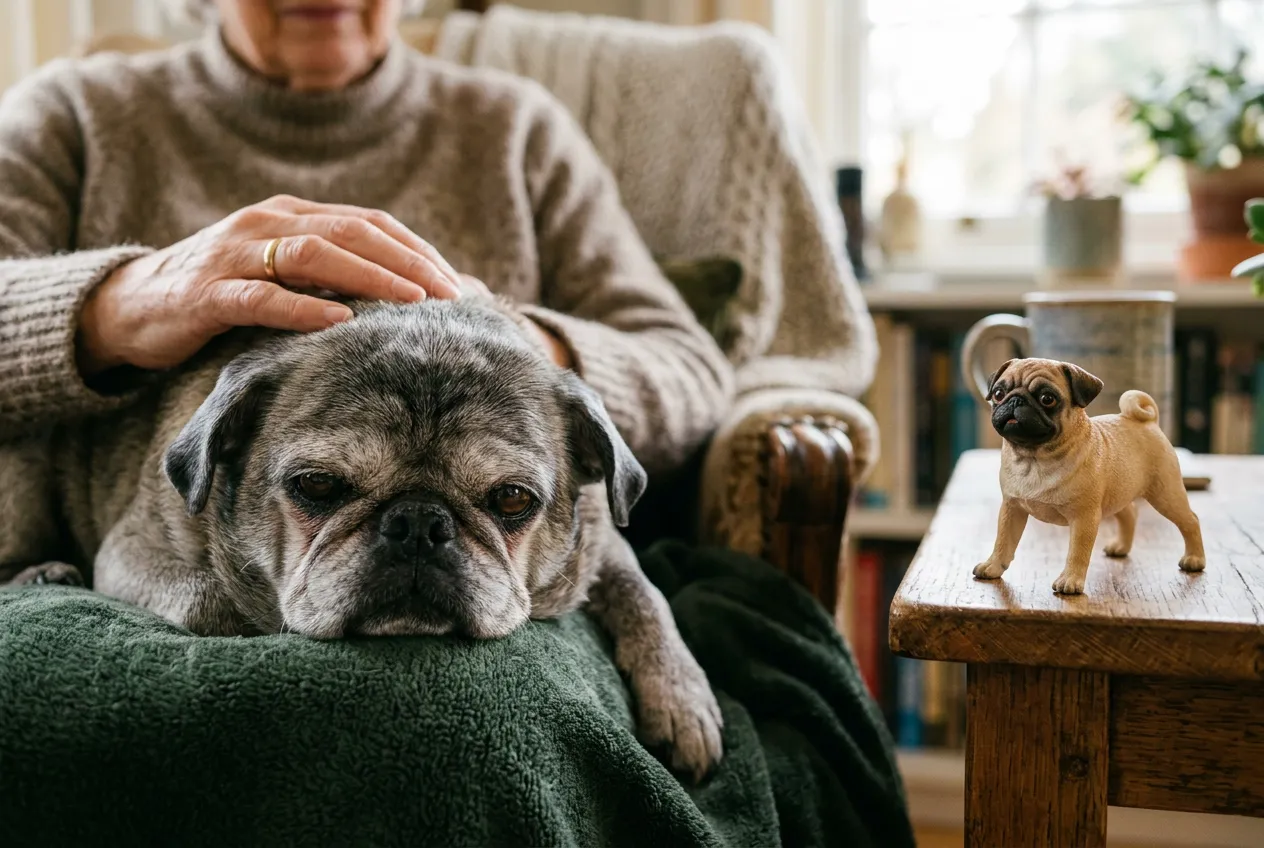
Your senior pug is stretched across the living room rug in a rectangle of late-afternoon light, and you're watching them breathe—really watching, the way you never used to—because something about the senior pug quality of life signs you've been noticing feels like a language you're only beginning to learn.
Quick Takeaways
- Pain shows up quietly in pugs — subtle behavioral shifts often signal discomfort before obvious symptoms appear
- Appetite changes aren't always about food — reduced eating frequently reflects emotional or cognitive changes, not just stomach issues
- The HHHHHMM scale is your best tool — a structured quality-of-life framework removes guesswork from hard decisions
- Memory matters before the end — many families find comfort in preserving their pet's likeness through a custom pet figurine while their pug is still here, full of personality
- Guilt is a sign of love, not failure — understanding these signs early gives you more time to respond with intention
Why Pugs Are Uniquely Difficult to Read
Here's the thing about pugs: they are constitutionally, biologically inclined to mask discomfort. Not out of stubbornness. Out of ancient survival instinct.
Every domestic dog carries the ghost of their wolf ancestors—a creature that hid weakness because weakness attracted predators. But pugs compound this with something specific to their anatomy. Their brachycephalic structure (that flat face, those wide-set eyes, that compressed skull) means their baseline normal already looks labored to the untrained eye. They snore. They breathe noisily. Their eyes water. Their skin folds trap moisture. So when something actually changes, it can blend into the visual noise of their everyday appearance.
This is the counterintuitive truth that most senior dog guides skip entirely: the "signs" in pugs aren't always new things appearing—they're often familiar things intensifying or familiar things disappearing. A pug who slows down is easier to notice than a pug who simply stops being enthusiastic. But both are telling you something.
Understanding this requires a different kind of attention. Not alarm. Not constant monitoring. Just a recalibrated baseline—a new literacy in the specific dialect your dog speaks.
"The most important question isn't 'is my pug sick?' It's 'is my pug still themselves?'"
Senior pugs are typically considered geriatric around age 9 or 10, though some reach this threshold earlier depending on their health history. The American Kennel Club's breed health overview notes that pugs are particularly susceptible to respiratory issues, joint deterioration, and neurological conditions as they age—all of which can complicate quality-of-life assessment because symptoms overlap.
What follows are seven signs to watch for. Not a checklist to cause panic. A vocabulary to help you listen.
Sign 1: The Appetite Shift That Isn't About Hunger
You set down the bowl. Your pug walks over, sniffs, and walks away.
Six months ago, that bowl would have been licked clean before you stood back up. Now there's food left in it—sometimes half of it—and your pug seems indifferent.
The mistake most people make here is assuming this is a digestive issue and adjusting the food. Sometimes that's right. But in senior pugs, appetite reduction is frequently the first visible symptom of cognitive and emotional changes, not gastrointestinal ones.
Canine Cognitive Dysfunction (CCD)—sometimes called "doggy dementia"—affects a significant portion of dogs over 11 years old. One of its earliest, most overlooked markers is a disconnection from previously reliable motivators. Food, for a pug, is perhaps the most reliable motivator in existence. When that interest flickers, it often signals that the brain is doing something different.
There's also the pain-appetite connection. Chronic pain elevates cortisol (the body's primary stress hormone) in dogs, and sustained cortisol elevation suppresses the hunger signals that originate in the hypothalamus. Your pug may not be "not hungry." They may be in enough discomfort that their body is chemically suppressing the appetite signal.
What to actually watch for:
- Food left in the bowl more than three days in a row (not just occasional pickiness)
- Approaching the bowl and then retreating without eating
- Eating significantly slower than usual, with pauses mid-meal
- Dropping food from the mouth (can indicate dental pain or neurological changes)
Track it for one week before drawing conclusions. A single skipped meal means nothing. A pattern across seven days is worth a vet conversation.
Sign 2: Sleep Changes That Go Beyond "Sleeping More"
Yes, senior dogs sleep more. This is expected. This is not the sign.
The sign is how they sleep, and when, and where.
A healthy senior pug sleeps longer but still cycles through—they wake, they stretch, they change position, they respond to sounds in the house. A pug whose quality of life is declining often sleeps in a way that looks different in texture: heavy, unresponsive, disconnected from the rhythm of the household. They may not rouse when you enter the room. They may sleep through meals. They may sleep in locations they previously avoided—cold floors instead of their bed, isolated corners instead of near their people.
This spatial shift is psychologically significant. Dogs are social sleepers by instinct; attachment theory in animal behavior research describes how bonded pets maintain proximity to their owners as a baseline comfort behavior. When a dog consistently seeks isolation, it often reflects a withdrawal that mirrors what we might call depression in humans—a neurobiological retreat from stimulation that feels like too much to process.
There's also the day-night reversal pattern associated with CCD. Some senior pugs begin sleeping through the day and becoming restless, disoriented, or vocal in the late evening and early morning hours. If your pug is pacing at 2 AM or whimpering in the night without apparent cause, this isn't random. It's a neurological signal that deserves veterinary attention.
Here's a day-in-the-life vignette that captures what this can look like: You come home after work, and your pug doesn't appear in the hallway. You find them in the back bedroom, on the hardwood floor, in a deep sleep that takes your voice and a gentle hand on their side to interrupt. They blink at you slowly, like they've surfaced from somewhere far away. By 11 PM, they're awake and restless, circling the kitchen.
That reversal? That's your pug's brain telling you something.
Sign 3: Pain Expression in a Dog Bred to Hide It
The following quality-of-life assessment framework is used by veterinary professionals and can help you evaluate your pug's pain level at home:
| Quality of Life Factor | Healthy Senior Pug | Declining Quality of Life |
|---|---|---|
| Hurt (pain level) | Settles easily, sleeps comfortably | Vocalizes when touched, guards body parts |
| Hunger | Eats willingly at mealtimes | Skips meals, loses interest in treats |
| Hydration | Drinks regularly, moist gums | Reduced water intake, dry/tacky gums |
| Hygiene | Maintains basic grooming behavior | Stops self-grooming, coat appears dull |
| Happiness | Engages with people or toys | Withdraws, rarely initiates interaction |
| Mobility | Moves around without assistance | Struggles to rise, avoids stairs |
| More Good Days Than Bad | Overall balance feels positive | Declining days outnumber comfortable ones |
This is the HHHHHMM scale, developed by veterinary oncologist Dr. Alice Villalobos, and it's one of the most compassionate tools available for this conversation. We'd encourage you to print it, score it weekly, and bring it to your vet.
For pugs specifically, the "Hurt" row is the hardest to assess. Because of their anatomy and their instinct to mask pain, they rarely yelp or cry out. Instead, watch for:
- Reluctance to jump onto furniture they previously accessed easily
- A subtle hunching of the spine when standing or sitting
- Squinting (beyond their normal pug expression) which can indicate head pain or eye discomfort
- Resistance to being touched in specific areas—turning their head away from your hand, stiffening when you pet along the spine or near the hips
- A changed walking gait—shorter steps, a slight hitch in one rear leg
The squinting one is frequently missed. Pugs are prone to corneal ulcers and eye pressure issues, both of which are painful and both of which can be present without dramatic symptom display.
Sign 4: Social Withdrawal and the Changed Relationship With You
Your pug used to follow you from room to room. Not anymore.
They're still in the house, but something about the proximity has shifted. They stay where they are. They don't reposition to be near you. They don't greet you at the door.
This one hits differently than the physical signs, because it feels personal. It can feel like they've stopped choosing you. Honestly? That interpretation makes sense—and it's also worth gently reframing.
Social withdrawal in senior dogs is not emotional rejection. It's usually a combination of two things: pain making movement feel costly, and cognitive changes that reduce the social drive itself. The same neurological shift that affects appetite and sleep affects the bonding-related neurochemistry—the dopamine and oxytocin systems that made your pug want to be near you.
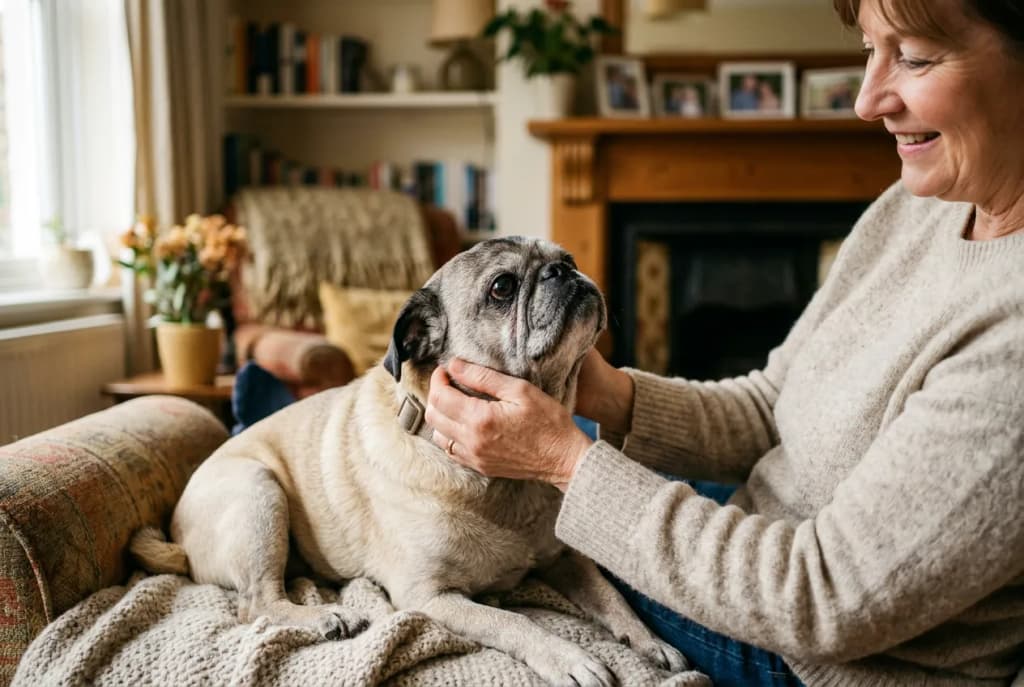
Here's the counterintuitive part: sometimes the pug who seems most withdrawn needs your presence the most—they just can't initiate it the way they used to. Going to them, sitting on the floor near them, placing a gentle hand in their visual field rather than waiting for them to come to you, can make a significant difference in their sense of security without requiring them to expend energy.
Watch specifically for:
- Stopping greetings at the door — one of the most reliable early social withdrawal signs
- Reduced eye contact — healthy, bonded pugs make frequent eye contact; a decrease is notable
- No response to favorite sounds (the treat bag rattling, the leash jingling, your car in the driveway)
- Flinching or moving away from touch they previously welcomed
The last one especially warrants a vet conversation. A pug who used to lean into petting and now subtly moves away from your hand is likely in pain in the area you're touching—or pain that's generalized enough that any touch feels like too much.
"We've seen families find the most peace when they shifted from 'what's wrong' to 'what does my pug still enjoy?' That reframe changes everything."
— The PawSculpt Team
Sign 5: Mobility Changes — What "Slowing Down" Actually Looks Like
This section could fill a book, so here's the focus: the difference between expected senior slowdown and quality-of-life-affecting mobility loss is specificity.
General slowdown looks like shorter walks, less enthusiasm for fetch, more rest on walks.
Quality-of-life-affecting mobility looks like this:
- Struggling to rise from lying down — watching a pug try multiple times to stand, front legs extending, rear legs trembling or delayed
- Hind limb weakness — this is significant in pugs because they are disproportionately susceptible to IVDD (Intervertebral Disc Disease), which affects the spine and can cause progressive weakness or paralysis in the back legs
- Avoiding previously normal surfaces — hardwood floors, stairs, the step up into the car
- Loss of bladder or bowel control — especially if sudden, this can indicate spinal cord involvement, not just age
The IVDD connection is something every pug owner needs to understand. Because of their chondrodystrophic genetics (their cartilage develops differently than long-legged breeds), pugs carry a higher baseline risk for disc disease throughout their lives, and this risk compounds with age. A pug who is suddenly more wobbly or seems to be knuckling over on one rear paw needs veterinary evaluation promptly—within 24 to 48 hours, not at the next routine appointment.
One order that has stuck with our team over the years was from a family in Colorado whose senior pug, Maple, had been deteriorating from spinal disease for months. They came to us not because she had passed, but because they wanted her figurine while she was still here—still herself, still looking at them with those enormous dark eyes. That decision gave them something to hold onto that was made with her, not after her. It's one of our favorite examples of using a 3D pet memorial keepsake as an act of presence rather than loss.
Sign 6: Breathing Changes in a Breed That Always Breathed Loudly
This one requires calibrated attention, because the baseline for pugs is already noisy.
Healthy pug breathing: audible, sometimes snore-like, consistent in rhythm, recovers quickly after exertion.
Concerning pug breathing: a change from that individual dog's personal baseline. This is the key. You're not comparing your pug to other dogs. You're comparing your pug to themselves—to how they sounded last month, last season.
Specific changes to flag:
- Open-mouth breathing at rest (pugs should breathe through their nose at rest)
- Breathing that doesn't settle after 10-15 minutes of rest following mild activity
- Blue or pale gums (seek emergency care immediately if you observe this)
- Extended neck posture when sleeping — a pug stretching their neck outward to breathe is working harder than they should be to get air
- Increased wheezing or reverse sneezing frequency — while reverse sneezing is normal in pugs, a dramatic increase in frequency can signal airway inflammation or more serious respiratory compromise
The quality-of-life dimension of breathing is this: if your pug is working to breathe, everything else becomes harder. Sleep is harder. Eating is harder. Movement is harder. A dog in mild respiratory distress is expending so much physiological effort on breathing that there's less energy available for the things that make life feel worth living.
This is also one area where the complexity of pug anatomy makes quality-of-life assessment uniquely difficult. Some of what seniors experience is treatable—airway surgeries (widening the nares, shortening the soft palate) that were once considered only for young dogs are increasingly performed in seniors with careful anesthetic management. A conversation with a veterinary internist or specialist is worth having before assuming respiratory changes are simply "part of aging."
Here is a quick-reference table to help you distinguish baseline pug breathing from signs that warrant veterinary evaluation:
| Breathing Pattern | Normal for Pugs | Warrants Vet Visit |
|---|---|---|
| Audible breathing at rest | Yes — baseline for breed | No, unless sudden dramatic change |
| Snoring during sleep | Yes | Only if new or significantly louder |
| Open-mouth breathing at rest | No — rare and concerning | Yes, within 24-48 hours |
| Reverse sneezing | Yes, occasional | Yes, if frequency dramatically increases |
| Blue/gray gums | Never normal | Emergency — immediate care |
| Extended neck to breathe | No | Yes, same day if possible |
| Breathing not settling after rest | No | Yes, schedule promptly |
Sign 7: The Disappearance of Joy — And Why This Is the Hardest Sign
Everything else on this list is relatively observable. You can time breathing rate, note appetite changes, score mobility on a scale.
This one is harder. This one lives in the quality of a glance.
Your pug had specific things that lit them up. Maybe it was the rustle of a cheese wrapper from two rooms away. Maybe it was the particular squeak of a specific toy. Maybe it was the moment you sat on the floor—they always came to you when you sat on the floor.
The disappearance of joy is not dramatic. It doesn't announce itself. It's the cheese wrapper that no longer brings them around the corner. The toy that sits untouched for a week. You sit on the floor, and they stay on their bed, watching you from across the room.
The scientific framework here is hedonic capacity—the neurological ability to experience pleasure. In senior dogs with pain, CCD, or systemic illness, the brain's reward circuitry is compromised. The dopamine release that made the cheese wrapper exciting no longer fires with the same intensity. This isn't stubbornness or mood. It's neurobiology.
And this—this specific observation—is the sign that most veterinary quality-of-life frameworks weight most heavily, because hedonic capacity is difficult to restore once it's significantly compromised. You can manage pain. You can support mobility. But when the core wiring for experiencing pleasure has been disrupted, quality of life has entered a different territory.
What this looks like in a daily routine: Your morning is usually marked by your pug hearing the alarm and thumping their tail against the bed. This week, you've noticed the tail doesn't thump. You get up, and they lift their head but don't stand. By the time you're ready for work, they've lowered their head back to the mattress. The response is still there—but it's small, and it costs them something visible.
That cost is the thing to watch.
The HHHHHMM scale's final criterion—"more good days than bad"—is ultimately a measurement of this: how often does your pug experience genuine joy? It doesn't have to be exuberant. A slow tail wag, a moment of seeking your hand, a sniff of interest at a smell outside—these count. But when even these small moments become rare, when an entire day passes without a single visible moment of pleasure, that's the conversation to have with your vet.
How to Actually Use These Signs Together
Reading these signs individually is useful. But the real skill—the thing that differentiates a panicked reaction from a thoughtful response—is understanding how they cluster.
One sign in isolation is almost never definitive. Three or four signs appearing simultaneously, or one sign intensifying rapidly over two to three weeks, is when you need to act.
Here is a simple framework to use at home:
- Note appetite — how many complete meals this week?
- Note sleep patterns — any day-night reversal, unusual locations?
- Note mobility — any new hesitation or struggling?
- Note social engagement — did they seek you out at all today?
- Note joy moments — can you name one specific moment of visible pleasure?
- Score the week: mostly good days, mixed, or mostly difficult days?
Keep a simple log—even a voice memo on your phone works. Over three to four weeks, a pattern either emerges or doesn't. This log is also invaluable when you bring it to your vet, because it replaces "I think something has changed" with "here is what changed and when."
For guidance on what these patterns mean clinically, the VCA Animal Hospitals' quality of life resources are excellent—written by veterinarians and accessible to non-specialists.
When the Signs Are There: Holding This With Intention
There's a specific kind of grief that arrives before loss. It has a clinical name—anticipatory grief—and it is real, and it is hard, and it is usually mixed with guilt in ways that are disorienting.
You might feel guilty for researching "end of life signs in pugs" while your dog is still alive. As if looking is the same as wishing.
It isn't.
Reading these signs, learning this language, paying this quality of attention to your senior pug—this is care. This is the highest expression of the bond you've built. It means you're committed to their comfort over your own comfort in the not-knowing.
Some families plant a small garden. Some create photo albums that live on the coffee table. Increasingly, families find something deeply meaningful in capturing their pet's likeness while they're still here—when the expression is still theirs, when the coat color is still vibrant, when you still know exactly how they hold their head.
The figurines created through PawSculpt's full-color 3D printing process are digitally sculpted by artists who work from your photos, then precision-printed in full-color resin that captures your dog's specific markings, coat pattern, and physical personality. The color is printed directly into the material—not applied on top—so what you get is a likeness with depth, with texture, with the weight of something made to last. For families navigating this particular window of time, ordering during it rather than after carries a different emotional meaning. It becomes an act of honoring what is, not only what was.
"There is something profound about preserving a pet's likeness while they're still beside you. It changes the object from a memorial into a celebration."
The Conversation With Your Vet — What to Actually Say
Most pet owners arrive at the vet and say some version of "I feel like something is off."
Vets are trained to work with this. But you can make the conversation significantly more productive by bringing specificity.
Instead of: "She seems slower lately."
Try: "She's been struggling to rise from lying down, specifically on her left rear leg, for about three weeks. She's skipped four meals in the last week, and she stopped coming to the door when I get home."
That specificity allows your vet to triangulate. It changes the conversation from vague concern to a clinically useful description.
Ask these specific questions:
- "On the HHHHHMM scale, how would you rate her currently?"
- "Is there a treatment option we haven't tried that might improve her comfort?"
- "What's the marker you'd watch for that would tell you quality of life is no longer manageable?"
- "What would you do if this were your dog?"
That last question is the most important one. A good vet will answer it honestly.
We're not vets—we're a team that works alongside pet families in their most tender moments—and we always encourage every decision to be made in partnership with a veterinarian who knows your individual dog. There is no substitute for that relationship.
Closing: The Language Has Always Been There
You were watching your pug in that late-afternoon light for a reason. Not because you're anxious, or morbid, or looking for problems.
Because you're paying attention. Because somewhere in you, you already sensed that they were communicating something—and you wanted to be fluent enough to hear it.
The senior pug quality of life signs described here aren't warnings about an ending. They're an invitation into deeper presence. Into a more precise, more attentive kind of love. One that asks: not just "are they alive?" but "are they living well?"
Your job, in this strange and tender chapter, is not to have the right answers. It's to keep asking the right questions. To keep watching. To keep translating.
And when the time comes to hold onto something—to have something tangible from this particular chapter, with this particular dog—visit pawsculpt.com to see what it looks like to honor that.
The light on the rug will move. It always does. But what you build in this time—the attention you gave, the signs you learned to read—that's yours to keep.
Frequently Asked Questions
What are the first signs of quality of life decline in senior pugs?
The earliest and most commonly overlooked signs are behavioral rather than physical. Watch for appetite shifts (leaving food in the bowl consistently over several days), reduced enthusiasm for greeting routines, changes in where they choose to sleep, and a decreased response to sounds or activities they previously loved. These behavioral changes often precede obvious physical symptoms by weeks.
At what age is a pug considered a senior dog?
Most veterinarians consider pugs to enter senior status around 9 to 10 years of age, though individual health history plays a significant role. Pugs with prior respiratory issues, IVDD history, or obesity may show senior-associated health changes earlier. If your pug is 7 or older, beginning annual senior wellness bloodwork is worth discussing with your vet.
How do I know if my senior pug is in pain if they're not crying or yelping?
Pugs are biologically inclined to mask pain, so vocalizing is rarely the primary indicator. Instead, watch for: reluctance to jump onto furniture they previously used, a subtle hunching of the spine when standing, squinting beyond their normal pug expression, stiffening or moving away when touched in specific areas, and a changed walking gait. These quiet signals are often more reliable than waiting for audible pain expression.
What is the HHHHHMM scale and how do I use it?
The HHHHHMM scale was developed by veterinary oncologist Dr. Alice Villalobos to help pet owners objectively assess quality of life at home. It evaluates seven factors: Hurt, Hunger, Hydration, Hygiene, Happiness, Mobility, and whether there are More good days than bad. Score each factor weekly and bring your notes to your veterinary appointment. It transforms a difficult subjective conversation into something concrete and productive.
Is sleeping more a sign that my senior pug's quality of life is declining?
Increased sleep alone is expected in senior dogs and isn't alarming. The concerning pattern is how they sleep and when—specifically, day-night reversal (awake and restless at night, deeply asleep during the day), consistently choosing isolation over proximity to family, and sleep so deep that they're unresponsive to normal household sounds. These patterns suggest cognitive or pain-related changes rather than simple healthy aging.
When should I have a quality-of-life conversation with my veterinarian?
Don't wait for a crisis. Have the conversation when you notice three or more of the seven signs changing simultaneously, when any single sign intensifies rapidly over two to three weeks, or when you observe sudden mobility changes (especially hind limb weakness, which warrants a vet visit within 24-48 hours in pugs due to IVDD risk). Bringing a written log of specific observations—dates, behaviors, meal counts—makes that conversation significantly more useful for both you and your vet.
Ready to Celebrate Your Senior Pug
Your pug has given you years of loyalty, warmth, and that particular brand of stubborn, snorty devotion that only a pug owner truly understands. Whether you're in the tender middle of this chapter or beginning to think about what lasting tribute might honor them, a custom PawSculpt figurine captures the specific details that make your senior pug irreplaceable—their coat markings, their characteristic expression, their physical presence—through full-color resin 3D printing that preserves those details with remarkable precision. Monitoring senior pug quality of life signs is an act of love, and so is choosing to preserve who they are while that love is still unfolding.
Visit pawsculpt.com to explore our process, preview options, and learn how families across the country are honoring their pets