
7 Environmental Enrichment Myths Your Corgi Doesn't Need to Believe
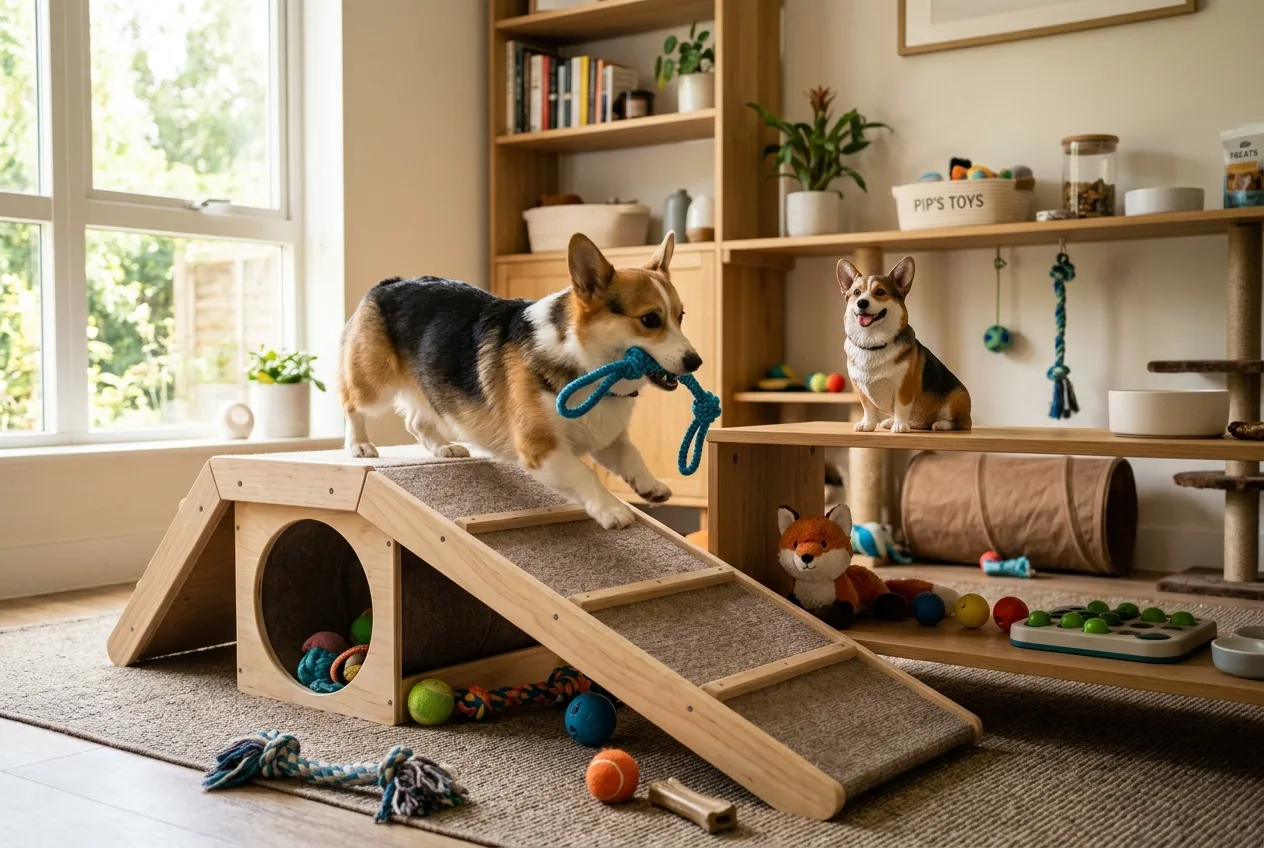
Research suggests corgi care mistakes often come from too much enrichment, not too little; on the front porch, the leash handle presses cold against your palm while your Corgi stares past three untouched toys toward a drifting leaf.
Quick Takeaways
- Novelty is overrated — rotate fewer enrichment tools instead of buying new ones weekly
- Arousal isn't enrichment — choose activities that settle your Corgi after play, not spike them
- Sniffing beats spectacle — ten minutes of scent work often outperforms flashy puzzle gadgets
- Memory matters too — browse custom pet figurines if you want a tangible way to honor daily life with your dog
- Experienced dog owners still miss this — recovery time is part of environmental enrichment, not an optional extra
Why so much pet enrichment advice misses the Corgi entirely
Most dog enrichment myths start with a good intention: tire the dog out, prevent boredom, stop bad behavior. Fine. But the standout problem is that many guides treat all smart dogs like small furry grad students who need constant assignments.
That’s not how many Corgis actually work.
Corgis are bright, yes. They're also often alert, motion-sensitive, routine-loving, and environmentally busy. Their nervous systems can tip from pleasantly engaged to revved up fast. A flirt pole session, a food puzzle, a barking fit at the mail truck, and a chaotic dog park visit can all land in the same bucket physiologically: elevated cortisol levels, the stress hormone that helps the body mobilize. Short-term, that’s normal. Stacked all day, it can create a dog who looks “energetic” but feels frayed.
That’s the angle most generic enrichment articles miss: your Corgi does not need maximum stimulation. Your Corgi needs the right texture of stimulation.
And texture is the word here. You can feel it in daily life. The rough rope toy that's always damp at the knot. The slick kitchen floor your dog avoids at dusk. The firm pressure of their compact body leaning into your shin after a walk. Those details matter because enrichment is not just what entertains a dog. It’s what helps a dog use their brain and body without dysregulating either one.
We’ve seen this pattern over and over from pet families. Someone buys five puzzle toys, signs up for agility, adds daycare, then wonders why their Corgi is mouthier, barkier, and harder to settle at 9 p.m. The mistake most people make is assuming behavior problems come from an empty schedule. Often, they come from an overfilled nervous system.
That’s the counterintuitive insight worth keeping: a dog can be under-rested and over-enriched at the same time.
The real standard for good environmental enrichment
Our top pick for evaluating environmental enrichment is simple: ask what your dog looks like 20 minutes after the activity ends.
If your Corgi is able to lie down, lick calmly, soften through the jaw, and drift into rest, that activity likely fits. If they pace, patrol windows, demand more, body-slam toys, or explode at every hallway sound, the activity may have been fun but not truly regulating.
Behaviorists often talk about arousal curves. In plain English: some activities raise a dog’s internal engine gently, then let it come down. Others floor the gas pedal and leave your dog idling hot. Corgis, with their herding heritage and environmental sensitivity, tend to notice everything. That can be useful in training. It can also make sloppy enrichment plans backfire.
Here’s a quick way to sort what helps from what hypes.
| Activity | Typical arousal level | Best use | Watch out for |
|---|---|---|---|
| Sniff walk on a long line | Low to moderate | Daily regulation | Pulling if pace is rushed |
| Frozen lick mat | Low | Post-walk decompression | Overusing high-calorie toppings |
| Flirt pole session | High | Short bursts with rules | Difficulty settling afterward |
| Food scatter in grass | Low | Rainy-day brain work | Frustration if area is too hard |
| Repetitive ball chasing | High | Limited, structured play | Obsessive anticipation |
Worth noting: “high energy breed” does not mean “high stimulation required every hour.” It often means “high intention required.”
A quick micro-story from the porch
One family told us their Corgi had a basket full of enrichment tools by the door—rubber feeders, wobble toys, squeakers, chew roots, tug rings. The dog ignored most of them and still barked at every passing truck.
Their fix wasn’t buying better stuff. It was cutting the lineup in half, adding a slower evening sniff route, and building a ten-minute “nothing happens” porch sit after dinner. Within a few weeks, the dog stopped acting like the world was a five-alarm fire.
"The best enrichment doesn’t leave your dog asking for more. It leaves them able to rest."

Myth #1 in corgi care: “A tired Corgi is always a happy Corgi”
This one is everywhere. And honestly, it sounds right.
But “tired” is not one thing. There’s satisfied tired, where your dog feels loose, warm, and pleasantly spent. Then there’s frazzled tired, where the body is exhausted but the brain is still scanning for the next trigger. Experienced dog owners know the difference when they feel it in the leash: one dog moves with soft weight; the other vibrates.
For Corgis, the second kind is common.
Why exhaustion can increase problem behavior
Research in both animals and humans points to a simple truth: fatigue lowers regulation. A tired brain has less bandwidth for impulse control. So if your dog is overexercised or overstimulated, you may see:
- more barking at normal sounds
- rougher mouthing during play
- frantic demand behaviors
- poorer response to cues they usually know
- second-wind zoomies late at night
This is where attachment theory actually helps explain dog behavior in a practical way. Dogs use predictable routines and familiar people as secure bases. If every day feels like a carnival of activity, the secure base gets fuzzier. Your Corgi may start clinging, checking in constantly, or escalating to get information.
The mistake most people make is trying to solve that escalation with even more output.
What actually helps more than another hard play session is structured decompression.
What to do instead
Our top pick is a three-part rhythm:
- Short engagement
- Low-friction decompression
- Protected rest
That might look like a 12-minute tug-and-train session, followed by a frozen chew on a washable mat, followed by one hour where nobody invites interaction.
Not glamorous. Very effective.
And yes, this can feel like you're “not doing enough.” That’s the cognitive dissonance many devoted owners run into: you love your dog, so inactivity can look like neglect. But for a highly alert breed, under-scheduling can be care.
Better goal: fulfilled, not flattened
A healthy enrichment plan leaves your Corgi:
- curious, not frantic
- pleasantly warm, not panting for an hour
- interested in connection, not demanding constant entertainment
- ready to nap
One of the more overlooked pieces of pet enrichment is the body’s need to transition. Fast stop-and-start fun can be hard on short-legged, long-backed dogs too. For breed-specific movement concerns, the American Kennel Club's Corgi breed guide is worth reading alongside advice from your veterinarian.
Micro-story: the evening “crash”
We’ve heard versions of this from countless families: the Corgi gets a long afternoon outing, comes home wired, shreds cardboard like a machine, then melts down at 8:30 p.m. when someone stands up from the couch. The dog isn’t “bad.” The dog is over threshold and running on fumes.
Here’s a useful benchmark.
| After an enrichment session, your Corgi... | What it likely means | What to do next |
|---|---|---|
| Lies down within 10-20 minutes | Good fit | Repeat this routine |
| Keeps bringing toys insistently | Too much arousal | Add sniffing or licking, reduce intensity next time |
| Patrols windows or doors | Nervous system still elevated | Create a dark, calm rest period |
| Mouths hands or clothes | Impulse control is dropping | End interaction, offer a chew, lower stimulation tomorrow |
| Falls asleep hard but startles easily | Overtired | Shorten sessions, protect recovery time |
Myth #2: More toys automatically mean better environmental enrichment
We’re not huge fans of toy quantity as a proxy for care. The dog industry loves visual abundance. Toy bins look loving. Subscription boxes look loving. A living room scattered with rubber, fleece, and squeakers looks like effort.
Your Corgi may prefer clarity.
Dogs don’t evaluate enrichment the way humans shop for novelty. They notice scent, familiarity, challenge level, mouthfeel, reward history. The rubber toy with a slight vanilla smell and a just-right give under the teeth may beat six “advanced” gadgets every time.
Why familiar objects can regulate better than new ones
This is the overlooked aspect that rarely gets enough attention: familiarity can be enriching because it lowers cognitive load.
A known chew, a favorite blanket edge, the same snuffle mat used twice a week—these can function like emotional furniture. Stable. Reliable. Easy to sink into. In neuroscience terms, predictable patterns reduce unnecessary decision-making and can support calmer behavioral responses. Your dog doesn't need to solve a puzzle every waking hour. Sometimes they need to press their chin into the same soft bolster bed and know what comes next.
That’s especially true for Corgis who are naturally observant and may already be gathering too much data from the environment.
Curate. Don’t accumulate.
Our edited recommendation:
- Keep 4 to 6 active enrichment items in rotation
- Store the rest out of sight
- Rotate every 5 to 7 days, not daily
- Pair one high-value item with one calm context
- Retire toys that trigger obsessive guarding or frantic fixation
The standout here is not novelty. It’s frictionless use. If a toy requires too much setup, cleanup, or supervision, most owners abandon it by week two. The best enrichment tool is the one you'll actually use four times this week.
Texture matters more than people think
Corgis are tactile. Many dogs are. But with Corgis, we often notice clear preferences: nubby rubber versus slick plastic, tightly woven fleece versus shaggy synthetic fluff, cool tile after activity versus a warm dense bed after dinner.
Try paying attention to:
- what your dog chooses to rest on
- which chew materials they revisit
- whether they prefer pushing, licking, shredding, or carrying
- how they use paws in play
That’s real data. Better than marketing copy.
Personal Aside
We’ll be real: some enrichment products are designed more for owner guilt than dog success. We’ve seen homes with gorgeous toy displays and dogs who only wanted a cardboard box, a fleece scrap, and ten slow minutes sniffing the hedge.
Micro-story: the untouched basket
A customer once sent us photos of her Corgi for a keepsake project and apologized for the “mess” in the background: a woven basket overflowing with enrichment toys. What stood out in every photo wasn’t the basket. It was the dog resting one paw on a flattened, frayed fabric carrot—the same toy in twelve different pictures over months.
That’s the kind of detail that tells the truth. And it’s one reason families gravitate toward keepsakes that preserve real-life habits, not idealized versions. Some save collars. Some build photo books. Others choose 3D pet sculptures that capture the exact markings, posture, and expression they know by touch and sight.
"Good enrichment respects your dog’s preferences instead of performing your devotion."
— The PawSculpt Team
Myth #3: Puzzle toys are the gold standard of pet enrichment
Puzzle toys are useful. We like them. But they are not the automatic winner many blogs make them out to be.
For some Corgis, food puzzles sharpen focus and build persistence. For others, they create frustration loops—pawing, barking, flipping, quitting, then staring at you like you personally ruined breakfast. If your dog finishes a puzzle and seems more agitated than settled, that’s not enrichment. That’s an argument in plastic form.
The psychology behind frustration enrichment
A little challenge is healthy. Too much challenge creates cognitive overload.
This matters because many owners confuse “working hard” with “benefiting.” But difficulty alone doesn’t produce enrichment. The sweet spot is what learning science often describes as optimal challenge—hard enough to engage, easy enough to succeed without stress stacking.
For Corgis, who can be quick learners and equally quick to protest unfairness, puzzle complexity should increase slowly.
Start by asking:
- Does my dog understand the game mechanics?
- Can they solve it within 3 to 5 minutes at first?
- Do they stay engaged without vocalizing in frustration?
- Do they return to baseline calmly afterward?
If not, scale down.
What often works better: scent before strategy
Here’s the counterintuitive bit. Many Corgis get more value from low-tech scent work than from “smart” puzzle devices.
Why? Because sniffing is biologically regulating. It slows pace. It organizes attention. It engages natural seeking behavior without requiring your dog to decode a contraption. And unlike some puzzles, it doesn’t make the owner the bottleneck of difficulty.
Our top picks:
- treat scatter in grass
- rolled towel with kibble folds
- cardboard box search game
- “find it” around one room
- scent trail from hallway to bed
Ten minutes of this can outperform a pricey puzzle in both engagement and post-activity calm.
Build a better enrichment ladder
Use this progression:
- Beginner: visible food in easy folds or open boxes
- Intermediate: hidden food under paper, towels, or cups
- Advanced: multiple scent points, one room to two rooms, delayed release
The mistake most people make is jumping straight to advanced gear because the dog is “smart.” Smart dogs still need clean learning history. Fast success builds confidence. Repeated failure builds noise.
Table: Best enrichment type by the state your Corgi is already in
Before choosing an activity, match it to your dog’s current nervous system.
| If your Corgi seems... | Best enrichment choice | Skip for now | Why |
|---|---|---|---|
| Restless but responsive | Sniff walk or scatter feed | Repetitive fetch | Sniffing lowers intensity while engaging the brain |
| Hyper and barky | Lick mat, chew, darkened rest area | Hard puzzles | Frustrated problem-solving can add heat |
| Flat and sleepy | Short training game | Marathon walk | Gentle activation beats draining effort |
| Clingy or vigilant | Predictable routine task | Novel group activity | Security often helps more than excitement |
| Destructive in the evening | Earlier decompression block | Late high-energy play | Prevents second-wind overstimulation |
Micro-story: the “genius dog” trap
We remember a family describing their Corgi as “too smart for beginner stuff.” Their dog was flipping puzzle toys, barking at them, and racing around after meals. They switched to simple room searches and a calmer feeding setup. Within days, mealtime stopped feeling like a casino.
That’s the thing. Intelligence doesn’t erase biology.
Myth #4: Physical exercise is the main thing that matters in corgi care
Physical exercise matters. Of course it does. But if you treat movement as the entire answer, you’ll miss the real issue in many homes: state regulation.
Corgis often don’t just need miles. They need rhythm.
A dog can walk two miles in a stimulating environment and come home noisier than before. Another dog can do a shorter route with pauses to sniff fence posts, feel bark under paws, and watch the neighborhood at a manageable distance—then sleep like a stone.
Why movement quality beats movement quantity
This is one of our strongest opinions, and we’ll stand by it: the quality of a walk matters more than the step count for many Corgis.
A regulating walk usually includes:
- a moderate pace
- room to sniff
- fewer forced greetings
- enough predictability that the dog isn’t surprised every ten seconds
- time to decompress after getting home
A dysregulating walk often includes:
- constant leash tension
- rushed pace
- repeated trigger exposure
- bikes, dogs, kids, delivery carts all stacked together
- no transition afterward
From a stress perspective, every trigger is a deposit into the same nervous-system account. Your dog doesn’t separate “fun excitement” and “annoying excitement” as neatly as we do.
The underused tool: stillness outdoors
This one surprises people. One of the best forms of environmental enrichment for a Corgi may be doing almost nothing outside.
Sit on the porch. Sit near a quiet field. Let your dog observe. No performance. No obedience drill every five seconds. No need to make eye contact for treats unless needed. Just watch the world at a tolerable distance while the breeze moves through fur and the wooden step stays cool under their chest.
Observation can be enriching because it gives the brain practice processing the environment without having to react to everything in it. That’s real skill-building. And often more transferable to daily life than an advanced trick.
A practical weekly rhythm
Here’s a schedule we like better than “go hard every day.”
| Day type | Primary focus | Time target | What success looks like |
|---|---|---|---|
| Decompression day | Sniffing + rest | 20-40 minutes | Easier settling at home |
| Training day | Short cue work + play | 10-15 minutes twice | Bright engagement, no frantic behavior |
| Adventure day | New route or location | 30-60 minutes | Curiosity without meltdown |
| Recovery day | Chews, scatter feeding, porch time | Flexible | Lower reactivity, longer naps |
Not every week needs all four. But most Corgis do well with variety in intensity, not just location.
Micro-story: the shorter walk that worked
One pet parent cut their evening walk from 50 minutes to 28. That sounds like giving up. It wasn’t. They shifted the route to a quieter loop, added three sniff breaks, and spent eight minutes on the porch before coming in. Their Corgi stopped exploding at the hallway mirror by the end of the week.
That’s enrichment done well—less dramatic, more effective.
"A dog’s day improves fastest when you stop chasing exhaustion and start building recovery."
Myth #5: If your Corgi is still demanding attention, your enrichment plan is failing
This one causes so much unnecessary guilt.
Some dogs ask for attention because they’re bored. True. But many ask because attention itself is the most reinforcing part of the day. Or because they’re dysregulated. Or because your schedule has accidentally taught them that nudging, pawing, barking, or dropping a toy in your lap works.
That’s not a moral failure. It’s just learning history.
Demand behavior isn’t always a sign of deprivation
Here’s the science in plain language: behaviors that get rewarded tend to repeat. If your dog receives eye contact, talking, movement, touch, or play after escalating, the escalation can strengthen.
At the same time, a dog with elevated stress hormones may have a lower threshold for self-settling. So the same outward behavior—pestering you—can come from two different roots:
- habit
- dysregulation
And the fix depends on which one you’re seeing.
How to tell the difference
Look at body language.
A habit-driven dog often seems bouncy, strategic, and persistent. They know the routine. A dysregulated dog may seem glassy-eyed, unable to disengage, more reactive to sounds, and physically tense through the face and shoulders.
What actually helps more than giving in or coldly ignoring the dog is creating a predictable off-ramp.
- Acknowledge briefly with a calm marker word
- Redirect to a settled behavior like mat, chew, or scatter
- Reduce stimulation in the room
- Protect the next 20 minutes from new excitement
This is not “teaching your dog to do nothing.” It’s teaching them how to come down.
Why experienced dog owners often get tripped up here
Experienced owners can overestimate their dog’s need for interactive enrichment because they’re good at training and enjoy engagement. We get it. Training is fun. Connection feels good. But your skill can become part of the problem if every spare minute turns into a mini-session.
Sometimes your dog needs your presence, not your performance.
That distinction matters. Attachment security often grows through calm co-existence—shared space, soft contact, predictable routines—not just active games.
Personal Aside
One thing we notice on photo-heavy custom orders is how often the most beloved images aren’t action shots. They’re the ordinary ones: chin on shoe, paws tucked under, side pressed against a porch step. People remember how a dog felt in the room. Not just what they could do.
That’s part of why meaningful objects matter too. For some families, a memorial keepsake or celebration figurine becomes a way to hold onto the posture, coloring, and compact weighty presence that defined their dog’s daily life. Not as a substitute for care. As a continuation of attention.
Myth #6: Every enrichment activity should be interactive
Nope.
In fact, one of the most overlooked principles in pet enrichment is that autonomy itself is enriching. Choice lowers pressure. And lowered pressure often improves behavior faster than another round of “fun.”
If every activity depends on you—your voice, your hands, your timing, your approval—your Corgi may become highly skilled at involving you in everything. Cute at first. Exhausting by month four.
Why independent enrichment builds emotional flexibility
Dogs benefit from what psychologists might call agency—the experience of being able to act on the environment and get a meaningful result. Chewing, sniffing, foraging, choosing a rest spot, watching the street from a safe distance... all of these let your dog participate in life without needing constant instruction.
That matters for Corgis because many are naturally social and highly tuned to human movement. Too much interaction can create dependency loops where the dog never fully practices self-directed calm.
Our top independent options:
- frozen food toy in a quiet space
- cardboard shred box
- supervised bully stick or long-lasting chew
- scent scatter in yard
- window access only if it doesn’t trigger barking
- choice between two rest surfaces
The standout here is choice architecture. Instead of orchestrating every second, set up two or three safe options and let your dog pick.
The “good owner” myth that keeps people over-involved
There’s a subtle cultural pressure in dog ownership: if you’re not actively engaging your dog, you’re slacking. We don’t buy that.
A good enrichment plan includes windows where your Corgi is:
- not being spoken to
- not being cued
- not being hyped up
- not being managed minute-to-minute
That’s how many dogs learn to move from “What’s next?” to “I’m okay now.”
Micro-story: the chew that changed the evening
We’ve seen this simple shift work again and again. A family moved their nightly play burst earlier, then offered a chew on a dense mat near the couch at 7:30. Same dog. Same house. But the room felt different—less jangly, more grounded. They described their Corgi’s paws as finally “going heavy” on the floor instead of skittering across it.
That tactile detail says a lot.
A note on safety
We’re not vets, so for chew safety, swallowing risk, dental concerns, or GI issues, check with your veterinarian. The ASPCA’s dog care resources are also a solid baseline for general wellbeing and supervision practices.
Myth #7: Enrichment is only about the dog’s present, not their story
This last one is the perspective most articles ignore entirely.
Environmental enrichment shapes memory. Not just your dog’s day, but your own emotional archive of them.
That may sound abstract. It isn’t.
The routines that genuinely fit your Corgi—the porch sits, the cool patch of tile after lunch, the frayed toy they carry by one ear, the way they lean their dense little body into your calf after a sniff walk—become the sensory details your mind stores. Those are the details that return years later when you touch an old leash or find a tuft of fur caught in a blanket seam.
Why this matters now, while your dog is still here
Human memory is strongly tied to sensory encoding. Texture, posture, color, routine, and repeated context all help experiences stick. So a well-designed enrichment life does something beautiful: it gives both of you more of the right kind of memory.
Not endless novelty. Distinctive, repeatable moments.
That’s why we’re not huge fans of enrichment advice that turns every day into a content calendar. You don’t need twelve photogenic activities. You need a few rituals that fit your dog so well they become part of the household’s emotional architecture.
Examples:
- the same porch step at dusk
- the same woven mat for evening chews
- the same garden edge for sniff checks
- the same blanket folded at the armchair corner
- the same pause before unclipping the leash
These rituals regulate the dog. And they mark time for you.
The role of tangible remembrance
In our years working with pet families, one pattern stands out. People rarely tell us they miss the big adventures most. They miss the micro-details: the shape of a white chest patch, the cocked ear, the loaf-like sit, the compact weight in their arms, the grain of fur color along the back.
That’s where tangible remembrance comes in—not as a sad afterthought, but as a recognition that ordinary life is worth preserving.
Some families frame candid porch photos. Some save collars in drawers. Some commission custom pet figurines because a full-color resin piece can capture markings, stance, and expression with unusual specificity. At PawSculpt, the figurines are digitally sculpted by master 3D artists, then precision 3D printed in full color so the pet’s coat pattern and coloring are reproduced directly in the resin. The finish includes a protective clear coat, and the subtle surface grain is part of the object’s authentic character.
That authenticity matters. Real memory is not plastic-perfect either.
What to expect if you ever choose that route
If a figurine is something you’re considering—whether to celebrate a living dog or honor one you’ve lost—the process starts with photos. Good input helps a lot.
The best photos usually show:
- eye level or slightly above
- natural light
- clear views of face, chest, sides, and back
- distinctive markings
- a posture that feels true to the dog
If you want the current details, options, and process information, your best move is to visit the PawSculpt website or the main product pages directly. We won’t pretend fixed business details belong in a care article because they change. What matters here is the why: preserving the touchable truth of a dog’s daily presence.
Table: Which kind of enrichment memory are you building?
This is a useful gut-check if your routine feels scattered.
| Routine type | What your dog experiences | What you’re likely to remember | Keep or rethink? |
|---|---|---|---|
| Constant novelty | Excitement, inconsistency | A blur of “busy” | Rethink |
| Repeated calming rituals | Predictability, regulation | Specific beloved moments | Keep |
| High-intensity daily play | Adrenaline, anticipation | Chaos mixed with guilt | Reduce if settling is poor |
| Scent-based routines | Natural engagement | Distinct places and habits | Strong keep |
| Shared quiet observation | Security, co-regulation | Posture, presence, peace | Our favorite |
Micro-story: the porch dog
One order that stuck with us came from a family who said their Corgi’s favorite “activity” was sitting on the front porch with one paw over the edge of the lowest step. Not chasing. Not performing. Just watching the street with that sturdy, fox-faced seriousness only a Corgi can pull off.
They didn’t want a glamorous action pose. They wanted that. Because that was the dog.
"The routines that calm your dog today become the details you’ll treasure someday."
How to build a corgi care plan that actually works
By this point, the pattern is clear: the best corgi care plan is not the most creative one. It’s the one that balances engagement with recovery, challenge with clarity, and novelty with familiarity.
So here’s our edited framework. If your current routine feels noisy, start here for two weeks before buying anything new.
The 5-part enrichment filter
Run every activity through these five questions:
- Does it match my dog’s current state?
- Does it end cleanly?
- Can my dog succeed quickly?
- Does it support rest afterward?
- Would I still do this in a stressful week?
A simple weekly blueprint
Try this for a typical adult Corgi, adjusting for age, health, and temperament:
- Daily: 1 sniff-centered walk, 1 calm chew or lick session, 1 brief training game
- Three times weekly: scent search indoors or outdoors
- One to two times weekly: higher-energy play, short and structured
- Every day: at least one protected rest block with no social pressure
- Weekly: rotate one enrichment item, not the entire setup
That’s enough for many dogs. Really.
Signs your plan is working within 2 to 3 weeks
Look for:
- faster settling after walks
- reduced toy-demand loops
- fewer evening meltdowns
- softer body language in the house
- better sleep
- more interest in calm proximity
If you’re not seeing progress, don’t panic. First trim intensity. Then increase predictability. If behavior still concerns you—especially anxiety, pain signs, sudden reactivity, or compulsive behavior—bring in your vet or a qualified trainer. Enrichment can support health, but it can’t diagnose discomfort.
One final overlooked truth
The best dog lives are not always the busiest ones.
They’re the ones with enough stimulation to feel alive, enough predictability to feel safe, and enough softness around the edges to let the nervous system unclench. You can feel that difference in a room. In the warm weight of your Corgi against your ankle. In the way their paws stop tapping and simply rest.
The myth worth dropping first
If you change only one thing after reading this, let it be this: stop measuring enrichment by how impressed other people would be.
Measure it by what happens in your dog’s body.
On that front porch, with the leash cooled by evening air and your Corgi watching the world instead of fighting it, the goal isn’t to prove you’re an exceptional owner. The goal is smaller. Better too. Build one ritual this week that leaves your dog softer than it found them.
Maybe that’s a slower walk. Maybe it’s a cardboard search game. Maybe it’s ten quiet minutes outdoors with no agenda at all.
And if those ordinary rituals become the details you want to keep forever, that’s not extra sentimentality. That’s attention doing its best work.
Frequently Asked Questions
What is the best enrichment for a Corgi?
For many Corgis, the best enrichment is a mix of sniffing, chewing, short training, and real downtime. Not every activity needs to be exciting. If your dog can settle within 10 to 20 minutes afterward, you’re probably on the right track.
Can a Corgi get too much enrichment?
Absolutely. This is one of the biggest dog enrichment myths. If your Corgi seems more reactive, mouthy, demanding, or unable to nap after a packed day, the issue may be overstimulation rather than boredom.
Are puzzle toys enough for dog enrichment?
Usually not on their own. Puzzle toys can be useful, but they shouldn’t carry the whole plan. Most Corgis do better with a broader rhythm that includes scent work, calm chewing, movement, and recovery.
How often should I do enrichment with my Corgi?
Think daily, but not dramatic. A sniff walk, a simple food search, or a chew session each day is often enough, with more active games added a few times a week depending on your dog’s age, health, and temperament.
What are signs my Corgi’s enrichment plan is working?
Look for softer body language, better naps, less evening chaos, and quicker recovery after activity. A successful routine doesn’t just occupy your dog—it improves life between activities.
What photos work best for a custom pet figurine?
Clear, well-lit photos from several angles are ideal. Natural light helps. Show the face, chest, sides, back, and any special markings or expressions that make your dog unmistakably yours.
Ready to Celebrate Your Pet?
Every pet has a story worth preserving. Whether you're honoring a beloved companion who's crossed the rainbow bridge or celebrating your furry friend's unique personality, a custom PawSculpt figurine captures those details that make your pet one-of-a-kind.
For many families, the most meaningful part of corgi care is noticing the everyday details while they're still happening—the stance on the porch, the tilt of the ears, the exact pattern of sable, red, or tricolor fur. PawSculpt turns those details into a lasting keepsake through digital artistry and full-color 3D printing.
Visit pawsculpt.com to learn more about our process and guarantees