
The Disaster Preparedness Step Most Pitbull Owners Overlook Until It's Too Late
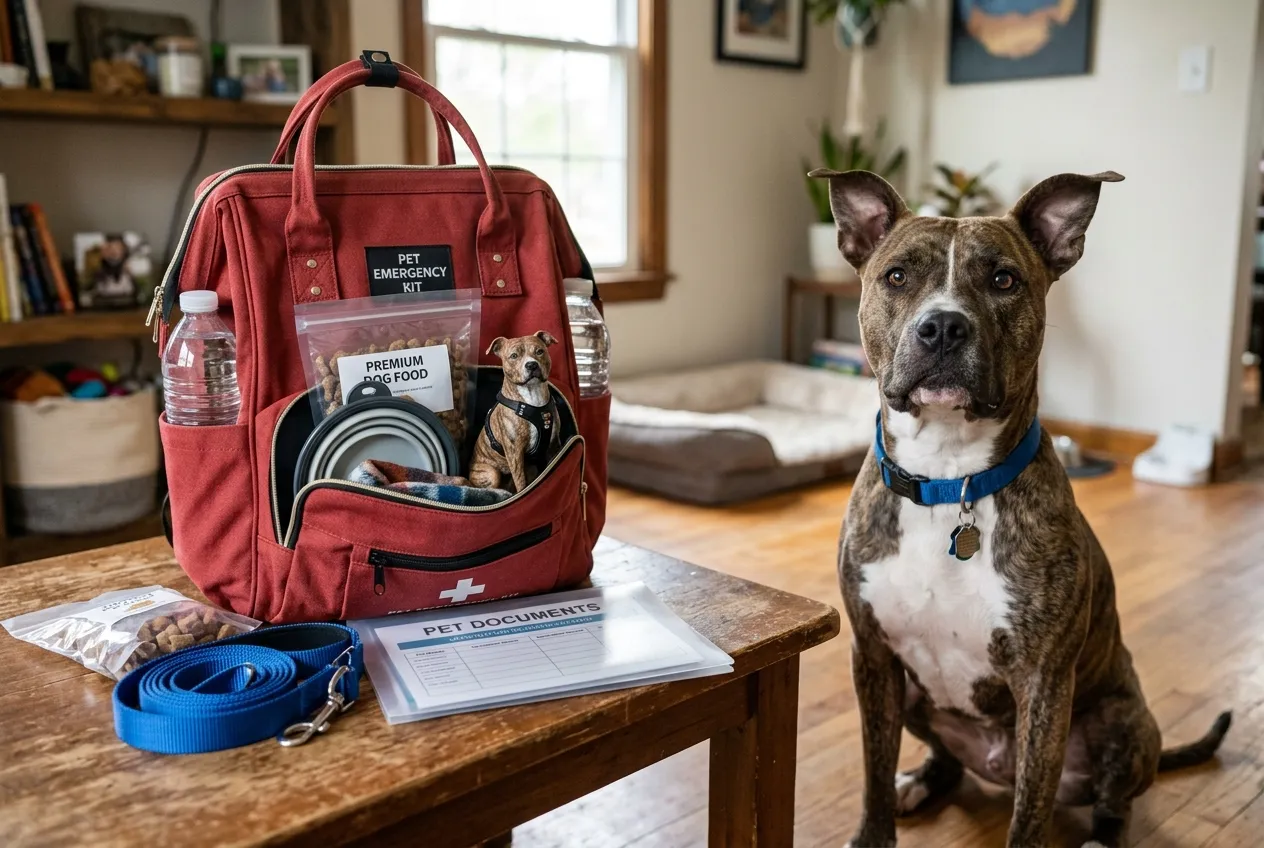
The damp smell of turned earth hung in the garden—tomato plants, wet mulch, the faint musk of a pitbull who had been digging where she shouldn't—when the wildfire evacuation alert hit a customer's phone last September. She had forty-five minutes. And no pet disaster preparedness plan.
Quick Takeaways
- Breed-specific bias can delay your evacuation — pitbull owners face shelter restrictions that require advance planning most guides ignore
- Your dog's emergency kit needs more than food and water — include breed documentation, behavioral references, and vaccination proof in a single go-bag
- Identify pet-friendly lodging before disaster strikes — pre-research hotels and shelters that explicitly accept bully breeds
- A physical keepsake of your pet belongs in your preparedness plan — a custom pet figurine or detailed photo file ensures you carry their likeness if you lose everything else
- Practice your evacuation route with your dog at least twice a year — rehearsal reveals problems (leash reactivity, car anxiety) you can solve before they become emergencies
The Overlooked Crisis: Why Standard Emergency Plans Fail Pitbull Families
Most pet disaster preparedness guides assume a kind of universal dog. A golden retriever, maybe. Something medium-sized, crowd-friendly, welcome everywhere. They tell you to pack kibble, grab your leash, and head to the nearest Red Cross shelter.
But if you own a pitbull—or any bully breed, or a dog that looks like one—that advice has a fatal gap.
Breed-specific legislation (BSL) and shelter restrictions remain active in hundreds of municipalities across the United States. According to the ASPCA's position on breed-specific legislation, these laws range from outright ownership bans to mandatory insurance requirements, muzzle ordinances, and exclusions from public emergency shelters. During Hurricane Katrina, countless pit bull owners refused to evacuate because they knew—correctly—that their dogs would be turned away at the door. Some died for that knowledge.
This is the disaster preparedness step most pitbull owners overlook until it's too late: building an evacuation plan that accounts for breed discrimination. Not as an afterthought. As the foundation.
We'll be real—this isn't the article where we tell you to buy extra batteries. You can find that anywhere. This is the one where we walk through the specific, practical, sometimes uncomfortable steps that bully breed owners need to take before the sirens start.
"The families who lose the most in emergencies aren't the ones who lacked supplies—they're the ones who lacked a plan that fit their actual life."
— The PawSculpt Team
Building a Breed-Aware Evacuation Plan
Why Generic Plans Break Down
Here's the counterintuitive insight most emergency guides won't tell you: the biggest threat to your pitbull during a disaster isn't the disaster itself—it's the bureaucratic infrastructure that activates afterward.
Emergency animal shelters are often run by organizations with intake policies. Some explicitly exclude "aggressive breeds" (a designation that frequently sweeps in American Pit Bull Terriers, American Staffordshire Terriers, Staffordshire Bull Terriers, and any mixed breed with a blocky head). Hotels that advertise as "pet-friendly" often have weight limits or breed restrictions buried in their fine print. Even well-meaning neighbors who offer to help may hesitate when they see your dog.
A customer we worked with in Northern California told us she'd evacuated during the 2020 wildfires with her two pit mixes. She drove to three motels before finding one that would let her dogs inside. By then, the roads behind her were closed.
That story isn't unusual. It's the norm.
Step 1: Map Your Breed-Friendly Destinations Now
Before any emergency, build a prioritized list of three to five destinations that will accept your pitbull without argument. These fall into categories:
| Destination Type | Pros | Cons | Action Required |
|---|---|---|---|
| Friend/family home (50+ miles away) | Most reliable; no breed restrictions | Depends on relationship; may have their own pets | Confirm willingness annually; do a trial visit |
| Breed-friendly boarding facility | Professional care; secure | May fill quickly during regional disasters | Call ahead; get on priority lists |
| Hotels with no breed restrictions | Widely available | Policies change; verify each time | Maintain a list of 5-10 options across evacuation routes |
| Veterinary emergency boarding | Medical care available | Expensive; limited space | Establish relationship with your vet; ask about emergency boarding |
| Rescue network contacts | Deep understanding of bully breeds | Informal; less predictable | Join local pitbull rescue groups; exchange contact info |
The critical detail: call these places. Don't rely on websites. Policies change, staff turnover happens, and the person answering the phone during a flood may not know what the website says. Get a name. Write it down. Update it every six months.
Step 2: Create a Breed-Specific Documentation Packet
This is where pitbull owners need to go beyond the standard "grab your vet records" advice. You need a portable documentation packet—physical copies in a waterproof bag and digital backups on your phone and cloud storage.
Your packet should include:
- Current vaccination records (rabies certificate is non-negotiable for any shelter or hotel)
- Veterinary health certificate dated within the last 12 months
- Breed verification letter from your vet, if applicable—some vets will write a letter identifying your dog as a "mixed breed" or specific breed that may avoid BSL triggers
- Canine Good Citizen (CGC) certificate or proof of obedience training—this is your strongest counter-argument when someone questions your dog's temperament
- Photos of your dog from multiple angles (we'll talk more about why these matter beyond identification)
- Microchip number and registration confirmation
- A brief behavioral summary: how your dog handles strangers, other animals, loud noises, and confinement
That last item might seem odd. But when you're asking a shelter volunteer to accept your pitbull at 2 AM during a hurricane, handing them a one-page summary that says "Friendly with adults, dog-selective, no bite history, crate-trained, responds to 'sit' and 'down'" changes the dynamic entirely. You're not asking them to take a risk. You're showing them the risk is already managed.
Step 3: Know Your Local BSL Map
If you're evacuating, you may be crossing county or city lines. BSL varies by municipality, not just by state. Denver only repealed its pit bull ban in 2021—and some surrounding areas still have restrictions. Miami-Dade County in Florida maintained its ban until voters overturned it in 2023. But dozens of smaller cities you've never heard of still have active bans or restrictions.
Look up the BSL census maintained by breed advocacy organizations and map the jurisdictions along your likely evacuation routes. If your route passes through a city that bans your dog's breed, plan an alternate route now.
This sounds extreme. It isn't. A pitbull owner in an evacuation zone who drives through a BSL jurisdiction could legally have their dog seized by animal control—even during a disaster. It's happened.
The Emergency Kit Most Guides Get Wrong
What Actually Goes in a Pitbull Emergency Kit
Every disaster preparedness checklist tells you the same thing: food, water, bowls, leash, medications. Fine. But those lists were written for a hypothetical dog, not yours.
Here's what a pitbull-specific dog emergency kit actually needs, broken into tiers:
Tier 1: The 15-Minute Grab (Already Packed, Always Ready)
This is the bag by your door. You don't assemble it during the emergency. It's already done.
- 3-day supply of your dog's regular food in a sealed, labeled container (rotate every 3 months)
- Collapsible water bowl and 1 gallon of water
- Any daily medications plus a 7-day backup supply
- Sturdy 6-foot leash and a well-fitted harness—not a retractable leash, which offers zero control in chaos
- A muzzle your dog has been trained to wear comfortably—more on this below
- Documentation packet (the one we described above, in a waterproof sleeve)
- A familiar-smelling item: a blanket, a worn shirt, something that carries the scent of home
That last item isn't sentimental fluff. Dogs navigate stress through their noses. In an unfamiliar environment—an evacuation center, a friend's basement, a motel room that smells of industrial cleaner—a single object that carries the familiar smell of their life can be the difference between a calm dog and a dog in full panic. The smell of your couch. Your morning coffee. Their usual sleeping spot. Bottle that if you can.
"In an emergency, your dog doesn't need perfection—they need one thing that smells like normal."
Tier 2: The Extended Kit (For Longer Displacements)
- 7-day food supply and treats for training reinforcement
- Portable crate or exercise pen (your dog should already be crate-trained—if they aren't, start today)
- Waste bags, paper towels, enzyme cleaner
- A copy of your homeowner's or renter's insurance (some policies cover pet-related damage during evacuations)
- Contact information for three breed-friendly emergency vets along your evacuation routes
The Muzzle Conversation Nobody Wants to Have
Here's the part where we challenge a common assumption.
Most pitbull owners resist muzzle training. It feels like giving in to the stereotype. It feels like admitting your dog is dangerous. We understand that reaction—and we think it's worth moving past.
A muzzle is not an admission of danger. It's an evacuation tool. During a disaster, your dog will encounter frightened strangers, panicked animals, loud noises, and confined spaces. Even the most bombproof dog has a threshold. More practically: some emergency shelters that would otherwise turn your pitbull away will accept a muzzled dog. A muzzle, in this context, is a key that opens doors.
But—and this matters—the muzzle only works if your dog already associates it with positive experiences. A basket muzzle (the kind that allows panting and drinking) introduced through treat-based conditioning over several weeks becomes a neutral object. Slapping one on a terrified dog for the first time during an evacuation is a recipe for panic and potential injury.
Start muzzle conditioning now. Not because your dog is aggressive. Because the world is unpredictable and your dog deserves every advantage.
| Muzzle Training Phase | Duration | Goal | Method |
|---|---|---|---|
| Introduction | Days 1-3 | Dog willingly sniffs muzzle | Present muzzle, treat heavily, remove |
| Nose insertion | Days 4-7 | Dog puts nose inside voluntarily | Smear peanut butter inside; let dog lick |
| Brief wearing | Week 2 | Dog wears muzzle 10-30 seconds | Clip briefly, immediate treat, remove |
| Extended wearing | Weeks 3-4 | Dog wears muzzle 5-10 minutes calmly | Wear during walks or play; normalize |
| Generalization | Ongoing | Dog is relaxed with muzzle in varied settings | Practice in car, at vet, around strangers |
What We Wish We Knew Sooner
(Candid retrospective insights from the PawSculpt team, drawn from years of conversations with pitbull-owning customers)
We wish we'd known that pet photos serve a dual purpose. We talk to customers every day who want a 3D-printed memorial figurine of their pet, and the first thing we ask for is high-quality photos from multiple angles. More than once, families who lost everything in a fire or flood have told us that the only clear photos they had of their dog were the ones they'd submitted to us for a figurine project months earlier. Their phone was destroyed. Their computer was gone. But those photos—uploaded to a cloud service—survived. Your pet's photo archive is a disaster preparedness asset. Back it up.
We wish we'd known how many people lose their pets permanently during evacuations—not because the pet dies, but because identification fails. Microchips migrate. Collars fall off. Wet ink on tags becomes illegible. The redundancy principle applies: microchip plus collar with current tags plus a GPS tracker plus clear photos distributed to local shelters. No single method is enough.
We wish we'd known that practicing matters more than planning. A family we worked with ran a full evacuation drill with their two pitbulls—loading crates into the car, driving their route, checking into a hotel. On the drill run, they discovered one dog couldn't physically fit through the back door of their SUV with the crate positioned the way they'd planned. They fixed it in their driveway on a Saturday afternoon instead of discovering it at midnight during a flood.
We wish we'd known that emotional preparedness is real. Disasters don't just test logistics—they test your ability to make fast decisions under terror. Knowing your plan cold, knowing your dog's documents are in one bag, knowing your destination is expecting you—that's not just practical. It's psychological. Panic narrows cognition. Preparation widens it.
Your Dog's Emotional Emergency Plan
What Happens Inside a Pitbull During a Disaster
This section matters more than most people think. Pitbulls are, by temperament, unusually attuned to their owner's emotional state. This is one of the breed's greatest strengths in daily life—and a genuine vulnerability during crisis.
When you panic, your dog reads it. They smell the cortisol change on your skin. They hear the pitch shift in your voice. They feel the tension in the leash. And pitbulls, who bond deeply and singularly to their families, often respond to that stress not by fleeing but by becoming hypervigilant. A hypervigilant dog in a chaotic environment is a dog at risk of being labeled "aggressive" by someone who doesn't understand what they're seeing.
Your emotional regulation is part of your pet evacuation preparation. This sounds abstract, but the practical application is concrete: rehearse your plan enough times that the physical motions—grab the bag, load the crate, open the car, secure the harness—become automatic. When your conscious brain is flooded with fear, your muscle memory carries the load.
Calming Protocol for Evacuated Dogs
Once you've reached safety, your pitbull's stress is just beginning. New smells, new sounds, confinement, disrupted routine—these stack up fast.
- Set up their crate or designated space immediately, before you unpack anything else for yourself. Your dog needs a defined territory.
- Place the familiar-smelling item inside the crate. That blanket from Tier 1 of your kit is doing its most important work now.
- Maintain feeding schedule ruthlessly. Even if the times need to shift, keep the routine—same bowl, same order, same location relative to their crate.
- Limit exposure to strangers for the first 24-48 hours. Your dog needs to decompress. This isn't the time for introductions.
- Resume training commands. Ask for sits, downs, stays—not because your dog needs obedience, but because familiar commands provide cognitive structure in an unfamiliar world. They give your dog something they know how to succeed at.
A quick note: if your dog is showing signs of extreme stress (prolonged panting, refusal to eat for more than 24 hours, uncharacteristic aggression, or self-harm), contact a veterinarian. We're not vets, and some stress responses require professional intervention—particularly in dogs with pre-existing anxiety.
The Identification Gap That Loses Pitbulls Permanently
After a disaster, animal control and rescue organizations recover thousands of dogs. Reunion rates are significantly lower for bully breeds—not because fewer pitbulls survive, but because breed misidentification complicates the search.
Your dog is microchipped as a "pit bull mix." The shelter that found her logged her as "American Staffordshire Terrier." A volunteer posting to lost-pet boards described her as a "brown bully breed." You're searching for "blue-nose pitbull." Four different descriptions, same dog, and none of them match in a database search.
The fix is visual, not textual. Distribute clear, high-resolution photos—not breed labels—to every shelter, rescue group, and social media lost-pet page within a 100-mile radius of where you were separated. Include:
- Front-facing head shot
- Left and right profile
- Full body standing
- Any unique markings (scars, brindle patterns, chest patches, eye color variations)
- A photo showing size reference (next to a recognizable object)
These are, not coincidentally, the same kinds of detailed photos that make for excellent reference material if you ever want to capture your dog's likeness in a lasting way—whether through a custom 3D-printed pet figurine or any other keepsake. The point is: document your dog thoroughly while you can. Not later. Now. On a sunny afternoon when they're standing in the garden with mud on their nose and you have no reason to think anything could go wrong.
"The best time to photograph your pet in detail was yesterday. The second-best time is right now."
Financial Preparedness: The Costs Nobody Talks About
Evacuating with a pitbull isn't free. And the costs hit differently than for owners of breeds that are universally welcome.
| Expense Category | Typical Range | Pitbull-Specific Notes |
|---|---|---|
| Pet-friendly hotel (per night) | $75-$200+ | Many charge $25-$75 pet deposit; some add breed surcharges or refuse bully breeds entirely |
| Emergency boarding | $30-$75/day | Breed-friendly facilities may charge premium rates |
| Emergency vet visit | $150-$500+ | Stress-related GI issues are common post-evacuation |
| Replacement supplies | $100-$300 | Crate, food, leash, bowls if your kit was lost |
| Travel/fuel | $50-$200+ | Longer routes to avoid BSL jurisdictions add mileage |
| Lost wages | Varies | Extended displacement may require time off work |
Build a pet emergency fund. Even $500 set aside in a dedicated savings account changes your options dramatically during a crisis. It means you can say yes to the hotel that charges a pet deposit instead of sleeping in your car. It means you can afford emergency boarding if your primary destination falls through.
Some homeowner's and renter's insurance policies cover pet-related evacuation expenses. Check yours—not during the disaster, but this week.
The Reunion Plan: After the Disaster
The hours and days after a disaster are when most pets are permanently lost. Here's a tightly structured reunion protocol if you become separated from your pitbull:
- Within the first hour: Report your lost dog to local animal control, including microchip number and photos. Call your microchip company to flag your pet as lost and verify that your contact information is current.
- Within the first 6 hours: Post to social media lost-pet groups specific to your area. Include your five reference photos. Avoid breed-label language—describe your dog's actual physical characteristics instead ("40-lb brown and white dog with cropped ears and a white chest blaze" is more useful than "pit mix").
- Within the first 24 hours: Visit every animal shelter within a 50-mile radius in person. Do not rely on phone descriptions or website photos. Shelter workers may have categorized your dog under a breed name you wouldn't recognize.
- Within 48-72 hours: Expand your radius. Contact breed-specific rescue organizations. Post to platforms like Petco Love Lost (which uses facial recognition to match lost and found pets). Place physical flyers with large color photos at intersections near where you were separated.
- Ongoing: Do not stop looking after a week. Dogs found during disasters are sometimes held for extended periods before being posted publicly. Some are transported to shelters in other states. Keep checking. Keep calling.
The emotional weight of this phase is crushing. You're dealing with the aftermath of a disaster and the terror of a missing family member. This is where all that advance preparation—the photos, the documents, the microchip, the contacts—carries you through. You've already done the work. Now it's execution.
A Tangible Anchor in Uncertain Times
There's something we've noticed over the years at PawSculpt that connects to disaster preparedness in a way that might not be obvious at first.
When families order a custom figurine of their pet—digitally sculpted by our 3D artists and then precision-printed in full-color resin that captures every marking, every patch of brindle, every scar—they sometimes tell us it started as a gift idea. But the reason they finish the order, the reason they go through the revision process and place it on their shelf, is often something quieter. It's the knowledge that they have something permanent. Something that won't be lost in a flood or corrupted on a water-damaged phone. Something that captures their dog exactly as they are right now.
We're not suggesting a figurine replaces a disaster plan. Obviously. But we are saying that the impulse to preserve—to hold onto what matters—is the same impulse that drives you to pack that emergency kit, to photograph your dog from every angle, to rehearse loading the car at 2 AM. It's the refusal to be caught off guard. It's love, translated into preparation.
If you've been meaning to get good reference photos of your pitbull, let this be the push. Take them today. Use them for whatever you want—a disaster preparedness file, a social media post, a custom figurine from PawSculpt. The photos are the foundation of all of it.
Closing: Back to the Garden
That customer in Northern California—the one with the tomato plants and the mud-nosed pitbull and the forty-five-minute warning—she made it out. Both of them. Her house didn't.
She told us later that the thing that saved them wasn't bravery or luck. It was boredom. Months earlier, on a slow Sunday, she'd done the unsexy work: called three hotels, confirmed they'd accept her dog, saved the numbers in her phone. She'd packed a bag with kibble and vet records and a ratty towel that smelled like the living room. She'd driven the route once, just to see how long it took.
When the alert hit, she didn't strategize. She grabbed the bag, loaded the dog, and drove. Forty-five minutes was more than enough because she'd already spent the hours that mattered.
Your pitbull emergency plan doesn't need to be perfect. It needs to exist. It needs to account for the specific realities of owning a breed that the world hasn't fully decided to trust yet. And it needs to be practiced—not just imagined, but physically rehearsed—before the smell of smoke replaces the smell of garden soil.
Start today. Not with the big things. With the bag. With the photos. With one phone call to one hotel.
The rest will follow.
Frequently Asked Questions
Do emergency shelters accept pitbulls during disasters?
Many public emergency shelters have breed restrictions that exclude pitbulls and other bully breeds. This is why advance planning is critical—contact shelters along your evacuation routes before a disaster, and build a list of alternative destinations including breed-friendly boarding facilities, hotels that have confirmed acceptance of your dog, and personal contacts who can host you.
What should be in a dog emergency kit for a pitbull?
Beyond the basics (food, water, medications), pitbull owners need breed-specific documentation: vaccination records, a vet letter identifying your dog's breed, proof of training like a CGC certificate, and a behavioral summary. Add a sturdy 6-foot leash, a well-fitted harness, a conditioned basket muzzle, and a familiar-smelling comfort item. Keep everything in a waterproof bag near your door.
Should I muzzle-train my pitbull for emergencies?
Absolutely—and it's not a concession to stigma. A basket muzzle trained through positive association over several weeks becomes a neutral tool that can open doors at shelters and hotels that would otherwise refuse your dog. Start conditioning now using treats and brief wearing sessions, gradually increasing duration over three to four weeks.
How can I find my pitbull if we get separated during a disaster?
Act within the first hour: report to animal control with your microchip number and photos. Visit shelters in person within 50 miles—don't rely on phone descriptions, as breed misidentification is common. Post detailed photos (not breed labels) on social media lost-pet groups. Use facial recognition tools like Petco Love Lost. Don't stop searching after a week; dogs recovered during disasters are sometimes held or transferred for extended periods.
What is breed-specific legislation and how does it affect my evacuation plan?
BSL refers to local laws that restrict or ban certain dog breeds, and it varies by municipality—not by state. During an evacuation, driving through a jurisdiction with an active pit bull ban could legally result in your dog being confiscated, even during a crisis. Map BSL-free routes using breed advocacy resources and the AKC's BSL guide before you need them.
How much should I budget for a pet emergency fund?
Even $500 set aside can dramatically improve your options—covering pet deposits at hotels, emergency boarding fees, or replacement supplies. Factor in potential emergency vet visits ($150-$500+), extended boarding ($30-$75 per day), and extra fuel costs from longer BSL-free evacuation routes. Check whether your homeowner's or renter's insurance covers any pet-related evacuation expenses.
Ready to Celebrate Your Pet?
Disaster preparedness starts with knowing your pet—every marking, every scar, every expression. Whether you're building a pitbull emergency plan or simply honoring the companion who makes your life fuller, a custom PawSculpt figurine captures the details that make your dog irreplaceable. Digitally sculpted and precision-printed in full-color resin, each piece preserves your pet exactly as they are today.
Visit pawsculpt.com to learn more about our process and guarantees