
The One Ritual That Helps Siamese Cat Owners Finally Say What They Couldn't
She was halfway across the dog park when she noticed her hand—still curled, fingers forming the shape of a small skull she'd scratched ten thousand times. Her Siamese had been gone eleven days. Her body hadn't caught up. That phantom gesture, reaching for a cat no longer there, is where a siamese cat memorial ritual actually begins—not in ceremony, but in the muscle memory your hands refuse to release.
Quick Takeaways
- Ritual isn't about closure—it's about conversation — the most effective grief rituals let you say things left unspoken
- Siamese-specific grief carries unique weight — their vocal, bonded nature leaves a silence other breeds don't
- Writing a letter to your cat changes your neurological grief pattern — structure the unsaid into something you can hold
- Physical anchors accelerate healing — tangible keepsakes like custom pet figurines give grief a landing place beyond memory
- The "right time" for ritual is when you stop functioning around the absence — not a calendar date, but a felt threshold
Why Siamese Cat Grief Hits Different (And Nobody Talks About It)
Here's something we've learned from working with thousands of grieving pet families: Siamese cat owners grieve differently. Not harder, necessarily. But differently. And the distinction matters because it changes what kind of memorial ritual will actually help you.
Most grief resources treat all cat loss the same. Lose a tabby, lose a Siamese, lose a Persian—same advice. Light a candle. Plant a garden. But anyone who's lived with a Siamese knows the relationship wasn't like other cat relationships. These cats talk to you. They follow you room to room. They have opinions about your schedule, your dinner, your phone calls. They wedge themselves into the geometry of your daily life with a persistence that borders on co-dependency.
So when they're gone, the absence isn't passive—it's loud.
You don't just miss a cat. You miss a conversational partner. The yowl when you opened the fridge. The chirp at 6:14 AM that meant I see you're awake and I have thoughts. The specific weight of a body that always chose your lap, your chest, your left shoulder.
One family we worked with described it this way: "Other people say they miss their cat. I miss being known by mine." That distinction—being known versus simply cohabiting—is what makes Siamese grief so disorienting. You've lost a witness to your life.
And here's the counterintuitive part that most grief guides skip entirely: the ritual that helps isn't about remembering your cat. It's about finishing the conversation.
The Silence That Isn't Silence
Walk into the room where your Siamese spent most of their time. Not the whole house—the room. For most Siamese owners, there's a specific room. Maybe the kitchen. Maybe the bedroom. Maybe the office where they sat on your keyboard and stared at you with those absurd blue eyes while you tried to work.
Stand in that room and notice what you hear.
It's not quiet. It's the wrong sound. The ambient noise of a house that used to have a voice in it and doesn't anymore. The refrigerator hum that used to be interrupted. The absence of claws on hardwood at 3 PM when the sun hit the hallway.
Spatial grief—the experience of a space feeling physically wrong after loss—is under-discussed in pet bereavement. But it's one of the most acute forms of suffering Siamese owners describe to us. The chair arm where they perched. The windowsill with the nose prints you haven't cleaned (and shouldn't yet). The indent in the couch cushion that's slowly filling back in.
This spatial dimension is precisely why a generic "light a candle and think about them" ritual falls flat. Your grief isn't abstract. It's architectural. It lives in corners and doorways and the three-inch gap between your pillow and the headboard where a warm body used to curl.
The ritual that works has to meet the grief where it actually lives.
The Letter Ritual: Saying What You Couldn't While They Were Here
Here's what we're going to walk you through—and we'll be real, this isn't something we invented. Variations exist in human grief therapy, hospice care, and bereavement counseling. But we've adapted it specifically for the Siamese cat bond because the dynamics are unique enough to warrant it.
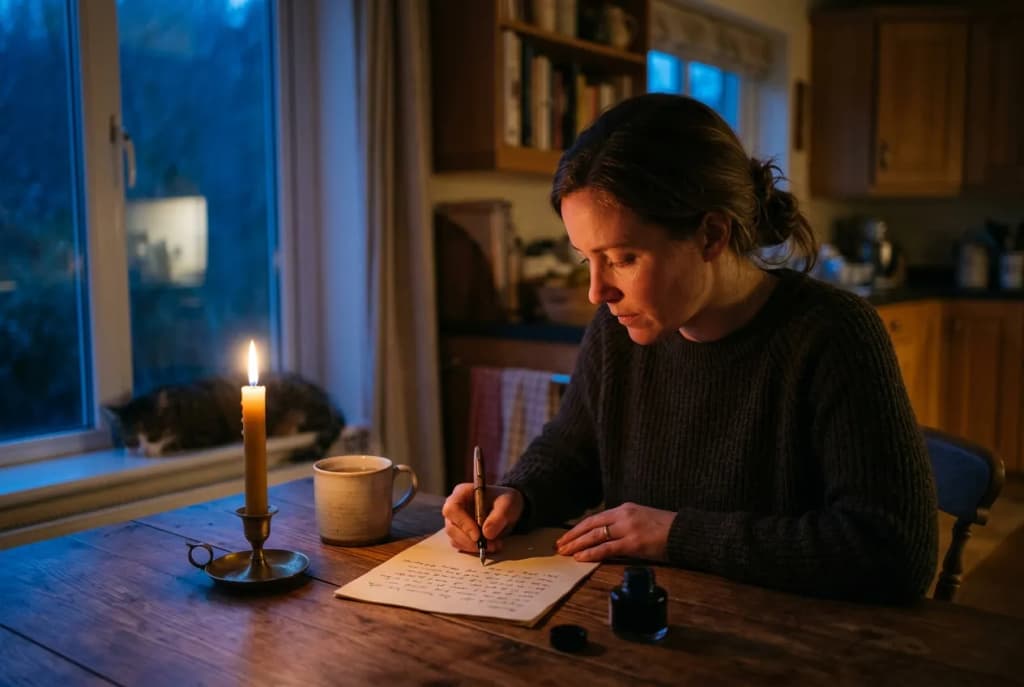
The core ritual is writing a letter to your cat. But not a eulogy. Not a tribute. A letter that says the things you couldn't say while they were alive—including the hard things.
Most memorial guides encourage you to write about happy memories. And that's fine. But it doesn't address the actual knot in your chest, which is almost never about the good times. The knot is about the things you didn't say, the decisions you second-guess, and the emotions you're afraid to admit.
What Goes in the Letter (The Parts Nobody Tells You)
Here's a framework. You don't have to use all of it. But scan the list and notice which ones make your stomach tighten. Those are the ones that need writing.
1. The apology you owe them (or think you do).
Many Siamese cat owners carry guilt about the end. Did you wait too long? Did you not wait long enough? Was the euthanasia decision made on a Tuesday when maybe, maybe, Wednesday would have been different? This is one of grief's cruelest mechanisms—second-guessing euthanasia timing is almost universal among cat owners who chose to end suffering, and it's rarely discussed openly because people fear judgment.
Write the apology. Even if it's irrational. Especially if it's irrational. Get it out of your circulatory system and onto paper.
2. The relief you're not supposed to feel.
We'll say it because someone needs to: if your Siamese was sick—kidney disease, cancer, hyperthyroidism, any of the conditions that stalk this breed—you may have felt a wave of relief when it was over. Not relief that they're gone. Relief that the 2 AM medication schedules, the vet visits, the watching-them-decline is finished. That relief doesn't make you a monster. It makes you someone who was carrying an unsustainable weight and your body put it down.
The guilt that chases that relief is one of the most isolating emotions in pet loss. Write about it. Name it. Let the letter hold it so your chest doesn't have to.
3. The thing they did that drove you crazy.
This one surprises people. But some of the most cathartic letters we've heard about include a section on the annoying stuff. The 4 AM yowling. The counter-surfing. The way they'd knock your water glass off the nightstand and stare at you while it happened. Grief has a tendency to canonize, and the flattening of a complex relationship into pure sainthood actually makes the loss harder to process. Your cat was a whole personality. Let them be that on paper.
4. What you're afraid of now.
This is the part most people skip, and it's the most important. What scares you about life without them? Be specific. Not "I'm sad." But: "I'm afraid I'll forget the exact sound of her chirp." Or: "I'm afraid no one will ever need me that specifically again." Or even: "I'm terrified that I'll get another cat and it'll feel like betrayal."
"Grief doesn't need your permission to be complicated. It just needs somewhere to land."
The fear of forgetting is particularly acute with Siamese owners because so much of the bond was behavioral—sounds, habits, routines—rather than purely visual. You can look at photos all day, but a photo doesn't meow back. Writing down the specific behaviors, the exact quirks, the precise sequence of their morning routine creates a record that photographs can't.
How to Actually Do It
| Step | Action | Why It Matters |
|---|---|---|
| 1 | Choose the room where your cat spent the most time | Spatial context activates deeper emotional memory |
| 2 | Write by hand, not by keyboard | Handwriting slows cognition and increases emotional processing |
| 3 | Address the letter directly to your cat by name | Second-person address ("Dear Miko") engages conversational memory |
| 4 | Include at least one "hard truth" from the list above | Unspoken emotions are the ones that calcify into prolonged grief |
| 5 | Read it aloud once, then seal it | Vocalization completes the communication loop your brain is stuck in |
| 6 | Decide what to do with it (keep, bury, burn) | The physical act of doing something with the letter creates ritual closure |
A few notes on execution. Write by hand. Not on a laptop. Not in your phone's notes app. The physical act of forming letters slows your brain down enough to access the emotional processing centers that typing bypasses. There's research supporting this—the Association for Pet Loss and Bereavement has long advocated for written expression as a primary grief tool, and the tactile element matters more than people realize.
Read the letter out loud. Yes, to an empty room. Yes, it will feel absurd. Do it anyway. Your Siamese was a vocal cat. You had a verbal relationship. Finishing the conversation out loud completes a neurological loop that silent reading doesn't.
Then decide what to do with the letter. Some people keep it in a box with their cat's collar. Some bury it in the garden. Some burn it—not out of destruction, but release. The physical act of doing something with the letter is the ritual. The writing is the preparation.
The Counter-Point: When Ritual Isn't Enough (And That's Okay)
We'd be dishonest if we didn't say this: ritual has limits.
If you're three months out and you still can't enter the room where your cat died. If you've stopped eating regularly. If you're calling in sick to work not occasionally but consistently. If the grief has become a room you can't leave—ritual alone isn't going to cut it.
The pet loss community has a complicated relationship with professional help. There's a pervasive, damaging narrative that says grieving "too much" for an animal is disproportionate. That narrative is garbage, but it's also real, and it keeps people from seeking therapy because they're ashamed of their grief intensity.
Here's what we know from years of working with bereaved pet families: the depth of your grief is not a measure of your weakness. It's a measure of your capacity for attachment. But if that grief has become functionally debilitating—not just painful, but actually preventing you from living—a grief counselor who specializes in pet loss is not a luxury. It's a tool. The same way the letter is a tool. The same way a memorial is a tool.
Ritual creates a container for grief. It doesn't cure it. And anyone telling you that a single ceremony or object will "fix" your loss is selling something, not helping.
"We've learned that healing doesn't come from one perfect gesture. It comes from giving grief a place to live—something to hold, something to return to."
— The PawSculpt Team
That said—and this is important—the container matters. What you put your grief into shapes how you carry it forward. Which brings us to the physical dimension of memorial.
Beyond the Letter: Building a Physical Anchor for Memory
The letter addresses the conversation. But Siamese grief also has a tactile dimension that words alone can't satisfy. You miss the feel of them. The weight. The temperature. The specific texture of that short, cream-colored coat under your fingertips.
This is where physical memorials earn their place—not as replacements (nothing replaces a living being) but as anchors that prevent memory from becoming abstract.
Here's what we mean. In the first weeks after loss, memory is vivid. You can close your eyes and see every marking, every whisker angle, every shade of seal point or chocolate point on their face. But memory degrades. Not because you loved them less, but because that's what brains do. Within six months, you'll start second-guessing details. Was the mask darker on the left side? Were the ears that big? Did the eyes really look like that?
The fear of forgetting is not irrational. It's neurologically inevitable. And it's one of the most painful secondary losses in pet bereavement—losing not just the cat, but the clarity of the cat.
Physical memorials—the right ones—interrupt that degradation.
What Works (And What's Just Stuff)
Not all memorials are equal. Here's an honest breakdown:
| Memorial Type | Emotional Impact | Longevity | Captures Uniqueness | Effort Level |
|---|---|---|---|---|
| Photo in a frame | Moderate | High | Moderate (2D only) | Low |
| Paw print casting | High initially | High | Low (generic shape) | Low |
| Urn with ashes | Varies widely | Permanent | None (visual) | Low |
| Custom figurine | Very high | Very high | Very high (3D likeness) | Low (you provide photos) |
| Memorial garden | High | Seasonal | Low | High |
| Tattoo | Very high | Permanent | Moderate | Moderate |
| Commissioned painting | High | High | High (artist-dependent) | Moderate |
A framed photo is fine. It's also flat. It captures one angle, one moment, one expression. Your Siamese was a three-dimensional creature who looked different from every angle—the profile with those dramatic ears, the front view with the crossed eyes half of them have, the back with that tail curved just so.
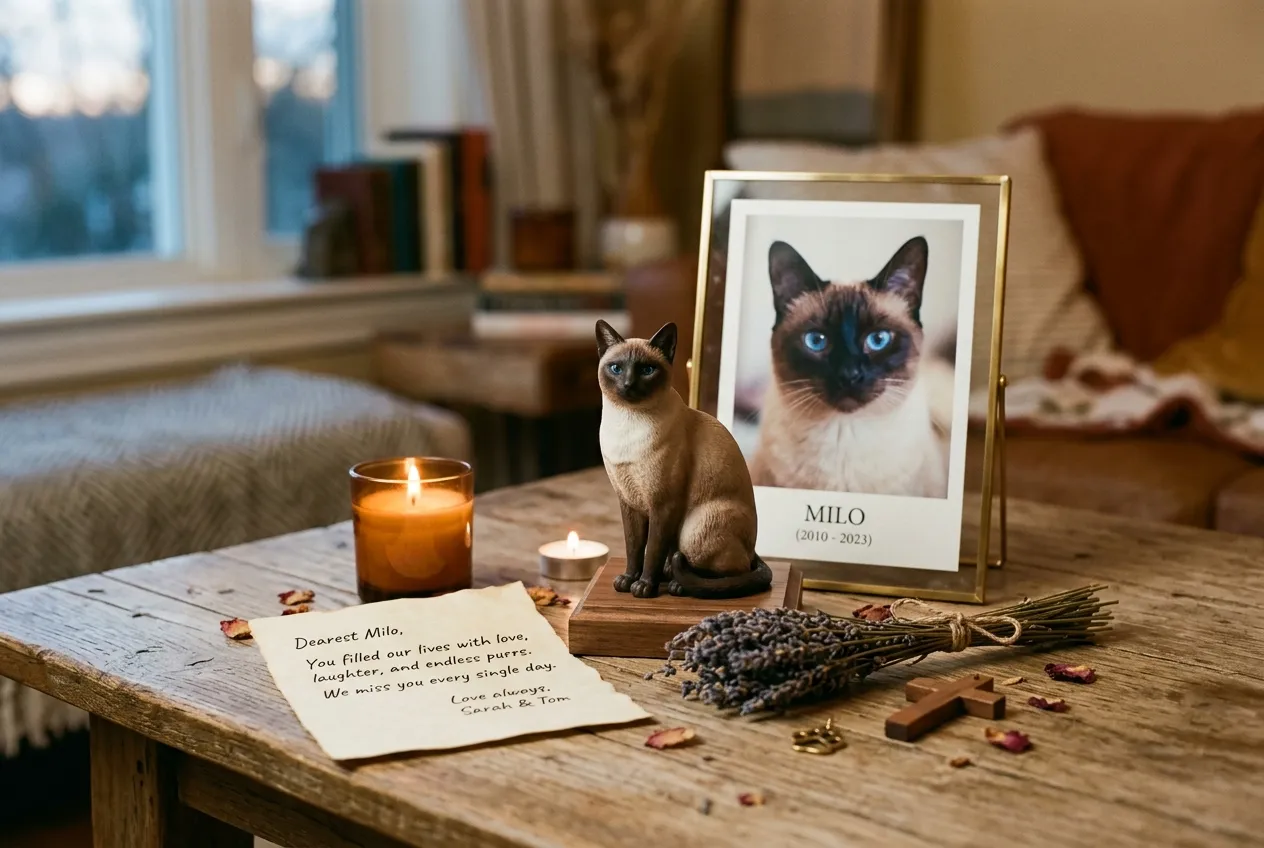
This is where something like a custom 3D pet figurine fills a gap that other memorials can't. A figurine exists in space the way your cat existed in space. You can set it on the windowsill where they sat. You can see it from across the room and for a half-second, the shape registers before the material does. That half-second matters more than you'd think.
PawSculpt's process uses full-color 3D printing technology—the color is embedded directly in the resin, voxel by voxel, which means your Siamese's specific point coloration, the gradient from cream to seal, the blue of the eyes, the pink of the nose leather—it's all reproduced in the material itself, not layered on top. The result has a texture and depth that flat media can't replicate. For specific details about the process, turnaround, and options, their website walks you through everything.
But here's our honest take: a figurine works best when it's part of a larger ritual practice, not a standalone fix. Pair it with the letter. Place it in the room. Let it become part of the spatial landscape of your grief—an anchor point that says they were here, they were real, they were exactly this.
"A memorial isn't where grief ends. It's where memory gets to stay solid."
The Grief Ritual for Siamese Cat Owners: A Complete Ceremony
Let's pull everything together into a single, structured pet loss ceremony you can perform alone or with family. This isn't religious. It isn't New Age. It's practical, grounded in what we've seen actually help people move through—not past, but through—the loss of a deeply bonded Siamese cat.
Before You Begin
Choose a time when you won't be interrupted for at least 45 minutes. Not a weekend morning with kids running around. Not a lunch break. A real, protected window. Grief work done in fragments tends to stay fragmented.
Gather:
- Your handwritten letter (or write it as part of the ceremony)
- One physical object that belonged to your cat (collar, toy, blanket)
- A photo—ideally one that captures their personality, not just their appearance
- A candle (optional, but the act of lighting and extinguishing creates temporal bookends)
- A physical memorial if you have one (figurine, paw print, urn)
The Five Movements
We call these "movements" instead of "steps" because they aren't linear. You might circle back. That's fine.
Movement 1: Spatial Return (5 minutes)
Go to your cat's room. Not the whole house—the room. Sit where they sat, or as close as you can. If they had a perch, a bed, a corner—orient yourself toward it. Don't do anything yet. Just be in the space and notice what's different. What's missing. What sounds wrong. This isn't wallowing. It's locating the grief in physical space so the rest of the ritual has somewhere to land.
Movement 2: The Object (5 minutes)
Hold the physical object. The collar. The toy. Whatever you chose. Feel the weight of it. Notice the texture. If it's a collar, run your thumb over the tag the way you used to run your hand over their head. This tactile engagement reactivates sensory memory pathways that visual memory alone can't reach. You may cry. That's the point. Tears are not a side effect of grief—they're a mechanism of it.
Movement 3: The Letter (15-20 minutes)
Read your letter aloud. All of it. The apology. The relief. The annoyances. The fears. If you haven't written it yet, write it now—in this room, in this chair, with that object nearby. Address your cat by name. Use the voice you used with them (and yes, we all had a voice).
When you finish reading, sit with the silence for a moment. That silence is different now than it was at the start. It's not the absence of your cat. It's the space after you've said what needed saying.
Movement 4: The Placement (5 minutes)
If you have a physical memorial—a figurine, a framed photo, an urn—place it deliberately. Not shoved on a shelf. Placed. Choose the spot with intention. The windowsill. The nightstand. The desk where they used to sit. The act of giving a memorial a specific, chosen location transforms it from an object into a landmark. It becomes the place in your home where your cat's presence is acknowledged, not avoided.
If you don't have a physical memorial yet, place the photo. Or the collar. Something tangible in a chosen spot.
Movement 5: The Release (5 minutes)
This is where you decide what to do with the letter. Keep it, bury it, or burn it. Each option carries different weight:
- Keeping it means the conversation stays open. You can return to it. Add to it. Some people write a new letter every year on the anniversary.
- Burying it connects the words to the earth—particularly meaningful if your cat is buried in a garden or if you've scattered ashes.
- Burning it is release. Watching the words become smoke is a visceral, physical experience of letting go—not of love, but of the weight of the unsaid.
None of these is better than the others. Choose the one that makes your stomach unclench.
After the Ceremony
Don't immediately scroll your phone. Don't turn on the TV. Give yourself ten minutes of nothing. Walk outside if you can. The transition from ritual space back to daily life needs a buffer, or the emotional work you just did gets overwritten by stimulation.
In the days following, you may notice something subtle: the spatial grief shifts. The room doesn't feel as wrong. Not because you've "moved on"—that phrase can go straight in the trash—but because you've addressed the space. You've spoken into it. You've placed something in it. The architecture of absence has been acknowledged, and acknowledgment is the first thing grief actually needs.
The Emotions Nobody Warns You About (Months 2-6)
The ceremony helps with the acute phase. But Siamese grief has a long tail, and there are emotional landmines in months two through six that catch people off guard.
Jealousy. You'll see someone at the vet with a Siamese kitten and feel a flash of something ugly. That's normal. It doesn't mean you're a bad person. It means your brain is registering what you've lost in real time, and comparison is its bluntest tool.
The anxiety about getting another cat. This one is layered. Part of you wants to fill the space. Part of you feels like wanting to fill the space is a betrayal. And part of you is terrified that a new cat will either be too similar (and you'll spend the whole relationship comparing) or too different (and you'll resent them for not being your cat). All three of these fears can coexist simultaneously, and none of them mean you're not ready. They mean you're processing.
Anger at people who don't get it. "It was just a cat." If you hear this, you have our full permission to walk away from that conversation. But here's the nuance: sometimes the anger isn't at the dismissive comment. It's at the fact that the world kept going. Traffic didn't stop. Your inbox didn't empty. The sun came up the morning after, which felt like a personal insult. Grief wants the world to match its magnitude, and the world's refusal to do so is its own kind of loss.
Guilt about moving on. The first time you laugh—really laugh—after your cat dies, you'll feel it. A stab of something that says how dare you. The first time you rearrange the furniture. The first time you sleep through the night without reaching for them. Each of these milestones carries a small betrayal tax that grief levies without warning.
The letter ritual can be repeated at any of these moments. It's not a one-time ceremony. It's a practice. Write a new letter when a new emotion surfaces. The conversation doesn't have to end just because the first letter is finished.
Saying Goodbye to Your Siamese Cat: What "Goodbye" Actually Means
Here's the counterintuitive insight that most grief rituals for cat owners miss entirely: you're not actually saying goodbye.
Think about it. "Goodbye" implies an ending. A door closing. A conversation terminated. But that's not what happens when a bonded Siamese cat dies. What happens is the conversation shifts from two-way to one-way. You're still talking to them. You're still reaching for them. You're still hearing phantom meows at 6:14 AM.
The ritual isn't about ending the relationship. It's about renegotiating it.
You're moving from a relationship of presence to a relationship of memory. From a relationship of touch to a relationship of objects. From a relationship of sound to a relationship of silence-that-holds-meaning.
The letter gives you a way to say the unsaid. The physical memorial gives you a way to preserve the seen. The ceremony gives you a container for the felt. Together, they don't close the door. They build a new room—one where your cat exists differently, but still exists.
And that room? It doesn't have to be sad. Eventually—not on a timeline anyone else gets to dictate—that room becomes a place you visit with something closer to gratitude than pain. Not because the grief is gone. But because the grief has been given a shape, a location, and a voice.
Your Siamese demanded to be heard in life. The least you can do is let them be heard in memory.
The park bench where she noticed her hand still curling? She goes back sometimes. Not to grieve. To sit in the shape of what she carried, and to feel—in the curl of her fingers, in the weight of a small figurine in her jacket pocket, in the sealed letter tucked in her nightstand drawer—that the conversation was never really over. It just changed languages.
That's what a siamese cat memorial ritual actually does. Not closure. Translation.
Frequently Asked Questions
How long does grief last after losing a Siamese cat?
There's no universal timeline, and anyone who gives you one is oversimplifying. Acute grief—the can't-function, crying-in-the-grocery-store phase—typically peaks in the first two to four weeks. But Siamese owners often experience grief waves for six to twelve months because the bond was so behaviorally integrated into daily life. The triggers are environmental: the empty chair, the quiet morning, the sound of a can opener. These don't disappear on a schedule.
Is it normal to feel relief after a sick cat dies?
Completely. If your Siamese was battling kidney disease, cancer, or any chronic illness, the relief you feel when their suffering ends is your nervous system putting down a weight it's been carrying for weeks or months. That relief doesn't cancel out your love—it exists because of your love. The guilt that follows is common but not earned.
What is the best memorial ritual for a cat owner?
The letter ritual described in this article—writing an honest, unsent letter that includes the hard emotions, then reading it aloud in your cat's space—is one of the most effective approaches we've encountered. It works because it addresses the conversational nature of the Siamese bond rather than just the visual memory. Pair it with a physical memorial for the strongest effect.
Should I get another cat after my Siamese dies?
There's no correct answer and no correct timeline. The anxiety you feel about it—fear of betrayal, fear of comparison, fear of loving differently—is all normal. A useful barometer: wait until the desire for a new cat feels like anticipation rather than an attempt to fill a void. Those feel different in your body, and you'll know the difference when you're ready.
How do I stop feeling guilty about my pet's euthanasia?
You may not stop entirely, but you can reduce its grip. Write about the decision in specific detail: what your vet said, what your cat's quality of life looked like, what information you had at the time (not what you know now in hindsight). Guilt thrives on vagueness. Specificity starves it. If the guilt remains debilitating after several weeks, a pet loss counselor can help you process it structurally.
What physical memorials help most with pet grief?
Three-dimensional memorials—figurines, sculptures, even taxidermy for some—tend to have higher emotional impact than flat photographs because they exist in space the way your pet did. A custom 3D-printed figurine that captures your Siamese's specific markings and posture can serve as a daily anchor point, particularly when placed in a location your cat frequented.
Ready to Honor Your Siamese's Memory?
Some bonds are too specific for a generic memorial. Your Siamese wasn't just any cat—they were a voice, a presence, a personality that filled every room they entered. A custom PawSculpt figurine captures exactly that: the point coloration, the blue eyes, the ears, the posture that was unmistakably theirs—all rendered in full-color resin through precision 3D printing.
Visit pawsculpt.com to see how the process works and explore your options for a lasting siamese cat memorial ritual keepsake.