
Capturing the 'Sploot': Why Corgi Owners Need Overhead Photos
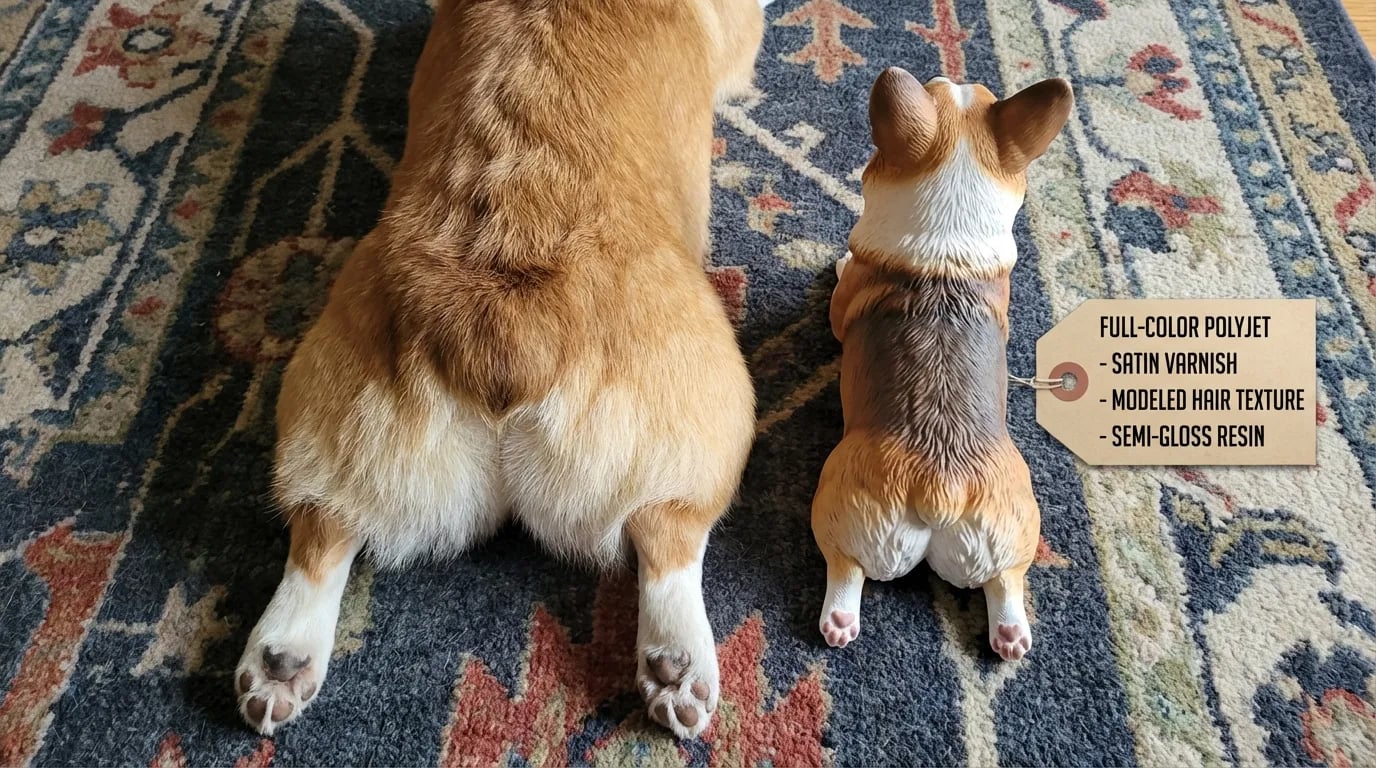
You’re standing over your Corgi in the kitchen, watching those stubby back legs kicked out flat against the cool tile like a frog mid-leap. It’s the classic "sploot"—ridiculous, adorable, and fleeting—and while you scramble for your phone to snap a picture, you realize the standard eye-level angle just doesn't do the geometry of this absurdity justice.
Quick Takeaways
- The "Sploot" is anatomical — It requires specific hip flexibility common in Corgis but rare in other breeds.
- Overhead angles capture the shape — Top-down photos preserve the unique "loaf" or "drumstick" silhouette better than side profiles.
- Lighting matters more from above — Avoid casting your own shadow over the dog by positioning light sources to your side.
- 3D modeling relies on this angle — For custom figurines, top-down views provide critical data on markings and body width.
The Geometry of the Sploot
Most pet photography guides tell you to "get down on their level." And usually, that’s excellent advice. Seeing the world from a dog's eye view creates intimacy and connection. But Corgis? Corgis are the exception to the rule.
When you get down on the floor with a splooting Corgi, you lose the context. From the side, a sploot just looks like a dog lying down. You miss the symmetry of the "drumsticks" (the thighs). You miss the way the paws turn outward. You miss the sheer flatness of the pose that makes it so comical.
The "sploot"—technically known as a frog-leg stretch—is a hallmark of the breed. It’s not just cute; it’s a display of hip flexibility and relaxation. When you capture this from directly overhead, you aren't just taking a picture of a dog; you are documenting a specific physical trait that defines the Corgi silhouette.
"A Corgi without a sploot is like a sky without stars—still beautiful, but missing the magic."
Why the "Bird’s Eye View" Wins
Think about the unique markings on your Corgi's back. Maybe they have a "saddle" pattern, or a specific spot near the tail, or that classic white collar that varies in thickness. When you shoot from the front or side, these defining features get compressed or hidden entirely.An overhead shot flattens the image in a way that highlights the coat pattern map. It turns your dog into a piece of living art. This perspective emphasizes the:
- Symmetry of the ears (the equilateral triangle effect).
- Width of the shoulders relative to the hips.
- Exact curvature of the tail (or lack thereof).
The Technical Challenge: Lighting and Shadows
Here is the counterintuitive insight most people miss: Overhead photography is actually harder than portrait photography because you are the biggest obstacle.
When you stand over your dog to get that perfect 90-degree angle, your body blocks the overhead lights. You end up with a dark, grainy photo or, worse, a weird silhouette of your head cast right across your dog’s back.
How to Fix the "Shadow Problem"
Don't rely on the ceiling light in your kitchen or living room. Instead, try this:- The Window Trick: Position your Corgi near a window (use a treat to lure them if necessary). Stand with the window to your side, not behind you. This allows natural light to wash across the texture of the fur from the side, creating depth without casting your shadow.
- The "Offset" Angle: Instead of holding the phone directly in front of your face, hold it out slightly further and tilt the screen down. You stay out of the light path, but the lens still looks straight down.
- The Chair Method: If you’re short (or your Corgi is particularly long), safely standing on a sturdy chair gives you enough height to zoom in slightly. Zooming in (telephoto lens) rather than physically moving closer reduces the chance of your shadow creeping into the frame.
| Lighting Source | Best For | The Risk | Pro Tip |
|---|---|---|---|
| Kitchen Overhead | Quick snaps | Harsh shadows, yellow tint | Turn on all lights in adjacent rooms to fill shadows. |
| Window (Daylight) | Texture & Color | Uneven lighting (one side dark) | Use a white poster board on the shadow side to bounce light back. |
| Phone Flash | Emergencies | "Red eye," flattened fur texture | Never use flash for overhead texture shots; it washes out the coat. |
Why "Top-Down" Matters for 3D Art
We see thousands of pet photos here at the studio. When pet parents send us reference images to create a custom 3D figurine, they almost always send 20 photos of the dog’s face and zero photos of the dog’s back.
This is a massive missed opportunity, especially for Corgis.
To create a truly lifelike replica, our digital sculptors need to understand the volume of the dog. How wide is the ribcage compared to the waist? Does the fur fluff out at the hips? A Corgi’s body shape is basically a loaf of bread—if we don't know the dimensions of the loaf, we can't bake it right.
"The back of your pet tells a story just as distinct as their face—it's the view you see every time they lead you on a walk."
— The PawSculpt Team
The overhead photo is the blueprint for the body. Without it, artists have to guess the coat pattern on the spine. With it, we can map every spot and swirl exactly where it belongs.
Capturing the "Sploot" in Action
You can’t force a sploot. It’s a moment of zen. If you try to physically manipulate your dog’s legs, they will just roll over for belly rubs or get annoyed. You have to be a sniper—patient, observant, and ready.
The "Wait and Bait" Strategy
Most Corgis sploot after physical exertion. The best time to get this photo is 10 to 15 minutes after a walk or a vigorous play session.- Clear the Clutter: If you know your dog loves to sploot on the cool kitchen tile, quickly kick the stray shoes or dropped mail out of the frame before the dog settles.
- The Silent Approach: Corgis are alert. If you stomp over, they’ll pop up. Walk softly.
- The High-Value Distraction: If they start to turn their head to look at you (ruining the flat sploot profile), toss a tiny treat just in front of their nose. As they focus on the treat, snap the photo of their back.
Beyond the Photo: Preserving the Quirk
There is something undeniably funny about the Corgi physique. It’s a mix of dignity and goofiness that few other breeds possess. The sploot encapsulates that perfectly. It’s a reminder that your dog feels safe enough in your home to be completely vulnerable, legs splayed, belly against the floor, guarding absolutely nothing.
Photos are great, but they live on your phone. They get buried under screenshots of recipes and memes. This is why tangible keepsakes are having such a resurgence.
Imagine a small, perfect replica of that sploot sitting on your desk. Not a generic Corgi figurine from a gift shop, but your Corgi. The specific way their left leg kicks out a little further than the right. The exact patch of white fur on their shoulder.
Because we use full-color 3D printing technology, we don't just paint a generic model. We digitally sculpt the specific geometry of your pet based on your photos—including that crucial overhead angle—and then print it in full-color resin. The color isn't painted on; it is built into the material itself, capturing the gradient of the fur and the pink of the paw pads with incredible fidelity.
Frequently Asked Questions
Why do Corgis sploot?
It’s a combination of temperature regulation and stretching. Corgis often sploot on cool surfaces like tile or hardwood to cool their bellies. Anatomically, their hip structure allows for this extension, stretching the hip flexors after exercise.Is splooting bad for my dog's hips?
generally, no. If your dog does it voluntarily, it usually indicates good flexibility. However, if you notice your older Corgi struggling to get up from a sploot or favoring a leg, it’s worth checking with a veterinarian, as noted by resources like the American Kennel Club, to rule out hip dysplasia or arthritis.What is the best camera angle for a Corgi?
It depends on the goal. For emotional connection and portraits, get on the floor at eye level. For showcasing their unique body shape, coat patterns, or the "sploot," shoot from directly overhead. Avoid the "human standing up looking down at a 45-degree angle" shot—it usually results in the dreaded "big head, tiny body" distortion.How many photos do I need for a custom figurine?
To get a truly accurate PawSculpt figurine, we recommend at least 8 to 10 photos. This should include the face (front and 3/4 view), both side profiles, the tail, and critically, that top-down view we’ve been discussing to capture the body width and markings.Ready to Celebrate Your Pet?
Every pet has a story worth preserving. Whether you're honoring a beloved companion who's crossed the rainbow bridge or celebrating your furry friend's unique personality, a custom PawSculpt figurine captures those details that make your pet one-of-a-kind.
Free instant AI preview • 3D artist preview within 7 days • 5 free revisions