The Second Dog Syndrome: Navigating Guilt When You Love the New Puppy
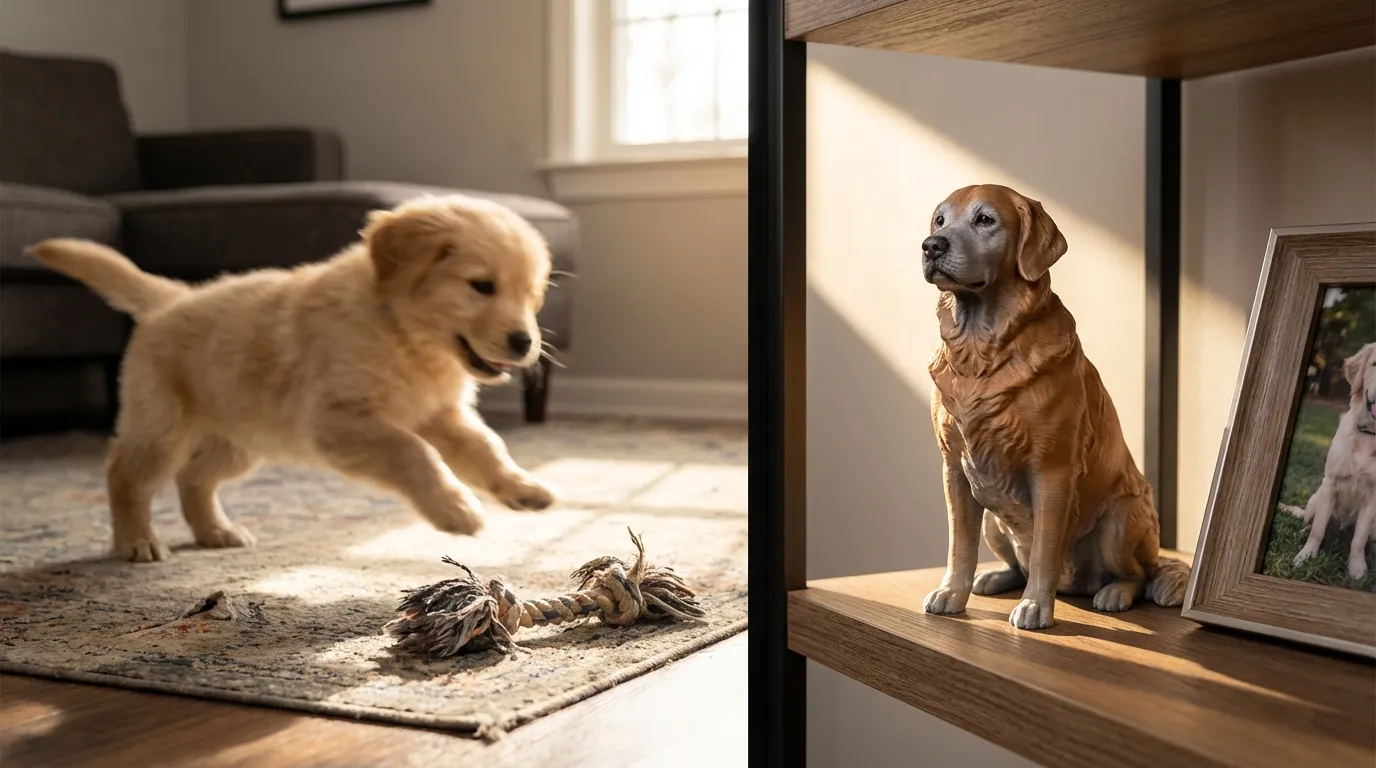
The click of nails on the hardwood hallway floor sounds different now—lighter, faster, less rhythmic than the old shuffle. It’s the specific sound of getting a new dog after loss, a staccato beat that interrupts the quiet but somehow makes the silence underneath feel even louder.
Quick Takeaways
- Guilt is a symptom of love — feeling bad about loving a new pet proves your capacity for loyalty, it doesn't disprove it.
- The "3-3-3 Rule" applies to you too — just as rescue dogs need 3 days, 3 weeks, and 3 months to adjust, your heart needs the same timeline to accept a new reality.
- Love is not a finite resource — lighting a new candle doesn't dim the flame of the first one; your first dog taught you the language of love you're speaking now.
- Anchors help stabilize emotions — keeping a tangible memory, like PawSculpt's custom figurines, allows you to honor the past while embracing the present chaos.
The Anatomy of Second Dog Syndrome
We call it "Second Dog Syndrome," but in our years working with pet families, we've found it's actually an identity crisis disguised as a pet problem.
Here is the scenario we see constantly: You bring the new puppy home. They are cute. They are vibrant. They are alive. And for the first twenty minutes, the dopamine hits. But then, you walk down the hallway to the kitchen, and you instinctively step over the spot where your old dog used to sleep. The spot is empty. The puppy is chewing a table leg in the other room.
Suddenly, you aren't just a person with a new dog. You are a traitor.
This is the visceral reality of pet grief guilt. It’s the sinking feeling that by enjoying the new dog, you are overwriting the memory of the old one. We often treat our hearts like hard drives with limited storage space—if we save new files, we must be deleting the old ones.
But here is the counterintuitive insight that most people miss: Your grief and your joy are coming from the exact same source.
The pain you feel is the legacy of the bond you built. The joy you feel with the new puppy is the application of the lessons your first dog taught you. You aren't replacing the dog; you are continuing the career of being a dog lover, a career your first dog trained you for.
"Grief isn't a problem to be solved. It's a love story that continues after the last chapter."
The "Comparison Trap": Why The New Dog Always Loses (At First)
One of the biggest hurdles in bonding with a new puppy is the unfair comparison game. We see this often when customers send us photos for a memorial sculpture of a passed dog, and simultaneously mention their new puppy is "driving them crazy."
Here is the unfair math you are doing in your head:
You are comparing your previous dog—a "finished product" with whom you had 10, 12, or 15 years of telepathic understanding—with a brand new, untrained, chaotic biological organism.
You remember your old dog as the wise soul who sat by your feet while you cried. You forget that at six months old, that same wise soul ate your drywall and peed on your duvet.
The Rose-Tinted Reality Check
To help navigate this, we recommend a reality check. We've broken down the comparison trap to show you what's actually happening in your brain:
| The Old Dog (Memory) | The New Dog (Reality) | The Psychological Trap |
|---|---|---|
| The "Soulmate" Phase | The "Roommate" Phase | You expect instant intimacy, but you're currently just strangers living together. |
| Predictable Habits | Chaos & Disruption | You interpret the disruption as "wrongness" rather than just "newness." |
| Understood Your Vocabulary | Doesn't Know "Sit" | You feel frustrated that the communication shorthand is gone. |
| represented Comfort | Represents Work | You resent the work because you're grieving the loss of the comfort. |
| The "Best Of" Reel | The Raw Footage | You are comparing a highlight reel to a blooper tape. |
The Actionable Shift: When you catch yourself comparing ("Buster never barked at the mailman"), force yourself to finish the sentence with a timestamp ("...when he was ten years old. But when he was a puppy, he chewed the mailman's shoes.")
The "Betrayal" Myth: Reframing Your Narrative
Why does it feel like cheating?
Psychologists suggest that when we lose a primary attachment figure (and yes, dogs are attachment figures), our brain categorizes "moving on" as a threat to the bond. If I stop crying, I stop caring.
But let's look at this differently. Imagine you had a wonderful teacher in first grade who taught you how to read. You loved her. She moved away. In second grade, you got a new teacher and read new, more complex books.
Is reading the new books a betrayal of the first teacher? No. The first teacher gave you the ability to read the new books.
Your first dog taught you the language of interspecies love. They taught you how to read body language, how to be patient, how to prioritize another being's needs. When you pour love into a new dog, you are exercising the skills your first dog gave you. The new dog is the legacy.
Practical Exercise: The "Legacy List"
Instead of focusing on what the new dog does differently, make a list of things you are doing better this time because of your first dog.- "I am more patient with potty training because Max taught me it eventually clicks."
- "I am buying better food because Bella taught me nutrition matters."
- "I am taking more photos because I know how fast it goes."
This reframes the new dog from a replacement to a beneficiary.
Navigating the "Relief" (The Emotion Nobody Talks About)
We need to address the elephant in the room. Or rather, the healthy puppy in the room.
If your previous dog had a long, drawn-out illness, senior cognitive decline, or mobility issues, the last few months or years were likely exhausted. You were a caretaker. There were pills, accidents, sleepless nights, and constant worry.
Then, the new puppy arrives. They are healthy. They run. They eat without coaxing.
And you feel... relief.
And then, immediately after the relief, you feel a crushing wave of shame. How dare I feel relieved that my soul dog is gone?
This is normal. You aren't relieved they are gone; you are relieved that the suffering (theirs and yours) is gone. The trauma of caretaking is real. Enjoying the vitality of a healthy animal is not a sin; it is part of the healing process.
"We've seen families heal by holding something tangible. Grief needs an anchor, especially when the house feels full of new, chaotic energy."
— The PawSculpt Team
Creating Space for Both: The Role of Tangible Memories
One of the most effective ways to manage the guilt of getting a new dog after loss is to physically demarcate space for the memory of the first dog.
When the new dog takes over the physical space—the bed, the bowls, the floor—you can feel like the old dog is being pushed out. You need a way to say, "This spot is still yours."
This is where we have seen our work at PawSculpt play a surprisingly therapeutic role. We create custom figurines, but for many of our clients, they function as "permission slips" to love the new dog.
Why Physical Anchors Work
In a home that is rapidly changing to accommodate a new puppy (gates up, rugs rolled away, new toys everywhere), having a permanent, unchangeable representation of your passed pet provides stability.Our process uses advanced full-color 3D printing technology. We don't paint these figurines. The color is built voxel-by-voxel into the resin itself, capturing the specific gray of a muzzle or the unique asymmetrical patch on an ear. Because they are digitally sculpted by artists and then printed, the likeness is precise.
Placing a custom figurine on a shelf or mantelpiece creates a "shrine" effect. It says: This dog has graduated. They are watching over the chaos, not being replaced by it.
It allows you to look at the new puppy tearing up a toy, then look up at the figurine of your old dog and think, "You would have hated him, wouldn't you?" It allows for a private conversation amidst the new noise.
5 Counterintuitive Rules for Bonding Without Guilt
Most advice tells you to "give it time." That’s vague. Here are five specific, actionable strategies to blend the past and present.
1. Change the Route, Not Just the Leash
Don't walk the new dog on the "Sacred Route" you took every morning for ten years. That route is filled with ghosts. The tree he peed on. The house with the cat he barked at. The Fix: For the first three months, turn left out of the driveway instead of right. Create a "New Dog Route." This prevents the constant overlay of memories and lets you build new associations.2. The "Hand-Me-Down" Hierarchy
Some items are sacred; others are just gear.- Sacred: The collar, the favorite stuffed lamb, the specific blanket they passed away on. Do not give these to the new puppy. Put them in a memory box.
- Gear: The crate, the leash, the food bowls. Reuse these. It’s environmentally sound and financially smart.
- The Insight: Your old dog doesn't care about the plastic bowl. They cared about the bond.
3. Verbalize the Introduction
This sounds strange, but try it. When you bring the new dog home, introduce them out loud to the memory of the old dog. "Buster, this is Cooper. Cooper, Buster built this house. Show some respect." It acknowledges the hierarchy. It sounds silly, but it externalizes the feeling that the first dog is still part of the family structure.4. Schedule "Grief Appointments"
The new puppy demands 100% of your attention. This can make you feel like you're ignoring your grief. The Fix: Set a timer for 10 minutes a day. Sit with your PawSculpt figurine, your photo album, or just in a quiet room. Use that time to miss your old dog actively. When the timer goes off, go back to the puppy. This compartmentalization ensures you don't feel like you're "forgetting" to grieve.5. Accept the "Different Love"
You will never love the new dog the same way you loved the first. And you shouldn't.- Your first dog might have been your "growing up" dog.
- Your new dog might be your "empty nest" dog.
- Your first dog was your "survival" dog.
- Your new dog is your "joy" dog.
Different loves are not greater or lesser. They are just different frequencies.
When It Just Doesn't Click (Yet)
Sometimes, despite all this, you look at the new dog and feel... nothing. Or worse, resentment.
This is often called the "Puppy Blues," but when combined with grief, it’s heavier. Please know that bonding is bio-chemical, not just emotional.
According to research on human-animal interaction, oxytocin loops take time to establish. With your old dog, a single glance triggered a massive oxytocin release. With the new puppy, that neural pathway hasn't been paved yet.
You are not broken. You are just construction working on a new road.
If you are six months in and still struggling significantly, it’s worth speaking to a professional. But for the first few months? You are in the trenches. Be gentle with yourself.
Frequently Asked Questions
How long should I wait to get a new dog after mine dies?
There is no "correct" timeframe. We have seen customers order a memorial figurine and get a new puppy in the same week. Others wait years. The right time is when the desire to give love becomes slightly stronger than the fear of losing it again. It is okay to get a dog while you are still grieving; the new dog can be a support system, not just a replacement.Is it better to get the same breed or a different one?
Getting a different breed is often easier for preventing the "comparison trap." If you had a Golden Retriever who was an angel, getting another Golden might make you subconsciously expect the same behavior. A different breed (or a mixed breed) forces you to learn a whole new set of behaviors, which can help distinguish the two relationships. However, if you are a "breed person" (e.g., you only love German Shepherds), sticking to what you know is fine—just focus on their individual quirks.Why do I feel resentful toward my new puppy?
Resentment is usually just exhaustion wearing a mask. You are mourning a dog who knew the rules while managing a puppy who breaks them. You are tired. You are sad. And this new creature is demanding energy you don't feel you have. This doesn't mean you made a mistake; it means you are human. Give yourself permission to take breaks from the puppy (use a crate or a pet sitter) to recharge.Can I use my old dog's name for the new one?
While it's a personal choice, most experts and behaviorists recommend against this. A name is a huge part of an identity. Giving a new dog the old name can subconsciously set an expectation that they will be the old dog. It can also be confusing for you emotionally. Let the new dog have their own title; they are writing their own story, not re-writing the old one.Ready to Celebrate Your Pet?
Every pet has a story worth preserving. Whether you're honoring a beloved companion who's crossed the rainbow bridge or celebrating your new furry friend's unique personality, a custom PawSculpt figurine captures those details that make your pet one-of-a-kind. We help you hold onto the memory of the past while you embrace the joy of the future.
Free instant AI preview • 3D artist preview within 7 days • 5 free revisions