
Two Empty Cages, One Worn Toy: Journaling Through Consecutive Hamster Losses
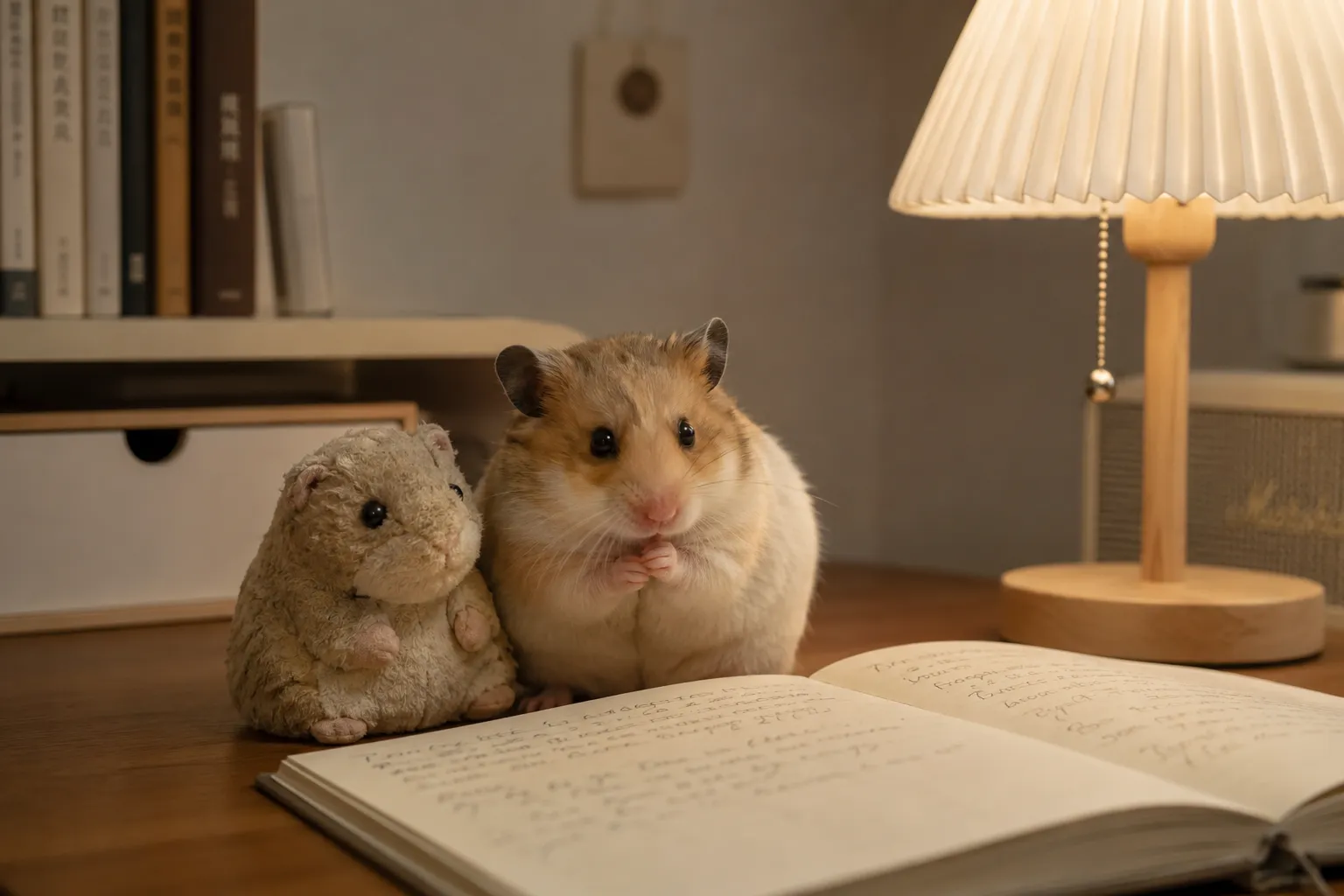
You're scrubbing the second water bottle clean on the front porch, late afternoon light slanting through the railing, when it lands on you—this is what hamster loss grief sounds like. A sponge squeaking against glass that no small mouth will ever drink from again.
Quick Takeaways
- Consecutive small-pet losses compound — the second goodbye reopens the first, so grieve both, not just the recent one.
- Shared objects carry double memory — a toy two hamsters used becomes a powerful anchor, not just clutter to toss.
- Journaling beats "staying busy" — writing for 10 minutes a day processes loss faster than distraction does.
- Tangible keepsakes help the grief land somewhere — many families preserve a pet's likeness through custom resin figurines when photos feel too flat.
- Grieving a "small" pet hard is normal — size has nothing to do with the size of the bond.
When the Second Cage Goes Quiet
Here's the thing nobody warns you about with small pets: they don't come one at a time, usually.
You get one hamster. Then, because the first one brought such unexpected joy into a quiet apartment or a kid's bedroom, you get another. Maybe they live in separate cages on the same shelf. Maybe their lifespans overlap by a year, maybe by a few months. And then, in the strange compressed timeline of small animals, you lose them close together.
Two empty cages on one shelf. That's a specific kind of ache.
We've worked with a lot of families over the years, and the ones grieving consecutive pet losses describe something the single-loss guides miss entirely. The second goodbye doesn't just hurt on its own. It pries open the first one, the one you thought you'd mostly sealed up. Suddenly you're not grieving one hamster. You're grieving both, plus the version of your home that had two living creatures in it, plus the rhythm you'd built your evenings around.
"The second loss doesn't add to the first. It multiplies it."
Why the math of grief feels so unfair
A dog might give you twelve, fourteen years. A hamster gives you two, maybe three if you're lucky and the genetics cooperate. So if you keep hamsters, you sign up for a lot of goodbyes in a short span of life. People who've never kept small pets don't get this. They think a two-year companion can't leave a two-year-sized hole.
They're wrong, and you already know it.
The cage that sat full for so long now reflects the overhead light back at you, empty. The wheel doesn't turn at 2 a.m. The little scratching sounds—the ones that used to wake you and mildly annoy you—are gone, and you'd give a lot to be annoyed by them again. The absence has a texture, and that texture is silence where there used to be small, busy life.
When the losses stack close together, you don't get the luxury of a clean recovery between them. You're still raw from the first when the second arrives. That's not weakness on your part. That's just the brutal arithmetic of loving creatures who don't live long.
The micro-grief most people skip
One thing we notice: people grieving consecutive losses often try to "be done" with the first pet before allowing themselves to feel the second. Like grief is a line and you have to finish one before starting the next.
It doesn't work that way. Grief isn't a queue. It's more like weather—two storm systems can sit over the same town at once.
So if you find yourself crying over the hamster you lost eight months ago while cleaning up after the one you lost last week, you're not "doing it wrong." Your heart is just processing what it couldn't finish before. Let both losses exist at the same time. Trying to file one away neatly is what gets people stuck.

The Grief Nobody Thinks You're Allowed to Feel
Let's talk about the feeling under the feeling. The shame.
A lot of people grieving a hamster carry a quiet, gnawing embarrassment about how hard it's hitting them. They think: It was a hamster. People lose parents, dogs, whole relationships. Who am I to fall apart over a palm-sized rodent that cost twelve dollars?
We need to say this plainly. The intensity of your grief is not measured against your pet's body weight.
"Size has nothing to do with the size of the bond."
This is the emotional truth that gets glossed over in nearly every article you'll find. The shame about grieving "too much" for a small pet is so common, and so rarely spoken, that people end up grieving in secret. They don't post about it. They don't tell coworkers why they're off. They sit with it alone, which is the worst possible way to carry it.
Why a hamster earns this much love
Think about what that little animal actually was in your daily life. It was the thing you checked on first thing in the morning, the warm weight in your cupped hands at the end of a hard day, the creature that recognized your voice and came to the front of the cage. For kids especially, a hamster is often the first being they're fully responsible for. The first death they witness up close.
That's not nothing. That's a lot.
A family we worked with had a daughter who'd cared for two dwarf hamsters through her whole middle-school stretch—the awkward years, the friend drama, the first heartbreaks. Those hamsters were the witnesses to her growing up. When they passed within a season of each other, her grief wasn't really proportional to the animals. It was proportional to everything they'd been present for.
So if someone makes you feel silly for hurting, here's your permission slip: the bond was real, the loss is real, and you don't owe anyone a justification.
The American Pet Loss community has long recognized that grief for any companion animal is legitimate and worth supporting—organizations like the Association for Pet Loss and Bereavement exist precisely because this kind of grief is so often dismissed by people who don't understand it.
The guilt that rides along
There's another layer with small pets specifically: guilt about whether you did enough.
Hamsters hide illness well. They're prey animals, hardwired to mask weakness until it's too late to do much. So owners often find out something's wrong only at the very end. And then comes the spiral: Should I have noticed sooner? Did I feed the wrong thing? Was the cage too small, too cold, too something?
Here's what we'll tell you, the same thing we'd tell a friend at the kitchen table. You were working with the information you had. Hindsight invents a version of you who knew things you couldn't have known. That version isn't real. The real you showed up, cleaned the cage, refilled the water, offered the sunflower seed. That's love, expressed in small daily acts.
The guilt is grief wearing a disguise. It's your love looking for somewhere to go now that its usual outlet is gone. Name it for what it is, and it loosens its grip a little.
What the Worn Toy Knows
Now, the worn toy.
If you kept two hamsters, odds are good that something got passed down. A wooden chew block. A little ceramic hideout. A plastic exercise ball that rolled across the same kitchen floor for both of them. One worn toy, two lifetimes of small teeth and small feet.
That object is doing something photographs can't. It holds texture—literal texture. The gnaw marks. The faded spot where fur rubbed against it season after season. Run your thumb over it and you're touching the actual evidence of two lives. Photos capture light. Objects capture wear, and wear is the fingerprint of a life lived.
This is why we always tell people: don't rush to clear out the cages.
The mistake most people make with the "stuff"
The well-meaning advice you'll hear is to pack everything away quickly so you're not "dwelling." A friend or family member, trying to help, might offer to bag up the cages and supplies while you're out.
We'd gently push back on that.
The objects are tools for grief, not obstacles to it. When you're ready—and only when you're ready—going through the cage piece by piece is one of the most healing things you can do. The bedding still in the corner. The food stash they hid (hamsters always hide food, and finding that secret pantry one last time can absolutely undo you). The worn toy that outlasted them both.
"Photos capture the light. Objects capture the wear. And wear is the fingerprint of a life."
Here's a concrete suggestion. Choose one object to keep, intentionally. Not the whole cage, not a box of everything. One thing. For most people grieving consecutive losses, the shared toy is the natural choice because it carries both pets at once. It becomes a single anchor for a double grief. Put it somewhere you'll see it—a shelf, a windowsill, a small dish on the desk. The rest can go to another pet owner, to a shelter, or into storage. But that one object stays.
The "so what" here matters: a single, chosen keepsake gives your grief a destination. Without one, grief sloshes around and attaches itself to random triggers—the cereal aisle where you used to buy seed mix, the corner of the room where the shelf stood. With a chosen anchor, you have somewhere to put the feeling on purpose.
Grief Journaling: The Tool That Actually Moves the Needle
Most grief advice is vague to the point of uselessness. "Be patient." "Take time." "Breathe." Cool. How.
Grief journaling is the specific, do-this-tonight tool that we've seen help more than almost anything else, and there's a reason it works that the inspirational quotes never explain.
When you lose two pets close together, the losses tangle. Your brain stores them as one big undifferentiated ache. Writing forces you to separate the strands—this memory belongs to the first hamster, that one to the second—and the act of separating is the act of honoring each life on its own terms. You can't grieve a blur. You can grieve a story.
Why writing beats "staying busy"
The instinct after loss is to fill every minute. Clean the whole house. Pick up extra shifts. Anything to avoid the quiet.
But here's the counterintuitive part. Distraction doesn't process grief—it just defers it. The feelings wait. They're patient. And they tend to ambush you later at the worst times, in the car, in the shower, in line at the store. Research on bereavement consistently points to expression over suppression as the path through. Naming feelings on paper lowers their intensity. Bottling them raises it.
Ten minutes of writing tonight saves you a 3 a.m. ambush next Tuesday. That's the trade.
A simple journaling structure that works
You don't need a fancy journal or good handwriting or any literary skill. A notes app works. The back of an envelope works. Here's a structure we've seen help people grieving small pets, especially consecutive losses:
- Name them, separately. Start each entry by writing each hamster's name. Two names, two lives. This stops the blur.
- Record one specific memory per pet. Not "she was sweet." Something specific—the way one stuffed both cheeks until they looked comical, the way the other only ran the wheel after the lights went out.
- Write the hard thing you haven't said out loud. The guilt. The relief, maybe (more on that below). The anger at how short their lives were. Whatever you've been hiding.
- End with one sensory detail you want to keep. The smell of fresh cedar bedding. The featherweight of a hamster asleep in your palm. Lock it down in words before time sands it smooth.
Below is a set of prompts mapped to where you are in the process. Use whichever fits the day—grief doesn't move in a straight line, so you might bounce around.
| When you feel... | Journaling prompt | What it does |
|---|---|---|
| Numb, can't cry | "Describe the cage the day before you lost them." | Re-engages frozen emotion through concrete detail |
| Guilty | "Write a letter forgiving yourself for what you didn't know." | Externalizes guilt so you can see it isn't fact |
| Afraid of forgetting | "List five tiny habits each pet had." | Preserves the details memory erodes first |
| Overwhelmed by both losses | "Write to each pet on a separate page." | Untangles compounded grief into two honored lives |
| Ready to heal | "What did loving them teach you?" | Turns loss toward meaning without rushing it |
The feeling people hide: relief
Let's name something raw.
If one of your hamsters declined slowly—stopped eating, struggled to move, suffered in a way you could see—there may have been a moment when it ended and you felt something other than pure sorrow. You felt relief. The waiting was over. The watching-them-suffer was over.
And then, almost instantly, the guilt clamped down. What kind of person feels relieved their pet died?
A loving one. That's the answer. The relief you felt when their suffering stopped doesn't make you cold—it makes you someone who hurt watching them hurt, someone who wanted their pain to end more than you wanted your own comfort. Relief and grief aren't opposites. They're roommates. They show up together all the time, and one doesn't cancel the other.
Write that down too. The relief belongs in the journal as much as the tears do. Pretending it wasn't there is how it festers.
"We've seen families heal by holding something tangible. Grief needs an anchor, not an explanation."
— The PawSculpt Team
A Tuesday Evening, Six Weeks Later
Let me show you what the other side of this looks like, in an ordinary moment.
It's a Tuesday. You're making dinner, half-listening to something on your phone. Your eye catches the worn toy on the windowsill—the wooden block both of them gnawed smooth—and instead of the gut-punch it used to be, you feel something quieter. A small, warm pull. You pick it up, run your thumb over the marks, and you actually smile at the memory of the one who used to drag it into her nest like treasure. Then you set it back down and finish chopping the onions.
That's healing. Not forgetting. Not "moving on." Just the day the memory stops cutting and starts keeping you company instead.
It takes most people somewhere between three and eight weeks to reach the first of those gentler moments, though it varies a lot and there's no schedule you're failing if it takes longer. Consecutive losses often stretch the timeline, because you're metabolizing two goodbyes. That's expected. Don't let anyone—including yourself—rush it.
Turning Memory Into Something You Can Hold
At some point, most grieving pet owners hit the same wall: photos aren't enough.
You scroll through your camera roll and the pictures feel flat. Two-dimensional. They show what your hamster looked like in one frozen instant, but they don't carry the presence—the roundness, the specific tilt of the ears, the particular brown-and-white pattern that made yours unmistakably yours. For small pets this is especially frustrating, because hamsters move fast and photograph badly. Most people only have blurry shots.
This is where families start looking for something more tangible. Some plant a small memorial in the garden. Some make a shadow box with the worn toy and a photo. And increasingly, pet parents preserve their companion through a custom pet figurine that captures the actual shape and markings—the thing a flat photo can't hold.
Why a 3D keepsake lands differently for small pets
Here's the part worth understanding. At PawSculpt, the figurines are digitally sculpted by 3D artists and then precision-printed in full-color resin. The color isn't a coating brushed on top—it's printed into the material itself, voxel by voxel, so your hamster's specific coloring and markings live inside the piece rather than sitting on the surface. A clear protective coat goes on at the end for sheen and durability, and that's the only hands-on finishing step.
What that means for you: the brown saddle marking, the white belly, the particular shade of dwarf-hamster gray—those come through in real color and real three-dimensional form. The natural fine texture of the print gives it an authentic, held-in-the-hand quality rather than a glossy plastic-toy look.
For consecutive losses, some families ask for both hamsters together, side by side the way they sat on the shelf in life. One piece, both companions. It turns the two empty cages into a single small monument you can keep on the windowsill next to that worn toy. If you want the specifics on how it works, what it costs, and turnaround, PawSculpt's site walks through the whole process.
We'll be real with you though: a figurine isn't for everyone, and it isn't a fix. It's an anchor, one option among several. Some people find more comfort in a journal, a planted bulb, a donation to a small-animal rescue in their pets' names. There's no wrong vessel for the love. The point is to give it somewhere to live.
Here's an honest comparison of the common ways people memorialize small pets, so you can pick what fits you:
| Memorial option | Effort | Cost | Best for |
|---|---|---|---|
| Grief journal | Low, ongoing | Free | Processing emotion, separating compounded losses |
| Shadow box with worn toy | Medium, one-time | Low | People who want to display real objects |
| Memorial garden / planted bulb | Medium, seasonal | Low | Those who find comfort in living, growing tributes |
| Custom full-color figurine | Low (you send photos) | Varies — see site | Capturing exact shape and markings; two pets together |
| Donation to rescue in their name | Low | Your choice | Turning grief into help for other small animals |
When and Whether to Get Another Hamster
This question deserves its own honest answer, because the anxiety around it is real and rarely addressed.
After consecutive losses especially, a lot of people feel a knot when they think about getting another hamster. Two layers to that knot. One: anxiety about going through this again—the short lifespan, the inevitable goodbye, the whole cycle. Two: guilt about "replacing" them, as if a new pet betrays the ones you lost.
Neither feeling means you shouldn't. They just mean you're someone who takes the commitment seriously.
On the practical side, we'd say this: don't decide while you're in the acute phase. The first few weeks are not the time to make the call, in either direction. Some people rush to fill the empty cage to escape the silence, and that's adopting from panic, not readiness. Others swear off pets forever in a moment of raw pain they'll feel differently about in two months.
Give it time. A useful gut-check: when you can walk past the pet store small-animal section and feel curiosity rather than just an ache, you might be getting close. A new hamster doesn't replace the ones you lost any more than a new friend replaces an old one. The cage can hold a new life and still honor the old ones. They're not competing for the same space in your heart—your heart just makes more room.
And if you decide you're done with hamsters? That's a complete and valid choice too. Knowing your limit is its own kind of wisdom.
"A new pet doesn't replace the one you lost. The heart doesn't run out of room—it builds more."
How to Help a Grieving Child Through Small-Pet Loss
Worth a section of its own, because hamsters are so often a child's pet, and kids grieve differently.
The instinct many parents have is to soften it—"he went to a farm," or quietly swapping in a look-alike before the child notices. We'd steer you away from both. Kids are sharper than we give them credit for, and a discovered lie does more damage than the original loss. Worse, it teaches them that grief is something to hide.
Instead, let the child lead a small ritual. A shoebox burial in the yard. Drawing a picture of the hamster. Saying a few words. Children process loss through doing, not through abstract talk. Giving them a concrete action—choosing the worn toy to keep, helping write a journal entry, picking the spot in the garden—gives their grief a job.
And here's the overlooked part: when there were two pets and both are gone, kids often fixate on the unfairness more than the sadness. "It's not fair that both of them died." Don't argue them out of it. It isn't fair. Sit in that with them. Validating the injustice helps more than explaining biology. The lesson isn't "death is natural"—it's "I'm not alone in feeling this."
The ASPCA offers solid guidance on supporting family members, including children, through pet loss if you want a deeper resource.
When Grief Doesn't Lift
One last honest note, because the warm parts of this can accidentally imply that everyone heals on a tidy schedule. They don't.
For most people, the sharpest edges of small pet grief soften within a couple of months, even with consecutive losses. The toy on the windowsill stops cutting and starts comforting. You laugh at a memory before you cry at it.
But if weeks turn into months and you're not sleeping, not eating, withdrawing from people, or the guilt has hardened into something that won't budge—that's worth taking seriously. We're not therapists or vets, so we won't pretend to diagnose anything. What we'll say is that grief that doesn't move at all, that keeps you from functioning, deserves real support from a counselor or a pet-loss support line. There's no shame in it. Reaching for help is the same impulse that made you a good pet owner in the first place: noticing when something needs care, and acting on it.
The goal was never to "get over" them. It's to carry them in a way you can live with. That's what all of this is for—the journaling, the worn toy, the figurine, the garden bulb. Not erasing the love. Giving it a shape you can hold.
Frequently Asked Questions
Is it normal to grieve a hamster as much as a larger pet?
Completely normal. Grief tracks the strength of the bond, not the size or lifespan of the animal. For many people—especially kids—a hamster is a first real responsibility and a daily source of comfort. Losing that hurts, and anyone who makes you feel silly about it simply doesn't understand what the animal was to you.
How long does hamster loss grief usually last?
The sharpest pain typically softens within a few weeks to a couple of months, with the first "gentler" moments often arriving around three to eight weeks in. Consecutive losses can stretch that timeline because you're processing two goodbyes at once. There's no schedule you're failing if yours takes longer.
Why do consecutive pet losses feel so much harder than one?
Because the second loss doesn't just add to the first—it reopens it. You find yourself grieving both pets, plus the version of your home and daily routine that had both of them in it. Let both losses exist at the same time rather than trying to "finish" one before feeling the other.
Is it okay that I felt relieved when my sick pet passed?
Yes, and it doesn't make you a bad person. If your hamster was suffering, relief that the suffering ended is a sign you loved them enough to hurt watching them hurt. Relief and grief regularly show up together. Naming the relief honestly—even in a journal—keeps it from turning into hidden guilt.
Should I keep my hamster's old cage and toys?
Keep at least one meaningful object, intentionally. For people who've lost two pets, a shared worn toy is often the natural choice because it holds both lives at once. You don't have to keep everything, but resist letting someone bag it all up before you're ready. The objects are tools for grief, not obstacles to it.
How does writing in a grief journal actually help?
Journaling forces you to separate tangled losses into distinct memories, which honors each pet on its own terms instead of as one big blur. Expressing feelings on paper also lowers their intensity, while bottling them up tends to raise it. Ten focused minutes tonight can spare you an ambush of grief later.
Ready to Celebrate Your Pet?
Every pet has a story worth preserving, even the smallest ones who only stayed a couple of years. Whether you're carrying fresh hamster loss grief or honoring two companions who left empty cages on the same shelf, a custom PawSculpt figurine captures the exact shape, color, and markings that made them unmistakably yours—the details a flat photo just can't hold.
Visit pawsculpt.com to learn more about our full-color 3D printing process, flexible revisions, and quality guarantee.