
Explaining the Urn to Little Ones: Facing a Rabbit's Goodbye With Gentle Honesty
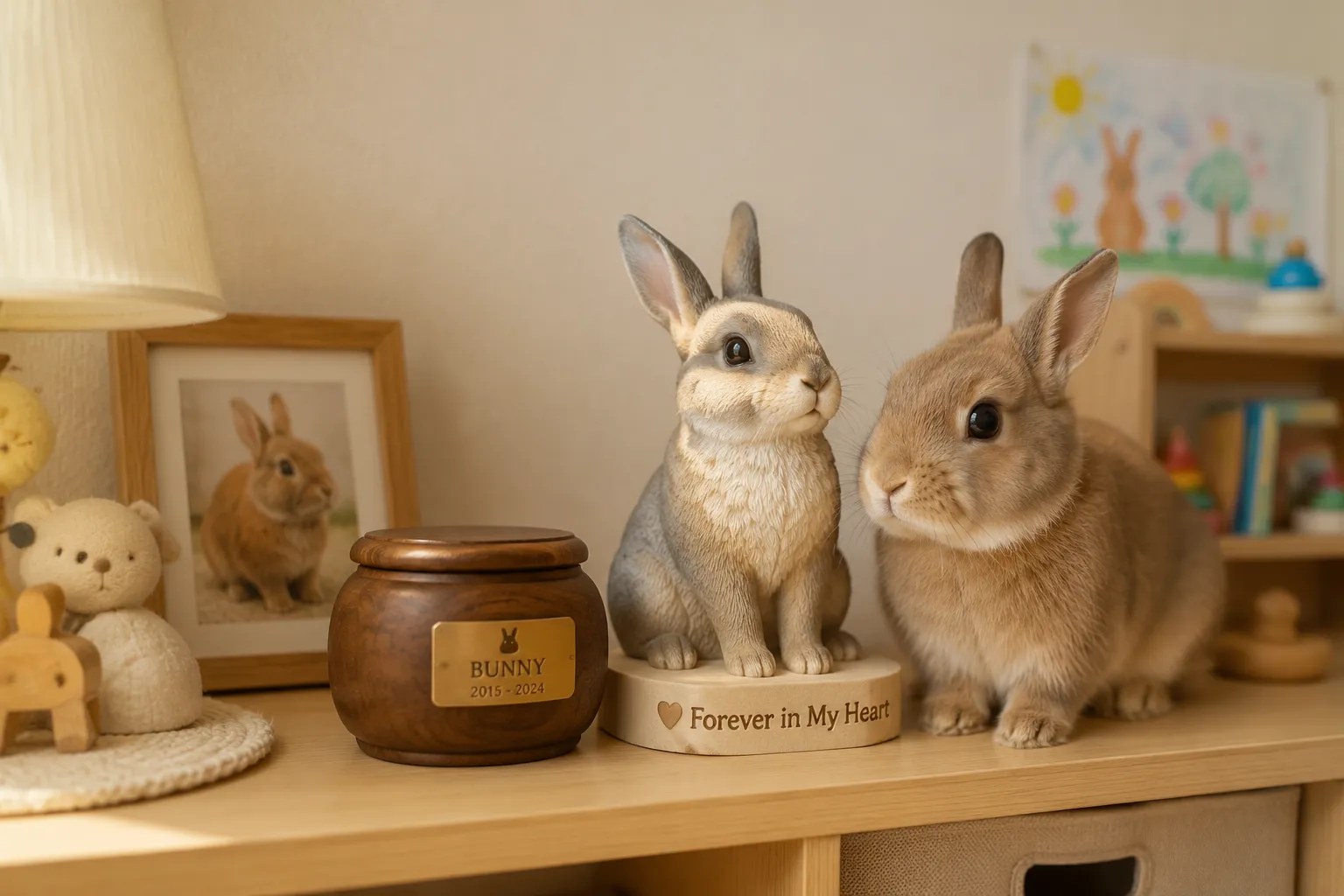
Timothy hay smells like sun-warmed fields, and that scent clings to the cardboard hutch long after it sits empty. For most families, rabbit loss with kids begins right there—not with the goodbye itself, but with a child pressing their face into a fleece blanket that still carries the warm, slightly grassy smell of their friend.
Quick Takeaways
- Name death plainly, no euphemisms — "passed on" and "put to sleep" confuse young children's literal thinking.
- Let kids help choose the ashes container — participation turns a scary object into something they understand.
- Anticipatory grief starts before the death — a sick rabbit gives families weeks to prepare hearts.
- Concrete objects anchor abstract loss — children grasp "gone" better when memory has a physical home, like a custom keepsake figurine on their shelf.
- The fear of forgetting is real for kids — build a memory ritual, not just a single sad conversation.
Why a Rabbit's Goodbye Lands So Differently Than We Expect
Here's something we've noticed across thousands of memorial orders: rabbit families grieve with a specific kind of ache that surprises even them. People expect to be wrecked by a dog. They brace for it. But a rabbit? A lot of parents quietly assumed it would be "smaller," and then it wasn't.
Rabbits are prey animals. That changes everything about the bond. They don't bound up to you demanding attention the way a Labrador does. They choose you. When a rabbit—an animal hardwired by millions of years of evolution to flee anything bigger than itself—decides to flop over and fall asleep against your leg, that's a profound act of trust. Children feel that, even if they can't name it.
"A rabbit deciding to trust you is one of the quietest, biggest things a prey animal can do."
And for a huge number of kids, the family rabbit is their first real encounter with death. Not a goldfish flushed before they noticed. Not a great-grandparent they barely met. This is the soft, warm creature that ate parsley from their hand yesterday and is cold this morning. That's a seismic event in a small person's understanding of how the world works.
The science of why kids bond hard with small animals
There's real cognitive machinery behind this. Young children operate heavily on what developmental psychologists call attachment theory—the drive to form secure bonds with responsive beings. A rabbit, with its soft fur and need for gentle handling, becomes a kind of attachment figure the child can actually care for, flipping the usual script where adults care for them.
Then there's the sensory imprinting. A child's developing brain encodes smell more powerfully than almost any other sense, because the olfactory bulb wires directly into the limbic system—the seat of emotion and memory. That hay-and-warm-fur smell isn't just a detail. It's a neurological bookmark. Which is exactly why a kid will bury their face in an empty blanket weeks later and dissolve into tears they can't explain.
So when we say a rabbit's death "shouldn't" hit this hard, we're frankly ignoring the biology. It hits hard because the bond was real, the trust was earned, and the loss is encoded deep in the parts of the brain that don't listen to logic.
The Slow Goodbye: Anticipatory Grief Before the Last Breath
Not every loss is sudden. Often a family knows it's coming—the rabbit stops eating, develops GI stasis that won't resolve, or simply slows down as the years catch up. This stretch of knowing-but-not-yet has a name: anticipatory grief.
A mother told us about the two weeks she had with her daughter's lop-eared rabbit after the vet said there was nothing more to do. Every evening her seven-year-old would sit on the kitchen floor, syringe-feeding mush, narrating the rabbit's day to him in a small steady voice. She was, without knowing it, doing grief work in real time.
Here's the counterintuitive part most guides miss: anticipatory grief is a gift, not just a burden. When you know the goodbye is coming, you can do something most sudden-loss families never get the chance to do—you can prepare a child's heart while the rabbit is still warm and breathing.
What to actually do during the slow goodbye
Don't waste the runway. This window is precious and it closes.
- Tell the truth in age-appropriate doses. "Clover is very sick, and the medicine can't fix it. She's going to die soon, and we're going to make her as comfortable and loved as we can until then."
- Invite participation, not protection. Let kids help with the gentle care—warming a blanket, offering a favorite herb. Being useful counters the helplessness that fuels later anxiety.
- Capture sensory memories now. Take a short video where you can hear the rabbit's soft grinding "purr." Save a tuft of shed fur in a small tin. Photograph the unique markings while the light is good.
- Talk about the body vs. the rabbit. Plant the early seed: "Clover's body is getting too tired to keep working. The part of her that loves you doesn't have a body."
That last one matters more than it looks. We'll come back to it, because it's the foundation for everything you'll later explain about the urn.
"Anticipatory grief is the rare goodbye where love still has something to do with its hands."
The "so what" here: research on grief consistently suggests that people who get to say goodbye intentionally—who do the small rituals of care at the end—tend to carry less of the sharp, unfinished regret that haunts sudden losses. You're not just comforting your kid. You're inoculating them against a harder grief later. The American Society for the Prevention of Cruelty to Animals offers thoughtful pet loss and grief resources for families navigating exactly this stretch.
Explaining the Urn to Little Ones Without the Lies
Now the hard part. The rabbit is gone, the cremation is done, and there's a small container on the shelf that holds what's left. And a four-year-old is going to point at it and ask, "Is Clover in there?"
How you answer this shapes more than the moment. It shapes whether your child learns that death is something the family faces honestly together, or something so frightening the grown-ups have to wrap it in fog.
Why euphemisms backfire (and the brain science behind it)
Young children are concrete, literal thinkers. This isn't a flaw—it's a developmental stage. Their brains haven't yet built the abstraction machinery to handle metaphor reliably. So when you reach for the soft phrases, here's what actually lands in a small head:
| What You Say | What a Young Child Hears |
|---|---|
| "We put Clover to sleep" | Sleep is dangerous. I might not wake up. Bedtime is now terrifying. |
| "We lost Clover" | If she's lost, we should look for her. Why aren't we looking? |
| "Clover went away" | She left me. Did I do something? When is she coming back? |
| "God needed another rabbit" | God takes the ones I love. I'd better not love anything too much. |
| "Clover passed on" | Passed on to what? To where? This means nothing to me. |
Every one of those gentle phrases creates a new anxiety to manage. The kindest thing you can say is also the simplest: "Clover died. Her body stopped working, and it won't work again."
It feels brutal. It isn't. Clarity is mercy here. A child who understands what happened can grieve it. A child stuck on a riddle stays anxious indefinitely.
So what's actually in the container?
When the urn question comes, answer it the way you'd answer "what's in this box?"—calmly, truthfully, and without making it a horror.
"This is called an ashes container. After Clover died, her body was treated with a lot of heat, the way that turns things very soft and small, almost like warm sand. These are the ashes of her body. It's a way to keep her body close to us, even though Clover—the part that binkied and trusted you—isn't in her body anymore."
Notice the move we keep making: separating the body from the being. This is the single most useful conceptual tool you can hand a grieving child, and it's grounded in how kids naturally already think. Many children intuitively believe the "real" pet is something more than fur and bone. You're not introducing a strange idea. You're confirming one they already half-hold, and giving it solid ground.
"Tell a child the truth about death, and you teach them the world can be faced, not just feared."
Let them help choose and place it
This is the insider move, and it surprises parents every time. Don't hide the urn. Involve the child in it.
A scary object you're not allowed to touch or ask about becomes a source of dread. The same object, chosen together and given a place of honor, becomes a comfort. Let your kid help decide: Does Clover's container go on the bookshelf, or the window where she liked the sun? Should we put her favorite dried flower next to it? Do you want to draw a picture to keep there?
We worked with one family whose six-year-old insisted the rabbit's ashes container needed a tiny pile of timothy hay beside it "so he won't be hungry." The parents almost corrected him. They're glad they didn't. That little ritual—refreshing the hay every Sunday—became the kid's way of staying connected, and it faded gently on its own as the grief softened. That's healthy mourning, self-directed.
The principle: participation transforms fear into agency. A child who places the urn, decorates around it, and decides on its rituals is a child actively processing the loss instead of being haunted by an off-limits object on a high shelf.
Teaching the Philosophy of Impermanence Through a Rabbit's Life
Here's where rabbit loss with kids becomes something bigger than sadness. A rabbit's life—short, vivid, gentle—is one of the clearest teachers of impermanence a child will ever meet. And we mean that as a genuine gift, not a consolation prize.
Most adults flinch from the philosophy of impermanence because we've spent decades pretending things last. Kids haven't built that wall yet. They can actually hear "everything that lives, dies, and that's part of what makes it precious" without despair—if you frame it right.
The leaf, the rabbit, and the season
Abstract concepts need concrete handles for young minds. Try anchoring impermanence in things they can see.
A morning vignette that plays out in countless homes: a kid notices the first fallen leaf of autumn on the porch where the rabbit's run used to sit, rain just starting to tick against the railing. You crouch down. "See how the leaf was green all summer, and now it's red and falling? It's not broken. It did its whole leaf-life, and now it's resting. Clover did her whole rabbit-life. She wasn't supposed to last forever. Nothing alive is."
It's a thirty-second conversation. But you've just given your child a framework that will hold for the rest of their life.
The "so what": children who learn early that loss is woven into love—rather than a malfunction or a punishment—grow into adults with measurably more resilient relationships to grief. You're not making them sad. You're making them sturdy.
What rabbits teach that other pets don't
Rabbits live, on average, far shorter lives than the family dog, and they hide illness until late because—prey animal again—showing weakness in the wild gets you eaten. This means two things for your child's education in impermanence:
- The lifespan is graspable. A child can hold "Clover lived eight years" in a way they can't quite hold a human lifetime. The whole arc is visible.
- Goodbyes can come without warning. Rabbits teach that we don't always get notice, which is hard but true, and learning it gently at age seven beats learning it brutally at thirty.
"We've seen families heal faster when the loss has a shape they can hold in their hands. Grief needs an anchor, and children need one most of all."
— The PawSculpt Team
The Fear of Forgetting: A Grief Most Kids Can't Name
Let's talk about the emotion almost nobody warns you about. A few weeks after the loss, a child will sometimes say something that gut-punches a parent: "I can't remember what he sounded like anymore." And then comes the panic.
This is the fear of forgetting, and in children it can be more distressing than the death itself. To a young mind, forgetting feels like a second betrayal—like losing the rabbit all over again, except this time it's their own fault. We've had parents tell us their kid stopped sleeping over this exact worry.
Name it directly for them. "Are you scared you'll forget Clover? That's a really normal, really loving worry. And here's the truth—we don't keep someone by remembering every single thing. We keep them by keeping a few special things on purpose."
Then make forgetting impossible by building external memory anchors. This is where the body-vs-being lesson pays off again: the rabbit's being lives in memory, and memory can be helped along with objects.
Practical memory anchors that actually work
- A memory box the child decorates and fills—the fur tin, a photo, the last uneaten hay, a drawing.
- A "remember when" jar. Each time someone recalls a Clover moment, they write it on a slip and drop it in. The jar fills. The fear empties.
- A tangible likeness. Photos fade in a drawer and live trapped in a phone. Some families find that a physical, full-color representation of their pet does what flat images can't—it gives small hands something to hold.
That third one is where families increasingly turn to keepsakes like custom pet figurines. For a child terrified of forgetting a face, having an accurate three-dimensional likeness on the nightstand—correct ear set, correct markings, the exact tilt of the head—can be enormously steadying. It's not about decoration. It's about giving the fear of forgetting a concrete, daily answer.
A Parent's Hidden Guilt: "Was It Just a Rabbit?"
Here's an emotion the grown-ups carry in silence. A lot of parents feel a creeping guilt about how hard they're taking it—or about a flicker of impatience with how hard their kid is taking it. There's a voice that whispers, it was just a rabbit, get it together.
We'll be direct: that voice is wrong, and it's also completely normal to hear it. The guilt usually comes from cognitive dissonance—the discomfort of holding two clashing beliefs at once. Belief one: "rabbits are small pets, this should be manageable." Belief two: "I am genuinely devastated." The brain hates the contradiction and resolves it by manufacturing guilt.
The fix isn't to grieve less. It's to update belief one. The bond was real, the trust was earned, the loss is legitimate. Full stop. A family that lets the grief be as big as it actually is teaches a child something invaluable: that love is measured by depth, not by the size of who you loved.
And if you ever feel a quiet flicker of relief alongside the sadness—relief that the late-night syringe feedings are over, that the worry has ended—that doesn't make you cold. It makes you someone who carried a heavy thing for a long time and is allowed to set it down. The Association for Pet Loss and Bereavement has long acknowledged these tangled feelings as a normal part of mourning.
Memorial Options for Families: What Helps, What's Just Marketing
We've watched a lot of families navigate the "what do we do with this grief" question. Some options genuinely help children process. Some are mostly for the adults. Both are valid—just know which is which. Here's our honest read after seeing how these play out over time.
| Memorial Option | Effort | Best For Kids Because | Honest Caveat |
|---|---|---|---|
| Backyard burial + marker | Low | Tangible "place" to visit and talk to | Not possible for renters or movers |
| Memory box | Low | Child-led, sensory, ongoing | Can get forgotten in a closet |
| Memorial garden plant | Medium | Living symbol that grows with time | Plant death can re-trigger grief |
| Photo book | Medium | Narrates the whole life story | Stays flat; less interactive |
| Custom 3D figurine | Medium | Holdable, accurate, permanent likeness | Worth choosing a quality maker |
| Ashes container display | Low | Honest, present, ritual-friendly | Needs the body/being talk first |
Notice we didn't crown a winner. The right choice depends on your kid, your living situation, and what your family needs. A child who's tactile and visual may bond hard with a figurine. A child who needs a "place" may need the buried marker more. Many families layer two or three.
A note on keepsake quality, since people ask
If you go the figurine route, here's the behind-the-scenes truth most companies won't tell you: getting a rabbit right is harder than getting a dog right. Rabbits are all subtle geometry—the exact ear length and fold, the dewlap, the way the markings break across the face. Get the ears wrong and it stops being your rabbit and becomes a rabbit.
At PawSculpt, the pieces are digitally sculpted by master 3D artists and then precision 3D printed in full-color resin, where the color is part of the material itself rather than a coating on top. That matters for accuracy—a Dutch rabbit's crisp markings or a harlequin's patches reproduce directly in the resin, protected by a clear coat for sheen and durability. The result has a natural, authentic texture, not a glossy plastic look. You can see the full process on the memorial keepsakes page rather than us quoting specifics that change over time.
What to expect if you commission a likeness
Without promising timeframes or policies (those live on the site for a reason—they update), here's the general shape of the experience:
- Gather your photos. Clear, well-lit shots from multiple angles—front, both sides, and a face-forward. Natural daylight beats flash every time.
- Capture the markings. Make sure at least one photo shows the full coat pattern clearly. This is what separates "a rabbit" from "your rabbit."
- Note the personality pose. Was your rabbit a loafer? A binky-er? An ear-flat-back lounger? Mention it.
- Review the preview. A good maker shows you the digital model before production so the ears, the eyes, the markings are right.
- Bring kids into the choosing. Letting a child help pick the pose makes the finished piece theirs to grieve with.
For the photo angles that work best, the American Veterinary Medical Association's guidance on pet loss is also a gentle resource for families deciding how to memorialize.
A Gentle Script: The Whole Conversation, Start to Finish
Parents tell us they freeze in the moment, so here's a usable scaffold. Adapt the words; keep the bones.
When death is near:
"Clover is very sick and her body can't get better. She's going to die soon. That's nobody's fault. Let's make her feel safe and loved for the time she has."
Right after the death:
"Clover died. Her body stopped working and it won't start again. It's okay to be really sad. I'm sad too. We loved her so much."
At the urn:
"This container holds Clover's ashes—what's left of her body. We keep it close because we loved her body. The part of Clover that loved you isn't in there; it lives in your memories and your heart."
When the fear of forgetting hits:
"You won't forget the important parts. And we'll help—we'll keep her pictures, her stories, maybe something special on your shelf. Remembering her is a way of loving her that never has to stop."
Weeks later, on a hard day:
"Missing Clover means you loved her a whole lot. That feeling will get softer over time, but it never means you have to stop loving her."
"We don't move on from the ones we lost. We move forward, carrying them in lighter and lighter pockets."
Frequently Asked Questions
How do I explain a pet rabbit's death to a young child?
Use plain, honest language: "Clover died. Her body stopped working and it won't work again." Skip euphemisms like "put to sleep" or "we lost her," because literal-minded young children take those at face value and develop new anxieties around sleep or being lost. Clarity actually comforts—a child who understands what happened can begin to grieve it.
Should I let my child see or hold the ashes container?
Yes, and we'd gently encourage it. An off-limits object on a high shelf becomes a source of dread. Explain calmly that the container holds the rabbit's ashes, then let your child help choose where it sits and what small ritual surrounds it. Participation turns fear into a sense of agency.
Is it normal for kids to grieve a rabbit so intensely?
Very. For many children, a rabbit is their first real experience of death, and the bond with a prey animal that chose to trust them runs surprisingly deep. The grief reflects the depth of love, not an overreaction. Let the grief be as big as it honestly is.
What is anticipatory grief, and is it a bad thing?
Anticipatory grief is the mourning that begins before the death, when you know a pet is terminally ill. Far from being purely negative, it can be a gift—it gives a family time to do gentle end-of-life care together and to prepare a child's heart while there's still time.
How do I help a child terrified of forgetting their rabbit?
First, name and normalize the fear. Then build external memory anchors: a decorated memory box, a "remember when" jar, photos in a visible spot, or a physical likeness like a figurine. These give the fear of forgetting a tangible, everyday answer instead of an open wound.
Ready to Celebrate Your Pet?
Every pet has a story worth preserving. When a family is facing rabbit loss with kids, a physical keepsake can give children something steady to hold onto—an accurate, full-color likeness that answers the fear of forgetting with the exact ears, markings, and personality that made your rabbit one-of-a-kind. Whether you're honoring a companion who's crossed the rainbow bridge or celebrating a friend who's still binkying around the living room, a custom PawSculpt figurine captures the details that matter.
Visit pawsculpt.com to learn more about our digital sculpting process, preview turnaround, revisions, and quality guarantee.