
When You and Your Partner Grieve Your Siamese Cat Differently: Why Art History Says a Fur Clipping Matters More Than You Think
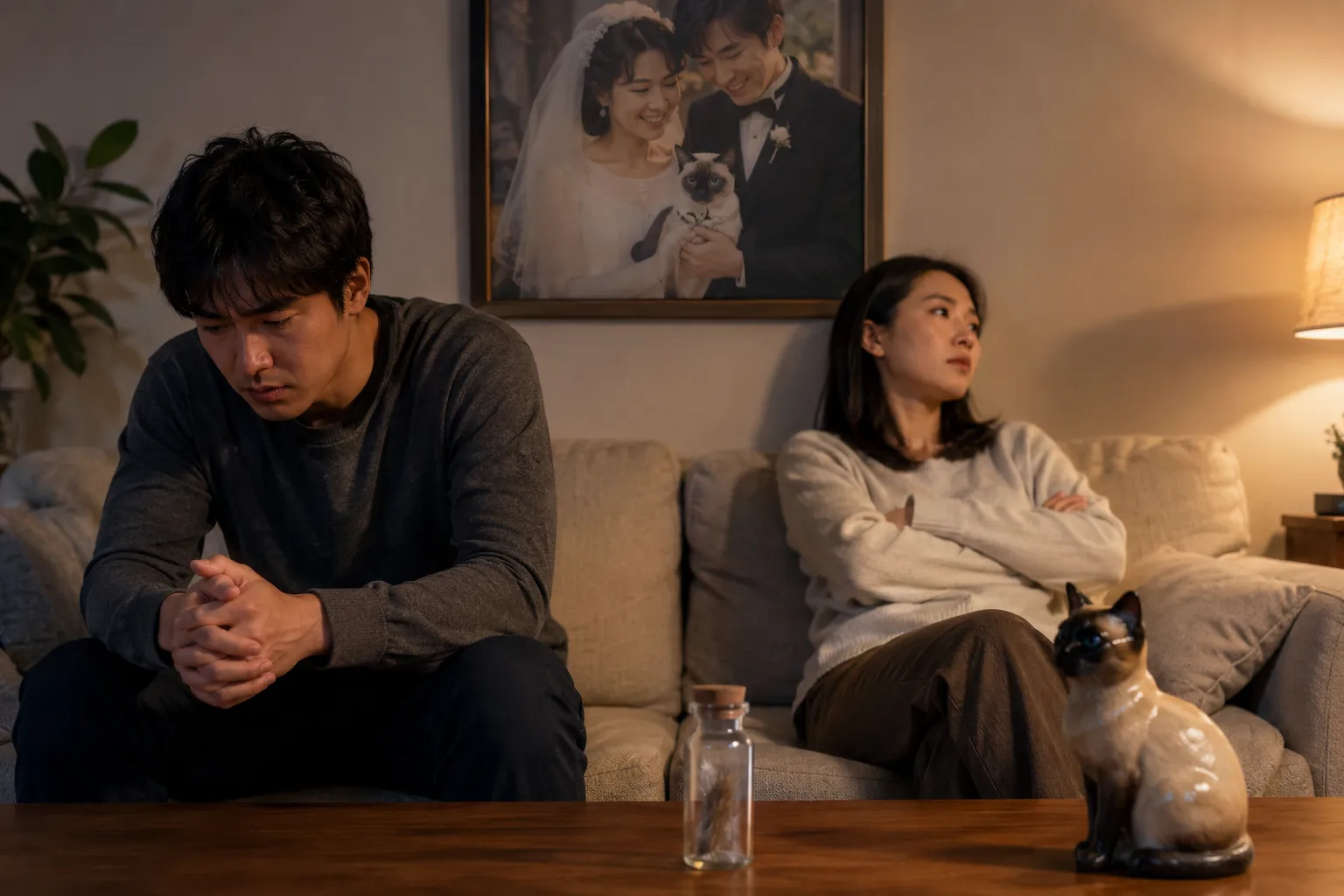
The smell of her fur still clung to the throw pillow—warm, faintly sweet, like sun-warmed dust and something distinctly alive. Marcus noticed it first, on the front porch where their Siamese, Lila, used to press her seal-point face against the screen door. His partner, David, hadn't sat out there in weeks. That difference—one drawn toward the scent, the other repelled by it—is where couple pet grief fractures open in ways nobody warns you about.
Quick Takeaways
- Grieving differently doesn't mean loving differently — partners often interpret each other's grief style as a measure of attachment, which breedsresentment
- Art history reveals why physical relics matter — mourning portraits and hair jewelry weren't sentimental excess; they were neurological anchors for processing loss
- A fur clipping serves a specific cognitive function — it gives the brain a "transition object" that bridges presence and absence, reducing complicated grief patterns
- Tangible memorials like custom pet figurines can become shared grief anchors — giving couples a neutral object to project love onto together
- The 6-week mark is when most couples hit their grief conflict peak — knowing this timeline helps you prepare rather than react
Why Siamese Cat Loss Hits Couples Harder Than They Expect
Here's something we've observed working with thousands of grieving pet families: Siamese cat owners report more intense relational grief conflict than owners of almost any other breed. That's not a coincidence, and it's not because Siamese owners are more dramatic.
It's because Siamese cats bond asymetrically.
Unlike breeds that distribute affection evenly across a household, Siamese cats are notorious for choosing a person. They vocalize differently with their preferred human. They follow one partner from room to room while tolerating the other. They develop inside jokes—specific meows, specific rituals—with one half of a couple.
So when Lila died, Marcus lost his daily companion, his shadow, his conversational partner. David lost the cat he loved but who never quite chose him back. Both losses are real. But they're structurally different griefs wearing the same name.
"The hardest memorial conversations we witness aren't about the pet—they're about what the pet meant differently to each person in the room."
— The PawSculpt Team
This asymetry creates a specific kind of pain: Marcus felt David wasn't grieving enough. David felt Marcus was grieving performatively. Neither was true. Both felt abandoned by the other at the exact moment they needed connection most.
The "Grief Gap" Nobody Talks About
Most articles about grieving differently from your partner offer the same advice: be patient, communicate, give each other space. That's not wrong. It's just insufficient.
The real issue is what psychologists call disenfranchised grief asymetry—when one partner's grief is socially validated while the other's is minimized. In Siamese households, the "chosen" human gets the sympathy. Friends say, "Oh, she was YOUR cat, wasn't she?" The other partner hears an implicit message: your loss is lesser.
David told us something that stuck: "People kept asking Marcus how he was doing. Nobody asked me. After a while, I started believing my grief didn't count."
| Grief Expression | Partner A (Primary Bond) | Partner B (Secondary Bond) |
|---|---|---|
| Timeline | Acute grief often4-8 weeks | Delayed grief, sometimes hitting weeks later |
| Triggers | Absence of routine (feeding time, lap time) | Witnessing partner's pain; empty spaces |
| Social validation | High — others acknowledge the bond | Low — grief often minimized or overlooked |
| Common misread by partner | "They're not sad enough" | "They're making this about themselves" |
| Hidden emotion | Guilt about monopolizing the cat's affection | Shame about grief intensity feeling "unearned" |
That last row matters. The shame about grief intensity feeling unearned—that's the emotion almost no one admits to. If the cat didn't choose you, do you have the right to fall apart? (Yes. Absolutely yes. Love doesn't require reciprocity to be real.)
What Art History Actually Teaches Us About Fur Clippings
Here's where this article takes a turn you won't find in any grief support forum.
We need to talk about Victorian mourning culture—not as a curiosity, but as a blueprint that neuroscience is only now catching up to.
Between 1840 and 1900, bereaved Victorians didn't just cry and move on. They wore hair jewelry—brooches, rings, watch chains woven from the hair of the deceased. They commissioned mourning portraits. They kept death masks. And they weren't being morbid. They were doing something that modern grief research now validates: creating transitional objects.
The Neuroscience Behind Physical Relics
When someone (or some animal) dies, your brain faces a specific problem: it has built thousands of neural pathways predicting that being's presence. Every time you walk into the kitchen, your brain expects to see the cat on the counter. Every time you sit on the porch, it expects the weight of a warm body on your lap.
These predictions don't stop just because the being is gone. They fire anyway, and the mismatch between prediction and reality is what creates that gut-punch sensation of fresh grief, over and over.
A physical relic—a fur clipping, a collar, a figurine—gives the brain something to anchor those predictions to. It doesn't eliminate grief. But it provides what researchers call a "continuing bond object": something that says, this was real, this existed, here is proof.
The Victorians understood this intuitively. A lock of hair wasn't sentimental excess. It was a neurological tool.
Why a Fur Clipping Specifically
Not all relics are equal. Here's what makes a fur clipping memorial uniquely powerful:
- Scent retention: Fur holds scent longer than fabric or leather. Thatolfactory connection bypasses the rational brain entirely and activates memory directly.
- Texture: The tactile experience of touching fur activates the same neural pathways as petting the living animal.
- Authenticity: Unlike a photo, fur is of the animal. It's not a representation. It's a fragment of their physical being.
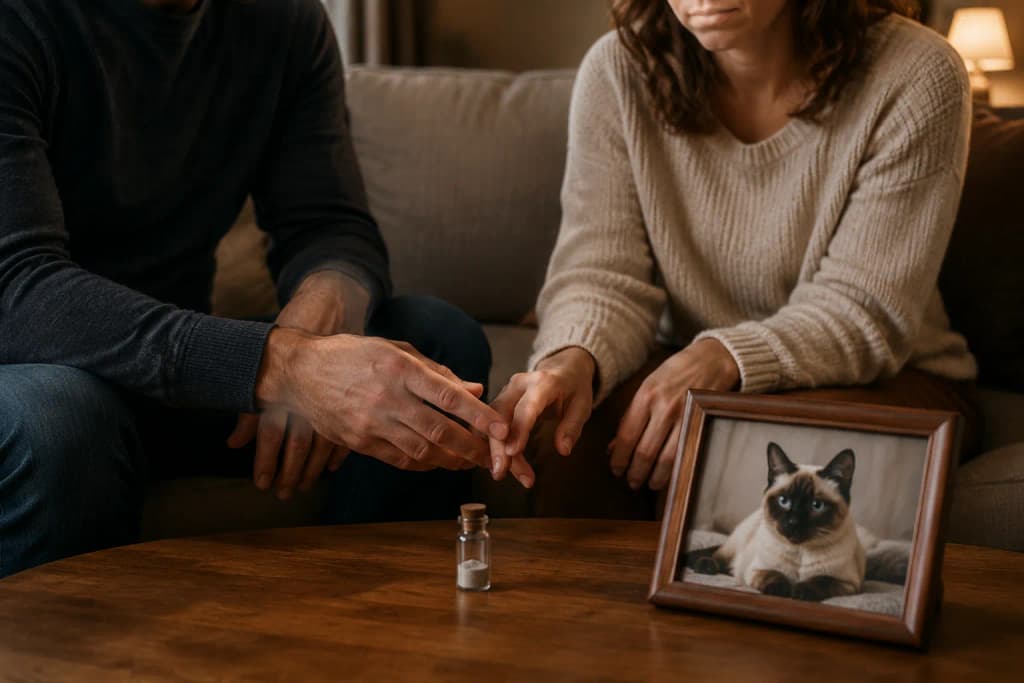
- Shareability: Both partners can hold it. It doesn't belong to the "chosen" human. It belongs to the relationship.
That last point is the counterintuitive insight: a fur clipping can function as a couples' grief object in a way that memories cannot. Memories are individual. They're stored differently in each brain. But a physical object exists outside both partners. It's neutral ground.
Marcus kept Lila's fur clipping in a small glass vial on the porch railing. David initially avoided it. But three weeks after Lila's death—right around the time his own delayed grief finally surfaced—he found himself holding it. Pressing it between his fingers. Smelling it.
"It smelled like the house used to smell," he said. "Before."
"Grief doesn't need words. Sometimes it needs weight—something you can hold in your hand and know it's real."
The 6-Week Conflict Point (And How to Survive It)
We'll be real: most couples who lose a pet together hit a wall around week six. Not week one, when the shock is fresh and everyone is gentle with each other. Not week three, when the caseroles arrive and friends check in. Week six, when the world has moved on and you're still standing in the kitchen at 6 PM wondering why you're holding an empty food bowl.
Here's what typically happens at the 6-week mark:
- One partner has begun to stabilize. They're sleeping better. They can mention the pet without crying. They might even laugh at memory.
- The other partner interprets this stabilization as betrayal. How can you be fine? How can you laugh?
- The stabilizing partner feels guilty, then defensive. "I'm not fine, I'm just functioning."
- The still-grieving partner feels abandoned. First the cat left. Now you're leaving too.
This cycle—guilt, defensiveness, abandonment,resentment—can damage relationships that were otherwise solid. And it's almost entirely preventable if you know it's coming.
What Actually Helps (Beyond "Communicate")
Create a shared ritual, not a shared timeline. You don't need to grieve at the same pace. You need one thing you do together that acknowledges the loss without requiring identical emotional states.
Some options we've seen work:
- A weekly "Lila moment": Every Sunday evening, both partners spend five minutes looking at photos together. No pressure to cry. No pressure to be cheerful. Just presence.
- A physical anchor point: A memorial shelf, a garden stone, a custom figurine placed somewhere both partners pass daily. Something that says we both loved her without requiring a conversation every time.
- A "check-in" phrase: One couple we worked with used the phrase "porch weather" to signal "I'm having a grief moment and I need you to just sit with me." No explanation required. No emotional labor demanded.
The key insight: the ritual matters more than the emotion inside it. You don't both need to feel the same thing at the same time. You just need to show up.
| Week | What's Happening | What Helps | What Hurts |
|---|---|---|---|
| 1-2 | Acute shock; both partners tender | Physical comfort; shared crying | Making big decisions; removing pet items too fast |
| 3-4 | Grief waves become irregular | Allowing different rhythms | Comparing grief intensity |
| 5-6 | Divergence peak; one stabilizes first | Shared ritual; naming the gap | Interpreting recovery as betrayal |
| 7-10 | Integration begins; new normal forms | Planning a memorial together | Rushing to "get another pet" |
| 12+ | Grief becomes background, not foreground | Honoring anniversaries | Pretending it never happened |
The Guilt Nobody Admits: Relief, Regret, and the Space Between
Let's talk about the thing that lives in the dark.
Many pet owners—especially those whose Siamese cats were elderly or ill—feel relief when the death finally comes. And then they feel monstrous for feeling relieved. And then they hide that relief from their partner, which creates a secret, which creates distance, which creates loneliness at the exact moment they need closeness.
Here's what we want to say clearly: that wave of relief you felt when their suffering ended doesn't make you a bad person. It makes you someone who spent weeks or months watching animal you love deteriorate. Someone who woke at 3 AM to check if they were still breathing. Someone whose nervous system was locked in a state of anticipatory grief for so long that the resolution—however devastating—also brought a kind of exhale.
The guilt that follows that relief is one of grief's cruelest tricks. It takes your compassion and reframes it as selfishness.
And here's the relational dimension: if one partner feels relief and the other doesn't, the relieved partner often withdraws. They can't share what they're feeling because they're terrified of being judged. They perform a grief they've already partially processed, which feels dishonest, which creates more guilt.
What to Do With the Guilt
Name it. Out loud, to your partner, if you can. "I feel relieved that she's not suffering anymore, and I feel terrible about feeling relieved." That sentence—spoken honestly—has saved more relationships than any grief counselor's pamphlet.
If you can't say it to your partner yet, write it down. Put it in a letter to your cat. Tuck it under the fur clipping. Give the guilt somewhere to live that isn't inside your chest.
According to the Association for Pet Loss and Bereavement, this mixture of relief and guilt is among the most commonly reported experiences in pet bereavement—and among the least discussed. You're not broken. You're not cold. You're human
"Relief and love aren't opposites. They're proof you were paying attention to their pain, not just your own."
The Art History Connection: Why Making Something Physical Changes Everything
Back to the Victorians for a moment—and then forward to now.
In 1861, when Prince Albert died, Queen Victoria didn't just mourn. She commissioned sculptures, portraits, busts, and memorial jewelry. She preserved his rooms exactly as he left them. And while history has sometimes mocked her for this (calling her grief "excessive"), modern attachment theory suggests she was doing exactly what a securely attached person does: maintaining a continuing bond through physical objects.
The key word is continuing. Not replacing. Not denying. Continuing.
When you keep a fur clipping, you're not pretending your cat is still alive. You're acknowledging that your relationship with them didn't end at death—it transformed. The love is still present. It just needs a new container.
From Fur Clipping to Full Portrait: The Spectrum of Physical Memory
Not everyone wants the same kind of memorial. And that's actually useful in a couple, because it gives each partner a way to grieve that fits their own style:
The Minimalist: A small vial of fur. A single photo in a frame. The collar hung on a hook by the door. Quiet. Understated. Present but not demanding.
The Curator: A shadow box with fur, a photo, a paw print, the favorite toy. A dedicated shelf. A story told through objects.
The Dimensionalist: Something that occupies space the way the cat did. A figurine that sits where she used to sit. A three-dimensional presence that catches light and casts shadow.
This last category is where we've seen the most powerful couples' healing happen. A flat photo is personal—you look at it alone. But a three-dimensional object exists in shared space. It becomes part of the room's geography. Both partners encounter it naturally, without having to seek it out.
PawSculpt's full-color 3D-printed figurines work this way for many of the families we serve. The figurine sits on the mantel or the windowsill, and it becomes a quiet presence—not a shrine, not a demand for emotion, just a fact. She was here. She was real. She was ours.
The color is printed directly into the resin, voxel by voxel, which means Lila's particular seal-point markings—the way the chocolate faded into cream at her chest, the specific blue of her crossed eyes—are reproduced with the kind of accuracy that makes your breath catch. It's not a generic Siamese. It's her.
Why Couples Should Choose a Memorial Together
Here's the counterintuitive advice: don't let one partner handle the memorial alone. Even if one person is "better at that stuff." Even if one person is further along in their grief. Even if it feels like a burden.
Choosing a memorial together—deciding what matters, what to include, what pose captures her best—is itself a grief ritual. It requires both partners to articulate what they loved. To compare memories. To discover, sometimes for the first time, what the cat meant to the other person.
Marcus thought David didn't care as much about Lila. But when they sat down to choose reference photos for a figurine, David pulled up a picture Marcus had never seen: Lila asleep on David's laptop keyboard, one paw draped over the trackpad. "She did this every night while you were asleep," David said. "I'd work late and she'd come find me."
The cat had chosen David too. Just differently. Just quietly. Just when no one else was watching.
The Smell Will Fade (And That's the Real Fear)
Let's return to the porch. To the throw pillow. To the scent that started this whole conversation.
The fear of forgetting is one of grief's most isolating experiences. You don't just miss your cat—you're terrified that one day you won't be able to recall the exact weight of her on your chest, the specific frequency of her purr, the way she smelled after sleeping in a sunbeam.
And here's the brutal truth: the scent will fade. Fur clippings lose their smell within months, sometimes weeks, depending on storage. The pilow will eventually smell like nothing, or like laundry detergent, or like the new normal of a house without a cat in it.
This is why the physical memorial matters beyond the fur itself. The fur is the bridge—the immediate, visceral, olfactory connection to the living animal. But it's temporary. What lasts is the object you build around the fur. The shadow box. The figurine. The ritual.
Think of it this way: the fur clipping is the raw material of grief. The memorial you create from it (or alongside it) is the architecture. One gives you the feeling. The other gives you the structure to hold that feeling across years, not just weeks.
Preserving What You Can
If you're reading this and your Siamese is still alive—or recently passed—here's what we'd recommend preserving now, before time erodes the details:
- Fur: Clip from their favorite spot (usually the chest or behind the ears, where the scent glands concentrate). Store in a sealed glass vial, not plastic.
- Paw print: Clay impressions or ink prints. Do this while they're alive if possible—it's gentler for everyone.
- Photos: Not just cute poses. Capture the weird angles. The way they looked from below when they sat on the glass table. The unflattering sleeping positions. These are the images that will make you laugh-cry in five years.
- Video with sound: Their specific meow. The pur. The chirping sound Siamese cats make when they see birds. You will want to hear it again.
- Written details: The things a photo can't capture. How heavy she felt. How her fur felt different on her belly versus her back. The specific spot she liked scratched. Write it down now, while your body still remembers.
When One Partner Wants a New Cat and the Other Doesn't
This is the conflict that breaks couples who survived everything else.
It usually surfaces around month three or four. One partner—often the one who stabilized first—starts mentioning kittens. Browsing shelter websites. Sending links with captions like "look at this face." The other partner experiences this as a betrayal so profound it takes their breath away.
The anxiety about getting another pet is real and valid. It's not about the new animal. It's about what getting a new animal means—or what it seems to mean. That the old one is replaceable. That the grief should be over. That love is transferable like a subscription.
None of that is true, of course. But grief doesn't operate on logic.
Here's what we'd suggest: set a mutual moratorium. Agree together—out loud, explicitly—that neither partner will bring home a new animal until both feel ready. Not until one feels ready. Both. And define what "ready" means for each of you.
For Marcus, ready meant: "I can walk past the cat food aisle without my chest tightening."
For David, ready meant: "I can look at a Siamese kitten and feel excitement instead of guilt."
They weren't ready at the same time. That's fine. The agreement held the space.
Building the Memorial Together: A Practical Framework
We've talked about why physical memorials matter. Here's the how—specifically for couples navigating different grief styles.
Step 1: Acknowledge the Difference (Week 1-2)
Say it plainly: "We're going to grieve this differently, and that's okay. Let's decide now how we'll stay connected through it."
Step 2: Choose One Shared Object (Week 2-4)
This doesn't have to be expensive or elaborate. It needs to be:
- Chosen together
- Placed in shared space
- Meaningful to both (not just one)
Options range from amed photo to a garden stone to a digitally sculpted, full-color 3D-printed figurine that captures your specific cat's markings and personality. The point isn't the price point. It's the act of choosing together.
Step 3: Create a Micro-Ritual Around It (Week 3-6)
Light a candle next to it on Sundays. Touch it when you walk past. Tell it something about your day. This sounds strange until you do it—and then it feels like the most natural thing in the world.
Step 4: Revisit at the 6-Week Mark (Week 6)
Remember that conflict peak we discussed? Use it. Sit down together and ask: "How are we doing? What do you need from me that you're not getting?" The memorial object gives you something to look at that isn't each other's face—which, paradoxically, makes honesty easier.
Step 5: Let It Evolve (Month 3+)
The memorial's role will change. In the early weeks, it's a grief anchor. By month three, it becomes a gratitude object. By year one, it's simply part of your home—a quiet testament to a life that mattered.
The Counterintuitive Truth About Couple Grief
Here's what most articles about grieving differently from your partner won't tell you:
The grief gap isn't a problem to solve. It's information to use.
When your partner grieves differently than you, they're showing you something about themselves that you might never have seen otherwise. The partner who goes quiet is showing you how they process overwhelm. The partner who talks constantly is showing you how they metabolize pain. The partner who cleans out the cat's things immediately is showing you how they regain control. The partner who can't touch anything for months is showing you how deeply they attach.
None of these responses are wrong. And all of them are invitations—if you're willing to look—to know your partner more deeply than you did before.
Lila's death didn't break Marcus and David. It showed them to each other in a new light. The grief gap became, eventually, a bridge. Not because they closed it, but because they learned to stand on opposite sides and still reach across.
The Porch, Revisited
Six months after Lila died, Marcus put a new throw pillow on the porch chair. The old one—the one that smelled like her—went into a cedar chest in the closet. Not thrown away. Just held differently.
On the porch railing, where the fur clipping used to sit alone in its glass vial, there's now a small figurine. Seal-point face. Blue eyes. One paw slightly raised, the way Lila used to bat at moths in the evening light. The full-color resin catches the late afternoon sun and throws a tiny shadow across the railing— shadow roughly the size and shape of a cat.
David sits on the porch now. Not every day. But sometimes. And when he does, he doesn't avoid looking at the figurine. He looks right at it. Sometimes he talks to it.
"Porch weather," he says to Marcus, when he needs company out there.
And Marcus comes. Every time.
The scent is gone. But the love—held in glass, in resin, in ritual, in the space between two people who chose to grieve together even when they couldn't grieve the same—the love remains. Transformed, but undiminished. A continuing bond, anchored in something you can hold.
That's what art history knew all along. That's what the Victorians understood with their hair brooches and their mourning portraits. Grief needs a body. Give it one.
Frequently Asked Questions
Is it normal for couples to grieve a pet differently?
Completely normal—and more common than most people realize. Partners often had structurally different relationships with the pet (especially with Siamese cats, who tend to bond asymetrically). One partner may have been the primary attachment figure while the other had a quieter, less visible bond. Different grief timelines and expressions don't reflect how much either person loved the animal. They reflect different nervous systems processing different kinds of loss.
How long does grief last after losing a Siamese cat?
Acute grief typically runs 4-8 weeks, with the most intense couple conflict surfacing around week six. Full integration—where grief becomes background rather than foreground—often takes 3-6 months. But grief waves can return for years, especially around anniversaries, seasonal changes, or sensory triggers. There's no "correct" timeline, and anyone who gives you one is oversimplifying.
Why does a fur clipping help with pet grief?
Fur retains scent and texture that activate memory through the olfactory system, which bypasses rational processing entirely. Neuroscience shows that the brain builds prediction pathways expecting the pet's presence; a physical relic gives those pathways somewhere to land instead of firing into empty space. The Victorians used hair jewelry for the same reason—it's a continuing bond object that bridges presence and absence.
What should I do if my partner seems to be "over it" too quickly?
Stabilizing faster doesn't mean loving less. Your partner may process grief internally, through action, or on a delayed timeline. Rather than interpreting their recovery as betrayal, try creating a shared ritual—a weekly moment of acknowledgment that doesn't require matching emotional states. Ask directly: "Can you tell me what you're feeling?" You might be surprised by what's happening beneath the surface.
Is it normal to feel relief when a sick pet dies?
Yes. That exhale you felt when their suffering ended is a compassionate response, not a selfish one. You spent weeks or months in anticipatory grief, watching them decline, managing medications, checking their breathing at3 AM. Relief and love aren't opposites—they're proof you were paying attention to their pain. The guilt that follows is common but undeserved.
When should a couple get a new pet after loss?
Only when both partners feel ready—not just one. We'd recommend setting an explicit mutual agreement and having each person define what "readiness" means for them individually. For some, it's being able to browse shelter photos without chest tightness. For others, it's feeling excitement rather than guilt. This process typically takes 3-6 months minimum, but there's no universal answer.
Ready to Honor Your Siamese's Memory?
Every Siamese has a personality too specific for a generic memorial—the crossed eyes, the particular point pattern, the way they held their tail when they were judging you. Whether you're navigating couple pet grief together or finding your own way through Siamese cat loss, a tangible memorial gives both partners something to hold onto when words fall short.
A PawSculpt figurine captures those details that made your cat irreplaceable—digitally sculpted by master3D artists, then precision-printed in full color so every marking is exactly as you remember.
Visit pawsculpt.com to explore the process, see examples, and learn how it works