
Why Couples Grieve Differently After Losing a Ragdoll — And Why That's Not a Problem to Solve
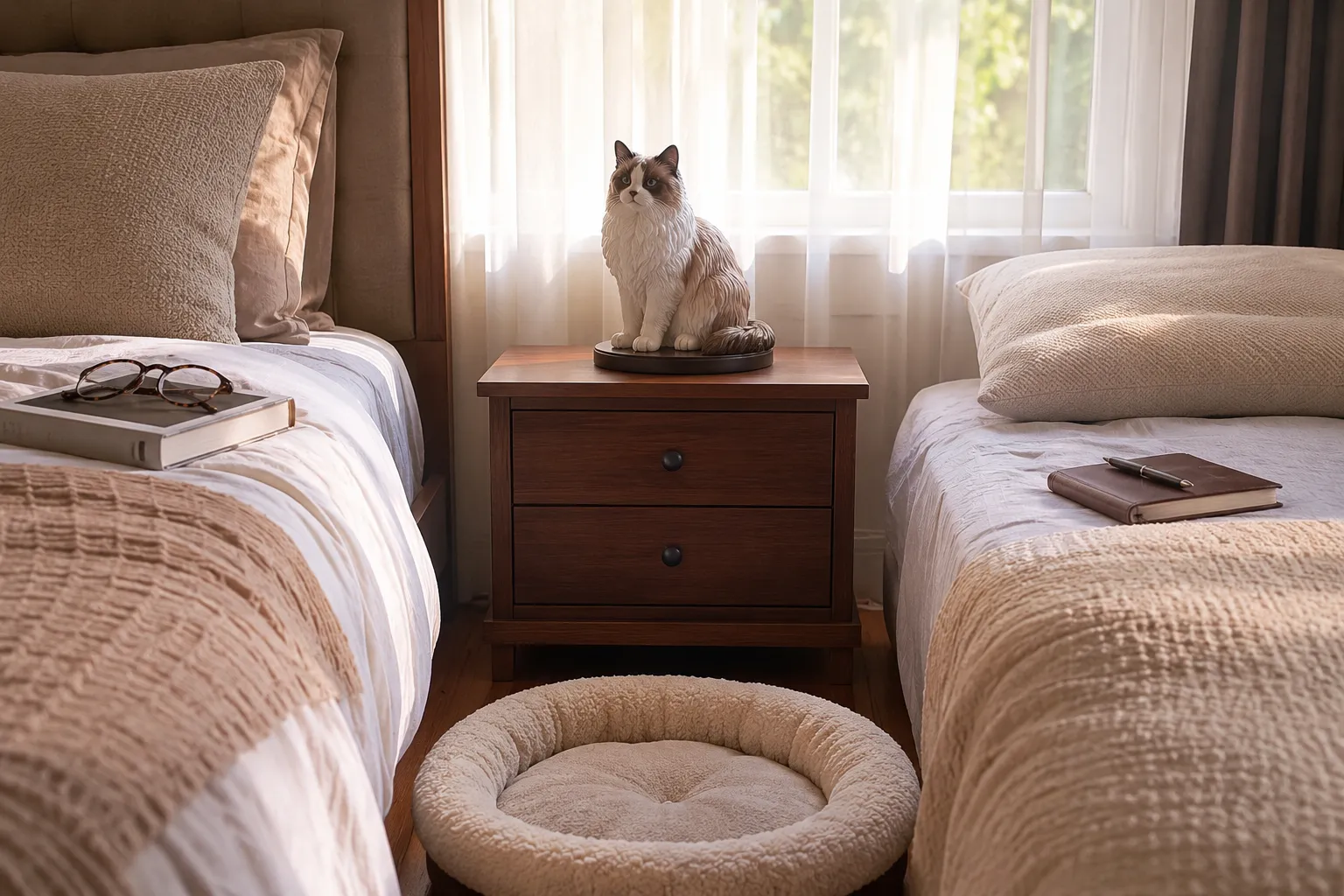
Two years ago, you both pressed your palms to the same warm fur on a cold steel exam table. Today, one of you weeps at the empty food bowl while the other seems untouched — and that gap is exactly why couples grieving a pet differently can feel so alone in the same house.
Quick Takeaways
- Mismatched grief is biology, not betrayal — partners process loss on different timelines and through different senses.
- Delayed grief often looks like coldness — the "unaffected" partner is frequently the one who breaks later and harder.
- Stop trying to synchronize your sorrow — shared rituals work better than matched emotions.
- A shared object can hold what words can't — many couples anchor their grief in a tangible keepsake like a custom pet figurine you both helped design.
- Pet loss during a life crisis compounds quietly — name the stacking, or it festers.
The Myth That You're Supposed to Grieve in Unison
Here's a scene we've heard described, in some form, hundreds of times.
It's the third evening after. One partner is curled on the couch, holding the collar, running a thumb over the worn nylon where the tag used to jingle. The other partner is in the kitchen, reorganizing a drawer that didn't need organizing, talking about whether to cancel the weekend plans.
To the one on the couch, this looks like indifference. To the one in the kitchen, the crying looks like drowning — and they don't know how to swim toward it without going under themselves.
Neither of them is doing grief wrong. That's the part nobody tells you.
We carry a cultural fantasy that a loving couple, struck by the same loss, should fall apart in roughly the same way at roughly the same time. Two people, one synchronized ache. It's a beautiful image. It's also almost never true, and the belief that it should be true causes more relational damage than the loss itself.
"The fight is rarely about the grief. It's about the grief not matching."
When you lose a Ragdoll — a breed bred specifically for that boneless, lap-melting docility, the cat who went limp with trust the second you lifted them — the absence has a particular texture. Ragdolls insert themselves into the physical fabric of a household. They're the weight on your chest at 6 a.m., the body that followed you room to room. So when a couple loses one, they're not grieving an abstraction. They're grieving a creature whose entire personality was contact. And contact is something two people experience differently.
Why "differently" usually means "on different clocks"
The most common pattern we see isn't that one person cares more. It's that one person's grief arrives on a delay.
Delayed grief in pet loss is wildly under-discussed, and it wrecks couples who don't have a name for it. One partner falls apart immediately — the acute, visible, textbook kind. The other stays functional, handles the logistics, fields the "I'm so sorry" texts, and feels a quiet, confusing flatness. Weeks pass. The first partner starts to surface, starts to have a good day. And that's often when the second partner finally collapses, sometimes months later, triggered by something absurdly small. A vacuum cleaner. A particular slant of afternoon light on the spot where the cat used to sun itself.
The cruelty of this timing is that the couple is rarely down at the same moment. They keep passing each other on the stairs of their own sorrow.

The Hidden Reasons Couples Grieve a Ragdoll's Loss So Differently
Let's go three levels deeper than "everyone's different," because that phrase, while true, helps no one.
The differences aren't random. They cluster around a few specific, identifiable fault lines. Understanding which one is operating in your home is the difference between resentment and relief.
Attachment style shapes the shape of the missing
People bond to pets the same way they bond to people — through their own attachment wiring. One partner may have had a relationship with the Ragdoll built on physical proximity (the cat slept on their side, greeted them first). The other may have had a relationship built on caretaking (they did the feeding, the vet runs, the litter).
When the proximity-bonded partner loses the cat, they lose a felt presence — a warmth, a weight, a body. Their grief is sensory and immediate.
When the caretaking-bonded partner loses the cat, they lose a role. Their grief is often slower because it surfaces in the gaps where a task used to live. There's no body to miss at 6 a.m. There's a 5 p.m. feeding that no longer happens, and the quiet wrongness of that takes longer to register.
Same cat. Two completely different holes.
The division of the dying
Here's something we've learned from talking with grieving families that you won't find in the first five articles you Google.
In most couples, one person carries the medical weight of a pet's final chapter. They're the one who notices the decline first, who pushes for the appointment, who asks the hard questions, who often makes the final call on timing. The other partner is more peripheral to the dying, by circumstance or by self-protection.
These two people will grieve in opposite directions.
The medically-involved partner often grapples with second-guessing the euthanasia timing — the relentless "did we do it too soon, or did we wait too long and let them suffer?" loop. Their grief is tangled with decision-fatigue and a specific, gnawing form of responsibility.
The peripheral partner, meanwhile, didn't have those decisions to metabolize. Their grief is cleaner but also more sudden — the cat was here, and then, from their vantage point, abruptly wasn't. They may feel guilty for not having carried more of the weight, which then makes them reluctant to claim much grief at all.
"One of you negotiated with death for weeks. The other got the news. Of course you don't match."
If you recognize your household here, please hear this: the partner who managed the dying is not "more bonded." They're more exhausted, and exhaustion can look like either hysteria or numbness depending on the nervous system it's running through.
When the loss lands during a personal crisis
This one deserves its own breath.
Pet loss during a personal crisis — a job loss, a health scare, a move, a parent's illness, a strained marriage — doesn't add to your stress. It multiplies it, and it does so unevenly.
We worked with a couple last year (details changed for privacy) who lost their Ragdoll three weeks after one of them received a frightening diagnosis. The diagnosed partner had no bandwidth for the cat's death — every emotional resource was already spoken for. The other partner, who felt helpless about the diagnosis, poured all of their displaced fear into grieving the cat, because it was a loss they were actually allowed to cry about.
From the outside, it looked like one person didn't care and the other was overreacting to "just a cat." From the inside, both were managing terror the only ways available to them.
Grief doesn't wait for a convenient slot in your life. It barges in, and when it arrives during an existing crisis, it tends to attach itself to whichever partner has the least to lose by feeling it.
Here's a table we sometimes share to help couples locate themselves. None of these are better or worse — they're just different machinery.
| Grief Pattern | What It Looks Like | What It Actually Means | What the Partner Often Misreads |
|---|---|---|---|
| Immediate/acute | Crying, can't function, talks constantly about the pet | Proximity-bonded; sensory loss hit instantly | "You're falling apart and I can't reach you" |
| Delayed | Calm, handles logistics, breaks down weeks later | Functional under shock; grief surfaces in routine gaps | "You don't even care" |
| Decision-loaded | Replays the final days, can't stop "what if" | Carried the medical/euthanasia weight | "Why won't you just let it go" |
| Avoidant | Stays busy, won't discuss it, deflects | Self-protecting; feels grief is unsafe to enter | "You've completely moved on" |
| Displaced | Grief seems "too big" for the loss | Loss landed during another crisis and absorbed it | "You're being dramatic" |
The Emotions Couples Feel But Almost Never Say Out Loud
If we only talk about sadness, we miss the feelings that actually corrode relationships in the weeks after a loss. These are the ones partners hide from each other, and sometimes from themselves.
The relief you're afraid to admit
If your Ragdoll declined slowly — kidney disease is common in the breed, and the long goodbye it creates is its own particular ordeal — there's a good chance one or both of you felt relief when it ended.
Relief that the 3 a.m. medication schedule was over. Relief that the daily watching-them-fade was done. Relief that you could sleep, or leave the house, or stop spending money you didn't have on a fight you were always going to lose.
That relief, sitting right next to your grief, can feel obscene. Like proof you didn't love them enough.
It's not. The relief is the residue of how hard you loved them — how much of yourself you poured into their comfort. You can only feel relieved of a burden you actually carried. The guilt that chases the relief is one of grief's nastiest tricks, and it's almost universal among people who nursed a pet through a long decline. Naming it out loud to your partner, even once, drains most of its poison.
"Relief isn't the opposite of love. It's the exhaustion of having loved that hard."
The feeling that you're being judged — by your own partner
Many people brace for outside judgment ("it was just a cat"). Fewer expect it from inside the relationship.
The acutely-grieving partner often feels silently judged for being "too much." The delayed-grief partner often feels judged for being "too cold." Each interprets the other's different response as a verdict on their own. This is the quiet engine behind a lot of post-loss arguments that seem, on the surface, to be about something else entirely — the thermostat, the dishes, who forgot to call whose mother.
If you take one practical thing from this article, let it be this: when a fight erupts in the weeks after the loss and feels disproportionate, ask yourself whether you're actually fighting about the grief gap. You usually are.
The fear of forgetting
Both partners, on different timelines, will hit a moment of panic when they realize they can't quite summon the exact sound of the purr, or the precise weight of the cat settling onto their legs.
This fear of forgetting drives a lot of memorial behavior — and it's also where couples can finally do something together, which we'll get to. The texture of memory fades faster than we expect. The specific roughness of a Ragdoll's tongue, the particular cool of their nose, the way the fur at the ruff was longer and softer than everywhere else. These details blur within months, and the blurring frightens people who equate remembering with loving.
"We've watched grief soften the moment it has something solid to hold. The hands need an anchor before the heart can rest."
— The PawSculpt Team
Why You Shouldn't Try to Fix the Gap (And What to Do Instead)
Now for the counterintuitive heart of this whole piece.
The instinct, when you notice you and your partner are grieving differently, is to close the gap. To get them to cry if they're not crying. To get them to calm down if they're crying too much. To pull each other onto the same page.
Don't.
The attempt to synchronize grief is one of the most reliable ways to turn two grieving people into two lonely, resentful people. When you push a delayed-grief partner to "let it out," you shame them for a nervous system doing exactly what it needs to do. When you ask an acute-grief partner to "pull it together," you tell them their love is an inconvenience.
The goal was never to grieve the same. The goal is to grieve alongside.
Build a shared ritual, not a shared feeling
Here's the distinction that changes everything. You cannot match feelings on command. You can share an action.
A ritual is a container that holds two different griefs in the same space without demanding they look alike. One partner can sob through it; the other can stand quietly through it. Both are participating. Neither is performing.
Concrete options that have worked for couples we've talked with:
- A weekly 10-minute "remembering" walk along a route the household used to take, where talking is allowed but not required.
- Lighting a single candle at dinner for the first month — a physical, repeatable act that acknowledges the absence without a script.
- Co-writing a list, one line each, alternating, of small specific things you don't want to forget. The weird meow. The favorite sunbeam. The way they'd flop.
- Choosing a memorial object together — a process that gives the delayed-grief partner a task (which is how they often access feeling) and the acute-grief partner an outlet.
That last one matters more than it sounds, and it's worth slowing down on.
The strange power of a shared physical object
This connects directly to the fear of forgetting and to the touch-hunger that a Ragdoll's death leaves behind.
Ragdoll people are, almost by definition, tactile people. You don't choose a cat famous for going limp in your arms unless you love the physical. Which means the loss is partly a loss of something to hold. The lap is empty. The hands have nowhere to go.
This is why so many couples find unexpected comfort in a tangible keepsake — not a photo on a screen, but something with weight, something both partners can pick up. Some families plant a tree. Some keep the collar in a small box. And increasingly, couples commission a custom pet memorial figurine that reproduces their cat's exact markings, posture, and that signature Ragdoll flop.
What we've noticed — and this surprised us when we first started seeing it — is that the choosing often heals as much as the having. When a couple sits together over photos, arguing gently about which pose is the most "them," debating whether to capture the cat mid-stretch or curled in the classic loaf, they're doing grief work without calling it that. The delayed-griever gets a concrete project. The acute-griever gets to talk about their cat for an hour. They meet in the middle of an object instead of in the middle of an argument.
What to Expect When You Memorialize Together
A few couples have asked us what the process of creating a figurine actually looks like, especially when two grieving people with different visions are involved. We'll be real about it.
Our figurines are digitally sculpted by master 3D artists and then produced through full-color 3D printing — the color is printed directly into the resin itself, voxel by voxel, not added on top afterward. The only manual finishing step is a protective clear coat that gives the piece its subtle sheen and guards the surface. The result has a vibrant, true-to-life color with a fine natural grain to it — authentic, with real physical presence in your hand, not a glossy mass-produced look.
For Ragdolls specifically, this technology earns its keep. The breed's coloring is genuinely hard to capture — the way the dark points on the ears and face melt into the cream of the body, the subtle gradient nobody else seems to notice until it's wrong. Full-color 3D printing reproduces those exact transition zones in the markings directly in the material, which is why the finished piece reads as your cat and not a generic fluffy white shape.
For the actual specifics — turnaround, revisions, options, the guarantee — we'd rather you get current details straight from the source than trust a number in a blog post, so take a look at pawsculpt.com when you're ready.
Here's what tends to make the experience smoother for couples specifically.
| Stage | What Happens | Why It Helps Grieving Couples |
|---|---|---|
| Choosing photos | You select reference images together | Forces shared looking, shared remembering |
| Picking the pose | You decide which posture is "most them" | Surfaces stories; both partners contribute |
| Digital preview | You see a 3D model before production | Gives the planning-minded partner control |
| Refining details | You flag markings, expression, proportions | The "fear of forgetting" gets a productive outlet |
| Receiving the piece | A physical object arrives with real weight | The touch-hunger finally has somewhere to land |
A few honest tips for the photo stage
Since the markings make or break a Ragdoll piece, the references matter more than for most breeds.
- Natural daylight beats flash, which blows out the cream tones and erases the subtle point gradients.
- Multiple angles help more than one perfect shot — a 3D sculptor is building a whole body, not a flat image.
- Don't only send the "pretty" photos. The slightly goofy ones often capture the real posture and expression better than the posed portraits.
- Include something that shows scale or proportion if your cat had a distinctive body shape (Ragdolls run large and long).
The "so what" here: the more honestly the reference photos show the cat being itself, the more the finished object will trigger the specific memories you're afraid of losing — which is the entire point.
What We Wish We Knew Sooner
A candid retrospective from our team, the things we've learned that we didn't understand when we started.
- The "unaffected" partner is often the one quietly designing the memorial. We've seen it again and again — the person who "didn't seem to care" is the one who reaches out to us, alone, weeks later. Grief was just running on a delay.
- Couples who order together argue less afterward. Not because the object fixes anything, but because the process gave them a shared activity that didn't require shared feelings.
- People underestimate the touch part. Almost everyone talks about wanting to "see" their pet again. What they actually crave, and what surprises them, is wanting to hold something.
- The piece becomes more important over time, not less. In the raw early weeks it can feel like too much. A year on, it's often the thing people say they're most grateful they did before the memory blurred.
When the Grief Gap Is Actually a Warning Sign
We promised honesty, so here's a limitation. Most grief mismatches are normal and resolve as both partners move through their own process. But not all of them.
If weeks turn into many months and one partner remains completely unable to function — can't work, can't sleep, won't leave the house — or if the gap has hardened into genuine contempt rather than confusion, that's beyond what a candle ritual or a memorial figurine can hold.
We're a figurine company, not therapists, and we'll always say so plainly. The Association for Pet Loss and Bereavement (aplb.org) maintains pet-loss support resources and chat rooms specifically for this, and there's real research on the human-animal bond — the NIH has published on how profoundly these attachments register in the brain — that confirms what you already feel: this is a real loss, and complicated grief is a real condition that sometimes needs real help.
Asking for support isn't a failure of love. It's an extension of it.
Here's a simple table to help you tell ordinary mismatch from something that warrants more support.
| Signal | Likely Normal Mismatch | Worth Getting Support |
|---|---|---|
| Timeline | Partners grieve weeks apart | One partner stuck, unable to function for months |
| Tone | Confusion, hurt feelings | Settled contempt or stonewalling |
| Function | Work and sleep mostly intact | Sustained inability to work, sleep, or eat |
| Communication | Awkward but still talking | Complete shutdown, no conversation possible |
| Trajectory | Slowly softening over time | Worsening or completely frozen |
How to Talk About It Without Making It Worse
A few specific scripts, because "communicate more" is useless advice and we won't insult you with it.
Instead of "Why aren't you upset?" — try "I know you're feeling this too, even if it doesn't look like mine. I'm not asking you to cry. I just don't want to feel alone in it."
Instead of "You need to pull yourself together" — try "I don't know how to help, and watching you hurt makes me feel useless. Tell me what's actually useful, even if it's just sitting here."
Instead of "It was just a cat" (please never) — try silence, and a hand on their back. Touch says what your skepticism shouldn't.
The principle underneath all of these: describe your own experience instead of diagnosing theirs. The grief gap widens every time one partner tells the other what they're feeling or failing to feel. It narrows every time someone says "here's what's happening in me."
And give it time on the calendar, not the clock. Most couples find the worst of the mismatch eases within three to six weeks as the delayed-grief partner catches up and the acute-grief partner stabilizes. If you can simply not break the relationship during that window — lower the stakes, forgive the snapping, assume good faith — you usually come out the other side closer, not further apart.
The Gap Was Never the Problem
Go back to that cold steel table, and the warm fur under four hands.
You touched the same cat. But one of you was memorizing the weight, and one of you was already bracing for the empty drawer. You were grieving in different directions before the loss even arrived, because you loved in different directions the whole time. That's not a flaw in your relationship. It's the fingerprint of two separate people who happened to love the same small creature.
The couples who make it through don't do it by finally feeling the same thing. They do it by stopping the demand that they should. They build something they can both touch — a ritual, a list, a small heavy object on the shelf that catches the afternoon light right where the cat used to lie.
So if you and your partner are grieving a pet differently right now, in the same house and somehow miles apart, you don't have a problem to solve. You have two real, separate, equally valid loves to honor — ideally, together. Reach for each other before you reach to fix each other. The gap closes on its own. The love doesn't have to.
Frequently Asked Questions
Is it normal for couples to grieve a pet differently?
Completely normal, and far more common than the synchronized sorrow we imagine. Partners grieve through their own attachment wiring and on their own timelines — one may grieve immediately, the other on a delay of weeks. Different responses reflect different bonds with the same pet, not different amounts of love.
Why does my partner seem unaffected after losing our Ragdoll?
The most likely explanation is delayed grief. The partner who stays functional in the first days is often the one absorbing the shock by staying busy, and they frequently collapse later, triggered by something small. The "unaffected" partner is also, in our experience, often the one who quietly reaches out to create a memorial weeks down the line.
Is it normal to feel relief when my pet finally passed?
Yes, particularly after a long decline like Ragdoll kidney disease. Relief is the residue of how hard you cared — you can only feel relieved of a burden you actually carried. The guilt that arrives right behind the relief is one of grief's cruelest tricks, and nearly everyone who nursed a pet through a long illness feels it.
How long does the grief mismatch between partners usually last?
For most couples, the sharpest part of the mismatch eases within three to six weeks as the delayed-grief partner catches up and the acute-grief partner stabilizes. The goal during that window is simply not to damage the relationship — forgive the snapping, lower the stakes. If one partner can't function for months, seek professional support.
Should we try to grieve at the same pace?
No, and trying to is one of the surest ways to turn two grieving people into two resentful ones. You can't match feelings on command, but you can share an action. Build a ritual — a candle, a weekly walk, choosing a memorial object together — that holds two different griefs in the same space without demanding they look alike.
Can creating a figurine together actually help our relationship?
It often does, partly because the process gives each partner a different way in. The planning-minded partner gets a concrete project; the openly grieving partner gets to talk about their cat for an hour. Couples who design a memorial together tend to argue less afterward — not because an object fixes grief, but because it gave them something to do side by side.
Ready to Celebrate Your Pet?
Every pet has a story worth preserving. Whether you're honoring a Ragdoll who's crossed the rainbow bridge or finding a way through the strange, lonely experience of couples grieving a pet differently, a custom PawSculpt figurine gives both of you something solid to hold — capturing the exact markings, posture, and personality that made your companion unmistakably yours.
Visit pawsculpt.com to explore our full-color 3D printing process, preview options, and quality guarantee.