A Custom Figurine vs a Canvas Print: Which One Still Looks Like Your Samoyed in 20 Years?
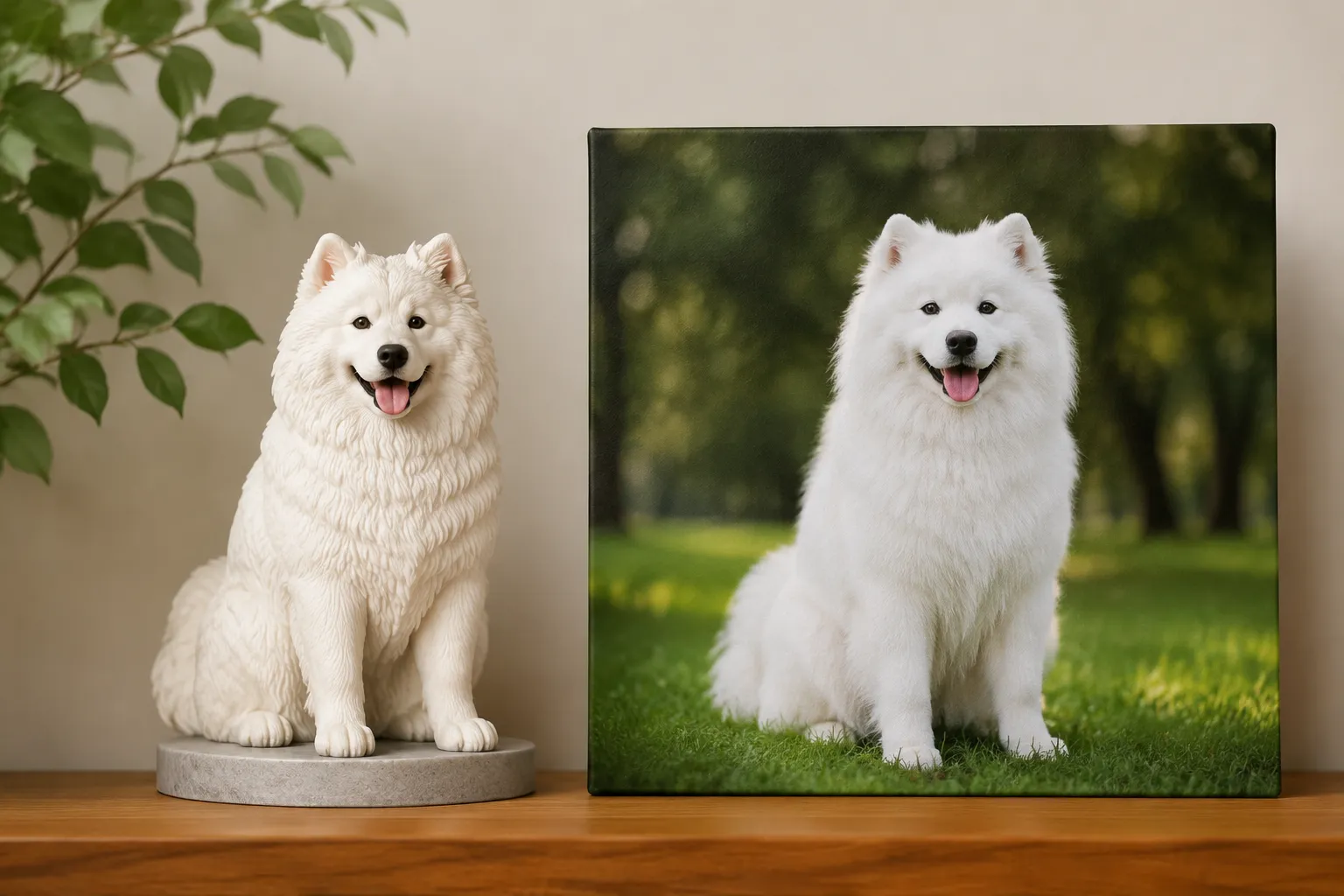
When was the last time you knelt on a walking trail, camera angled low against the morning frost, and thought: will this photo still smell like him in twenty years? That question—custom pet figurine vs canvas print—matters more than most Samoyed owners realize until the ink has already faded.
Quick Takeaways
- Canvas prints degrade measurably within 5–10 years — UV exposure, humidity, and ink chemistry work against flat media even in ideal conditions
- Full-color resin figurines preserve dimensional detail — fur texture, ear tilt, and unique markings survive decades without color loss
- The "recognition test" favors 3D objects — your brain identifies a loved one faster from a sculptural form than from a flat image
- Explore how PawSculpt's full-color 3D printing captures Samoyed coats — visit pawsculpt.com for process details and examples
- Neither option is universally "better" — the right choice depends on your space, your grief timeline, and how you physically interact with memory
The Longevity Problem Nobody Talks About
Here's the thing most memorial guides skip entirely: they compare products at the moment of purchase. Glossy canvas, vivid colors, that satisfying unboxing. But a Samoyed memorial kepsake isn't a decoration. It's a time capsule. And time capsules need to survive time.
We've worked with thousands of pet families, and the pattern we see repeatedly is this—someone orders a canvas print within weeks of loss, hangs it in a sunlit hallway because that's where their Samoyed used to sleep in the afternoon light, and contacts us three to seven years later because the whites have yellowed to cream and the eyes look flat. Not ruined. Just... diminished.
That diminishment is the real enemy. Not catastrophic failure. Slow erosion.
What Actually Happens to a Canvas Print Over Time
Let's break this into a cause-and-effect chain, because the degradation isn't random:
- UV exposure breaks down pigment molecules inkjet prints. Even "archival" inks rated for 75+ years assume museum conditions—no direct sunlight, 40–60% humidity, stable temperature.
- Canvas tension shifts as wood stretcher bars expand and contract seasonally. This creates micro-cracking in the ink layer that's invisible at first but compounds annually.
- Dust accumulation in canvas weave texture traps moisture against the ink surface, accelerating chemical breakdown in humid climates.
- Color shift is non-uniform—blues and blacks hold longest, while whites and warm tones fade first. For a Samoyed's predominantly white coat, this is particularly devastating.
The result? Your Samoyed's defining feature—that luminous, cloud-dense fur—is the first thing to loseidelity.
| Degradation Factor | Canvas Print Impact | 3D Resin Figurine Impact |
|---|---|---|
| UV exposure | Ink fading (whites first) | Minimal with UV-resistant clear coat |
| Humidity | Canvas warping, mold risk | No absorption; resin is non-porous |
| Physical contact | Smudging, oil transfer | Handled safely; color is internal |
| Dust | Embeds in weave texture | Wipes clean from smooth surface |
| Temperature cycling | Stretcher bar warping | Dimensionally stable resin |
"A memorial should age with you, not ahead of you."
What Happens to a Full-Color Resin Figurine Over20 Years
The physics here are fundamentally different. When color is printed voxel-by-voxel directly into resin material, there's no surface layer to peel, fade, or separate. The pigment isn't sitting on top of something—it is the something.
Think of it like the difference between painting a wall (surface application) and dyeing fabric (color integrated into the material itself). A painted wall chips. Dyed fabric holds its hue until the fibers themselves break down.
Full-color 3D printed resin protected by a UV-resistant clear coat has no ink layer to degrade, no canvas to warp, no stretcher bars to shift. The primary aging factor is dust accumulation—which wipes off with a microfiber cloth.
We'll be real: no object is immortal. But the degradation timeline for protected resin is measured in decades-to-centuries under normal household conditions, not years.
The Recognition Test: Why Your Brain Treats3D Differently
Here's the counterintuitive insight that changes this entire comparison: longevity isn't just about material science. It's about cognitive recognition.
Neuroscience research on object recognition shows that humans identify familiar beings faster and more emotionally from three-dimensional forms than from flat images. This isn't opinion—it's how spatial memory works. Your brain stored your Samoyed as a volumetric presence: the slope of the skull, the curve of the tail over the back, the way the ears sat slightly asymetrical when alert.
A canvas print gives you one frozen angle. A figurine gives you the form.
Walk past a canvas print on your hallway wall for six months and your brain begins to "wallpaper" it—filtering it into background visual noise. This is called habituation, and it's well-documented in environmental psychology. Your eyes slide past familiar flat images.
But a three-dimensional object on a shelf, desk, or mantel? Your brain re-processes it from slightly different angles every time you pass. The light catches differently at8 AM versus 6 PM. You pick it up. You rotate it. You notice the ear tilt you'd forgotten about.
That re-engagement is what keeps a memorial alive as a memorial rather than becoming invisible furniture.
The Smell Factor (Yes, Really)
This is the part nobody writes about, and it matters.
Grief researchers have documented that olfactory memory is the most emotionally potent sense tied to loss. The scent of your Samoyed's fur after rain. The warm, biscuity smell of their ears. The particular dusty-sweet note of their favorite sleeping blanket.
A canvas print has no olfactory dimension. It hangs flat, sealed behind glass or varnish, offering nothing to the nose.
A figurine—particularly one you handle, one that sits near where your dog used to sleep, one that absorbs the ambient scent of your home—becomes part of the sensory landscape of your space. We've had customers tell us they keep their figurine on the same shelf as their dog's collar, and over time, the two objects become linked in a way that triggers full-sensory memory when they pick up the figurine.
This isn't magic. It's associative conditioning. But it's powerful, and it's a dimension of the "which memorial lasts longer" question that pure material science mises entirely.
Personal Aside: Our team debated whether to include this section. It felt almost too intimate. But then one of us mentioned keeping a figurine next to a jar of their late dog's favorite treats—unopened, just for the smell when the lid comes off—and we realized this is exactly the kind of honest, slightly weird grief behavior that deserves acknowledgment rather than silence.
Which Pet Memorial Lasts Longer: A Framework for Deciding
Rather than giving you a single answer, here's the decision framework we've developed after years of watching families navigate this choice:
Decision Factor 1: Where Will It Live?
| Placement | Canvas Print Suitability | Figurine Suitability |
|---|---|---|
| Sun-facing wall | Poor (accelerated fading) | Good (UV-resistant coat) |
| Interior hallway | Moderate (low light helps) | Excellent |
| Desk/shelf near window | N/A (wrong format) | Good with indirect light |
| Bedroom nightstand | N/A (wrong format) | Excellent (touchable) |
| Climate-controlled room | Good Excellent | |
| Humid bathroom/kitchen | Poor (moisture damage) | Good (non-porous) |
If your intended display location gets more than 2 hours of direct sunlight daily, a canvas print's effective lifespan drops dramatically. Full stop.
Decision Factor 2: How Do You Process Memory?
This is the question that actually matters most, and it's the one no comparison article asks.
Visual processors (people who find comfort in looking at photos, scrolling camera rolls, maintaining photo walls) may genuinely prefer a canvas print—at least initially. The familiar photograph format matches their existing grief architecture.
Tactile processors (people who kept their dog's collar, who still touch the spot on the couch where their dog slept, who find comfort in holding physical objects) will almost always connect more deeply with a figurine.
Spatial processors (people who notice absence as empty space—the missing weight on the bed, the gap by the front door) benefit from a figurine's physical presence in a way that flat media cannot replicate.
Most people are some combination. But knowing your dominant mode helps predict which memorial will still feel active in your life at year5, year 10, year 20.
Decision Factor 3: The "Explain It to Someone" Test
Imagine a friend visits your home in 15 years. They notice your memorial. With a canvas print, the conversation is: "That's a nice photo. What was their name?"
With a figurine, the conversation is: "Oh wow—look at that face. Were their ears always like that? Was that their actual pose?"
The figurine invites story-level engagement. It prompts questions about personality, not just appearance. And those prompted stories are how memory stays vivid across decades.
"The best memorial isn't the one that looks most like your pet. It's the one that makes you talk about them."
The Samoyed-Specific Problem with Flat Media
Samoyeds present a unique challenge for two-dimensional representation, and this is something we've learned specifically from working with Samoyed owners.
The breed's defining visual characteristic—that dense, white double coat—reads as a blown-out white mass in most photographs. The subtle cream undertones near the ears, the silver-gray shadowing along the spine, the way light passes through the outer guard hairs creating an almost luminescent halo effect—these details exist in three-dimensional space and are notoriously difficult to capture in a single photograph.
A canvas print of a Samoyed often looks like a white shape with dark eyes and a dark nose. The dimensionality that makes the breed so visually striking gets flattened into a silhouette.
A 3D figurine vs photo print comparison becomes especially stark with white-coated breeds because the sculptural form preserves what photography loses: the volume and texture of the coat itself. When PawSculpt's digital sculptors model a Samoyed, they're working with the full topology of the fur—the way it parts along the neck ruff, the feathering on the backs of the legs, the plume of the tail curving over the back. That geometry, printed in full-color resin, catches real light in your home the same way real fur does.
According to the American Kennel Club's Samoyed breed standard, the breed's "sparkling white" coat with its "silver-tipped" outer hairs is the breed's most distinguishing feature. Preserving that dimensionality isn't aesthetic preference—it's accuracy.
The Color-in-Material Advantage for White Coats
Here's a technical detail that matters specifically for Samoyed owners considering a custom pet figurine vs canvas print:
On a canvas print, "white" is actually the absence of ink—it's the canvas substrate showing through. Over time, that substrate yellows. Your Samoyed's coat yellows with it.
In full-color resin 3D printing, white is an actual pigment printed into the material. It doesn't yellow because it's not relying on a substrate. The white you see at year one is the white you see at year twenty.
For breeds where white is the dominant color, this single technical difference is arguably the most important factor in the entire comparison.
"We've printed hundreds of Samoyeds, and the coat is always the challenge and the reward. Getting that luminous white right—in a material that holds it permanently—is what makes the final piece feel alive."
— The PawSculpt Team
The Cost-Per-Year Calculation Nobody Does
Let's talk money honestly, because this is a practical guide and practical guides address cost.
Most people compare the upfront price of a canvas print versus a custom figurine and stop there. Canvas prints are cheaper. Obviously. You can get a decent one for $40–$80. Custom figurines cost more (visit pawsculpt.com for current pricing, as it varies by size and complexity).
But here's the math nobody does: cost per year of active emotional utility.
A canvas print that fades noticeably by year 7 and becomes "background wallpaper" to your brain by year 3 has an effective emotional lifespan of maybe 3–5 years of active engagement. Divide its cost by 3–5.
A figurine that maintains color integrity for 20+ years and resists habituation due to its three-dimensional nature has an effective emotional lifespan of... well, as long as you're alive to hold it. Divide its cost by 20+.
The per-year cost of the figurine is almost always lower.
This isn't a sales pitch. It's arithmetic. And it applies to any quality figurine, not just ours. The principle holds regardless of vendor.
When a Canvas Print IS the Better Choice
We promised honesty, so here it is: there are scenarios where a canvas print genuinely serves you better.
- You want large-scale wall coverage. A 24x36" canvas creates visual impact that a figurine can't match in terms of room presence from across space.
- You have a truly exceptional photograph. If you captured a once-in-a-lifetime shot—perfect light, perfect expression, perfect composition—preserving that specific image at scale has its own value.
- You're in early acute grief and need something fast. Canvas prints ship in days. Custom figurines take longer because of the digital sculpting process. If you need something now, a canvas print bridges the gap.
- Budget is the primary constraint. A good canvas print at $60is better than no memorial at all. Always.
The mistake is treating these as either/or when they can be sequential. Many families we work with started with a canvas print for immediate comfort and added a custom 3D pet figurine later when they were ready for something more permanent.
Practical Longevity: Care and Maintenance Compared
Canvas Print Maintenance (To Maximize Lifespan)
- Hang away from direct sunlight—even UV-filtering glass only blocks ~60% of damaging rays
- Maintain 40–55% humidity—too dry cracks the canvas, too humid invites mold
- Dust with a soft, dry brush monthly—never use cleaning sprays on unglassed canvas
- Inspect stretcher bars annually—re-tension if sagging occurs
- Consider UV-protective spray reapplication every 3–5 years
Resin Figurine Maintenance (To Maximize Lifespan)
- Dust with a microfiber cloth as needed
- Keep out of sustained direct sunlight (the clear coat is UV-resistant, not UV-proof)
- That's essentially it
The maintenance asymetry is significant. A canvas print requires active preservation effort. A figurine requires only basic dusting.
| Maintenance Task | Canvas Print | Resin Figurine |
|---|---|---|
| Regular dusting | Weekly (soft brush) | As needed (microfiber) |
| Environmental control | Critical (humidity, temp) | Minimal concern |
| Reaplication of protection | Every 3–5 years | Not required |
| Professional restoration | May need at10–15 years | Unlikely to need |
| Handling precautions | Don't touch surface | Handle freely |
The 20-Year Thought Experiment
Close your eyes for a moment. It's twenty years from now. You've moved houses—maybe twice. You've rearranged furniture dozens of times. Life has layered new joys and new losses over this one.
Where is your Samoyed's memorial?
The canvas print: if it survived the moves (stretcher bars are fragile in transit), if it found wall space in each new home (not guaranteed—wall art is the first casualty of downsizing), if the colors held (dependent on every environment it passed through)—it's hanging somewhere. Maybe a hallway. Maybe a guest room. Your eyes pass over it daily without registering it.
The figurine: it's on your desk. Or your nightstand. Or the shelf by the front door where you still, twenty years later, pause for half a second on your way out—a muscle memory from the days when pausing meant reaching down to scratch behind white ears. You pick it up sometimes. The weight of it in your hand is familiar. The ear tilt still makes you smile. It smells faintly of your home, which is to say it smells faintly of every version of your life it's witnessed.
That's not poetry. That's material science meeting cognitive psychology meeting the simple physics of how objects exist in space.
Making the Decision: A Practical Checklist
If you've read this far, you're serious about getting this right. Here's the decision reduced to its clearest form:
Choose a canvas print if:
- [ ] You have a specific photograph that holds deep meaning independent of the subject
- [ ] You want immediate, large-scale visual presence
- [ ] You'll commit to proper environmental controls
- [ ] Budget is your primary constraint
- [ ] You process grief primarily through visual contemplation
Choose a custom figurine if:
- [ ] You want the memorial to remain emotionally active for 10+ years
- [ ] You're a tactile person who finds comfort in holding objects
- [ ] Your Samoyed's coat and physical form are what you most want preserved
- [ ] You want something that survives moves, humidity, and sunlight
- [ ] You want visitors to ask about your dog's personality, not just their appearance
Choose both if:
- [ ] You want immediate comfort (canvas now) plus long-term permanence (figurine later)
- [ ] You have both wall space and shelf space to dedicate
- [ ] Different rooms serve different emotional functions in your home
The Detail That Changes Everything
We'll leave you with this.
Twenty years from now, you won't remember what your Samoyed looked like in a photograph. You'll remember what they looked like in life—the three-dimensional, light-catching, space-occupying reality of them. The way their head tilted. The specific angle of their smile. The volume of that ridiculous coat.
A custom pet figurine vs canvas print isn't really a comparison of two products. It's a comparison of two theories of memory: memory as image, or memory as presence.
The trail you used to walk together still exists. The frost still forms on those mornings. And somewhere in your home, there should be something that holds the shape of what walked beside you—something that still looks like your Samoyed not just today, but in twenty years, when the missing has softened into something quieter, and what remains is just the specific, irreplaceable geometry of a face you loved.
Frequently Asked Questions
How long does a canvas print of a pet last?
Under ideal conditions—no direct sunlight, controlled humidity, proper mounting—a quality canvas print can maintain good color for 10–15 years. But "ideal conditions" rarely match real homes. In typical placement with some sun exposure, noticeable fading begins within 5–7 years. White and warm tones degrade first, which is particularly problematic for Samoyed portraits.
Do custom pet figurines fade over time?
Full-color resin figurines where pigment is integrated into the material itself (not painted on top) show minimal color change over decades. The UV-resistant clear coat provides an additional protection layer. The primary "aging" is dust accumulation, which wipes off easily. No reapplication of protective coatings is needed.
Which is better for a Samoyed memorial, a figurine or a photo?
For Samoyeds specifically, figurines have a distinct advantage because the breed's most recognizable feature—the voluminous white double coat—loses its dimensionality in flat photographs. A 3D form preserves the coat's volume, the tail's curl, and the ear set in ways that a single photographic angle cannot. That said, if you have an extraordinary photograph, a canvas print preserves that specific captured moment.
How much does a custom pet figurine cost compared to a canvas print?
Canvas prints typically range from $40–$80 for standard sizes. Custom figurines represent a higher upfront investment that varies by size and complexity. For current pricing and options, visit pawsculpt.com. When calculated as cost-per-year of active emotional engagement, figurines often prove more economical over their longer functional lifespan.
What photos work best for ordering a custom pet figurine?
Multiple clear photos from different angles produce the best results—front face, both profiles, full body from the side, and a three-quarter view. Good lighting that shows your pet's actual coloring (not washed out by flash or darkened by shadow) matters more than professional camera quality. Photos showing your pet's characteristic pose or expression help digital sculptors capture personality, not just anatomy.
Can I get both a canvas print and a figurine?
Absolutely, and many families do exactly this. A canvas print serves as immediate comfort during acute grief—it ships fast and provides large-scale visual presence. A custom figurine, ordered weeks or months later when you're ready to engage with the creative process, becomes the long-term permanent memorial. The two serve different emotional functions and can coexist in your home.
Ready to Preserve Your Samoyed's Presence?
You walked trails together. You know the exact weight of that head resting on your knee, the precise angle of those dark eyes looking up. A custom pet figurine captures the three-dimensional truth of your Samoyed—the coat volume, the ear tilt, the personality that no flat image can hold—in full-color resin built to last decades, not years.
Visit pawsculpt.com to see the process, explore examples, and learn about current options and guarantees