PawSculpt vs Etsy Sellers: The Production Timeline Truth That Changes How You Gift a Corgi Figurine
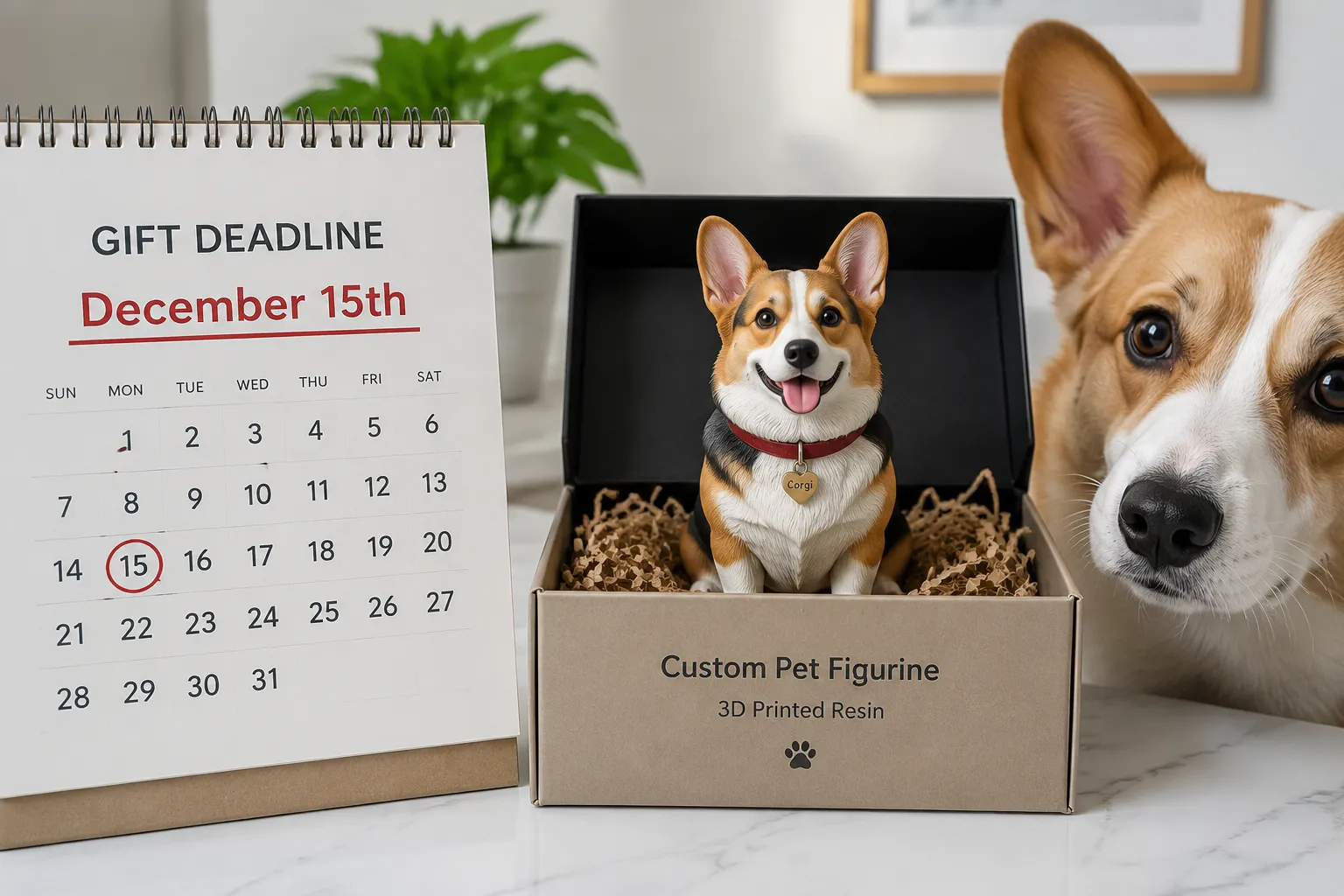
The golden light hits the water at Cannon Beach, and your Corgi bolts toward the surf—ears pinned back, stuby legs churning sand into tiny explosions. You grab your phone, snap three photos in quick succession, and think: that's the one. That's the figurine. But here's where the story of PawSculpt vs Etsy pet figurine options splits into two very different timelines—and if you're gifting that custom Corgi figurine for someone's birthday, anniversary, or memorial, the production timeline truth matters more than you'd expect.
Quick Takeaways
- Not all "custom" means the same timeline — Etsy sellers and dedicated studios operate on fundamentally different production models
- Your photo quality determines your delivery date — bad reference images add days or weeks to any custom pet figurine order
- Pet figurine delivery time varies wildly by method — the gap between 3D printing and traditional sculpting can be substantial
- Explore the full process at PawSculpt — understanding exactly how your figurine gets made helps you plan gifting timelines
- The best place to order custom pet sculpture depends on your deadline — not your budget
The Timeline Problem Nobody Talks About
Here's the thing most gift-givers discover too late: the phrase "custom pet figurine" covers an absurdly wide range of actual processes. It's like saying "custom meal"—that could mean a chef preparing your omelet to order in four minutes, or a caterer planning your wedding dinner over six months.
When you search for a custom Corgi figurine on Etsy, you'll find listings from hundreds of sellers. Some are solo artists working from their kitchen tables. Others are small studios with a handful of employees. A few are actually resellers who outsource overseas. And each of these operates on a completely different clock.
"The timeline isn't just about speed—it's about when in the process your pet actually becomes your pet in the figurine."
— The PawSculpt Team
What we've learned from working with thousands of pet families is that most people start their search about three weeks before they need the gift. Three weeks. And that number—that's where dreams collide with reality for a lot of folks.
The "Custom" Spectrum Most Buyers Don't Realize Exists
Let's break this down honestly, because nobody else seems to:
Level 1: Template-based customization. The seller has a pre-made Corgi body. They adjust the color pattern, maybe tweak the ear position. Fast, but your figurine shares its DNA with hundreds of others.
Level 2: Semi-custom sculpting. An artist starts from a base model but significantly modifies it to match your specific pet. More unique, but the timeline stretches.
Level 3: Fully custom creation. Your pet is modeled from scratch—every proportion, every marking, every quirk of their particular face built from the ground up. This is where you get something that actually looks like your dog, not a dog.
The counterintuitive insight here? Level 1 isn't always faster than Level 3. A solo Etsy artist doing template work might have a 47-person queue ahead of you. A dedicated studio with streamlined technology might produce a fully custom piece in less time because their entire operation is built for exactly this workflow.
| Customization Level | What You Get | Typical Etsy Range | Dedicated Studio |
|---|---|---|---|
| Template-based | Generic breed shape, custom colors | Varies wildly by seller queue | Not typically offered |
| Semi-custom | Modified base with your pet's features | Depends on artist availability | Faster due to workflow design |
| Fully custom | Built from scratch to match your pet | Often the longest wait | Optimized process, check website for details |
| Rush/expedited | Priority queue placement | Rarely available | Often available as an option |

Why Etsy's Marketplace Model Creates Hidden Timeline Chaos
Picture this morning routine: You wake up, coffee in hand, laptop open. You find a gorgeous Corgi figurine on Etsy—five stars, beautiful portfolio photos. You message the seller asking about timeline. No response for two days. You message again. They reply: "Currently booking for orders8-10 weeks out."
Eight to ten weeks. For a birthday that's in four.
This isn't the seller's fault. Most Etsy figurine artists are genuinely talented people running one-person operations. They're sculpting, painting, photographing, packaging, shipping, answering messages, managing their shop listings, and probably working another job. Their queue is their queue, and there's no way to parallelize a single pair of hands.
The Communication Gap
Here's something that genuinely surprised us when we started talking to customers who'd tried other options first: the biggest frustration isn't the wait itself—it's the uncertainty during the wait.
Common patterns we hear:
- "I placed my order and didn't hear anything for three weeks. I didn't know if they'd started or forgotten."
- "They sent a progress photo that looked nothing like my dog, and I didn't know how to ask for changes without being rude."
- "The listing said 4-6 weeks but it ended up being 11 weeks with no explanation."
Many Etsy sellers are wonderful communicators. But many aren't—because communication takes time they'd rather spend creating. And when you're gifting something for a specific date, that radio silence becomes genuinely stressful.
The Revision Reality
Let's talk about what happens when the first version doesn't look right. Because honestly? It often doesn't, regardless of who's making it. Custom work requires iteration.
On Etsy, revision policies are all over the map:
- Some sellers offer unlimited revisions (but each one adds week or more)
- Some offer one revision included, then charge per additional change
- Some show you nothing until it's finished and shipped
- Some will send a photo mid-process but won't make changes at that point
This is where the timeline really balloons. You thought you were on a 6-week track, but after two rounds of "the ears aren't quite right" and "his markings are more orange than brown," you're at 10 weeks. And that birthday? It passed.
The Technology Divide: Why Production Method Is the Real Timeline Story
Okay, let's get into the part that actually changes how you think about this decision. Because the method of creation is the single biggest factor in your timeline—bigger than the seller's queue, bigger than shipping, bigger than revisions.
Traditional Sculpting (Most Etsy Sellers)
The process looks something like this:
- Artist studies your photos
- Armature/wire frame built
- Clay sculpted over days or weeks
- Piece dried/cured
- Primed and painted (multiple layers, drying time between each)
- Sealed and finished
- Photographed for approval
- Shipped
Each of those steps has built-in waiting time. Clay needs to cure. Layers need to dry. The artist needs to step away and come back with fresh eyes. It's beautiful, artisanal work—but it's inherently slow.
Full-Color 3D Printing (PawSculpt's Approach)
The process is fundamentally different:
- Digital sculptor studies your photos
- 3D model created on screen (with real-time adjustability)
- Digital preview sent for your approval
- Revisions made digitally (no material waste, no drying time)
- Approved model sent to full-color 3D printer
- Color printed directly into the resin—voxel by voxel
- Clear coat applied for protection and sheen
- Shipped
Here's what matters for your timeline: steps 2through 4 can happen incredibly fast because digital sculpting doesn't require physical materials to cure, dry, or set. When our team sends you a preview and you say "his left ear flops a little more," that change happens in the digital file in minutes, not days. No starting over. No waiting for new clay to dry.
And step 6—the actual printing—produces the finished, full-color piece in one go. The color isn't a layer applied on top. It's part of the material itself. The resin comes out of the printer already bearing your Corgi's exact sable-and-white pattern, those particular amber eyes, that specific pink tongue angle.
"A custom figurine isn't just a gift—it's proof that someone saw your pet the way you see them."
| Production Stage | Traditional Sculpting | Full-Color 3D Printing |
|---|---|---|
| Initial creation | Days to weeks (physical sculpting) | Digital modeling (faster iteration) |
| Preview/approval | Photo of physical piece | Digital render before printing |
| Revisions | Requires physical rework + drying | Digital adjustments, no material waste |
| Color application | Multiple paint layers + drying between | Color printed INTO the material |
| Final finishing | Sealing painted surface | Clear coat for protection |
| Risk of damage during changes | Higher (physical manipulation) | None (digital until final print) |
The Photo Factor: How Your Input Shapes the Timeline
This is the part where you have more control than you think. And it's the part most guides completely skip.
The quality of photos you provide doesn't just affect the final result—it directly impacts how long the whole process takes. Bad photos mean more back-and-forth. More questions from the artist. More guesswork that leads to revisions later.
What Actually Makes a Good Reference Photo
Forget the generic advice about "good lighting" and "clear photos." Here's what specifically matters for a Corgi figurine (and honestly, for any pet figurine):
The ear situation. Corgis have those magnificent radar-dish ears, and they're almost never in the same position twice. Send photos showing the ears from the front AND the side. If your Corgi has one ear that's slightly wonkier than the other (they often do), make sure that's visible.
The floof factor. That Corgi butt—the famous fluffy pantaloons—looks completely different depending on whether your dog just got gromed or is in full winter coat. Send photos that represent how you think of your dog, not just the most recent snapshot.
The color truth. Phone cameras lie about color, especially with sable Corgis. That warm reddish-brown can photograph as anything from orange to dark chocolate depending on the light. If possible, send one outdoor photo in natural light AND one indoor photo. The artist can triangulate the real color.
The personality shot. This is the one people forget. Send at least one photo that captures your dog's energy—the head tilt, the play bow, the dignified sit. This is what transforms a figurine from "a Corgi" to "my Corgi."
The Photo-to-Timeline Connection
Here's the day-in-the-life scenario that plays out constantly: Sarah wants a figurine of her Corgi, Biscuit, for her mom's birthday. She sends three blurry photos taken in dim living room light. The artist messages back asking for better references. Sarah doesn't see the message for two days because she's busy. She takes new photos but it's been raining all week so the lighting is still off. Another round of messages. A week has evaporated before the actual creation even begins.
Compare that to someone who sends five clear photos from multiple angles in good light, with a note saying "his ears are more upright than they look in photo3—photo 1 is most accurate." That order moves into production almost immediately.
Your prep work is free timeline insurance.
The Gifting Calendar: Working Backward From Your Date
Let's get practical. You have a date in mind—a birthday, anniversary, a memorial. How do you work backward?
The Honest Math
For any custom figurine—whether from Etsy or a dedicated studio—you need to account for:
- Communication time: Getting quotes, asking questions, providing photos
- Queue/start time: How long before work actually begins on yours
- Creation time: The actual making of the thing
- Revision time: At least one round (plan for it even if you hope you won't need it)
- Shipping time: Don't forget this exists (people do, constantly)
- Buffer: Because life happens
The mistake most people make? They Google "custom pet figurine," find something they like, and assume the listed production time is the total time from click to doorstep. It's not. It's usually just the creation phase—and sometimes not even that.
When to Order Based on Your Deadline
We'll be real: we can't give you exact numbers for every seller out there, because every operation is different. But here's the framework:
For Etsy sellers (traditional methods):
- Check their current stated timeline
- Add 2-3 weeks for communication and revisions
- Add shipping time (domestic or international?)
- Add a 1-week buffer minimum
- If the total exceds your available time, you need a different plan
For dedicated studios like PawSculpt:
- Visit pawsculpt.com to check current production timelines (they update these)
- Digital workflows typically mean faster revision cycles
- The preview-before-printing model means fewer surprises at the end
- Still add shipping time and a reasonable buffer
The "Too Late" Pivot
Here's something nobody writes about: what to do when you've realized you don't have enough time.
Option A: Gift the promise. Create a beautiful card explaining that a custom figurine is being made. Include one of the reference photos you'll be using. People love this—it extends the anticipation and gives them something to look forward to.
Option B: Find a rush option. Some studios offer expedited production. This usually costs more, but if the date matters, it matters. Check PawSculpt's FAQ page or contact them directly about rush availability.
Option C: Choose a different format. Maybe a custom illustration or digital portrait can be produced faster and you save the figurine for a future occasion.
The point is: knowing the timeline truth early gives you options. Discovering it two weeks before the date gives you panic.
The Quality Question: Does Faster Mean Worse?
This is where people's assumptions get them into trouble. There's a deeply ingrained belief that slower = more careful = better quality. And in some contexts, that's true. A hand-thrown ceramic pot benefits from the potter taking their time.
But with modern full-color 3D printing? Speed and quality aren't inversely related the way you'd expect.
Think about it this way: when a digital sculptor spends time on your figurine, they're spending it on artistry—getting the proportions right, capturing the expression, nailing the personality. They're not spending it waiting for paint to dry or clay to cure. The technology handles the physical production with consistent precision every single time.
The color in a full-color resin print doesn't fade differently based on how fast it was printed. The structural integrity doesn't change. The detail resolution is determined by the printer's capabilities, not by how rushed the operator feels.
"Speed without sacrifice isn't cutting corners—it's removing unnecessary waiting from a process that doesn't benefit from it."
Where Speed Does Compromise Quality
Let's be fair and honest here. There ARE situations where rushing hurts:
- The artistic phase: If a sculptor (digital or traditional) is pressured to approve a model before they're satisfied, the final piece sufers. Good studios won't let this happen regardless of timeline pressure.
- The communication phase: If you rush through providing references or approving previews without really looking, you might end up with something that's technically well-made but doesn't capture your pet.
- The shipping phase: Overnight shipping with inadequate packaging can mean a broken figurine on arrival.
The key insight: the phases that benefit from patience are the human phases, not the production phases. Take your time choosing photos. Take your time reviewing the preview. But don't assume that a longer manufacturing process produces a better physical object.
PawSculpt vs Etsy: The Comparison Nobody Makes Honestly
Look, we're obviously biased here. We're PawSculpt. But we also genuinely believe in giving you the full picture, because an informed customer is a happy customer—even if they choose someone else.
When Etsy Might Be Your Better Choice
- You want a specific artistic style that a particular Etsy artist is known for (watercolor-inspired, cartoonish, ultra-realistic polymer clay)
- You have unlimited time and want to support a solo artist's creative process
- You want a specific material like polymer clay, wool felt, or ceramic
- Budget is your primary constraint and you've found a newer seller offering lower prices to build their portfolio
- You want something truly one-of-a-kind in a medium that can't be replicated by any technology
When PawSculpt Makes More Sense
- You have a specific deadline and need predictable timelines
- Accuracy to your actual pet matters most—you want it to look like YOUR Corgi, not a generic Corgi
- You want to see and approve before production (digital preview model)
- You value consistent communication throughout the process
- Color accuracy is critical—full-color 3D printing reproduces markings with precision that's hard to achieve with manual methods
- You want something durable—UV-resistant resin with integrated color won't chip or fade like surface-applied finishes
The Hybrid Approach
Here's something counterintuitive: some of the saviest gift-givers we've worked with use both. They order a PawSculpt figurine for the guaranteed-timeline gift, and they commission an Etsy artist for a longer-term piece that arrives whenever the artist's muse cooperates. Two different representations of the same beloved pet, two different artistic interpretations. It's actually kind of beautiful.
The Corgi-Specific Considerations
Since we're talking specifically about Corgi figurines, let's address what makes these stumpy legends particularly interesting (and challenging) to capture in three dimensions.
The Proportion Problem
Corgis are, let's be honest, architecturally absurd. Those short legs supporting that long body, topped with those oversized ears—the proportions that make them hilarious and adorable in life can look wrong in a figurine if the artist doesn't nail them precisely.
According to the American Kennel Club's Pembroke Welsh Corgi breed standard, the ideal Corgi is "low-set, strongurdily built" with a body that's "moderately long." But YOUR Corgi might be leggier than breed standard, or chunkier, or have a longer snout. A good custom figurine captures YOUR dog's specific version of Corgi-ness, not the platonic ideal.
The Fur Challenge
Corgi fur has that distinctive double-coat texture—smooth on top, fluffy underneath, with those dramatic "fairy sadle" markings on the back that many Pembroke owners love. In a traditional sculpted piece, representing this texture requires significant skill and time. In full-color 3D printing, the texture is captured both in the physical surface detail AND in the color mapping—those subtle gradients where the white chest meets the sable sides.
The Expression Factor
Every Corgi owner knows: these dogs have range. The head tilt. The sploot. The "I'm judging you" face. The full-speed zoomies grin. Choosing which expression to immortalize is honestly the hardest part of the whole process for most people.
Our advice? Pick the expression that makes you laugh. Not the dignified portrait pose—the one that's so them it hurts.
| Corgi Feature | Why It's Challenging | What to Provide |
|---|---|---|
| Ear position | Changes constantly, defines expression | Multiple photos showing typical ear set |
| Body proportions | Unique to each dog, easy to get wrong | Full side-view photo, standing naturally |
| Coat color transitions | Subtle gradients, hard to match | Photos in natural daylight |
| Tail (or lack thereof) | Pembroke vs Cardigan, docked vs natural | Clear rear-view photo |
| The "sploot" or chosen pose | Must look natural, not forced | Action shot or candid in desired position |
The Emotional Timeline Nobody Warns You About
We need to talk about something that goes beyond logistics. Because ordering a custom figurine of your pet—especially if it's a memorial piece—has an emotional timeline that runs parallel to the production timeline.
If Your Corgi Has Passed
The urgency feels different here. It's not about a birthday deadline. It's about neding something tangible to hold onto while the grief is still raw. Many owners report that the waiting period for a memorial figurine is emotionally complicated—it keeps the loss present in a way that's both painful and oddly comforting.
What we've seen work: order when you're ready, not when you think you should be. Some people order within days. Some wait months until they can look at photos without crying. Both are valid. The figurine will be there whenever you're ready to begin the process.
And here's the thing about memorial pieces specifically: the revision process can be emotional. Seeing a digital preview of your departed pet—rendered in three dimensions, looking alive and present—hits differently than looking at a photo. Be prepared for that. It's okay to need a day before you can respond with feedback.
If Your Corgi Is Still With You
The emotional timeline here is pure joy, but there's a specific kind of anticipation anxiety that gift-givers experience. You've ordered this thing, you're excited about it, and you cannot tell the recipient. The secret-keeping period is its own little adventure.
Pro tip from families we've worked with: use the waiting period to write a letter to go with the figurine. Explain why you chose this particular pose, what this pet means to you, why you wanted to capture them in this form. The letter often becomes as treasured as the figurine itself.
Making Your Decision: A Framework That Actually Helps
Forget pros-and-cons lists. Here's the decision framework that actually matches how real people think about this:
Ask yourself these three questions in order:
- When do I need it by? (Be honest. Add a week to whatever you're thinking.)
- What matters more: a specific artistic style, or accuracy to my actual pet?
- How much uncertainty can I tolerate during the process?
If your answers are "soon," "accuracy," and "not much"—you want a dedicated studio with a technology-driven workflow. Visit pawsculpt.com and explore their process.
If your answers are "whenever," "I love this artist's specific style," and "I'm patient"—browse Etsy with joy and find your person.
If your answers are somewhere in between—that's most people, honestly—then do your research on both options, ask specific timeline questions before ordering, and make your choice based on the answers you actually receive, not the answers listed on a shop page that might be outdated.
The Details That Separate Good From Great
One last thing before we wrap this up. Regardless of where you order, here's what separates a figurine that sits on a shelf from one that makes someone cry (in the good way) every time they look at it:
The base matters. A thoughtful base—whether it's styled like grass, sand, a favorite blanket, or kept minimal—frames the figurine and gives it context. Think about where your Corgi was happiest.
Scale matters. Too small and you lose detail. Too large and it feels like a novelty item rather than a kepsake. Most people are happiest with something they can hold comfortably in one hand.
The "wrong" angle matters. The best figurines look good from every angle—including the ones you don't see in product photos. Ask about how the piece looks from behind, from above, from the side you'll actually see it from on your shelf.
The unboxing matters. This is a gift. How it arrives—the packaging, the presentation, the care taken in transit—is part of the experience. Don't overlook this when choosing a seller.
Coming Back to the Beach
Remember that moment at the start? The golden light, the sand explosions, the three rapid-fire photos? That moment—that specific, unrepeatable convergence of light and joy your ridiculous low-rider dog charging the Pacific—that's what you're trying to preserve.
The production timeline truth isn't just about logistics. It's about respecting the weight of what you're asking someone to create. You're asking them to take a living, breathing, zoming creature and distill them into something you can hold in your hands forever.
Whether you choose an Etsy artist who'll spend weeks lovingly shaping clay, or you choose PawSculpt's full-color 3D printing technology that captures every marking in precision resin—the best place to order a custom pet sculpture is the one that gives you confidence your pet will be seen. Really seen. Not as a breed, but as a soul.
Start early. Send good photos. Be honest about your deadline. And when that figurine finally arrives—however it was made, wherever it came from—set it somewhere you'll see it on ordinary Tuesday mornings. That's when it matters most.
Frequently Asked Questions
How long does a custom Corgi figurine take to make?
It depends entirely on the production method and the seller's current queue. Traditional sculpting on Etsy can range from 6-12 weeks or more, while technology-driven studios like PawSculpt often have shorter, more predictable timelines. The best approach is to check current production estimates directly with your chosen seller before ordering—and remember that the stated production time usually doesn't include communication, revisions, or shipping.
Is PawSculpt better than Etsy for custom pet figurines?
Neither is universally "better"—they serve different needs. PawSculpt excels at color accuracy, predictable timelines, and a preview-before-production workflow using full-color 3D printing. Etsy excels at offering diverse artistic styles, unique materials (polymer clay, felt, ceramic), and supporting independent artists. If you have a firm deadline and want accuracy, a dedicated studio makes sense. If you want a specific artistic interpretation and have flexible timing, Etsy can be wonderful.
What photos do I need for a custom pet figurine?
Aim for 4-5 clear photos from multiple angles: front face, full side profile, three-quarter view, and any detail shots showing unique markings. Shoot in natural daylight when possible. Include at least one "personality shot" that captures your pet's typical expression or pose. For Corgis specifically, make sure ear position and coat color transitions are clearly visible.
How far in advance should I order a custom pet figurine as a gift?
As early as you possibly can. Most people underestimate the total timeline by 2-4 weeks because they forget to account for initial communication, photo gathering, revision rounds, and shipping. A good rule: take whatever deadline you have, subtract at least a week for buffer, and start your research well before that adjusted date.
Are 3D printed pet figurines good quality?
Modern full-color resin 3D printing produces remarkably detailed figurines. The color is integrated directly into the material (not painted on top), which means it won't chip, peel, or fade the way surface-applied finishes can. The pieces have a fine natural texture protected by a clear coat, resulting in a vibrant, durable kepsake. It's a different aesthetic than traditional sculpting—neither better nor worse, just different.
What if my custom figurine doesn't look like my pet?
This is why the preview/revision process matters so much. Studios that offer digital previews (like PawSculpt) let you see and approve the design before any physical production happens—making changes is quick and cost-free at that stage. For Etsy sellers, confirm their revision policy upfront: how many rounds are included, what changes are possible mid-process, and what happens if you're not satisfied. Good communication and clear reference photos dramatically reduce the chance of disappointment.
Ready to Celebrate Your Corgi?
Every Corgi has a personality bigger than their legs are long. Whether you're memorializing a companion who gave you years of joy or celebrating the ridiculous, wonderful dog currently asleep on your feet, a custom figurine captures the specific details—the ear tilt, the markings, the expression—that make your pet irreplaceable. Now that you know the production timeline truth about where to find the best custom Corgi figurine, you can plan with confidence.
Visit pawsculpt.com to explore the full process, current timelines, and satisfaction guarantees