Is a Custom Poodle Figurine Worth It? Reviewing the Digital Sculpt of a Curly Coat
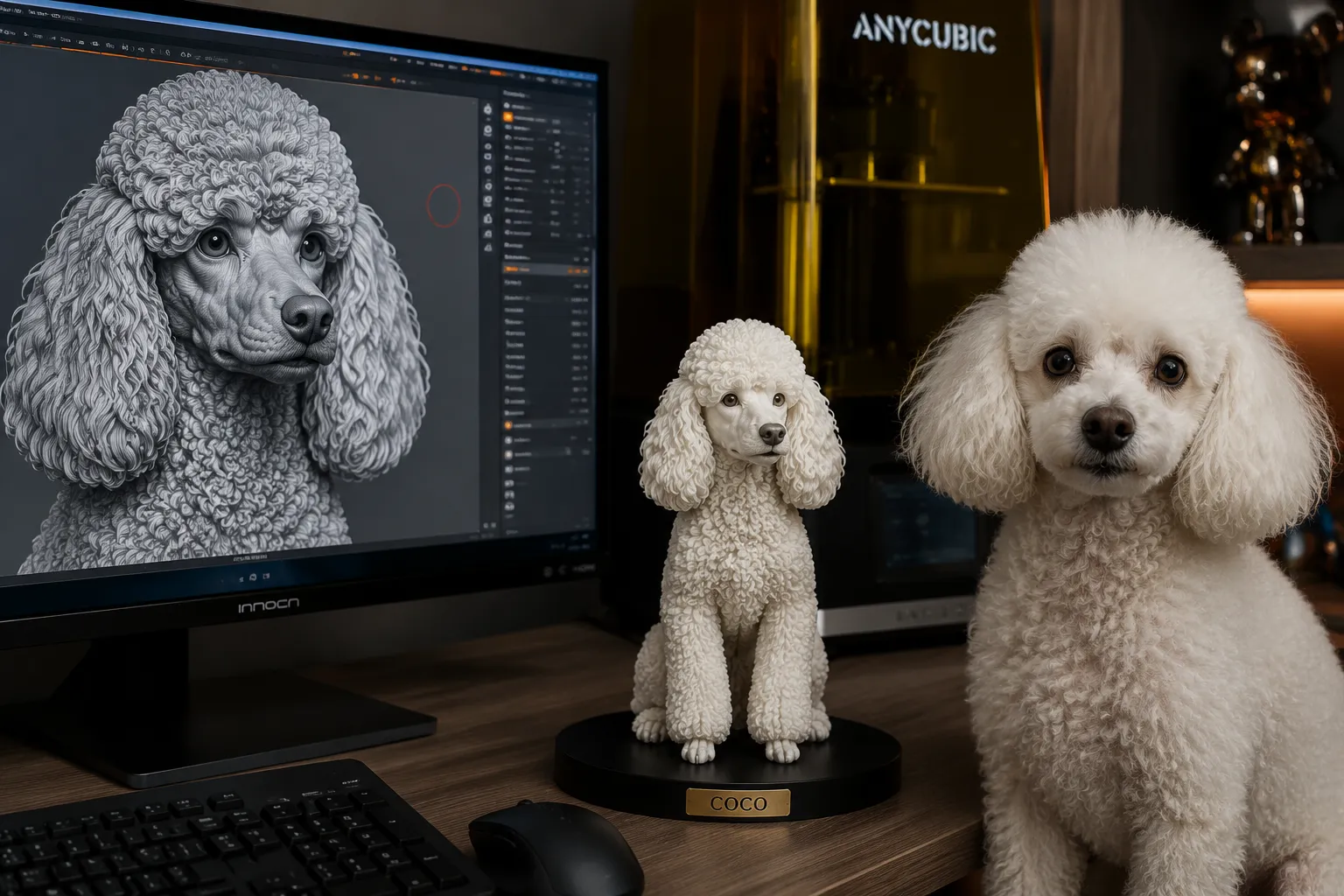
"The poodle's curls are not decoration. They are architecture." — a sentiment every groomer eventually learns the hard way
At the dog park, a silver Standard Poodle shakes off the drizzle, and every curl springs back into place. That spring—that exact texture—is the reason a custom poodle figurine is one of the hardest things our studio ever has to get right.
Quick Takeaways
- A poodle's curly coat is the single toughest coat type to sculpt — judge any figurine by how it handles curls.
- The digital sculpt preview is where the real decision happens — approve the curl flow, not just the pose.
- Full-color 3D printing embeds color in the resin — no painting, no fading brushwork, no peeling layers.
- Worth depends on the sculpt review, not the price tag — see how the digital sculpt process works before you commit.
- Reference photos with raking light beat studio glamour shots — texture matters more than a pretty pose.
Why a Poodle's Curly Coat Breaks Most Figurines
Here's something most companies won't tell you: a Labrador is easy. A pug is easy. Short, smooth, predictable coats forgive a lot of sins in a sculpt. A poodle does not forgive anything.
The curl is the problem. And the gift.
When we talk about a curly coat 3D sculpt, we're really talking about thousands of tiny, overlapping volumes—each curl casting a shadow on the one beneath it. Get the rhythm wrong and the dog stops looking like a poodle. It starts looking like a topiary, or a cloud, or a poorly frosted cake. We've seen all three in early drafts, and we've learned to spot the failure before it leaves the screen.
A poodle's coat isn't random, either. It has flow. The curls on the chest fall differently than the curls on the hindquarters. The topknot has its own logic. A bracelet-trimmed leg reads completely differently from a sporting-clip leg. If a sculptor treats all that fur as one uniform texture, the result feels dead—technically a poodle, emotionally a stranger.
That's the counterintuitive part. Most people assume the hard part of a poodle figurine is the face. It isn't. The face is straightforward. It's the coat that separates a keepsake you'll cherish from a generic dog statue that happens to be apricot.
"A poodle figurine lives or dies on the curls. Everyone looks at the eyes first. We look at the haunches."
What "good curls" actually look like in a sculpt
When our team reviews a poodle sculpt, we're not asking "does this look fluffy?" We're asking sharper questions:
- Do the curls have direction? Real curls flow with the body's contours, not against them.
- Is there depth variation? Flat, evenly-sized curls look printed-on. Real coats clump and vary.
- Does the silhouette read at arm's length? Squint at it. If the outline still says "poodle," the curl mass is working.
- Are the trim transitions honest? The line where a clipped area meets longer fur should be crisp, not smudged.
This is the lens we'll use for the rest of this article. Because the question "is a pet figurine worth it" has a different answer for a poodle than it does for almost any other breed.
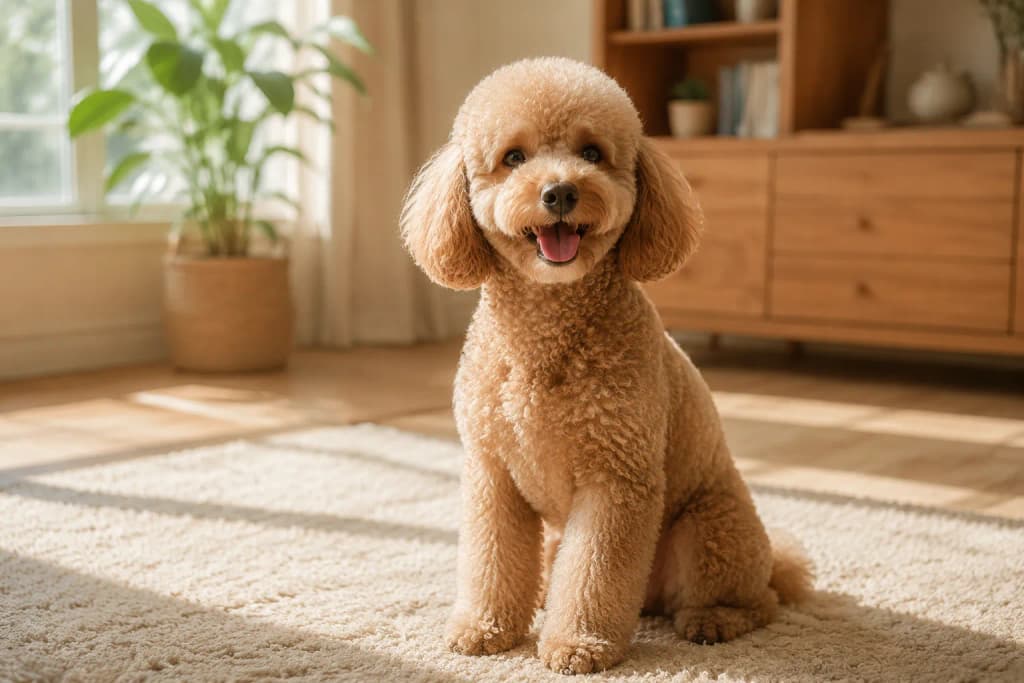
Is a Pet Figurine Worth It? The Honest Answer
We'll be real with you. Sometimes the answer is no.
If you want a rough likeness to sit on a desk and you're not fussy about whether it truly looks like your dog, you can find cheaper mass-produced poodle figures. They exist. They're fine for what they are. We're not going to pretend otherwise.
But that's not why people come to us. People come to us because the dog in their head has a specific face, a specific coat, a specific tilt of the head when the doorbell rings. And for that dog, a generic figure is almost worse than nothing—because the gap between "kind of looks like him" and "that's HIM" is the gap where the heartbreak lives.
So the worth question really breaks down into three honest sub-questions.
Question one: Do you want your poodle, or a poodle?
This sounds obvious. It isn't. A surprising number of folks think they want a custom piece, then realize they'd be just as happy with a breed-accurate generic one. There's no shame in that—it saves money. The custom route is worth it only when the individual details matter to you: the asymmetrical ear, the gray coming in around the muzzle, the slightly crooked sit.
One family we worked with had a Standard Poodle who'd lost a little fur on one flank from an old surgery. They specifically asked us to keep it. That scar was part of who he was. That's when custom earns its keep.
Question two: Can the coat actually be captured?
Curly coats are demanding, but they're also where the value concentrates. A well-executed curly coat 3D sculpt is genuinely hard to find off the shelf, because mass production smooths everything into vague bumps. When you see your dog's actual curl pattern reproduced—the topknot, the tail pom, the way the chest fur sits—that's the moment the price stops feeling like a price.
Question three: Will you actually keep it where you'll see it?
Here's the spatial truth nobody mentions. A figurine's worth is measured in proximity. The piece that sits on a high shelf in the guest room, visited twice a year, returns very little. The one on the nightstand—the one your hand passes every morning—returns something every single day.
Before you buy, decide where it lives. The empty corner of a desk. The windowsill where the dog used to nap in the sun. The spot matters as much as the sculpt.
"A keepsake you never reach for is just clutter. A keepsake within arm's reach becomes a habit of remembering."
Inside the Digital Sculpt Review: Reading a Curly Coat
This is where we earn our reputation, so let's go behind the curtain.
Every PawSculpt poodle starts the same way: a master 3D artist digitally sculpts your dog inside professional modeling software (think ZBrush or Blender—the same tools used for film and game characters). Nothing physical exists yet. It's all on screen, fully rotatable, fully editable. This stage is your real decision point, and most people rush through it. Don't.
When your digital sculpt review preview arrives, here's how a practitioner actually inspects it.
Step one: Check proportions before texture
Ignore the curls at first. Seriously. Look at the skeleton underneath. Is the leg length right? Is the chest depth right? Is the muzzle the correct ratio to the skull? Poodles vary enormously—a Toy's proportions are nothing like a Standard's, and even within Standards, leg-to-body ratio differs.
We use the reference photos to do proportional checks against landmarks: eye-to-eye width, ear set, the distance from elbow to ground. If the bones are wrong, no amount of beautiful fur saves it. Fix structure first.
Step two: Read the coat flow
Now the curls. We trace the flow lines—imaginary paths the fur follows across the body. On a poodle, these radiate from a few growth centers and cascade down. A good sculptor builds the curl mass along these lines, not as a uniform stipple.
This is the make-or-break stage for the custom poodle figurine. Ask yourself: does the topknot sit right? Does the coat get denser where it should (chest, hindquarters) and tighter where it's trimmed? If something feels off here, say so. This is exactly what revisions are for.
Step three: Silhouette and symmetry
We rotate the model and check the outline from straight-on front, straight-on back, and both profiles. Curly coats hide asymmetry well to the casual eye but a trained one catches it fast. We're looking for a left ear that drifted larger than the right, or a topknot leaning off-center.
Step four: The face, last
Counterintuitive again—we lock the face after the coat, because the surrounding fur frames the expression. A great muzzle inside a wrong coat still reads wrong.
Here's a quick reference for what to scrutinize at each review stage:
| Review Stage | What to Check | Red Flag |
|---|---|---|
| Proportions | Leg length, chest depth, muzzle ratio | "Looks like a different size poodle" |
| Coat flow | Curl direction, density variation | Uniform, stippled, topiary-like fur |
| Silhouette | Outline reads as poodle from all angles | Blobby or generic dog shape |
| Symmetry | Even ears, centered topknot | One side visibly heavier |
| Face | Eye set, expression, muzzle | Expression feels "off" or blank |
The single best thing you can do during review? Compare the sculpt to your photos side by side, not from memory. Memory lies. Memory smooths and idealizes. Photos keep you honest.
From Screen to Shelf: How Full-Color 3D Printing Handles Curls
Once you approve the sculpt, the digital file goes to print. And this is where we need to clear up a big misconception, because it changes how you should think about the whole product.
We do not paint these figurines. No brushes, no acrylics, no white model that gets colored in afterward. PawSculpt uses full-color resin 3D printing—a process where the printer lays down color and material together, voxel by voxel (a voxel is just a 3D pixel, a tiny cube of colored resin). Your poodle's apricot, silver, black, or parti-color is embedded inside the resin itself, not coated on top.
Why does this matter for curls specifically? Because hand-painting a coat with this much micro-texture would be a nightmare—every curl shadow, every density shift would have to be faked with a brush. Instead, the color information lives in the digital model and prints exactly as designed. The subtle gradient where a silver poodle's coat goes lighter at the tips? That gets reproduced directly in the material.
The tradeoffs we won't hide from you
No process is magic. Here's the honest engineering picture.
Full-color resin printing gives you vibrant, accurate color and excellent detail resolution—often in the range of tens of microns per layer (a micron is a thousandth of a millimeter, so we're talking very fine). That fineness is exactly why curl texture survives the trip from screen to shelf.
But resin has personality. Some formulations lean brittle, others tougher; there's always a tradeoff between crisp detail and impact resistance. A super-detailed thin tail pom is gorgeous and also the first thing to chip if the piece takes a tumble. We design with that in mind—thickening vulnerable areas just enough without losing the look.
Print orientation matters too. The angle a model is printed at affects where support structures touch the surface. Supports are temporary scaffolds that hold overhangs up during printing; where they attach, they can leave tiny marks (we call it support pitting or scarring). A good shop orients the model so any contact points land in low-visibility zones, then cleans them in post-processing.
Speaking of which, here's what actually happens after printing:
- Washing — uncured resin is rinsed away so fine curl detail doesn't get gummed up.
- Curing — UV light hardens the resin fully. Under-cure leaves it soft and tacky; over-cure makes it brittle and can yellow light colors. It's a balance.
- Support removal & light finishing — supports come off and any contact marks are gently smoothed.
- Clear coat — the only manual step. A protective clear varnish goes on to seal the surface, add a subtle sheen, and boost UV resistance so colors hold up.
That clear coat is the closest thing to "handwork" in the whole process, and its job is protection, not color.
| Aspect | Full-Color Resin 3D Print | What It Means For You |
|---|---|---|
| Color source | Embedded in resin during printing | Won't flake or peel like paint |
| Detail level | Very fine (tens of microns typical) | Curl texture and trim lines survive |
| Durability | Sturdy, but fine parts can chip | Keep it off the edge of the shelf |
| Finish | Natural print grain under clear coat | Authentic texture, not glossy plastic |
| UV resistance | Boosted by clear coat | Colors hold up in normal light |
One honest note on appearance: because this is a 3D print, you may see an extremely fine grain or layer texture up close under raking light (light hitting at a low angle). We consider that a feature, not a flaw—it reads as authentic surface, not the soulless smoothness of injection-molded plastic. If you want glass-smooth perfection, that's a different product and, frankly, a less characterful one.
"Every curl tells you something about the dog. Our job is to make sure not one of them gets flattened into a generic bump."
— The PawSculpt Team
What Photos Actually Capture a Curly Coat
You can have the best sculptors in the world and still get a mediocre poodle figurine if the reference photos are bad. Garbage in, garbage out applies brutally here. So let's fix that before you ever place an order.
The mistake most people make is sending their prettiest photos. The glamour shot. The one where the dog is backlit by golden sunset and looks like a shampoo commercial. Those are gorgeous and nearly useless to a sculptor, because backlight kills texture and turns curls into a flat halo.
What we actually need is the opposite of glamour: flat, even light that reveals the coat. An overcast day outdoors is perfect. So is open shade. The goal is to see into the curls—the depth, the direction, the clumping—not to flatter them away.
The angles that matter most
For a poodle especially, we want:
- A straight profile (full side view, standing) — this is the workhorse shot for coat flow.
- A front-on face shot at the dog's eye level — crouch down; don't shoot from above.
- A three-quarter view — splits the difference and confirms proportions.
- A back/hindquarter shot — poodles carry a lot of coat character back here, and it's the most-skipped angle.
- A close-up of the coat texture — get near enough to see individual curls in one area.
That last one surprises people. A dedicated texture close-up, even just of the chest or a leg, tells the sculptor more about your dog's specific curl pattern than ten full-body shots.
Here's a quick photo guide we share with every poodle client:
| Shot | Why It Matters | Pro Tip |
|---|---|---|
| Full side profile | Captures coat flow & posture | Dog standing naturally, square to camera |
| Eye-level face | Locks expression & ear set | Crouch to their height |
| Three-quarter | Confirms proportions | Slight angle, full body in frame |
| Hindquarter/back | Often-missed coat character | Don't skip this one |
| Coat close-up | Reveals true curl pattern | Fill the frame with one fur area |
| Raking-light detail | Shows curl depth | Shoot with side light, overcast day |
A few more field-tested tips. Take photos when the coat is freshly groomed and dry—a wet or matted coat hides the very texture you're paying to preserve. Avoid heavy filters; that "warm" filter shifts an apricot poodle toward a color that isn't real. And if your dog has crossed the rainbow bridge and you only have a handful of photos, send everything you have, blurry ones included. Our team has built beautiful sculpts from imperfect archives. We're used to it. (The American Kennel Club's Poodle breed standard is also a useful sanity-check for proportions when photos are limited.)
What to Expect When You Order
We won't quote you exact timelines or prices here—those shift, and we'd rather you get current details straight from the source than trust a number in a blog post that might be stale by the time you read it. You can find the up-to-date specifics on our custom figurine process page. What we can give you is the honest shape of the journey.
The general arc
- You submit photos and details — the more reference angles, the better the sculpt.
- A 3D artist digitally sculpts your poodle — structure first, then coat.
- You review the digital preview — this is your moment; scrutinize the curls.
- Revisions if needed — adjustments happen here, on screen, before anything prints.
- Full-color 3D printing & post-processing — print, wash, cure, finish, clear coat.
- Your figurine arrives — ready for that nightstand or windowsill you picked out.
The stage that determines everything is stage three. We genuinely mean it when we say slow down there. Pull up your photos. Walk away for an hour and come back with fresh eyes. The sculpt is infinitely editable while it's digital and not at all editable once it's resin.
Caring for your finished poodle
Once it's on your shelf, care is refreshingly low-effort:
- Dust gently with a soft, dry brush or microfiber cloth—the curl texture catches dust, so a soft brush beats a flat wipe.
- Keep it out of direct, all-day sun. The clear coat helps with UV, but no material loves baking in a south window forever.
- Avoid the shelf edge. Fine details like tail poms and ear tips are the chip risk. Place it where a passing elbow won't send it flying.
- Don't soak it. A barely-damp cloth for stubborn dust is fine; submerging resin is not.
What We Wish We Knew Sooner
A candid retrospective from our team—the stuff we figured out the hard way over hundreds of poodle orders.
- The first preview almost never nails the topknot. And that's normal. We used to apologize for it; now we just tell clients upfront that the topknot usually takes one revision pass. Curly crown geometry is genuinely tricky.
- People underestimate how much trim style matters. A continental clip and a puppy clip on the same dog produce two completely different figurines. Tell us the trim you want immortalized—we can't read your mind, and your dog's coat changes through the year.
- Customers regret choosing the "dramatic" pose more than the natural one. That heroic, head-thrown-back stance looks cool in concept and slightly theatrical on a shelf for years. The quiet, natural sit ages better. Every time.
- The location decision should come first, not last. The folks happiest with their figurines picked the spot—the desk corner, the empty cushion's end of the couch—before it arrived. The piece felt like it belonged because there was already a space waiting.
Honestly, that last one is the thread running through this whole article. A custom poodle figurine isn't really about the resin. It's about reclaiming a small piece of space that the dog used to fill—and now fills again, in a way you can reach out and touch.
Frequently Asked Questions
Is a custom poodle figurine actually worth the money?
It depends on what you want. If a rough likeness is enough, a mass-produced figure is cheaper and fine. But if your dog's specific curl pattern, trim, and personality matter to you, a custom curly coat 3D sculpt captures things off-the-shelf pieces simply can't. The worth lives in the individual details.
Do you hand-paint the figurines?
No, and this is a common assumption worth correcting. We use full-color 3D printing, where the color is printed directly into the resin material—not brushed on afterward. The only hands-on step is applying a protective clear coat that seals the surface and adds a subtle sheen.
Why are poodles harder to capture than other breeds?
The curls. A poodle's coat has direction, density variation, and trim-specific structure that all have to be sculpted correctly or the dog reads as generic. Short-coated breeds forgive a lot; poodles forgive nothing. That's exactly why a well-done poodle sculpt is so satisfying.
What should I look for during the digital sculpt review?
Check proportions first, then coat flow, then symmetry, then the face. Compare the preview against your real photos side by side rather than from memory. If the curls feel uniform or the silhouette looks blobby, that's your cue to request a revision—while it's still editable on screen.
How do I take good reference photos of my poodle?
Shoot in flat, even light (overcast or open shade), not backlit glamour shots. Get a full side profile, an eye-level face shot, a hindquarter view, and at least one close-up of the coat texture. Freshly groomed and dry is ideal, since a matted coat hides the curl detail.
How do I care for the finished figurine?
Dust it gently with a soft brush or microfiber cloth, keep it out of all-day direct sun, and place it away from shelf edges so delicate parts don't chip. Skip soaking—a barely-damp cloth for stubborn dust is the most water it should ever see.
Ready to Celebrate Your Pet?
Every pet has a story worth preserving. Whether you're honoring a beloved companion who's crossed the rainbow bridge or celebrating your curly-coated friend's unbreakable spirit, a custom poodle figurine from PawSculpt captures the exact curls, trim, and tilt of the head that make your dog unmistakably yours.
Visit pawsculpt.com to explore our digital sculpt process, preview timeline, revision options, and quality guarantee.