
5 Daily-Routine Myths That Could Be Slowing Down Your Mid-Life Abyssinian
The hallway tile still carries it: that faint warm-biscuit smell of an Abyssinian who slept in the sunbeam by the door. If you do abyssinian cat care the way most guides tell you to, that same cat at seven can start moving like she's eleven. And the routine you trust is often the quiet culprit.
Quick Takeaways
- Mid-life slowdown is usually routine-induced, not age-induced — most "aging" signs are habit problems in disguise.
- Free-feeding dulls an Abyssinian's drive — switch to timed meals to wake up their natural hunting energy.
- Novelty beats consistency for this breed — rotate toys, paths, and play styles every few days.
- Capture your cat's spirit now, while it's vivid — many families preserve that energy with custom pet figurines before time blurs the details.
- Same food forever isn't loyalty, it's stagnation — mid-life metabolism shifts and the bowl should too.
The Lie Hiding in Your "Perfect" Routine
Here's the thing nobody tells you about Abyssinians.
They are not low-maintenance cats wearing a low-maintenance coat. They look sleek and self-sufficient, that ticked ruddy fur catching light like polished copper, and so we assume they run on autopilot. Feed them. Clean the box. Let them do their athletic thing on the bookshelf. Done.
But this breed is wired differently. An Abyssinian is closer to a border collie in a cat suit than to your neighbor's contented orange loaf. They need a job. They need a hunt. They need their day to mean something.
And somewhere around year six or seven, a strange thing happens. The cat who used to greet you at the door with that chirping trill starts sleeping through your arrival. The one who scaled the curtains now watches them. We hear this constantly from families who reach out to us, usually with a photo and a sentence that breaks our hearts a little: "She used to be so full of life."
Most of them blame age.
"Your cat didn't get old overnight. The routine got old, and she followed it down."
We're going to walk through five cat daily routine myths that quietly age your Abyssinian before her time. Not medical stuff — we're not vets, and for anything that smells like a health concern you should absolutely loop in your vet. This is about the rhythms. The rituals. The invisible architecture of a day that either keeps a spirit lit or slowly dims it.
Because here's what we've come to believe after years of preserving these animals in resin: the way you spend the ordinary Tuesday is the relationship. It's the whole sacred contract. And mid-life is exactly when that contract gets renegotiated, whether you notice or not.
Let's bust some myths.
Myth #1: "Free-Feeding Keeps Her Happy and Full"
Picture the bowl. Always topped off, sitting in the same corner of the kitchen, that dry kibble smell going slightly stale by evening. It feels generous. Loving, even. She'll never go hungry.
And it's slowly flattening her.
Why the Always-Full Bowl Betrays a Hunter
An Abyssinian's ancestry runs through some of the most relentless little predators in the feline world. Their entire nervous system is built around a loop: stalk, chase, pounce, kill, eat, groom, sleep. That's the sacred sequence. That's the rhythm their spirit actually runs on.
When food is just there, available 24/7, you've deleted the first four steps of that loop. You've handed her the reward without the ritual. And a hunter without a hunt doesn't become relaxed. She becomes hollow.
The mid-life part matters here. A young Abyssinian burns off the restlessness in sheer chaos — zoomies at 2 AM, knocking your glass off the counter for sport. By mid-life, that frantic energy fades, and if there's no structured outlet, it doesn't transform into healthy calm. It curdles into apathy. The slowdown you're seeing isn't aging. It's a hunter who forgot she was one.
"A full bowl feeds the body and starves the instinct."
What Actually Works
Switch to timed, measured meals — two to three a day, at roughly the same times. Here's the counterintuitive move most people miss: don't just put the bowl down. Make her work a little.
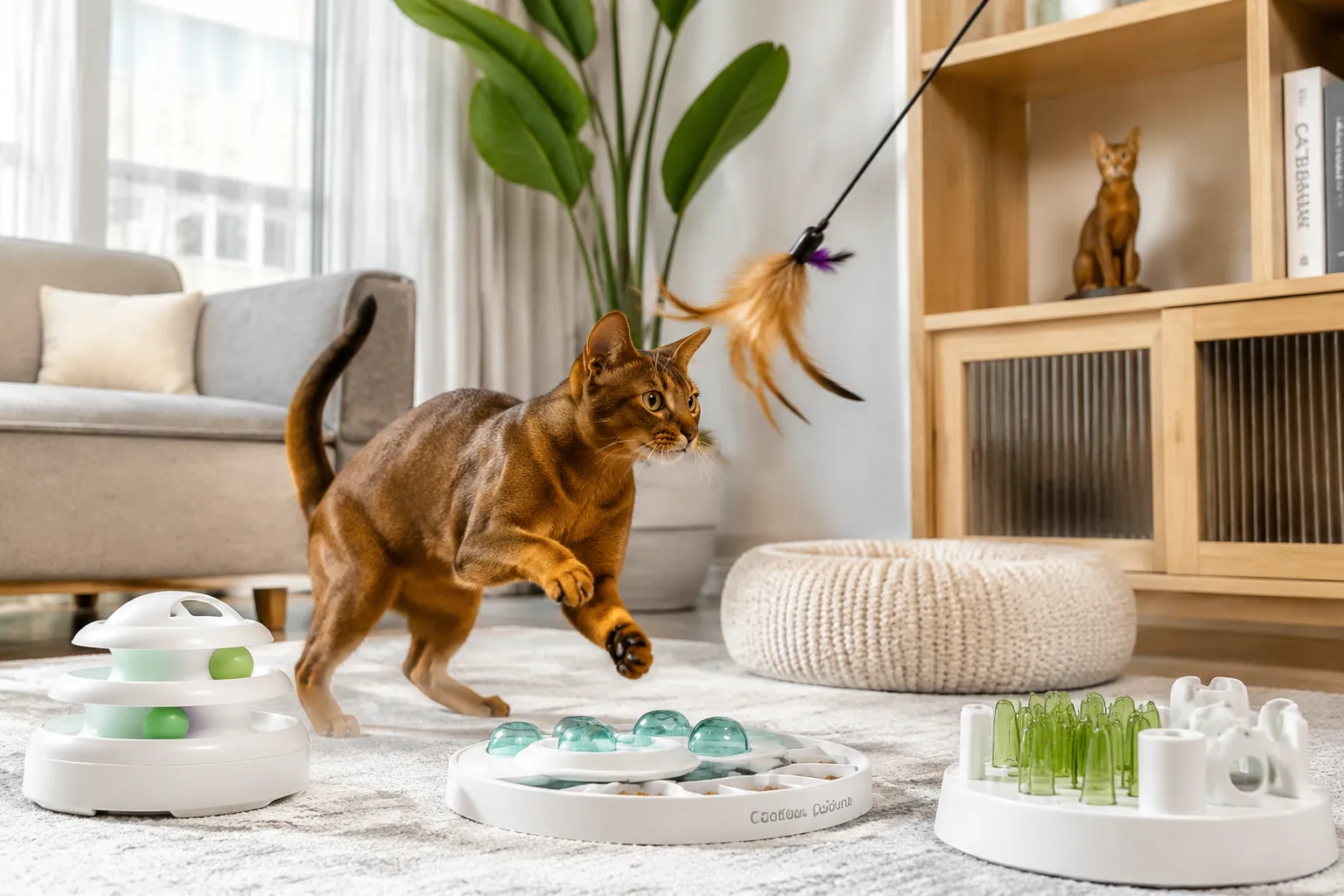
- Use a food puzzle or a snuffle mat so the meal requires problem-solving
- Toss a few kibble pieces down the hallway so she has to chase and "catch" them
- Do a quick 5-minute wand-toy hunt right before meals, so the play flows into the reward like it would in the wild
So what? Because you're not just feeding her. You're handing back the loop her soul is built around. We've watched families describe a genuinely different cat within two or three weeks — more vocal, more present, waiting by the play spot at dinnertime with that old electric focus back in her eyes.
Personal Aside: Honestly, this one took our own team a while to accept. A couple of us are dog people at heart, and the idea that a cat needs a "job" sounded precious. Then one of our 3D artists started timed feeding with her ruddy Aby, Saffron, and sent us a video three weeks later of the cat doing actual parkour off the fridge. We stopped doubting.
For specifics on portion sizes and ideal feeding schedules by weight, the American Veterinary Medical Association has solid, non-hysterical guidance worth bookmarking.
Myth #2: "She Exercises Herself — She's a Cat"
The scenario goes like this. You watch her sprint up the cat tree once in the morning, conclude she's getting her cardio, and move on with your life. She's independent. She'll move when she wants to move.
For most cats, sure. For an Abyssinian in mid-life? That's the myth that quietly turns muscle into stiffness.
The 15-Minute Ritual That Changes Everything
Self-directed movement drops off a cliff in mid-life. Not because she can't move, but because she has no reason to. There's no prey. No challenge. No partner in the hunt. Movement without meaning doesn't happen, and an Abyssinian is too smart to burn energy on nothing.
So you become the meaning.
We're talking 15 minutes of undivided, floor-level play each evening. Not 15 minutes of you on the couch flicking a laser while scrolling your phone. Present. On the ground. Phone in another room. This is a ritual, and rituals demand your actual presence to work.
Here's a simple structure that respects how their bodies and instincts work:
| Play Phase | Duration | What It Does |
|---|---|---|
| Slow stalk (drag toy low) | 3-4 min | Wakes the predator brain, warms muscles |
| Fast chase (erratic darts) | 4-5 min | Cardio, joint mobility, real exertion |
| The "catch" (let her win) | 2-3 min | Completes the loop, prevents frustration |
| Wind-down (slow drags) | 2-3 min | Cools her down, signals the hunt is over |
That "let her win" line is the part everyone skips. A laser pointer is the worst offender here — she can never catch the dot, so the loop never closes, and she's left vibrating with unfinished instinct. Always end with a physical toy she can sink her claws into. An uncaught hunt is a small cruelty.
"Presence is the only toy she actually needs. Everything else is just the excuse."
So what does this buy you? Joint mobility that doesn't quietly degrade. A cat who sleeps deeply instead of dozing restlessly. And honestly, a reconnection that you'll feel too — there's something almost meditative about those 15 minutes that the day's noise can't touch.
Myth #3: "Mid-Life Means She Naturally Wants Less Stimulation"
This is the saddest myth, because it's the one that sounds the most like wisdom. She's settling down. She's a senior in spirit now. She prefers her quiet life.
We'd gently push back on almost all of that.
Boredom Wears the Mask of Aging
An Abyssinian's defining trait — the thing breed people will talk your ear off about — is relentless curiosity. They open cabinets. They investigate the shower. They supervise your every chore with intense interest. That curiosity doesn't have an expiration date stamped at age six.
What does happen is the environment goes stale. Same furniture. Same view. Same three toys she's had since kittenhood, now smelling like nothing new. A brilliant, curious mind in an unchanging room doesn't mellow into contentment. It checks out. And a checked-out cat looks exactly like an aging cat — the sleeping, the disinterest, the flatness.
Here's the commonly overlooked truth: for this breed, novelty is more important than consistency. That flips most cat advice on its head. Yes, cats love routine — but Abyssinians need the routine to contain novelty. The ritual stays; the content rotates.
Try this rotation approach instead of the static toy bin:
- Rotate toys in and out every 3-4 days so old toys feel new again
- Change one vertical path weekly — move a perch, add a box, rearrange the cat tree
- Introduce new scents — a sprig of cat-safe herbs, a cardboard box from a delivery, anything carrying the outside world's smell
- Bring sound and motion to a window — a bird feeder outside the glass is the cheapest entertainment in existence
The scent piece deserves emphasis. A cat's world is built of smell far more than sight, and a fresh aroma — that earthy hit of a new box, the green snap of fresh catnip, rain blowing in through a cracked window — lights up the brain in a way no new toy can. Smell is novelty in its purest form for them.
"She's not slowing down. She's waiting for you to make the world interesting again."
We had a family tell us their nine-year-old Aby "came back" after they simply started leaving the bathroom door open so she could patrol a new room. Nine years old. Reborn by a doorway. That's not an outlier — that's the breed.
Myth #4: "Consistency Is King — Never Change Her Food"
The instinct here is pure love. She did great on this food for years, so why risk it? Change is stress. Stability is care.
But a mid-life body is not a young body, and feeding it like one is its own quiet harm.
Loyalty to the Bag vs. Loyalty to the Cat
Around mid-life, a lot shifts under the hood — activity levels, metabolism, how efficiently she processes protein and fat, her hydration needs. The food that built her muscular young body may now be quietly outpacing her energy burn, or under-supporting her changing joints. Feeding the same formula at the same volume for a decade isn't consistency. It's inertia wearing consistency's clothes.
We want to be careful here — we're not vets, and diet changes for a specific cat belong in a conversation with your actual veterinarian. So treat this as a prompt to ask, not a prescription.
That said, here's a general framework families find useful for thinking about mid-life feeding shifts:
| Life Stage | Rough Age | What Often Shifts | Worth Asking Your Vet |
|---|---|---|---|
| Young adult | 1-5 yrs | Peak energy, high burn | Maintenance portions |
| Mid-life | 6-10 yrs | Slowing metabolism, joint care | Calorie adjustment, hydration |
| Senior | 11+ yrs | Kidney, digestion, dental | Senior-specific formulas |
The hydration line matters more than people realize. Abyssinians, like many cats, are chronically under-drinkers — they evolved getting most of their moisture from prey, not bowls. By mid-life, that low-grade dehydration starts to matter. Adding wet food or a pet fountain can be one of the highest-impact changes you make, and it's the kind of thing that quietly supports everything else.
So what? Because the bowl isn't a shrine to the past. It's a living tool that should evolve with the actual cat standing in front of you, not the kitten in your memory.
"Every whisker, every ticked stripe of fur, tells a story. Our job is to capture the ones that matter most — while they're still bright."
— The PawSculpt Team
A Gentle Note on Catching the Spirit Before It Shifts
This is the part of mid-life that sneaks up on people, and it's why we do what we do.
Mid-life is the golden window. She's still got that copper shine, that athletic line, that mischievous expression — but she's also entering the years where the details start to drift. The exact pattern of her ticking. The specific tilt of her ears when she's plotting. The way she holds herself mid-leap.
A lot of families wait until the end to think about memorializing a pet, and we understand why. But some of the most meaningful pieces we create are of living cats, captured right at this vibrant peak. We don't paint these, by the way — that's a common misconception. Each one is digitally sculpted by master 3D artists, then precision 3D printed in full color, so the ticked coat and those specific markings come through in the resin itself. You can see how the process works at pawsculpt.com.
It's not about preparing for grief. It's about honoring a presence while it's fully, gloriously here.
Myth #5: "A Clean, Hands-Off Routine Means She Needs Less From You"
The final myth is the most seductive because it flatters us. Box is scooped. Coat looks great on its own — Abyssinians are famously low-grooming. Water's fresh. So the relationship runs itself now, right? You've graduated to easy mode.
This is where the spiritual contract gets quietly broken.
The Bond Is a Practice, Not a Possession
An Abyssinian bonds hard. They're often called "Velcro cats" for a reason — they want to be wherever you are, involved in whatever you're doing. The independence is a myth; the aloofness is a costume.
When your routine becomes purely transactional — feed, clean, repeat — you strip out the connective tissue. The grooming sessions. The conversations (and yes, they talk back). The simply being together with no task attached. And a Velcro cat deprived of velcro doesn't become more independent. She withdraws, and the withdrawal looks, once again, exactly like aging.
Here's the overlooked piece: even a low-grooming breed benefits enormously from being brushed a few minutes a week — not because the coat needs it, but because she does. It's touch. It's ritual. It's that quiet mutual grooming that, in the wild, only happens between animals who trust each other completely. You're not maintaining fur. You're maintaining a bond.
Build these tiny rituals into the structure of your week:
- Morning hello — a real one, eye contact and her name, before the chaos starts
- The weekly brush — 5 minutes, slow, while you talk to her
- A shared quiet hour — you reading, her on your lap, no agenda
- The bedtime check-in — the day's closing ritual, predictable and warm
"She doesn't need a bigger house or fancier toys. She needs the holy ordinary of your attention."
So what? Because the data point everyone misses about mid-life "decline" is how much of it is relational. Studies on the human-animal bond — the NIH has published genuinely fascinating work on this — keep pointing to the same thing: the connection itself is a kind of nourishment. For a breed this socially wired, the bond isn't a nice extra. It's a vital sign.
Putting It All Together: A Mid-Life Abyssinian's Day
Let's make this concrete. Here's what a routine looks like when you've cleared out the five myths — not rigid, just rhythmic. The kind of day that keeps a spirit lit.
| Time | Ritual | Myth It Defeats |
|---|---|---|
| Morning | Real greeting + measured breakfast (puzzle feeder) | Free-feeding, hands-off bond |
| Midday | Fresh scent or rotated toy left out | "Wants less stimulation" |
| Evening | 15-min structured floor play before dinner | "Exercises herself" |
| Weekly | 5-min brush, rearrange one perch | Hands-off bond, stale environment |
| Ongoing | Vet-guided food check-ins by life stage | "Never change the food" |
None of this is expensive. None of it takes more than 20-25 active minutes a day. That's the thing that gets us — the difference between a dimming cat and a thriving one is so often just intention, not money or time.
This whole approach treats mid-life cat health as something you participate in, not something you wait to happen to her. The body follows the spirit. Keep the spirit hunting, curious, and connected, and the body tends to follow it forward instead of folding inward.
That's the real cat care myth busting we wish someone had handed us years ago: aging isn't a switch that flips at age seven. It's a slope. And you have far more grip on that slope than the generic guides ever admit.
A Word on Honoring the Athlete She Is
We work in keepsakes, so we think a lot about which version of an animal a family wants to remember.
What strikes us, over and over, is how often people choose the still, sleeping pose — and how often they later wish they'd captured the motion. The leap. The alert ears. The coiled-spring readiness that defines an Abyssinian more than any peaceful nap ever could.
If you're doing the work in this article — keeping her hunting, keeping her curious — you're also keeping that athletic spirit visible. That's worth preserving. Whether through photos, video, or a tangible piece like a full-color 3D printed figurine that holds her exact ticked coat and posture in resin, capture her mid-leap, not mid-nap. Capture the version these rituals keep alive.
That's the legacy. Not a memory of a cat who slowed down, but a record of one who stayed fully herself, right to the end and beyond.
Frequently Asked Questions
At what age is an Abyssinian considered mid-life?
Most Abyssinians enter mid-life somewhere between 6 and 10 years old. It's not a hard line — it's the stretch where metabolism, activity, and recovery start to shift. This is exactly when the routine tweaks in this article matter most, because small changes now pay off for years.
Is it normal for my Abyssinian to slow down at age 7?
A little settling is normal, but a sharp drop in energy at seven is usually worth a second look. In our experience hearing from families, dramatic flatness is more often boredom or a stale routine than true aging. Add structured play and environmental novelty first — and check with your vet to rule out medical causes.
How much daily playtime does a mid-life Abyssinian really need?
Plan for at least 15 minutes of focused, floor-level play every evening, ideally right before a meal. The key detail people miss: end with a toy she can physically catch, not a laser dot. Completing that "hunt" closes the instinct loop and leaves her satisfied instead of wound up.
Should I stop free-feeding my Abyssinian?
For most cats of this breed, yes — timed, measured meals beat the always-full bowl. Free-feeding deletes the hunting sequence their brains are built around, which can lead to that mid-life apathy. Use puzzle feeders to add challenge, and confirm portion sizes with your veterinarian.
Do Abyssinians need a food change in mid-life?
Often, yes. As metabolism slows and hydration needs change around mid-life, the formula and portions that suited a young cat may not fit anymore. We're not vets, so treat this as a reason to ask yours about calorie adjustments and adding wet food, rather than a change to make on your own.
Ready to Celebrate Your Pet?
Every pet has a story worth preserving. Whether you're honoring a beloved companion who's crossed the rainbow bridge or celebrating your Abyssinian's curious, athletic personality at her vibrant mid-life peak, a custom PawSculpt figurine captures the ticked coat, the alert ears, and the details that make great abyssinian cat care so rewarding to watch pay off.
Visit pawsculpt.com to learn more about our full-color 3D printing process, flexible revisions, and quality guarantee.