What Vets Wish First-Time Owners Knew About Grooming a Mid-Life Persian
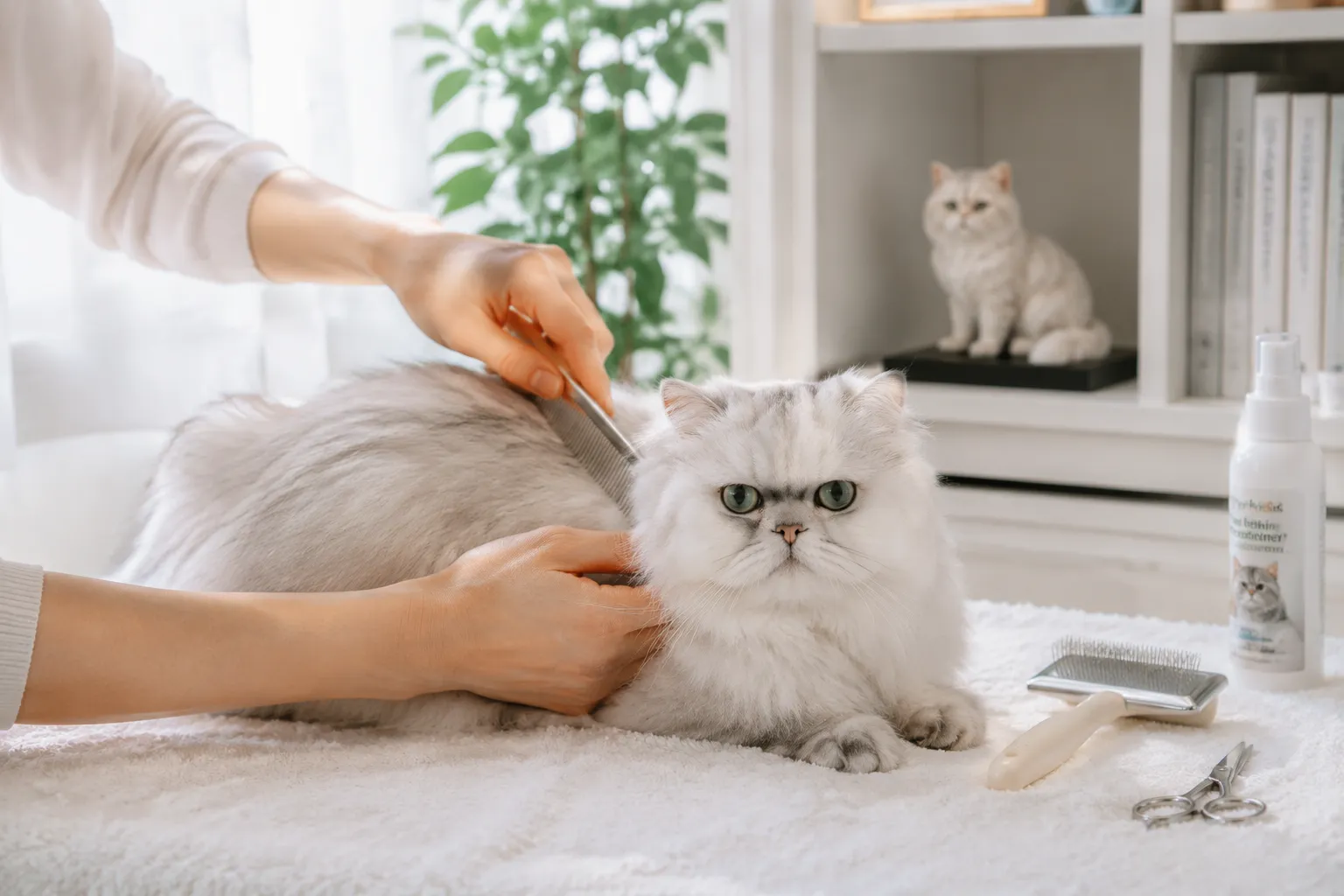
Ever run your fingers through a Persian's coat after a beach trip and hit that one tight knot tucked behind the front leg? That single mat is where persian cat grooming turns into either a quiet ritual or a wrestling match. Most first-time owners find it at the worst possible moment.
Quick Takeaways
- Mid-life Persians groom themselves less — watch for thinning self-care between ages five and eight.
- Daily two-minute combing beats a weekly marathon — short sessions keep cortisol low and trust high.
- Mats aren't a fur problem, they're a flexibility problem — weight and stiffness change everything mid-life.
- Capture their best coat while it's thriving — a custom full-color pet figurine preserves those markings long after they've grayed.
The Grooming Truth Nobody Tells First-Time Persian Owners
Here's the thing we've learned after working with thousands of pet families and their photos: almost every Persian grooming guide online treats a kitten and a seven-year-old cat like the same animal. They're not. Not even close.
We tested this assumption against the actual coats people send us. The standout pattern? Mid-life Persians — roughly five to eight years old — show up with totally different grooming challenges than the fluffy kittens in the stock photos. And nobody warns their owners.
Let's talk about Marisol. She's one of our customers, and her story is the reason we're writing this the way we are.
She adopted Juniper, a blue-cream Persian, when Juniper was already four. For the first year, grooming was easy. Juniper kept herself immaculate, and Marisol mostly just admired the cloud of fur. Then around year five, things shifted. Mats appeared out of nowhere. The vet asked why Juniper's belly was matting. Marisol had no idea anything had changed.
That gap — between what's happening to your cat and what you actually notice — is the whole story here.
"Your cat's coat doesn't change overnight. It changes so slowly you miss it. That's the trap."
Why mid-life is the real grooming inflection point
When vets talk about Persian grooming, the part they wish first-time owners understood is this: self-grooming declines with age before you can see it.
A young Persian is a contortionist. She twists, reaches her lower back, cleans behind her legs, keeps the whole system running. But as cats hit middle age, two things stack up. They often gain a little weight. And their spinal flexibility quietly decreases. Suddenly that reach behind the shoulder blade isn't comfortable anymore.
So the cat grooms less. Not because she's lazy — because it physically hurts or simply doesn't feel good. The fur she used to manage herself now becomes your job. And if you don't realize the handoff happened, the mats win.
This is one of those commonly overlooked aspects that changes how you should think about the whole thing. You're not just maintaining a coat. You're gradually taking over a job your cat used to do for herself.
What Vets Wish You Knew About Reading the Coat, Not Just Brushing It
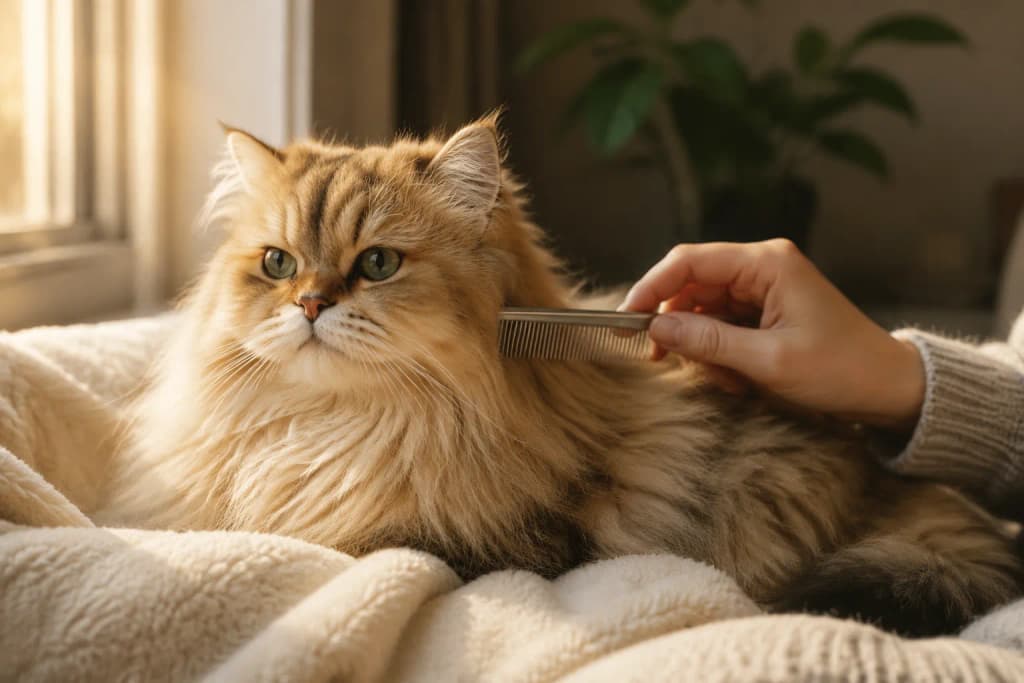
Most first-time cat owner tips boil down to "brush daily." Fine. But brushing without reading the coat is like mopping a floor without checking where the spill is.
When we receive photos for figurines, we look at fur the way a groomer does — texture, direction, where it clumps, where it shines. And the honest truth is, a Persian's coat tells you everything if you know the touch cues.
The four-zone touch test
Forget the eyes for a second. Persians are masters at hiding mats under that volume. Use your hands.
Run your fingertips — not a brush, your actual fingers — through these four zones every couple of days:
- Behind the front legs (the "armpits") — the number one mat zone, where skin folds trap loose fur.
- The belly — soft, often neglected, and where mid-life cats stop reaching first.
- The rear pantaloons and under the tail — sanitary issues plus friction make this a danger area.
- The ruff around the neck — dense, deep, and easy to skim over.
What you're feeling for is the difference between smooth glide and sudden snag. A healthy coat lets your fingers pass through like running them through cool water. A forming mat feels like a knot in a shoelace — your fingertip stops, catches, and there's a tiny dense warmth where the fur has felted together.
So what? Because catching a mat at the "snag" stage means a two-second comb-through. Catching it three days later means scissors, stress, and sometimes a vet visit. The texture difference is your early warning system.
"Your fingertips will find a mat days before your eyes do. Trust your hands."
The cortisol problem with marathon grooming
Here's a counterintuitive insight that surprised even us. Most guides push the big weekly grooming session. We're not huge fans of that approach for mid-life Persians.
Long, forced grooming sessions spike a cat's cortisol — the stress hormone. And here's the kicker: cats build associations fast. If grooming consistently means twenty minutes of pinning, tugging, and frustration, your cat's brain links the brush itself to threat. Neuroplasticity cuts both ways. You're either training calm or training dread, every single time.
What actually helps more than the weekly marathon is frequency over duration. Two minutes, daily, low pressure. The cat stays relaxed, the cortisol stays down, and the brush becomes background noise instead of a red alert.
Marisol switched to this. Two minutes every evening while she watched TV, Juniper on a towel in her lap. Within about three weeks, Juniper started climbing onto the towel on her own. That's classical conditioning doing its quiet work — the towel became a cue for closeness, not capture.
Long-Haired Cat Care: The Tools and Techniques That Actually Matter
Let's get specific, because vague advice helps nobody. After seeing what coats look like across thousands of cats, here's our honest take on long-haired cat care tools — the ones worth your money and the ones that aren't.
Our tool rankings, with opinions
Not all grooming tools are created equal, and the marketing on most of them is nonsense. Here's our curated short list.
| Tool | Best For | Skip If | Our Verdict |
|---|---|---|---|
| Stainless steel wide/fine comb | Daily mat detection | You only want to feel productive | The single most useful tool. Buy this first. |
| Slicker brush | Surface fluff, finishing | Your cat is mat-prone (it skips the undercoat) | Good support player, bad solo act. |
| Metal greyhound comb | The four-zone deep check | You're nervous about pressure | Our top pick for mid-life cats. |
| Dematting tool | Existing small mats only | The mat is tight to skin (vet job) | Useful but dangerous in rushed hands. |
| De-shedding blade | Short coats | You own a Persian (you do) | Skip entirely. Wrong tool for this coat. |
The standout here is the metal comb, not the fancy brush everyone photographs. A comb's teeth reach the skin layer where mats actually start. A slicker brush mostly fluffs the top and lies to you about the undercoat underneath.
Pro tip: warm the comb in your hands for a few seconds before the first stroke on a cold day. A cold metal comb against skin makes cats flinch — that tiny temperature shock starts the session on the wrong foot.
The line-combing technique vets actually recommend
The mistake most first-time owners make is brushing in long top-coat sweeps. Looks great on Instagram. Does almost nothing for the dense undercoat where mats breed.
Here's what works instead:
- Part the fur with one hand so you can see the skin in a line.
- Comb that exposed line from skin outward, in short strokes.
- Move the part down half an inch and repeat, working in layers like shingles on a roof.
- Hold the fur near the skin with your free hand when you hit a snag, so the tug pulls against your fingers — not the cat's skin.
That last step is the one vets emphasize and owners skip. Pulling a comb through a snag without anchoring the base means every tug yanks the follicle. It hurts. The cat remembers. And now you've made tomorrow's session harder.
The American Society for the Prevention of Cruelty to Animals offers solid foundational cat grooming guidance that backs this up — gentle, skin-aware technique protects both the coat and the relationship.
The Mid-Life Changes That Sneak Up on You
This is the section we wish someone had handed Marisol two years earlier. Mid-life brings coat and skin changes that have nothing to do with how often you brush — and everything to do with what's happening inside.
Skin gets drier, and oil distribution shifts
As Persians age into their middle years, sebaceous oil production changes. The coat can get slightly coarser and drier, which means fur strands grab each other more easily. More grabbing equals faster matting from the same amount of loose fur.
You'll feel it before you see it. A young Persian's coat feels like cool silk pouring over your hand. A mid-life coat sometimes feels a touch more like raw wool — still soft, but with a faint resistance, a little more friction strand to strand.
So what? It means the grooming routine that worked at age three genuinely isn't enough at age six. Same cat, different physics. You're not failing. The coat changed.
Weight, flexibility, and the belly nobody checks
We mentioned this, but it deserves its own moment. The belly and inner thighs are where mid-life mats explode, precisely because that's the first region a stiffer, rounder cat stops grooming.
Marisol's vet found a dense mat the size of a half-dollar on Juniper's lower belly — warm, tight to the skin, completely hidden under the topcoat. Juniper had been grooming around it for who knows how long. Marisol felt awful. She shouldn't have. That mat is almost a rite of passage for first-time Persian owners, and the guilt is universal.
"The mat you missed isn't proof you failed. It's proof your cat got older while you weren't looking."
That guilt, by the way, is worth naming. We see it constantly. There's a specific cognitive dissonance in loving an animal deeply while realizing you missed something physical happening to her body. The fix isn't shame. It's a better system.
A grooming schedule that respects mid-life reality
Here's a realistic cadence for a mid-life Persian, based on what consistently keeps coats healthy across the cats we see.
| Activity | Frequency | Time | Why It Matters |
|---|---|---|---|
| Four-zone touch check | Daily | 1 min | Catches mats at the snag stage |
| Line-combing session | Daily | 2-4 min | Prevents undercoat felting |
| Full body deep comb | 2x per week | 10 min | Reaches every layer |
| Sanitary/rear trim check | Weekly | 2 min | Prevents painful rear matting |
| Bath | Every 4-6 weeks | 20 min | Manages oil, reduces grease mats |
| Professional groom | Every 6-8 weeks | — | Lion cuts, deep mats, nail/ear care |
Notice the daily items are tiny. That's intentional. Consistency beats intensity every time with a creature that judges you based on how relaxed each session feels.
The PawSculpt Connection: Why We Care About Coats This Much
You might wonder why a custom figurine company is this deep in the weeds on grooming science. Fair question.
Because we look at fur for a living. When a family sends us photos, our master 3D artists study the exact way a Persian's coat falls — the volume of the ruff, the cream wash over the blue, the way light catches the longer guard hairs. Then we digitally sculpt it and bring it to life through full-color 3D printing, where the color is printed right into the resin itself, voxel by voxel.
"Every Persian's coat is a fingerprint. The markings, the density, the way the ruff frames the face — that's the soul we're capturing in resin."
— The PawSculpt Team
Here's what this taught us that's genuinely useful for you: a well-groomed coat photographs in a way that lasts. When Marisol decided to commission a figurine of Juniper, she'd just gotten her coat back to its prime after the mat scare. The photos showed Juniper at her absolute best — full ruff, clean lines, that blue-cream pattern glowing.
The figurine came out stunning because the subject was healthy. We're not vets — for any skin condition, lump, or behavior change, please see your veterinarian, full stop. But we can tell you that the coats we love sculpting most are the ones whose owners cracked the grooming code. There's an energy in a thriving coat that the full-color 3D printing process reproduces beautifully, fine natural texture and all.
Bathing a Persian Without Starting a War
Bathing deserves its own section because it's where the most first-time disasters happen. And the science of why it goes wrong is half the battle.
The temperature and texture game
Cats panic in baths largely because of unfamiliar tactile input — the weight of soaked fur, water temperature against skin, the loss of their normal coat texture. A Persian's soaked coat suddenly weighs more and clings, and that sensory change alone can spike stress.
Three things de-escalate it:
- Water slightly warmer than you'd think — around body temperature, so it doesn't read as a threat against the skin.
- A non-slip surface — a towel or mat in the sink, because slipping triggers the panic reflex hard.
- Comb out every mat BEFORE the bath — water tightens mats into concrete. This is the rule people break and regret.
That last one is non-negotiable. A small loose mat going into the water comes out as a felted rock. We've heard this story dozens of times.
Drying is where the real grooming happens
Here's an insider bit. The drying stage matters more than the wash for coat quality. A Persian left to air-dry mats as the undercoat clumps together damp.
Towel-press first — press, don't rub, because rubbing tangles. Then comb continuously while you blow-dry on low warm, working in those same shingled layers. The combing-while-drying is what gives show Persians that cloud-like separation. It's tedious. It's also the difference between fluff and felt.
When to Stop and Call a Professional
We're big believers in DIY grooming, but we'll be real about the limits. Some situations need hands more experienced than yours, and pushing past that point usually backfires.
Call a professional groomer or your vet when:
- A mat is tight against the skin — cutting it yourself risks slicing skin, which is shockingly easy with felted fur.
- The skin under a mat looks red, moist, or smells off — that can be a hot spot or infection.
- Your cat's coat is so matted it's pulling the skin — this is painful and sometimes needs sedation for a humane shave-down.
- Grooming has become a genuine fight every time despite short sessions — a pro can reset the experience.
The American Veterinary Medical Association has good general resources on recognizing when home care isn't enough. When in doubt, the vet visit is cheaper than the emergency one.
There's no shame in a lion cut, either. We've watched owners agonize over "ruining" their Persian's look. But a comfortable, mat-free cat with a short coat beats a beautiful, suffering one every time. The fur grows back. The trust you protect by not forcing painful sessions? That's the thing worth guarding.
Bringing It Full Circle: Marisol and Juniper Now
Remember that knot behind the front leg from the very first line? Marisol now finds those at the snag stage, fingertips first, before they ever become a problem. Two minutes a night. Juniper climbs into her lap when the towel comes out.
The coat scare became the reason their evenings have a ritual. And when Marisol looks at the figurine on her shelf — Juniper's blue-cream ruff captured in full-color resin, that natural printed texture catching the lamplight — she sees the version of her cat she fought to keep healthy.
That's the part the grooming guides miss. The brushing isn't really about the fur. It's about the few quiet minutes a day where you and a slightly-too-round, slightly-stiffer, deeply-loved animal sit together and you take over a job she can't quite manage anymore. That's not maintenance. That's devotion with a comb in your hand.
Run your fingers through the coat tonight. Feel for the glide. Find the snags before they find you. And when that coat is at its glorious best, consider preserving it — because persian cat grooming keeps them comfortable now, but the right keepsake keeps that beauty long after the years have softened it.
Frequently Asked Questions
How often should I groom a mid-life Persian cat?
Short and frequent wins. Aim for a two-to-four-minute comb daily, plus a deeper full-body session twice a week. Mid-life Persians groom themselves less effectively, so daily attention catches mats early and keeps the experience low-stress for both of you.
Why is my older Persian suddenly getting mats when it never used to?
Because the cat's body changed, not your effort. As Persians hit their middle years, reduced flexibility and a bit of weight gain mean they stop reaching the belly, inner thighs, and lower back. Drier skin makes the fur tangle faster too. The grooming responsibility quietly transfers to you, often without any obvious signal.
What is the single best tool for Persian grooming?
A stainless steel metal comb, hands down. Its teeth reach down to the skin layer where mats actually form. A slicker brush is a decent finishing tool, but it mostly fluffs the surface and hides what's happening in the undercoat.
Should I cut out a mat myself or see a professional?
If the mat is loose and lifts away from the skin, you can carefully work it out with a comb. But if it's tight against the skin, pulling the skin, or the skin underneath looks irritated, stop and call a groomer or vet. Cutting felted fur near skin leads to accidental cuts alarmingly often.
Is it normal to feel guilty when I find a hidden mat?
Completely normal, and you're in good company. Nearly every first-time Persian owner discovers a hidden belly mat and feels terrible. It's not a failure — it's a sign your cat aged while the change stayed invisible. The answer is a better daily touch-check system, not guilt.
Ready to Celebrate Your Pet?
Every pet has a story worth preserving. Whether you're honoring a beloved companion who's crossed the rainbow bridge or celebrating your Persian's gloriously healthy coat at its absolute prime, a custom PawSculpt figurine captures the details that make your cat one-of-a-kind — that signature ruff, those exact markings, the personality in the pose.
All those hours of careful persian cat grooming keep your cat comfortable and beautiful today. A full-color 3D-printed figurine lets you hold onto that beauty for good.
Visit pawsculpt.com to learn more about our process, preview turnaround, flexible revisions, and quality guarantee.