
Emergency-Ready Puppies: Busting 5 Myths About Disaster Prep for Your Dachshund
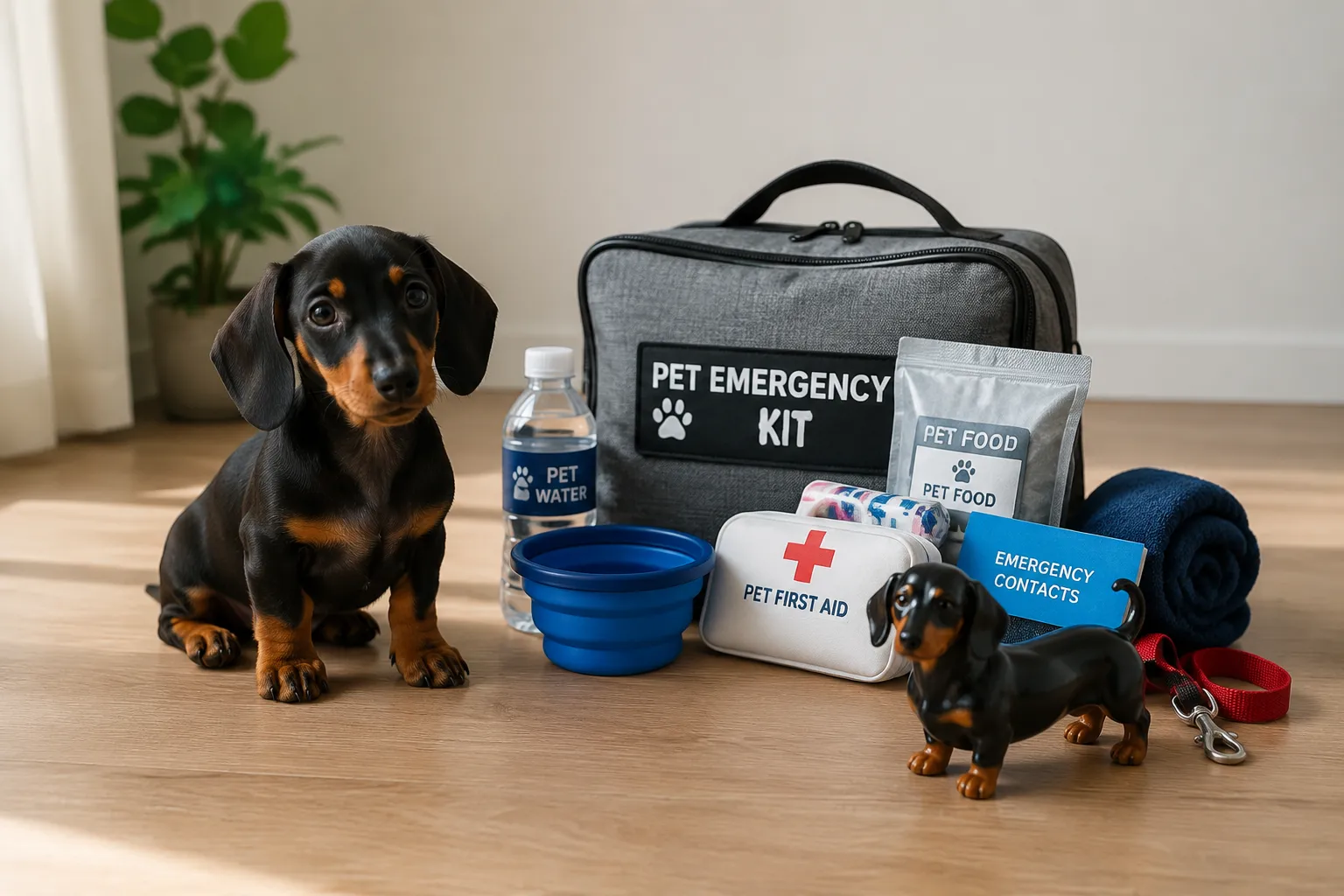
The scratch of tiny nails skidding across your home office floor, then the thud of a dachshund launching off the couch at the first thunderclap—that sound is exactly why dachshund disaster preparedness starts long before any storm rolls in.
Quick Takeaways
- A generic dog kit fails dachshunds — their long spine and prey drive need breed-specific gear and planning.
- Panic is the real emergency — condition calm now, because you can't teach it mid-crisis.
- Burrowing instinct works against you — a scared doxie hides, so evacuation demands a "grab spot," not a chase.
- Keep a current photo pack — clear shots reunite lost pets faster, and later they help you preserve your pet's likeness in something lasting.
- Practice the drill twice a year — a rehearsed exit beats a printed checklist every single time.
Here's the thing about emergency prep for a dachshund: most of the advice you'll find assumes you have a Labrador. A dog that follows you out the door. A dog that jumps into the car. A dog whose spine won't buckle if you scoop him up wrong in a hurry.
You don't have that dog.
You have a low-slung, opinionated, occasionally dramatic hound who was bred to dive into badger holes and refuse to come out. And that changes everything about how you should be preparing.
We've talked with thousands of pet families over the years, many of them first-time dachshund owners who came to us after a scare—a wildfire evacuation, a flooded basement, a power outage that stretched into days. The stories share a pattern. The prep they'd done was built for a generic dog, and it left gaps exactly where a dachshund needs the most support.
So let's clear the air. Five myths. Five corrections. All of them shaped around the specific, stubborn, wonderful animal snoring in your lap right now.
Myth 1: "A Standard Puppy Emergency Kit Covers a Dachshund"
Picture this. A family we spoke with had a beautifully stocked kit—food, water, leash, first-aid pouch, the works. When the evacuation order came, they realized their dachshund's collapsible ramp was still bolted to the couch. Their dog physically could not get into the SUV without it, and there was no safe way to lift a panicking long-backed dog into a high vehicle.
That's the trap with puppy emergency kit myths. The checklists online are calibrated for the average dog. Dachshunds are not average dogs. They're a body type.
Why the standard list leaves gaps
The intervertebral disc disease (IVDD) risk is the whole story here. Roughly one in four dachshunds will experience some form of disc problem in their lifetime, according to breed health research summarized by the American Kennel Club. That long back is gorgeous and it is also fragile in ways that a chaotic evacuation can expose fast.
A generic kit tells you to grab a leash. It doesn't tell you that yanking a dachshund by the collar during a rushed exit can compress the neck and spine at the worst possible moment.
So swap the assumptions. Here's what actually belongs in a dachshund's kit versus what the generic guides suggest.
Below is a comparison of the standard advice against what your doxie genuinely needs.
| Standard Kit Item | Generic Advice | What a Dachshund Actually Needs |
|---|---|---|
| Restraint | Collar and leash | Y-front harness that supports the chest, never a neck-only collar |
| Transport | "Carry your dog" | Rigid-bottom carrier sized so the spine stays flat, plus a ramp |
| Food | 3-day supply | 5-7 days; doxies are prone to stress-related GI upset |
| Meds | First-aid basics | Any prescribed anti-inflammatories, plus vet's IVDD notes |
| Comfort | A toy | A worn shirt with your scent to reduce burrow-panic |
The correction: build the kit around the body, not the checklist. A supportive harness and a flat-bottomed carrier aren't nice-to-haves. For a dachshund, they're the difference between a safe evacuation and a spinal injury layered on top of a disaster.
"You don't prep for the dog you wish you had. You prep for the one asleep on your feet right now."
And the "so what?" is blunt. In an emergency, adrenaline makes everyone move faster and rougher, including you. The gear has to protect your dog from the way you'll instinctively handle her when your hands are shaking.
Myth 2: "When Disaster Hits, I'll Just Grab Everything"
We hear this one constantly, usually with a confident laugh. "I know where everything is. I'll grab the dog and the bag and go."
Then the fire alarm goes off at 3 a.m. and reality arrives.
One customer described the exact moment it clicked for her. The evacuation siren cut through the neighborhood—that flat, rising wail—and her dachshund did what dachshunds do. He vanished. Not out the door. Under the bed, into the farthest corner, pressed against the wall where her arms couldn't reach.
She lost eleven minutes to that. Eleven minutes she did not have.
The counterintuitive truth about "grabbing" your dog
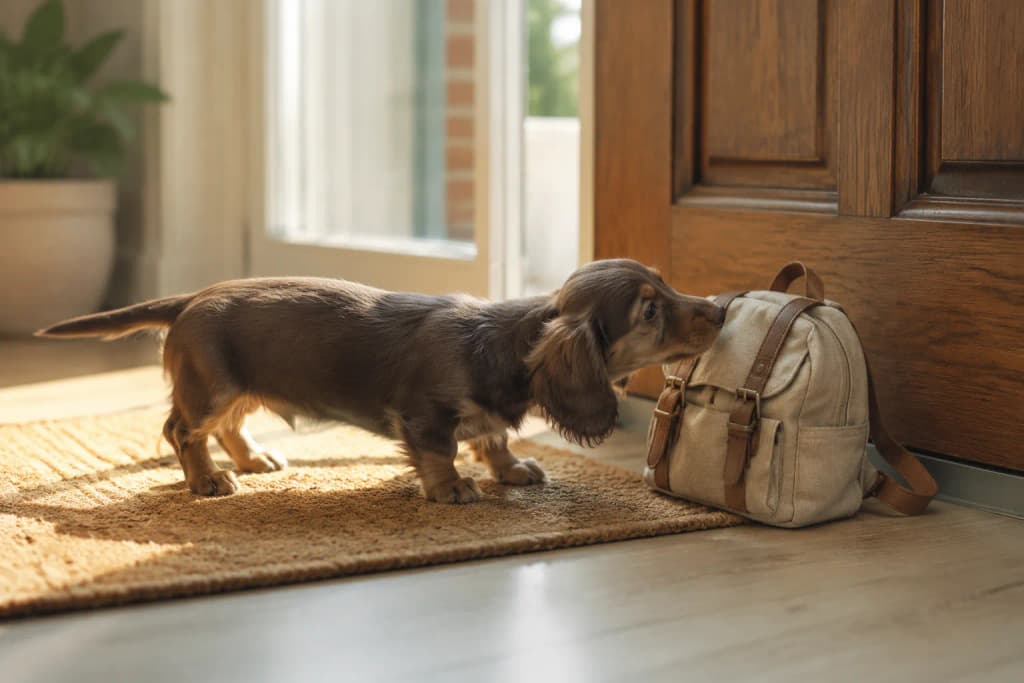
Here's what most pet disaster prep for first-time owners guides completely miss: the burrowing instinct that makes dachshunds so charming is a genuine liability in an emergency. These dogs were bred to go to ground. When the world gets loud and frightening, their hardwired response is to dig in and hide, not to run to you.
So the plan can't be "grab the dog." The dog will not be where you left him.
The plan has to be a designated safe zone—one specific, enclosed, easy-to-reach spot where your dachshund goes during stress, by training, so you know exactly where to look.
Try this. Pick a crate or a small room. Every time there's thunder, fireworks, or a loud delivery, calmly guide your dog there and make it rewarding. Warm blanket. A high-value chew. Quiet praise. Over 3-6 weeks, your dog builds an association: scary sound means go to the safe zone, not under the bed.
Now in a real emergency, you're not hunting a terrified animal through a dark house. You're walking to one known location.
"The disaster isn't the disaster. The panic is. Train the calm before you ever need it."
Why this matters so much: every minute you spend on your hands and knees reaching for a hiding dog is a minute the actual threat—smoke, water, fire—keeps advancing. You cannot install this instinct during the crisis. You build it now, on ordinary Tuesdays, with treats and repetition.
Sound is your early-warning system, and your enemy
Lean into the audio here, because sound is the whole game with an anxious dog. The specific noises that trigger a dachshund's flight-to-hide response—sirens, alarms, the deep percussive boom of thunder, the sharp crack of transformer failures during a storm—are also the exact soundtrack of most disasters.
If your dog spirals every Fourth of July, that's not a quirk to sigh about. That's a preview of how he'll behave when a genuine emergency arrives. Use those moments as unplanned drills. Watch where he goes. Time how long it takes to get him secured. Then fix the friction points before it counts.
Myth 3: "My Dachshund Will Follow Me Out the Door"
A short scenario. Family opens the door during a flash-flood warning, fully expecting the dog to trot out beside them. Instead the dachshund plants all four stubby legs, stares at the rising water on the driveway, and refuses to move. Not out of defiance exactly. Out of a very reasonable canine assessment that outside looks terrifying and inside is safe.
Dachshunds are, and we say this with love, spectacularly stubborn. That trait was selected for on purpose. A dog that gives up easily makes a lousy badger hunter. But that same tenacity means your doxie will absolutely dig in when you most need cooperation.
Stop relying on recall you haven't tested under stress
Most owners assume their dog's everyday obedience will hold in a crisis. It won't. A recall that works in your quiet backyard evaporates when sirens blare and the air smells like smoke.
What actually works better than trusting recall is removing recall from the equation entirely.
- Pre-clip a lightweight drag line to the harness during any weather event or alert, so you're never chasing a loose dog.
- Keep the carrier open and accessible near your exit route, not stored in a closet or the garage.
- Practice "load up" as a cheerful game — reward your dog for going into the carrier voluntarily, dozens of times, until it's automatic.
The dog who happily hops into her carrier for a treat on a calm afternoon is the dog who'll tolerate it when the room is chaos. The dog who only sees the carrier at the vet will fight you exactly when you can't afford the fight.
So what? Because in a real evacuation you have seconds, not a negotiation window. Every command you issue is a gamble. Every automatic, pre-trained behavior is money in the bank.
Here's a realistic look at how a dachshund's temperament reshapes standard emergency assumptions.
| Common Assumption | Dachshund Reality | Your Workaround |
|---|---|---|
| Dog follows owner outside | May freeze or bolt to hide | Pre-clipped drag line + carrier loading |
| Recall works under stress | Recall collapses with fear | Train automatic carrier entry instead |
| Dog jumps into vehicle | Can't and shouldn't jump | Ramp or full-body supported lift |
| Dog calms once you're calm | Sound-triggered panic persists | Desensitization + scented comfort item |
| Small size = easy to manage | Wriggling + long spine = hard | Rigid carrier that immobilizes safely |
Myth 4: "Microchipping Means We'll Always Get Reunited"
The microchip conversation is where a lot of first-time owners exhale and feel done. Chip's in, dog's registered, reunion guaranteed. Right?
Not quite. And this is the myth that breaks our hearts the most, because the fix is so simple.
A microchip is fantastic—when someone catches your dog, finds a scanner, and the registry has your current phone number. That's three conditions. In the confusion after a wildfire or flood, when shelters are overwhelmed and hundreds of pets are displaced, any one of those links can fail.
We worked with a family who lost their dachshund during an evacuation. The chip was current. But their dog had wedged himself into a storm drain and it took days for a searcher to spot him. What actually helped the reunion wasn't the chip. It was the flyer, made from a clear, recent photo, that a volunteer recognized.
Build a photo-and-ID system, not a single point of failure
Redundancy is the whole philosophy of good prep. Never rely on one system.
- Microchip — registered, with a phone number you actually check right now.
- Physical ID tag — on the harness, engraved with two contact numbers.
- A current photo pack — clear, well-lit shots from multiple angles, updated every few months.
- A "proof of ownership" set — photos of you together, vet records, adoption papers.
That photo pack does double duty, and this is the part people don't think about until later. The same clear, high-quality images that would help you find a lost dog are exactly the images that let you hold onto her memory if the worst ever happens.
Some families we've worked with came to us in the aftermath of a loss, wishing they'd taken better photos while they had the chance. That's part of why we always tell people: take the good pictures now. Get the ones with the light catching those long ears just right. Not only for emergencies, but because those are the images that let you create lasting custom pet figurines that hold onto the exact shape of your dog's face, the specific tilt of those ears, long after.
"The best photo of your dog is the one you take today, not the one you meant to take."
Why it matters: reunification is a chain, and chains break at the weakest link. A chip alone is one link. A photo, a tag, a proof set, and a chip? That's a chain with backups. In a real disaster, backups save lives.
"We've watched families rebuild after losing everything, and what they reach for first is a picture. A clear photo is protection you don't know you need."
— The PawSculpt Team
Myth 5: "Emergency Prep Is a One-Time Setup"
Last myth, and it's the sneakiest, because it feels responsible. You build the kit, you tuck it in the closet, you check the box. Done for good.
Except emergency prep isn't a monument. It's a living thing that goes stale.
A team member remembers a customer story that stuck: family pulled their two-year-old emergency kit during a hurricane warning. The food had expired. The water had gone funky. The medication was long past date. Worst of all, the photo inside was of their dachshund as a puppy—unrecognizable next to the gray-muzzled senior sitting beside them. A useless flyer.
Prep is a rhythm, not an event
Set a recurring calendar reminder. Twice a year, ideally when clocks change so you'll actually remember, you do a full refresh.
- Rotate the food and water so nothing expires.
- Check medication dates and restock anything close to expiring.
- Update the photo pack so it matches your dog's current appearance.
- Confirm your microchip registry still has the right phone number.
- Run a live drill — actually load your dog and walk your evacuation route.
That last one is the part almost everyone skips, and it's the most valuable. A drill reveals the eleven-minute problem from Myth 2 before it costs you. It shows you the ramp is stuck, the carrier's buried, the harness needs a new clip.
So what? Because a plan you've never rehearsed is a hypothesis, not a plan. The families who come through emergencies calmest are the ones who've walked the route with the dog, felt the weight of the carrier, and worked out the kinks on a sunny afternoon when the stakes were zero.
Here's a simple maintenance rhythm to keep everything current.
| Task | How Often | Why It Matters |
|---|---|---|
| Rotate food & water | Every 6 months | Expired supplies fail when you need them |
| Update photo pack | Every 3-4 months | Dogs change; a stale photo is a useless flyer |
| Verify chip registry | Every 6 months | Wrong number breaks the reunion chain |
| Full evacuation drill | Twice a year | Reveals hidden friction before a real crisis |
| Restock meds | As dated | Out-of-date IVDD meds are worthless mid-flare |
What We Wish We Knew Sooner
A candid sidebar from our team, since we've heard the same regrets from so many families:
- We wish we'd known that calm is a skill, not a mood. The dogs who did best in real emergencies were the ones whose owners had drilled quietly for months. You can't summon calm on demand. You build it.
- We wish we'd known how fast a dachshund can disappear. Under a bed, into a drain, behind a water heater. The burrowing isn't cute in a crisis. Plan for it.
- We wish we'd taken clearer photos. Not blurry phone snaps. Real, well-lit shots. They matter for reunions and, honestly, for everything that comes after.
- We wish we'd practiced the lift. Scooping a long-backed dog wrong, in a panic, is how spines get hurt. Learn the two-handed, fully-supported lift now, before your hands are shaking.
Putting It All Together: The 15-Minute Weekly Habit
You don't need to overhaul your life. Real preparedness is small, repeated, boring stuff done consistently.
Fifteen minutes, once a week, is enough to keep a dachshund genuinely emergency-ready:
- Five minutes of carrier and safe-zone practice — treats, calm voice, make it a game.
- Five minutes reviewing your gear — is the harness clipped, the ramp accessible, the kit stocked?
- Five minutes of desensitization — play thunder or siren sounds at low volume, reward calm.
That's it. Over weeks, those tiny sessions compound into a dog who goes to a known spot when scared, loads into a carrier without a fight, and tolerates handling when it counts.
The ASPCA's disaster preparedness guidance reinforces the same core idea from a broader angle: the households that fare best are the ones who planned specifically, not generally. For a dachshund, specific means honoring the spine, the stubbornness, and the burrow instinct in every decision you make.
And look, we'll be real with you. Most people reading this won't do the drills. They'll nod, feel prepared, and close the tab. If you're the rare owner who actually schedules that first practice session this week, you've already outprepared the vast majority. Your dog is genuinely safer because you took ten stubborn minutes.
Frequently Asked Questions
What should be in a dachshund emergency kit?
Beyond the standard food, water, and first-aid basics, a dachshund needs breed-specific gear. Pack a supportive Y-front harness (never rely on a neck collar), a rigid-bottom carrier that keeps the spine flat, and a ramp for vehicles. Add 5-7 days of food, any IVDD medications with your vet's notes, a scented comfort item, ID tags, and a current photo pack.
How do I evacuate a dachshund that hides during emergencies?
Train a designated safe zone long before you need it. Every time there's a loud noise, calmly guide your dog to one specific crate or small room and reward the calm. Over 3-6 weeks, your dachshund learns to go there instead of burrowing under the bed. In a real crisis, you'll know exactly where to find him.
Is a microchip enough to reunite with a lost dachshund?
Not on its own. A chip only works if someone catches your dog, finds a scanner, and your registry has your current number. Build redundancy: keep an engraved ID tag on the harness, maintain a current photo pack from multiple angles, and store proof-of-ownership records. The chain of ID systems is what actually brings dogs home.
How often should I update my dog's disaster prep?
Twice a year is the sweet spot, ideally when the clocks change so you'll remember. Rotate food and water, check medication expiration dates, update your photos to match your dog's current appearance, verify your microchip registry, and run an actual evacuation drill. Prep goes stale fast, and a stale plan fails.
Why is lifting a dachshund during an emergency risky?
Dachshunds are prone to intervertebral disc disease because of their long spine. Grabbing or scooping one incorrectly in a panic can compress the back and cause serious injury on top of the emergency itself. Learn a two-handed, fully supported lift now, and use a ramp instead of lifting into vehicles whenever possible.
Is it normal for my dachshund to panic at loud sounds?
Yes, and it's worth taking seriously. Dachshunds are often sound-sensitive, and the same noises that trigger hiding—thunder, sirens, alarms—are the soundtrack of most disasters. Use everyday loud events as practice, and desensitize gradually with low-volume recordings paired with treats to build lasting calm.
Ready to Celebrate Your Pet?
Every pet has a story worth preserving. Prepping for the worst is really an act of love, and part of that love is holding onto the details that make your dog irreplaceable—the exact set of those long ears, the way she tilts her head at a strange sound. As you build your dachshund disaster preparedness plan and gather those clear, current photos, consider capturing your dog's likeness in something lasting. A custom PawSculpt figurine, digitally sculpted by master 3D artists and then precision printed in full-color resin, reproduces your dog's unique markings and personality with striking detail.
Visit pawsculpt.com to learn more about our process, preview turnaround, revisions, and quality guarantee