
How to Refresh a Mid-Life German Shepherd's Manners: A Busy Owner's Weekend Checklist
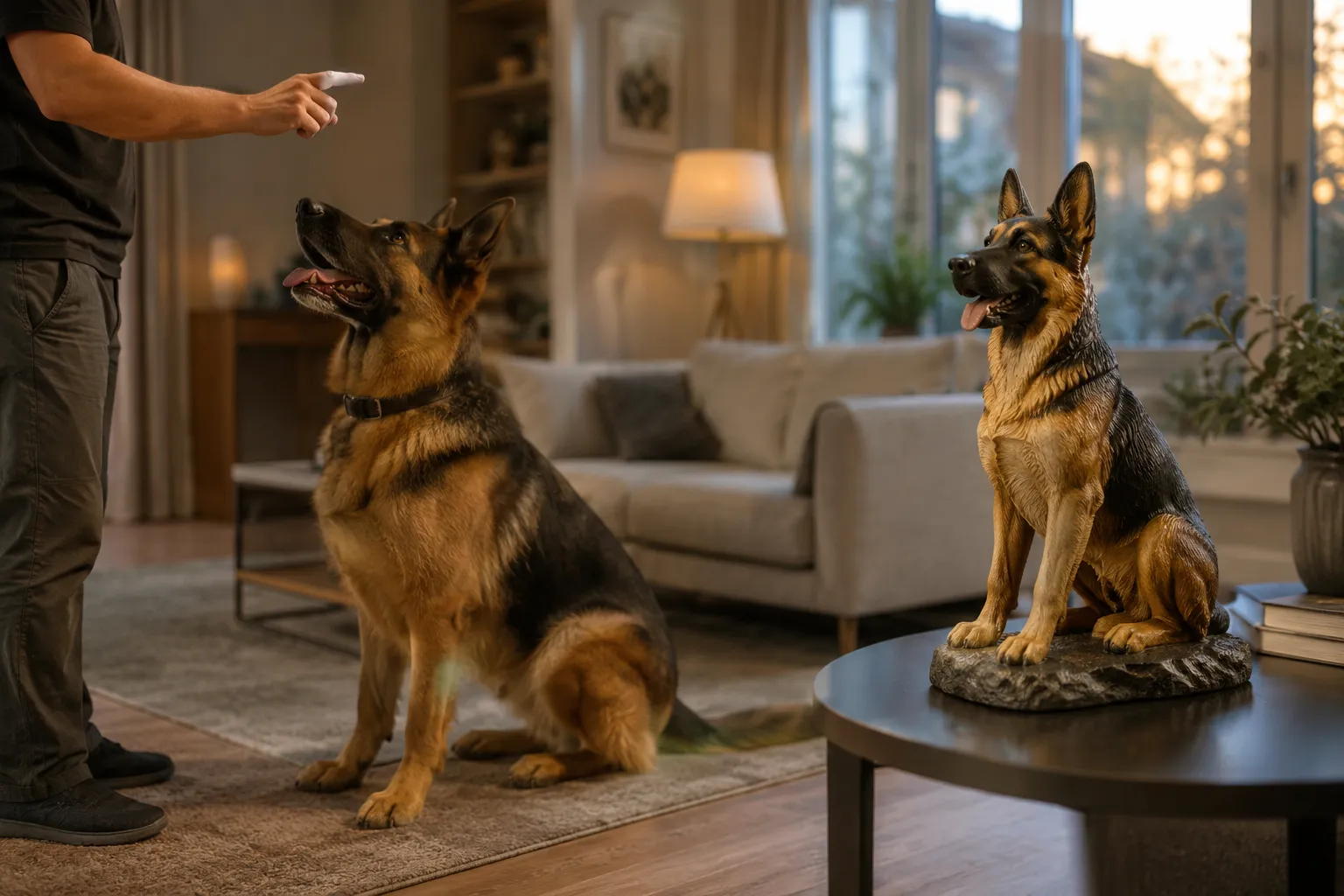
The leash slipped off the garage hook and clattered onto the concrete, and Duke—who used to plant his rear the second he saw it—just shouldered past you toward the open door. That crash is where most german shepherd manners training gets its second wind. Not with a puppy. With a dog who already knew better.
Quick Takeaways
- Your mid-life shepherd didn't forget his manners — the rules got fuzzy while life got busy.
- A weekend reset beats a boot camp — two focused days rebuild more than two random weeks.
- Fix your consistency first, not the dog — dogs read patterns, and yours probably drifted.
- Scent and routine anchor behavior more than treats — smell is memory for a German Shepherd.
- Celebrate the dog in front of you today — capture this chapter with a keepsake like a custom pet figurine before the gray muzzle sneaks in.
Why Your Mid-Life German Shepherd "Forgot" His Manners (Spoiler: He Didn't)
Here's the thing nobody tells you at the puppy classes. The hardest dog to train isn't the wild eight-week-old who pees on your shoe. It's the five-year-old who knows exactly what "sit" means and has quietly decided it's negotiable.
Duke didn't lose his manners in the garage. You did.
That sounds harsh. It isn't meant to. We've talked with thousands of pet families over the years, and the pattern is almost always the same. The dog was rock-solid at eighteen months. Then came the promotion, the new baby, the move, the year that ate itself. And somewhere in there, "off the couch" became "off the couch unless the game's on and you're too tired to care."
Dogs are pattern machines. A German Shepherd especially. This is a breed the American Kennel Club describes as intensely loyal and famously trainable—which is a polite way of saying they notice everything. They clock the day your standards slipped. They file it away. And a smart shepherd will test that soft spot the way water tests a crack in the foundation.
"A German Shepherd doesn't break the rules. He audits them, and he's very good at finding the ones you stopped enforcing."
So the first mental shift, before any checklist, is this: you're not retraining a dog. You're renegotiating a contract that got sloppy on your end.
The Counterintuitive Part
Most guides hand you a list of commands to "reteach." Sit, stay, heel, place. Drill them for twenty minutes a day.
But your mid-life shepherd already knows those words. Drilling them again is like sending a fluent adult back to kindergarten to relearn the alphabet. Boring for him, frustrating for you, and it misses the actual problem.
The problem isn't the vocabulary. It's the follow-through. He knows "sit." What eroded is the invisible thread that says sit means sit, every time, and I mean it. When you rebuild that thread, the old manners come flooding back—usually faster than you'd believe. We've seen dogs snap back to sharp within a single weekend, because the knowledge was never gone. It was just gathering dust.
That's why this is a refresh, not a rebuild. You're wiping the fog off a window, not installing a new one.
The Busy Owner Dog Training Checklist That Actually Fits a Weekend
Let's be real about your life. You don't have ninety free minutes a day. You have a Saturday, a Sunday, and a nervous suspicion that your dog is running the house.
Good news: that's enough. A focused weekend, done right, resets more than a month of distracted weekday attempts. Consistency in a short window teaches faster than inconsistency stretched thin.
Here's the map. Think of it as a two-day tune-up, not a marathon.
| Weekend Block | Focus | Time | What You're Actually Fixing |
|---|---|---|---|
| Sat AM | Threshold manners (doors, gates, car) | 20 min | The "barrel past you" habit |
| Sat PM | Loose-leash reset on a familiar route | 25 min | Pulling that crept back in |
| Sun AM | Impulse control at feeding + greetings | 20 min | Jumping, counter-surfing, demand barking |
| Sun PM | "Place" and settle under distraction | 25 min | The dog who can't switch off |
Four sessions. Roughly ninety minutes total across two days. That's less time than you'll spend scrolling this weekend, and it changes everything.
Saturday Morning: Own the Thresholds
Start where Duke fell apart—the doorway.
A threshold is any line your dog crosses: the front door, the garage, the car hatch, the baby gate. Mid-life shepherds who've gone rude almost always blow through thresholds first, because that's where excitement peaks and your attention is split (keys, phone, shoes, kids).
The fix is small and almost annoyingly simple. Stand at the door and wait. Hand on the knob. Don't open it until his butt hits the floor. The instant he sits, crack the door an inch. If he lunges, the door closes. Try again.
Within maybe eight or ten reps, the lightbulb comes back on. Oh. The door only opens when I'm polite. You just re-taught the contract without saying a single command. That's the magic of environmental rules—the door itself becomes the trainer.
So what? Because a dog who waits at thresholds is a dog who checks in with you before acting. That single habit bleeds into everything—leash walks, greetings, mealtimes. Fix the door and you've fixed ten other things by accident.
Saturday Afternoon: The Loose-Leash Reset
Pull the leash off that garage hook again. This time, you're the one running the drill.
Pick a route you both know cold. Not a new adventure trail—a boring block you've walked a hundred times. Novelty spikes a shepherd's arousal, and you want his brain calm enough to relearn.
The old advice is "stop when he pulls." Fine, but here's what actually works better for a mid-life dog who's testing you: change direction the moment the leash goes tight. No warning. Just pivot and walk the other way. He learns that pulling doesn't get him anywhere—literally. He has to keep an eye on you because you've become unpredictable in the most useful way.
You'll feel silly zigzagging down your own street. Do it anyway. Ten minutes of this and you'll feel the leash go soft in your hand, that gentle slack that means he's tracking you again.
"A loose leash isn't about control. It's a conversation where both of you finally agree to walk the same direction."
Reading Mid-Life Dog Behavior: The Signals Most Owners Miss
Before Sunday, spend a beat learning to read what your dog is actually telling you. Because mid-life dog behavior speaks a quieter dialect than puppy behavior, and busy owners tune it out.
A puppy's misbehavior is loud and obvious. A five-year-old's is subtle. He doesn't chew the couch anymore. Instead he does the thing that looks like obedience but isn't—the slow sit. The "I'll come when I've finished sniffing this." The eye contact that lingers a half-second too long before he does what you asked.
That half-second is the whole ballgame. It's a negotiation. And most owners miss it entirely because it's dressed up as compliance.
Here's a quick reference for the drift signals we hear about most from families with adult shepherds:
| What You See | What It Usually Means | The Real Fix |
|---|---|---|
| The delayed sit | He's testing whether you'll repeat yourself | Say it once, then wait—never repeat |
| Selective recall outside | Outdoors has become "optional command zone" | Rebuild recall on a long line first |
| Leaning into the leash | Pressure has stopped meaning anything | Direction changes, not stronger corrections |
| Ignoring you around guests | Excitement outranks your cue | Practice manners at low arousal first |
| The "one more sniff" stall | He's learned patience has no consequence | Move on without him; let the leash decide |
Notice a theme? Almost none of these need a stronger correction. They need clearer, calmer consistency. Shepherds don't respect volume. They respect reliability.
The Smell Factor Nobody Talks About
Now for something you won't find in the first five articles you'd Google.
Your dog's world is built out of smell, not sight. A German Shepherd's nose is a piece of biological machinery so sensitive it makes our best instruments look like toys. And that changes how you should think about training environments.
When you practice manners in a scent-chaotic place—a new park, a friend's house that smells of their three cats—you're asking your dog to concentrate while someone blasts a symphony in his ears. Of course he can't focus. It's not defiance. It's sensory overload.
So start your weekend reset in low-scent territory. Your own hallway. The garage with the door shut. The backyard at dawn before the neighborhood wakes up and lays down its morning layer of smells. The calmer the scent landscape, the faster the manners return. Then, only once he's solid, you add scent complexity like adding weight to a barbell.
We've noticed this ourselves in a roundabout way. When customers send us photos of their dogs for a figurine, the happiest, most relaxed shots almost always come from home—the dog on his own blanket, in his own space, surrounded by the smells that tell him you're safe here. That relaxed dog is also the trainable dog. Same principle, different lens.
"Every whisker and every worn spot on a favorite blanket tells a story. Our job is to hold onto the ones that matter most."
— The PawSculpt Team
Myth vs. Reality: What Busy Owners Get Wrong About Refreshing an Adult Shepherd
Let's bust a few things that keep good owners stuck. These come up constantly, and every one of them quietly sabotages a weekend reset.
Myth #1: "You can't teach an old dog new tricks."
Reality: A mid-life shepherd is arguably the best age to train. His brain is fully developed, his attention span dwarfs a puppy's, and he already speaks your language. What feels like stubbornness is usually just a clear rule that got muddy. Clean up the rule and watch him fly.
Myth #2: "Bad manners mean he needs more exercise."
Reality: This one surprised even us early on. Exhausting a shepherd with two hours of fetch often creates a fitter dog who misbehaves longer. Physical tiredness isn't the same as mental settling. Fifteen minutes of impulse-control work tires a shepherd more thoroughly than a five-mile run—and it's the settling, not the sweating, that fixes manners.
Myth #3: "If I use treats, he'll only obey for food."
Reality: Food is a paycheck, not a bribe—when you use it right. The trick is to reward the behavior unpredictably once it's relearned, the same way a slot machine keeps people pulling the lever. Fade the food to random, and the manners stick harder than if you'd never used it. Yank food away entirely too soon, though, and you're the boss who stopped paying and wonders why morale dropped.
That second myth deserves a moment. So many busy owners assume a tired dog is a good dog, and they run themselves ragged with dawn hikes they don't have time for. According to behavior resources like PetMD, mental enrichment and structured problem-solving do more for a dog's overall calm than raw physical burnout. You can give your shepherd a hard mental workout in the time it takes to make coffee. That's the busy owner's cheat code.
Sunday: Locking In the Reset
Two sessions left. This is where the weekend pays off.
Sunday Morning: Impulse Control at the Bowl and the Door
Feeding time is the purest test of a dog's self-control, and it's free daily training you're probably wasting.
Here's the drill. Fill the bowl. Hold it at your waist. Ask for a sit. Lower the bowl an inch. If he breaks the sit, the bowl goes back up. It's the same door logic from Saturday, applied to the thing he wants most in the world.
The first morning, this might take a full minute of stops and starts. He'll be baffled—dinner has never had a toll booth before. By the second meal, he's sitting like a gentleman and waiting for your release word. That daily thirty seconds of patience-under-desire rewires his default from "grab" to "check with you first."
Do the same with greetings. When someone comes over and Duke launches into his kangaroo routine, the fix isn't kneeing him or yelling. It's turning your back. No touch, no eye contact, no talk until four paws are on the floor. Attention is the reward he's after, so attention becomes the thing he only earns by being calm.
Micro-story: one family we worked with had a shepherd named Ranger who greeted every visitor by planting his paws on their chest—all seventy-five pounds of him. Grandma stopped visiting. They didn't need a trainer or a shock collar. They needed everyone to fold their arms and become a boring statue for about four days. Ranger figured it out. Grandma came back.
Sunday Afternoon: "Place" and the Art of Switching Off
The final piece, and honestly our favorite, is teaching the off-switch.
A restless mid-life shepherd who can't settle isn't a bad dog. He's a working breed with no assigned job, vibrating with unspent purpose. "Place"—a mat or bed where he goes and stays until released—gives him a job: hold this spot. It sounds too simple to matter. It's transformative.
Put a mat down. Lure him onto it, mark it, reward. Then build duration second by second. Sit near him at first. Turn on the TV. Drop a fork. Have someone walk by. Each small distraction he weathers on the mat is a rep of "I can be calm even when things are happening."
Within a weekend of practice, most dogs will hold a place for a few minutes. Within a couple weeks of five-minute daily reps, you'll have a dog who trots to his mat when the doorbell rings instead of losing his mind. That's the dream, and it's completely reachable.
Here's a simple daily maintenance schedule to keep the weekend gains from evaporating by Wednesday:
| Daily Anchor | When | Duration | Why It Holds Manners |
|---|---|---|---|
| Threshold wait | Every door exit | 5 seconds | Reinforces "check with me first" |
| Bowl patience | Every meal | 30 seconds | Daily impulse-control rep |
| Place/settle | Evening wind-down | 5 minutes | Teaches the off-switch |
| One-cue rule | All day | Ongoing | Protects the "I mean it" thread |
None of these add real time to your day. They're baked into things you already do. That's the entire philosophy—you don't find time to train a mid-life shepherd, you fold training into the life you already live.
The 15-Minute Weekday Glue
The weekend resets it. The weekdays keep it.
You don't need another training block Monday through Friday. You need fifteen minutes of intentional, undistracted floor time each evening—not scrolling, not half-watching a show, just you and the dog. Run through a couple of the anchors. Ask for a place. Reward a calm settle. Then just be with him.
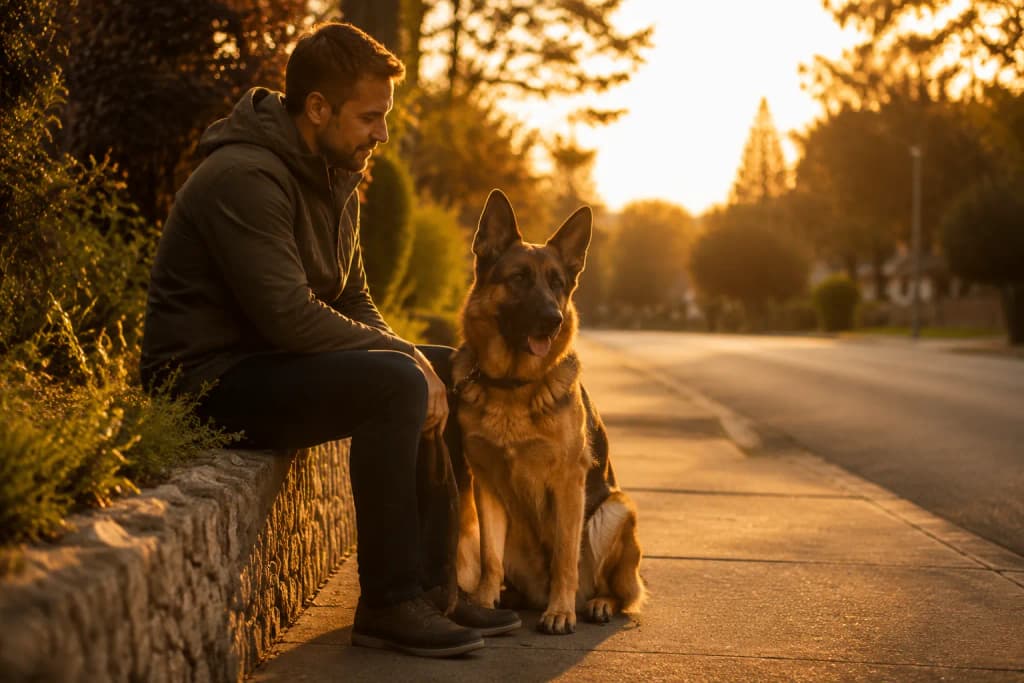
That last part matters more than the drills. A German Shepherd bonded to his person is a shepherd who wants to work with you. The manners are downstream of the relationship. Neglect the relationship and you're just managing a dog. Feed it and you're partners.
"Manners are just love with structure. The structure is how a dog knows the love is real."
And here's a quiet truth about the mid-life years specifically. Five, six, seven years old—this is the golden stretch. Old enough to be settled, young enough to still throw himself into a game of tug with the joy of a puppy. The gray hairs on the muzzle haven't shown up yet. The vet visits are still routine.
It goes fast. Faster than the puppy year, somehow, because you're not counting the days anymore.
Capturing This Chapter Before It Slips By
We didn't set out to write about mortality in a manners guide. But we'd be doing you a disservice if we didn't say this part.
The dog you're refreshing this weekend—the one testing your patience at the door—is at his prime. That thick double coat, the specific tan-and-black saddle pattern that's uniquely his, the alert ears, the way he watches you across a room. Right now it feels permanent. It always does, until it isn't.
Families come to us at two very different moments. Some arrive in grief, holding a photo and a collar that still carries a faint doggy smell they can't bring themselves to wash out. Others come while their dog is snoring on the mat three feet away, and they've simply decided not to wait for the sad chapter to start preserving the good one.
We'll be honest—the second group tends to be happier with the whole experience. There's something freeing about celebrating a dog while he's here, tail still thumping.
That's part of why some families choose a tangible keepsake during these prime years. A photo book, a paw-print casting, or increasingly, a custom pet figurine that captures the exact set of the ears and that unmistakable saddle marking. At PawSculpt, each piece is digitally sculpted by our 3D artists from your photos, then precision 3D printed in full-color resin so your shepherd's real markings—the specific way the black fades into tan along his flanks—come through in the material itself, not painted on top. A protective clear coat gives it a soft sheen and keeps the color true for years.
It won't hold a place command. But it'll hold this chapter, exactly as it is right now, long after Duke has traded the door-barreling for the dignified slowness of old age. You can see how the process works over at PawSculpt's collection of 3D pet sculptures whenever you're curious—no rush.
Bringing It All Together
Refreshing a mid-life shepherd's manners isn't about willpower or a trainer's magic touch. It's about two focused weekend days, a handful of fifteen-second daily anchors, and the honest admission that the rules got fuzzy on our watch, not the dog's.
Fix the thresholds. Reset the leash. Rebuild patience at the bowl. Teach the off-switch. Say every cue once and mean it. Then protect the whole thing with fifteen minutes of real presence each evening.
Do that, and the dog who blew past you in the garage becomes, by next weekend, the dog who plants his rear the second your hand reaches for the hook—looking up at you like okay, what's the job? He never forgot. He was just waiting for you to remember first.
Frequently Asked Questions
How long does it take to retrain a mid-life German Shepherd?
Because your dog already knows the commands, a focused weekend can sharpen them dramatically. What takes longer is cementing the new consistency into a habit—plan on two to four weeks of short daily reps before it feels automatic. The knowledge returns fast; the reliability builds gradually.
Why did my adult German Shepherd suddenly stop listening?
It rarely happens suddenly, even though it feels that way. The rules usually got inconsistent during a busy season, and your shepherd—who notices everything—started testing where the standards slipped. It's a follow-through problem on the human end, not a memory problem on the dog's end.
Is more exercise enough to fix my shepherd's bad manners?
It helps, but it's not the fix on its own. A physically exhausted dog isn't the same as a mentally settled one, and over-exercising can build a fitter dog who misbehaves for longer. Impulse-control games and "place" work do far more for calm behavior than raw miles.
Should I repeat a command when my dog ignores me?
No—this is one of the most common habits that erodes manners. Say the cue once, then wait. Repeating teaches your shepherd that the first cue is just a suggestion and the one that counts comes on the third try. Protecting the single-cue rule is half the battle.
What's the best age to train a German Shepherd?
Mid-life, roughly five to seven, is a sweet spot most people overlook. The brain is fully mature, focus is strong, and your dog already speaks your language. Puppies are cute, but an adult shepherd learns a refresh far faster than a distracted youngster learns from scratch.
Do I need a professional trainer for this?
For a manners refresh, usually not—the weekend checklist covers most cases. But we're not vets or certified behaviorists, so if you're seeing genuine aggression, fear, or anxiety rather than plain rustiness, loop in a professional. Real behavior issues deserve real expertise.
Ready to Celebrate Your Pet?
Every pet has a story worth preserving. While you're refreshing your mid-life German Shepherd's manners this weekend and rediscovering the sharp, loyal dog underneath the rust, consider capturing him exactly as he is right now—ears alert, saddle markings vivid, prime years in full bloom. A custom PawSculpt figurine, digitally sculpted and 3D printed in full-color resin, holds those one-of-a-kind details long after the gray muzzle arrives.
Visit pawsculpt.com to learn more about our process, preview turnaround, and quality guarantee.