
Your Rescue German Shepherd's First 30 Days: A Behavioral Adaptation Timeline That Calms Your Nerves
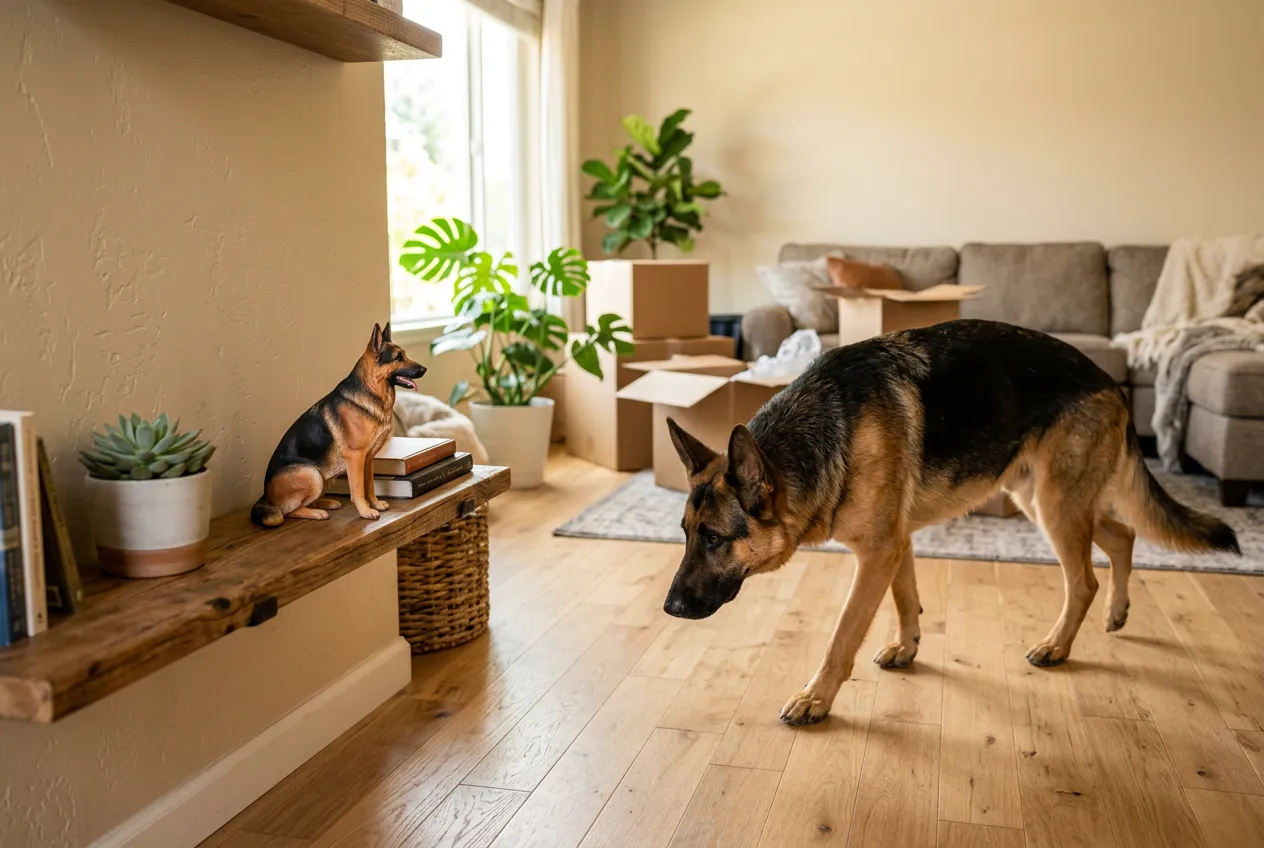
A 2022 survey by the ASPCA found that nearly 47% of rescue dog returns happen within the first 30 days—and German Shepherds rank among the top five breeds surrendered back to shelters. Your rescue German Shepherd's first month isn't a countdown. It's a conversation, conducted mostly through scent, body language, and the slow accumulation of trust neither of you can rush.
Quick Takeaways
- The "3-3-3 Rule" is a starting framework, not a fixed schedule — your German Shepherd's adaptation is scent-driven and nonlinear
- Days 1–3 are about olfactory mapping — let your dog smell everything before expecting any obedience or affection
- Weeks 2–3 often feel like regression, not progress — behavioral "setbacks" usually signal deepening comfort and trust
- Marking milestones helps you stay grounded — celebrate your dog's personality emerging through custom keepsakes or a simple journal
- Your nervous system sets the room's emotional weather — a calm owner accelerates adaptation more than any training protocol
The Spiritual Contract You Didn't Know You Signed
Here's what most adopted dog behavior adaptation timeline guides won't tell you: the moment you drove your rescue German Shepherd home, you entered a spiritual contract. Not a metaphor. A real, felt exchange of energy between two nervous systems deciding whether to trust each other.
Most guides frame this first month as a training problem. "Establish boundaries." "Crate train immediately." "Show the dog who's boss." And look—some of that advice has merit. But it misses the deeper architecture of what's actually happening.
Your German Shepherd—a breed developed over a century to read human intention with eerie precision—is running a complex internal algorithm. Not about rules. About safety. About whether the particular scent of your skin, the vibration of your voice at 2 a.m., and the emotional weather of your household constitute a place worth belonging to.
"A rescue dog doesn't need a trainer on day one. They need a witness—someone willing to sit in the discomfort of the unknown alongside them."
That contract runs both ways. You're also deciding—whether you admit it or not—if this particular animal's spirit fits the shape of the space in your life. That negotiation takes roughly thirty days. Sometimes more. Rarely less.
Why German Shepherds Process Rescue Differently
German Shepherds are not Labrador Retrievers. They don't default to social openness. The American Kennel Club's breed profile describes them as "confident, courageous, and smart"—but the subtext experienced GSD owners understand is this: they are intensely bonding animals who channel their loyalty through a narrow funnel.
What this means for rescue adaptation:
- They bond deeply, which means they grieve deeply. A surrendered GSD hasn't just lost a home. They've lost their person—the singular human they organized their entire emotional life around.
- Their intelligence makes transition harder, not easier. They're not passively absorbing the new environment. They're actively analyzing it, cataloging threats, ranking household members, and testing the consistency of your responses.
- They communicate through scent more than most owners realize. A German Shepherd's olfactory system contains roughly 225 million scent receptors (compared to your 5 million). Your house doesn't look like anything to them at first. It smells like everything.
That last point is crucial. And it's where most first-month guides fail entirely.
Days 1–3: The Olfactory Arrival (Not the Homecoming You Imagined)
Forget the fantasy. The one where your rescue German Shepherd trots through the front door, sniffs around cheerfully, and curls up at your feet by evening. That dog exists—on Instagram reels. Your dog, the real one, will likely do something far less cinematic.
They might freeze in the doorway. They might pace the perimeter of every room without making eye contact. They might refuse food for 24 hours. They might urinate on your hallway rug despite being reportedly housetrained.
All of this is normal. All of it.
What's Actually Happening Neurologically
During the first 72 hours, your rescue German Shepherd is performing what animal behaviorists call environmental mapping—and for a GSD, that process is overwhelmingly olfactory. They're cataloging:
- The scent signature of every human in the house (including emotional states—dogs can smell cortisol)
- Whether other animals have marked territory recently
- The baseline smell of "safe" versus "threat" in each room
- The chemical composition of your stress, which you're almost certainly radiating despite your best efforts
Here's the counterintuitive insight that changes everything: your dog is not ignoring you during these first three days. They're studying you with the most powerful sensory instrument in the mammalian world—their nose.
Your Only Three Jobs (Days 1–3)
- Establish a scent-safe zone. Choose one room. Place a bed or blanket there. Don't wash it after the first day—let your dog's own smell accumulate. That scent becomes their anchor.
- Minimize olfactory overwhelm. This means no scented candles, no air fresheners, no essential oil diffusers for the first week. Your home office might smell like vanilla latte to you. To your dog, it's a wall of chemical noise.
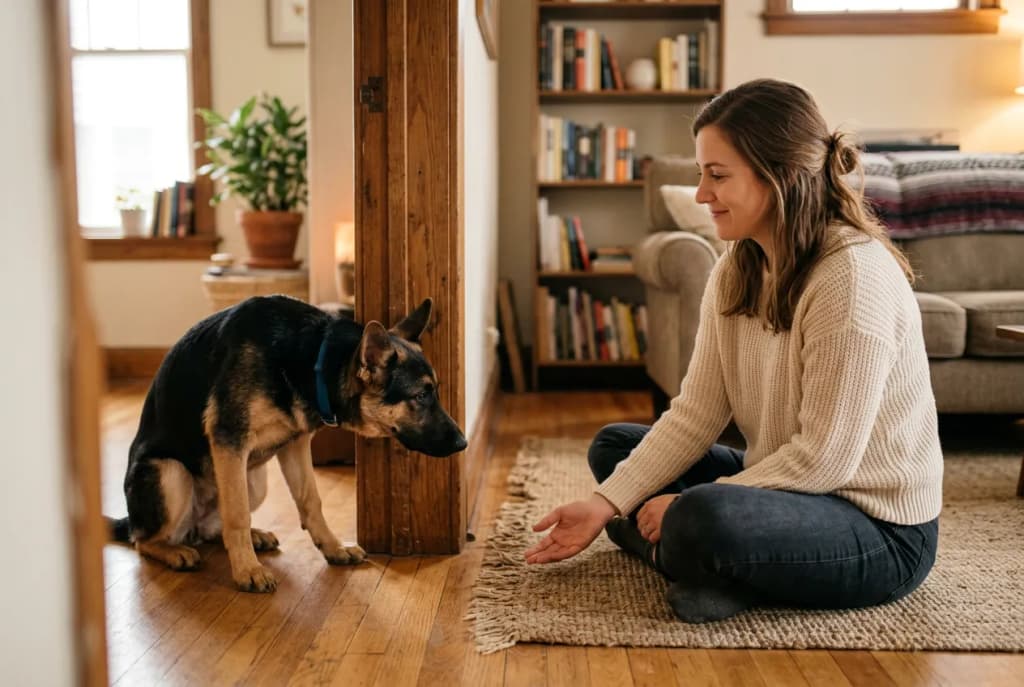
- Sit on the floor. Seriously. Spend 20 minutes twice a day sitting on the floor of your dog's safe room, doing nothing. Reading a book. Scrolling your phone. Let them approach on their terms. Don't reach. Don't call. Just exist.
The urge to comfort will be enormous. Resist it. Comfort from a stranger—which is what you are right now—isn't comforting. It's confusing.
| Day | Typical Behavior | What It Means | Your Best Response |
|---|---|---|---|
| Day 1 | Freezing, hiding, refusing food | Sensory overload; olfactory mapping in progress | Provide quiet space; don't force interaction |
| Day 2 | Cautious exploration, startling at sounds | Beginning to process environment; still hypervigilant | Maintain calm routine; avoid visitors |
| Day 3 | May accept food from hand; brief eye contact | First micro-signals of trust emerging | Reward calm behavior with soft voice, not treats |
Days 4–10: The German Shepherd Rescue Adjustment Begins in Earnest
Somewhere around day four or five, something shifts. It's subtle. Maybe your dog finally eats their full meal. Maybe they follow you from the living room to the kitchen—not closely, but at a distance, like a satellite finding its orbit.
This is the beginning of what we might call the spirit-testing phase. Your German Shepherd is no longer just mapping the environment. They're testing the consistency of your presence. And German Shepherds, more than almost any breed, are consistency addicts.
The Smell of Routine
Here's something most rescue German Shepherd first month guides overlook entirely: your dog is building a scent-based timeline of your daily habits. The smell of coffee at 6:45 a.m. The particular mix of soap and fabric softener when you emerge from the shower. The way the kitchen smells different at feeding time.
These aren't background details to a GSD. They're data points in a trust algorithm.
This is why erratic schedules during the first month are so damaging. Not because your dog needs military precision—but because every deviation from the emerging scent pattern triggers a fresh wave of uncertainty. The smell of your morning routine is becoming sacred to them. Don't disrupt it.
Practical Protocols for Days 4–10
- Feed at the same times daily, in the same spot, from the same bowl. The bowl itself will accumulate a scent profile that signals safety.
- Walk the same route for the first two weeks. Novelty is stimulating, yes—but a rescue GSD needs predictable scent landscapes before they can handle new ones.
- Introduce household members slowly. If you have a partner, children, or roommates, stagger their interaction. One new scent relationship at a time. Fifteen minutes of calm presence, then space.
- Don't bathe your dog yet (unless medically necessary). Their own smell is their only portable home. Washing it away resets the trust clock.
"We've noticed something beautiful in the photos families send us during week two—the dog's posture changes. Ears soften. Weight shifts forward. That's when the real personality starts emerging."
— The PawSculpt Team
That postural shift—from leaning back (ready to flee) to leaning forward (curious, approaching)—is one of the most reliable indicators that the spiritual contract is being honored by both sides.
Weeks 2–3: The Paradox of Regression (When "Worse" Means Better)
This is where most rescue adopters panic. And honestly? This is where a significant percentage of those 47% of returns happen.
Because here's the brutal truth about the rescue German Shepherd adjustment period: weeks two and three often look like your dog is getting worse, not better.
Behaviors you might see:
- Demand barking that didn't exist in week one
- Resource guarding of food, toys, or sleeping spots
- Destructive chewing on furniture, shoes, or door frames
- Separation anxiety symptoms—howling, pacing, scratching at doors when you leave
- Selective aggression toward one household member but not others
- Leash reactivity toward other dogs that seemed absent during the first week
Why This Is Actually Good News
The dog who hid behind your couch for three days was not a calm dog. They were a shutdown dog. Shutdown is a survival state—the neurological equivalent of playing dead. The animal suppresses all behavior because displaying behavior in an unknown environment is a risk.
As your German Shepherd begins to feel genuinely safer, the suppressed behaviors emerge. That's what regression is: the emergence of authentic personality from behind the survival mask.
Think of it this way. A houseguest on night one is polite, tidy, accommodating. By week three, they're leaving dishes in the sink and asking what's on Netflix. That's not rudeness. That's comfort.
Your dog's "bad behavior" in weeks two and three is the behavioral equivalent of leaving dishes in the sink. It means they've decided you're probably not a threat. Now they need to figure out the actual house rules—because they're planning to stay.
The Counter-Point: When Regression Is Actually a Red Flag
Intellectual honesty demands this section. Not all "regression" behaviors are healthy expressions of emerging comfort. Some are genuine distress signals that warrant professional intervention.
Seek a certified veterinary behaviorist (not just a trainer) if you observe:
- Aggression that escalates in intensity over consecutive incidents rather than remaining stable
- Self-harming behaviors like excessive licking that creates raw patches, or tail-chasing that continues for minutes without stopping
- Complete food refusal lasting more than 48 hours (this can indicate pain, not just stress)
- Any behavior that makes you feel physically unsafe in your own home
The line between "healthy decompression" and "behavioral crisis" isn't always obvious. We're not veterinarians—and this is precisely the moment to consult one. The ASPCA's behavioral helpline is a legitimate resource for rescue adopters navigating this gray zone.
Being honest with yourself about what you're seeing—even if it challenges the narrative of the rescue journey—is one of the most sacred acts of care you can offer.
| Behavior | Likely "Healthy Decompression" | Possible Red Flag |
|---|---|---|
| Barking | At specific triggers, decreasing over days | Constant, escalating, with no identifiable trigger |
| Resource guarding | Stiffening over food bowl, releases when you step back | Lunging, snapping, escalating even when you retreat |
| Chewing | On designated toys or occasional household items | On own paws, tail, or flanks causing injury |
| Separation distress | Whining for 10–15 minutes after you leave | Destroying doors/crates, self-injury, hours of distress |
| Reactivity on walks | Barking at dogs, recovers within seconds | Inability to redirect, prolonged fixation, lunging at people |
The Scent of Belonging: How Smell Marks the Turning Point
Somewhere around day 18 to 22—though your timeline may differ by a week in either direction—something happens that you might not consciously notice. But your dog will.
Your home begins to smell like both of you.
Your German Shepherd's scent has saturated their bed, the couch cushion they favor, the patch of carpet near the back door where they wait for walks. Your scent has become embedded in their routine—the particular chemistry of your hands when you fill the food bowl, the detergent on the blanket you toss over them during evening TV.
These scents merge. And for a dog, particularly one with 225 million olfactory receptors, this merged scent isn't just pleasant. It's home made manifest. The invisible architecture of belonging, built molecule by molecule.
This is the phase where many families we've worked with start to notice something remarkable: the dog develops a "place." Not just a preferred spot—a location they've chosen as their spiritual center in the house. Often it's near (but not directly beside) the primary caregiver. Close enough to smell them. Far enough to maintain the dignity German Shepherds seem to carry like a second coat.
Rituals That Accelerate Scent-Bonding
The word ritual might sound grandiose. It isn't. A ritual is simply a repeated action invested with meaning. Your dog doesn't know the word—but they understand the concept instinctively.
- The morning greeting ritual: Before coffee, before your phone, spend 90 seconds with your dog. Same spot. Same calm energy. Let them smell your hands (which carry the concentrated scent of your overnight biology). This becomes the olfactory "I'm still here" that anchors their day.
- The departure ritual: Leave a worn t-shirt (unwashed, 2+ days of wear) in their safe zone when you leave the house. Your scent in fabric form is a remarkably effective anxiolytic (anxiety reducer) for German Shepherds.
- The evening decompression ritual: Ten minutes of sitting together after dinner. Not training. Not playing. Just shared stillness. The goal is co-regulation—your calm nervous system teaching theirs what "safe evening" smells, sounds, and feels like.
"Belonging isn't a destination. It's a scent trail your dog follows home—one day at a time."
Days 21–30: The Emergence (Meeting the Dog You Actually Adopted)
Here's the part nobody prepares you for, and the reason the rescue German Shepherd first month is unlike any other experience in dog ownership:
The dog you bring home on day one is not the dog you'll have on day thirty. They're not even close.
The shutdown, cautious, uncertain animal who sniffed your doorframe for fifteen minutes before entering is now—if things have gone reasonably well—beginning to show you who they actually are. And German Shepherds, when they finally trust, are magnificent in their specificity.
You'll discover quirks. Maybe your dog has a deep, almost philosophical fascination with watching squirrels from the home office window, tracking them with the focused intensity of a scholar following an argument. Maybe they make a particular groaning sound when they lie down on cool tile—a sound so distinctly theirs that you'll come to hear it as a kind of signature. Maybe they have opinions about the rain. Many GSDs do—strong opinions, vocalized opinions, opinions that involve refusing to set foot on wet grass while giving you a look of magnificent betrayal.
These aren't just cute anecdotes. They're the emergence of a soul from behind the armor of survival. And witnessing it is a privilege.
What "Settled" Actually Looks Like
A common question we hear from rescue adopters around week four: "Is my dog adjusted yet?" The honest answer is nuanced.
Signs your German Shepherd is approaching baseline security:
- They sleep deeply in your presence (visible REM twitching, relaxed jaw)
- They voluntarily bring you a toy—not to play, but to share space around it
- They sigh. A deep, full-body exhale when settling down. This is the parasympathetic nervous system engaging, the biological "I am not in danger" signal.
- They start showing preferences—a favorite person, a preferred walking route, a specific treat they clearly love more than others
- They check on you. A GSD who walks into the room, confirms your location with a glance, and walks back out is a GSD who has filed you under "my person."
Signs you're not quite there yet (and that's okay):
- Hypervigilance at windows and doors (still scanning for threats)
- Inability to relax in shared spaces (chooses isolated spots consistently)
- Eating only when you leave the room (not yet comfortable being vulnerable near you)
- No play behavior whatsoever (play requires a baseline of felt safety that hasn't been reached)
The distinction matters because premature expectations are the enemy of genuine trust-building. Some German Shepherds—particularly those with traumatic histories—may take 60 to 90 days to reach what others achieve in 30. That extended timeline isn't failure. It's respect for the depth of what they're processing.
Marking the Milestone
Around day 30, something worth pausing for has happened. You and this animal—two separate nervous systems with entirely different evolutionary histories—have built a shared language from scratch. That's extraordinary, and it deserves recognition.
Some families mark this milestone practically: a new collar, a dedicated training class, a vet visit to establish long-term care. Others mark it more personally. A family we worked with recently told us they'd taken their GSD's favorite sleeping photo—ears back, tongue slightly out, sprawled across a couch cushion with the specific abandon that only deep safety produces—and had a custom 3D-printed figurine made to capture that exact moment of arrival. Not the polished, alert German Shepherd of the breed standard. The real one. The one who finally trusted enough to look ridiculous.
That impulse—to preserve the specific, the imperfect, the utterly personal—is worth honoring however you choose to do it.
The Emotional Adaptation Timeline You Won't Find in Other Guides
Most rescue German Shepherd first month guides focus exclusively on the dog's behavior. But there's a parallel timeline running underneath—yours. And ignoring it undermines everything.
Your Nervous System Is the Weather
German Shepherds are among the most handler-sensitive breeds on earth. They don't just observe your emotions. They inhale them. Cortisol, adrenaline, oxytocin—these chemicals alter your scent in ways imperceptible to you but screaming-loud to your dog.
This means your emotional state during the first 30 days isn't a side note. It's a primary environmental variable.
| Your Emotional State | What Your Dog Smells | Their Likely Response |
|---|---|---|
| Anxious anticipation | Elevated cortisol, shallow breathing scent | Hypervigilance, reluctance to approach |
| Frustration (at "bad" behavior) | Adrenaline spike, tension in muscle scent | Withdrawal, appeasement signals, or escalation |
| Calm confidence | Balanced cortisol, steady oxytocin | Gradual approach, relaxed body posture |
| Genuine joy (not performed) | Dopamine and oxytocin elevation | Mirrored relaxation, play initiation |
The practical implication is uncomfortable but important: if your rescue GSD isn't settling, the first place to look is your own nervous system. Not because you're doing something wrong—but because your biology is part of their environment, whether you intend it or not.
The Emotions Nobody Talks About
Rescue adoption is culturally framed as an unambiguous good. You saved a dog. You're a hero. Celebrate.
But honestly? The first 30 days often include emotions that don't fit that narrative:
- Regret. "Did I make a mistake? Am I in over my head?" This is devastatingly common and almost never discussed.
- Guilt. Guilt about feeling regret. Guilt about comparing this dog to a previous one. Guilt about moments of genuine irritation.
- Grief. If your last dog passed, bringing home a new animal can trigger fresh waves of loss. The new dog doesn't smell like the old one. The collar is different. The absence becomes louder, not quieter.
- Loneliness. The particular loneliness of loving an animal who hasn't decided to love you back yet.
All of these are legitimate. None of them disqualify you from being an excellent dog owner. The rescue community sometimes creates an unintentional pressure to perform gratitude and joy at every stage—but the truth is more complicated. And your dog, who can literally smell the difference between authentic and performed emotion, will benefit from your honesty.
Building Your Own Support Ritual
- Journal for five minutes each evening. Not about the dog's progress—about yours. What did you feel today? What surprised you? What scared you?
- Connect with other GSD rescue adopters. Online communities specific to German Shepherd rescue (not general dog adoption forums) will contain people who understand the breed-specific intensity of this experience.
- Schedule a "day 30 reflection." On the one-month anniversary, look back at your journal. The distance traveled will likely astonish you.
Beyond Day 30: The Long Unfolding
The first month ends, but the adaptation doesn't. German Shepherds continue deepening their bond for 6 to 12 months after adoption. What you've built in 30 days is a foundation—a shared scent, a mutual rhythm, the first tentative threads of a bond that will eventually become one of the most significant relationships in your life.
The dog who graduates from the first month isn't "fixed." They're begun. And the months that follow bring their own revelations—the first genuine play session, the first time they choose your lap over their own bed, the first walk where they look up at you with an expression that can only be described as recognition. Not just identifying your face. Recognizing your spirit as the one they've chosen.
Some families tell us they decide to create a permanent memorial of their pet's personality somewhere around the three-month mark—when the dog's true character has fully emerged and they want to capture that specific tilt of the head, that particular curve of the ear, in something more lasting than a photograph. PawSculpt's full-color 3D printing technology reproduces those details—the exact brindle pattern, the one ear that never quite stands fully upright, the expression caught in a favorite photo—directly in resin, color embedded at the material level rather than applied to the surface. It's a way of saying: I see you. The real you. And I want to remember this.
But whether you mark the milestone with a figurine, a framed photo, a new hiking trail, or simply a quiet moment of recognition on the living room floor—mark it. This bond is sacred. Treat it that way.
The Counterintuitive Truth About Rescue German Shepherd Adaptation
Here's the insight I want to leave you with—the one that reframes everything:
Your rescue German Shepherd is not adapting to your home. You are adapting to each other.
The conventional framing puts all the burden of change on the dog. They need to learn your rules, your schedule, your expectations. But the families who navigate this transition most successfully are the ones who recognize it as mutual transformation.
You will change during these 30 days. Your sleep patterns will shift. Your morning routine will reorganize itself around another being's needs. The scent of your own home will change—literally, chemically, as another mammal's biology merges with yours into something new.
That mutual transformation is the legacy of rescue. Not heroism. Not charity. A meeting of two souls who needed each other, figured it out slowly, and built something neither could have built alone.
The first 30 days are just the opening chapter.
"Rescue isn't something you do for a dog. It's something you and a dog do together."
Frequently Asked Questions
How long does it take a rescue German Shepherd to adjust to a new home?
The general framework is the 3-3-3 rule—3 days of decompression, 3 weeks of learning your routine, 3 months of true settling. But German Shepherds, with their intense bonding nature and high sensitivity, often require the full 60–90 day window for baseline security. Full bonding—the deep, unshakable GSD loyalty the breed is famous for—can take 6 to 12 months. Don't rush it. The depth of the eventual bond is worth the patience.
Is it normal for a rescue dog to not eat for the first few days?
Completely normal. Stress suppresses appetite in dogs just as it does in humans, and the olfactory overwhelm of a new environment can make food unappealing. Offer meals at consistent times, leave the bowl for 15 minutes, then remove it. If your dog hasn't eaten anything for more than 48 hours, contact your veterinarian—at that point, you want to rule out medical causes rather than assuming pure stress.
Why is my rescue German Shepherd getting worse after the first week?
This is the single most common concern we hear from rescue adopters, and the answer is almost always reassuring: your dog is decompressing, not deteriorating. The quiet, compliant animal you brought home was in survival shutdown. As they feel safer, suppressed behaviors—barking, chewing, resource guarding—emerge. Think of it as your dog finally feeling safe enough to have opinions. That said, if behaviors escalate in intensity or involve aggression that makes you feel unsafe, consult a certified veterinary behaviorist.
Should I crate train my rescue German Shepherd immediately?
Not on day one. The crate should be introduced as an inviting, optional safe space—door open, treats inside, zero pressure. Many rescue GSDs have negative crate associations from shelters or previous homes. Forcing crate time before trust is established can create a lasting aversion. Begin by feeding meals near the open crate, then inside it, and progress at your dog's pace over 7–14 days.
How do I help my rescue German Shepherd with separation anxiety?
Start with scent-based reassurance: leave a worn, unwashed shirt in their safe zone. Practice micro-departures—step outside for 30 seconds, return calmly, gradually extend duration. Avoid dramatic goodbyes or excited returns, as both signal that your absence is a significant emotional event. If distress is severe (self-injury, property destruction, hours of vocalization), seek professional behavioral support. This isn't a training issue—it's a neurological one that may require medication alongside behavior modification.
When will my rescue German Shepherd start bonding with me?
Watch for micro-signals starting around days 4–10: following you at a distance, brief voluntary eye contact, accepting food from your hand. By weeks 2–3, you might see the first deep sighs, relaxed sleeping in your presence, or the tentative offering of a toy. The moment they check on your location when you leave a room—glancing in, confirming, and walking away—that's the bond crystallizing. You'll know it when it happens. It smells like home.
Ready to Celebrate Your Rescue Journey?
The first 30 days with a rescue German Shepherd are a story of two beings learning to trust each other—and that story deserves to be preserved. Whether you're capturing the goofy ear tilt that emerged on day 22 or honoring the quiet dignity of your dog's favorite resting spot, a custom PawSculpt figurine freezes that hard-won personality in full-color resin, every marking and expression printed directly into the material itself. Your rescue German Shepherd's first month created something permanent. Now you can hold it in your hands.
Visit pawsculpt.com to explore the full process, preview options, and service details