
The Senior Tabby Cat Comfort Care Checklist Your Vet Probably Hasn't Mentioned
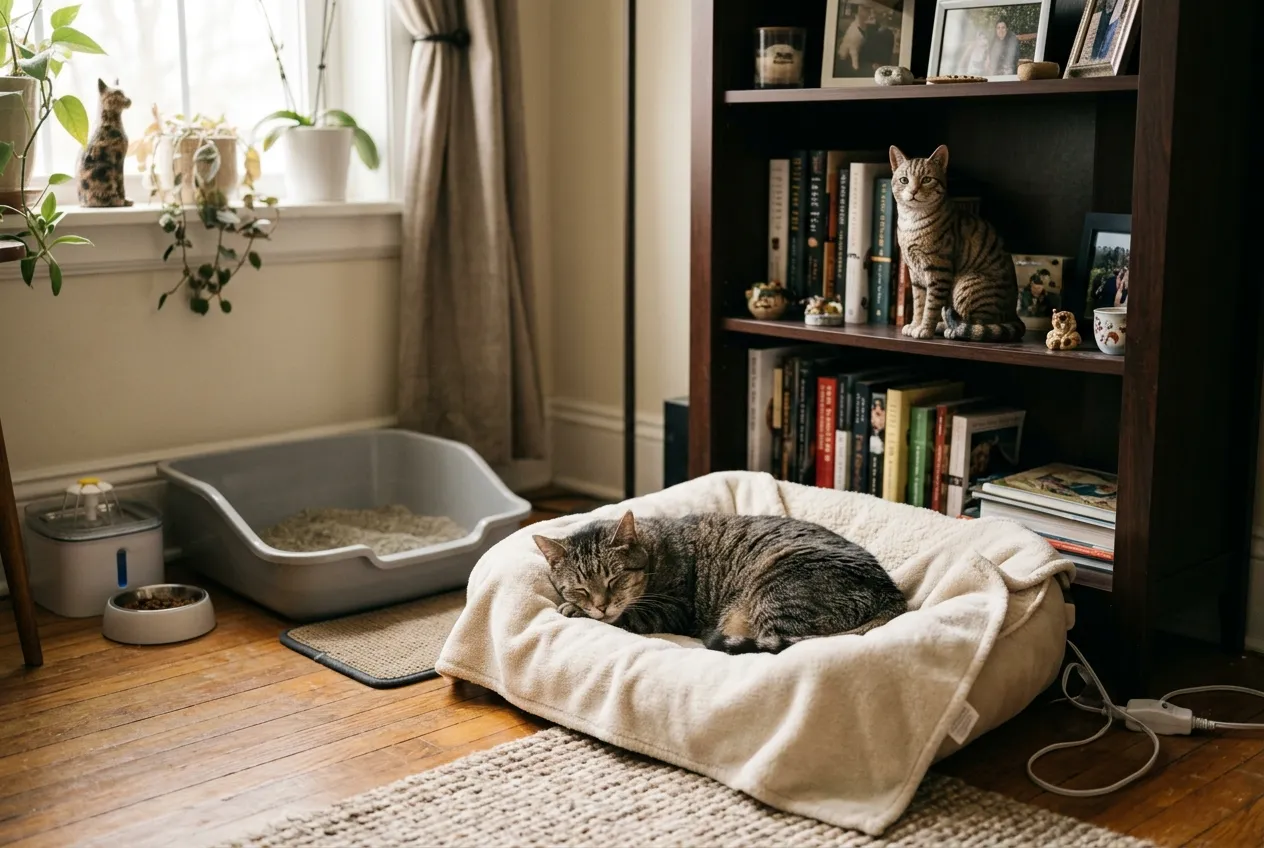
She was reaching for the same bag of senior cat food she'd bought for years when she noticed it—a faded orange tabby on the label, its face rounder and softer than her own cat's increasingly angular one. That was the moment a customer once told us she realized her senior tabby cat care routine had been running on autopilot while her cat had been quietly, steadily changing.
Quick Takeaways
- Your cat's comfort needs shift every 6-12 months after age 11 — reassess warmth, access, and mobility quarterly
- Weight loss in senior tabbies often hides behind their coat pattern — use hands-on body scoring, not just visual checks
- Environmental micro-adjustments matter more than expensive supplements — lighting, surface texture, and vertical access are free to fix
- Honoring your aging cat's spirit through a custom figurine preserves them at their most vibrant — before memory softens the details
- The "good day / bad day" journal is the single most underused tool — track patterns, not just moments, to guide end-of-life decisions
The Invisible Decline: Why Tabby Coats Hide What Matters Most
Here's something most guides won't tell you: tabby cats are uniquely difficult to assess visually as they age. That classic mackerel or classic pattern—the swirls, the stripes, the ticked fur—creates an optical illusion of fullness. A solid-colored cat who loses a pound looks noticeably thinner. A tabby who loses the same pound? The broken pattern of dark and light bands camouflages the emerging spine ridges, the hip bones slowly surfacing like stones in a receding riverbed.
This isn't vanity. This is life-or-death information hiding in plain sight.
We've worked with thousands of pet families over the years, and one thing keeps coming up in conversations about senior cats: the phrase "it happened so fast." But it almost never happened fast. The signs were there. The tabby coat just made them harder to see.
The Hands-On Body Score You Should Do Weekly
Forget looking. Start feeling. Every Sunday (or whatever day you can commit to), run both hands slowly along your cat's body using this sequence:
- Spine check — Run your fingers along the vertebrae from skull to tail base. You should feel them with light pressure but not see them. If they feel like a string of beads under a thin blanket, your cat has lost muscle mass.
- Rib assessment — Place your palm flat against the ribcage. Ribs should feel like the back of your hand when it's relaxed. If they feel like your knuckles when you make a fist, there's too little coverage.
- Hip and shoulder blades — These are the early warning zones. Prominent points here mean muscle wasting has already progressed.
- Belly pouch — In tabbies especially, the primordial pouch can swing lower as abdominal muscle tone decreases, mimicking weight gain while the rest of the body wastes.
Record what you feel, not just what you see. A simple note in your phone—"ribs slightly more prominent this week"—creates a timeline your vet can actually use.
| Body Area | Healthy Senior Feel | Concerning Feel | Action Needed |
|---|---|---|---|
| Spine | Felt with light pressure, not visible | Bead-like prominences, visible ridges | Increase caloric density; vet visit within 2 weeks |
| Ribs | Like back of relaxed hand | Like knuckles of a fist | Calorie and protein assessment |
| Hips/Shoulders | Smooth contour, mild prominence okay | Sharp points, visible from across room | Vet visit within 1 week; rule out hyperthyroidism |
| Belly/Pouch | Soft, some swing is normal | Distended or hard; sudden increase | Urgent vet visit — could indicate fluid buildup |
The counterintuitive part? A senior tabby who looks the same as last year is not necessarily fine. Stable appearance in an aging cat can mean the coat is masking a gradual redistribution—muscle loss offset by fluid retention or fat deposits in different areas. The hands know what the eyes miss.
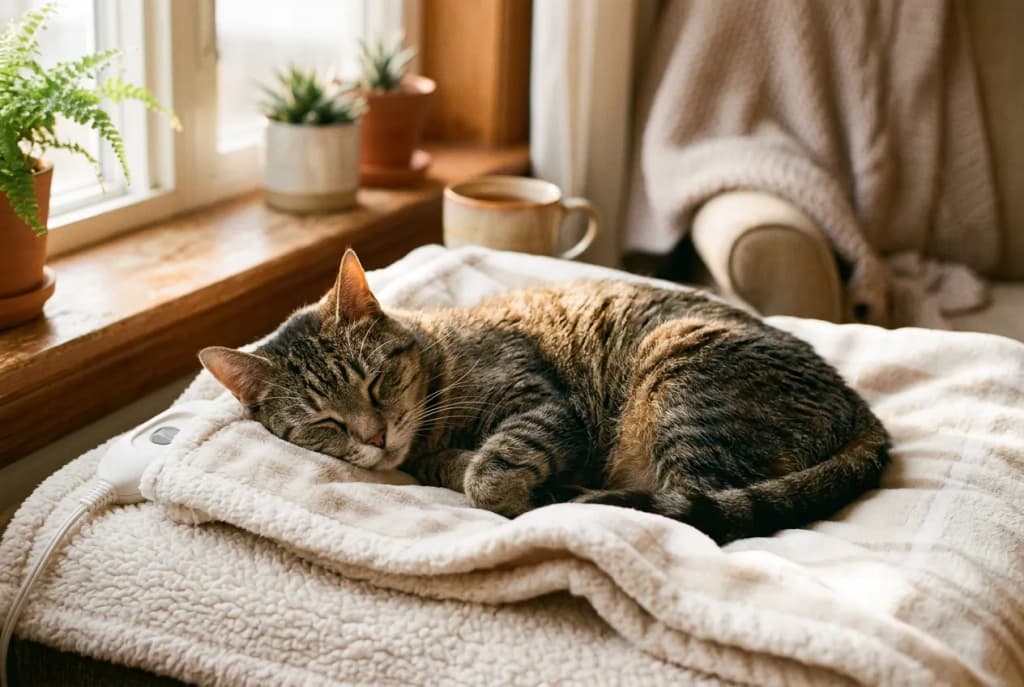
The Comfort Architecture of Your Home: Designing for a Cat Who Won't Ask for Help
Cats are, by nature, masters of concealment. A wild cat who shows weakness becomes someone else's meal. Your 15-year-old tabby sleeping on your couch still carries that ancient code. She won't limp to you and hold up her paw. She'll simply stop jumping to the windowsill. She'll choose the floor over the bed. And you'll think she's just mellowing out.
She's not mellowing. She's adapting to pain.
"The most important changes in a senior cat's life are the ones they never show you."
— The PawSculpt Team
This is where elderly cat comfort becomes less about medicine and more about architecture—the physical design of the space your cat lives in. And most vets, honestly, don't spend much time on this. They'll check bloodwork and prescribe joint supplements. But they rarely walk through your house with you and say, "Move that water bowl twelve inches to the left."
Light as Medicine
Here's something almost no one talks about: senior cats need different light. Their pupils don't dilate as efficiently. The lens yellows with age, filtering out blue light and dimming their world like a permanent Instagram filter set to "warm." A room that looks fine to you may look murky and shadowed to a 16-year-old cat.
What to do:
- Add a low-wattage nightlight in every room your cat frequents, especially near food, water, and litter. Not for you—for them. The warm glow of a 4-watt amber LED can be the difference between a confident walk to the water bowl and a hesitant, anxious one.
- Avoid rearranging furniture. A senior cat with declining vision navigates partly by memory. Moving the coffee table six inches can cause a collision that shakes their confidence for weeks.
- Place food and water in naturally lit areas during the day. Near a window, where the light falls in a warm rectangle on the floor. Cats gravitate toward these patches instinctively, and eating in good light helps them see and smell their food better.
Picture this: It's 6 AM. The house is still dark, but a small amber light glows near the hallway where the water fountain sits. Your tabby, whose golden-green eyes don't adjust like they used to, walks the familiar path with steady steps, drinks, then settles into the heated bed by the window just as the first grey light of morning begins to color the room. She didn't stumble. She didn't hesitate. That's comfort architecture working.
Surface and Texture: The Floor Is Not Your Friend
Hardwood and tile floors become ice rinks for arthritic cats. Their claws, which may be overgrown or brittle, can't grip smooth surfaces. Their weakened hind legs slide. And after one bad slip, many senior cats develop a visible anxiety about crossing open floor spaces.
The fix is cheap and immediate:
- Lay down runners or yoga mats along your cat's primary travel routes—from bed to litter box, from food to favorite napping spot
- Use bath mats (the non-slip kind with rubber backing) around food and water stations
- Skip the plush carpet remnants—thick pile actually catches arthritic claws and can cause tripping. Flat-weave or low-pile is better.
The Vertical World Collapses
Cats live in three dimensions. Kittens and young cats think vertically—shelves, counters, cat trees, the top of the refrigerator. But as arthritis, muscle loss, and vision changes set in, a senior cat's world flattens. The vertical dimension slowly becomes inaccessible, and with it goes a huge portion of their territory, their enrichment, and their sense of security.
Most people respond by removing the cat tree. That's backward.
Instead, build ramps and intermediate steps that let your cat access at least one elevated spot. A step stool next to the couch. A small ramp to the window perch. Even a stack of sturdy books beside the bed. The goal isn't to make them climb—it's to keep the third dimension alive in their world, even if they only use it to reach the couch.
| Comfort Modification | Cost | Difficulty | Impact on Quality of Life |
|---|---|---|---|
| Amber nightlights in key rooms | $5-15 | Easy | High — reduces anxiety, prevents falls |
| Non-slip runners on travel routes | $10-30 | Easy | Very High — immediate mobility confidence |
| Ramp/steps to one favorite spot | $15-40 | Moderate | High — preserves territory and enrichment |
| Heated bed near window | $25-50 | Easy | Very High — warmth + natural light + security |
| Raised food/water bowls (2-4 inches) | $10-20 | Easy | Moderate — reduces neck strain during eating |
| Second litter box on main floor | $10-15 | Easy | Very High — prevents accidents and stress |
The Nutrition Paradox: When "Senior Formula" Isn't Enough
Here's where things get genuinely counterintuitive, and where your vet's advice might be outdated.
For years, the standard recommendation for senior cats was to reduce protein to protect aging kidneys. Lower protein, lower phosphorus, less work for the renal system. It sounded logical. It was also, for many cats, exactly wrong.
Recent veterinary nutritional science—and the ASPCA's guidance on senior cat nutrition—increasingly supports the idea that healthy senior cats actually need more protein, not less, to maintain muscle mass and organ function. The old "kidney protection" diet should be reserved for cats with diagnosed chronic kidney disease, not applied as a blanket rule for every cat over 11.
The distinction matters enormously. A senior tabby on a low-protein "senior" diet may be slowly losing the muscle that keeps her mobile, keeps her warm, and keeps her alive—all in the name of protecting kidneys that might be perfectly fine.
What Actually Works
- Get baseline bloodwork done at age 10, then annually. Not just a general wellness panel—ask specifically for SDMA (symmetric dimethylarginine), which catches kidney decline earlier than traditional BUN/creatinine tests. If kidneys are healthy, there's no reason to restrict protein.
- Choose wet food over dry as the primary diet. Senior cats are chronically dehydrated. A cat eating only dry kibble gets roughly 10% of their water from food. A cat eating wet food gets 70-80%. For a senior cat with marginal kidney function, that difference is enormous.
- Warm the food slightly. Microwave wet food for 5-8 seconds (test temperature carefully) or add a tablespoon of warm water. This releases aromas that compensate for your cat's declining sense of smell. A cat who "stops eating" may actually just stop smelling.
- Offer smaller meals more frequently. Three to four small meals instead of two larger ones reduces nausea, maintains steadier blood sugar, and keeps the metabolism engaged.
"A senior cat who turns away from food isn't being picky. They're telling you something has changed—in their mouth, their stomach, or their ability to smell the world."
The Dental Secret No One Checks
We'll be real—dental disease is the most under-diagnosed source of suffering in senior cats. Studies suggest that over 70% of cats over age 3 have some form of dental disease, and by the time they're seniors, many are eating through significant oral pain.
The tricky part? Cats almost never stop eating because of mouth pain. They just eat differently—chewing on one side, dropping kibble, swallowing food whole, or preferring pâté textures over chunks. These subtle shifts get dismissed as "getting older" when they're actually cries for help muffled by ten thousand years of survival instinct.
Ask your vet for a dental exam under sedation. A conscious oral exam misses most of the problems. The teeth that hurt are usually the ones in the back—the premolars and molars—where resorptive lesions hide below the gumline like sinkholes. A single dental procedure can sometimes transform a "declining" senior cat into one who eats enthusiastically, grooms again, and acts years younger.
The Sacred Ritual of Observation: Building a Quality-of-Life Journal
There's a word in veterinary palliative care that doesn't get used enough in everyday pet ownership: assessment. Not the clinical kind. The daily, ritualistic kind—where you sit with your cat for five minutes and simply watch.
This is where senior tabby cat care crosses from the practical into something deeper. Something almost spiritual. Because what you're really doing, when you observe your aging cat with full attention, is bearing witness to a life in its final movement. And that act of witnessing—of truly seeing—is one of the most loving things a person can do.
How the Journal Works
Get a small notebook. Nothing fancy. Each day, note three things:
- What did she do today that she enjoys? (Sat in the sun patch. Purred when touched. Watched birds.)
- What did she struggle with or avoid? (Didn't jump on bed. Didn't eat morning meal. Seemed stiff after sleeping.)
- Overall impression: More good moments or more difficult ones?
That's it. Three lines a day. Takes 90 seconds.
But over weeks, this journal becomes something extraordinary. It becomes a map of your cat's trajectory—not the sharp cliff of a crisis, but the gentle slope that's so hard to see when you're standing on it. It reveals patterns. Maybe Tuesdays are consistently worse (could there be a noise source—garbage trucks, construction?). Maybe evenings are better than mornings (suggesting stiffness that improves with movement). Maybe the bad days are slowly outnumbering the good ones, and you've been telling yourself otherwise because love makes us optimistic.
This journal is not morbid. It is sacred. It's the practice of paying attention—the same quality of attention your cat has given you every day of her life, tracking your moods, your footsteps, your routines with a precision that borders on devotion.
The 5-5-5 Quality Assessment
When the time comes to evaluate your old cat's quality of life more formally, use what some palliative care vets call the 5-5-5 framework:
- 5 things your cat loves most (favorite spot, favorite food, favorite person, favorite activity, favorite time of day)
- 5 signs of comfort (purring, grooming, seeking affection, eating willingly, relaxed sleeping posture)
- 5 signs of distress (hiding, vocalizing, not grooming, refusing food, eliminating outside litter box)
When fewer than 2 of the "loves" are still accessible, and more than 3 of the "distress" signs are present most days, you're in the territory of a conversation with your vet about what comes next.
We know. That sentence is hard to read. But having a framework—something concrete and observed rather than emotional and panicked—gives you the clarity to make decisions from love rather than fear.
End-of-Life Comfort: The Conversations Your Vet Probably Hasn't Started
Most veterinarians are trained to treat disease. They're brilliant at it. But senior cat end-of-life care—the kind that's less about curing and more about comforting—often falls into a gap between medical training and something closer to hospice philosophy.
Here are the conversations worth initiating yourself:
Pain Management Beyond NSAIDs
If your vet's only suggestion for arthritis pain is meloxicam (a common feline NSAID), ask about:
- Gabapentin — Originally a seizure medication, now widely used for chronic pain and anxiety in cats. It can make vet visits less stressful too. Many cats become noticeably more comfortable and mobile within days.
- Solensia (frunevetmab) — A monthly injection specifically designed for feline osteoarthritis pain. It's a monoclonal antibody, not a traditional drug, and it's been a genuine breakthrough for many senior cats. Ask if your cat is a candidate.
- Adequan injections — A disease-modifying osteoarthritis drug given by injection. Some vets don't mention it because it requires an injection schedule, but many owners learn to give the shots at home.
- Laser therapy and acupuncture — Not fringe anymore. Many veterinary practices now offer these, and the evidence for pain relief in cats is growing.
The Hospice Conversation
You're allowed to say to your vet: "I want to talk about hospice care, not just treatment."
Hospice for cats means shifting the goal from extending life to maximizing comfort in the life that remains. It might mean stopping a medication that causes nausea, even if that medication is "helping" a lab value. It might mean prioritizing appetite stimulants over antibiotics. It might mean saying, "We're done with car rides to the clinic" and arranging home visits instead.
This isn't giving up. This is the most sophisticated form of love—choosing your cat's experience over your own need to do everything possible.
"Comfort is not the absence of treatment. It's the presence of intention."
Planning the Final Day
Nobody wants to think about this. But here's what we've learned from working with families in the aftermath: the ones who planned, even loosely, carry less regret.
Some things to decide before you're in crisis:
- Home euthanasia vs. clinic? Many areas now have vets who come to your home. The cost is higher, but the peace—for you and your cat—is immeasurable. Your cat dies in her own territory, on her own bed, surrounded by the scents and sounds she knows.
- Who will be present? Decide now, not in the moment. Some family members want to be there. Others can't bear it. Both are okay.
- What happens to the body? Cremation (private or communal), burial (check local regulations), or preservation through a service. Having this decided removes one agonizing decision from the worst day.
- What ritual will you create? Light a candle. Read something. Play a song she always heard. Ritual gives structure to the unstructurable.
Preserving the Spirit: Why the Weeks After Matter
Here's what nobody tells you about the aftermath of losing a senior cat: the house will feel wrong in ways you can't predict. Not just empty—architecturally wrong. The corner where the bed was. The windowsill with the worn spot. The sound of the heating vent that used to be accompanied by purring. Your home was co-designed by a being who is no longer in it, and every room holds the ghost of a routine.
Some people rush to fill this space. Others can't bear to change anything. Neither response is wrong.
But there's a third path that we've seen bring genuine comfort: creating something tangible that holds the essence of who your cat was. Not a replacement. Not a substitute. An anchor.
Some families plant a garden. Others frame a photograph. And increasingly, pet families are choosing keepsakes like custom 3D-printed pet figurines that capture their cat's specific markings—the exact pattern of that tabby coat, the particular way the stripes broke around the ears, the color of those eyes in afternoon light. Through advanced full-color 3D printing technology, every detail is reproduced directly in resin, with the color built into the material itself rather than applied afterward. The result is something that feels less like a product and more like a small, solid piece of presence.
We've seen these figurines placed on mantels, on desks, beside beds. One customer told us she keeps hers on the windowsill where her cat used to sit—and that the morning light hits it the same way it used to hit the fur. That's not commerce. That's ritual. That's a way of saying: you were here, and I will not let the world forget it.
If you're curious about the process—how photos become digital sculptures become full-color resin—you can explore the details at pawsculpt.com. But the point isn't the technology. The point is that some bonds deserve a physical form that outlasts memory.
The Gift of an Unhurried Goodbye
We want to close with something that might reframe how you think about this entire checklist.
Most of the advice above—the body scoring, the nightlights, the food warming, the pain management, the quality-of-life journal—these aren't just medical interventions. They're acts of attention. And attention, given fully and without agenda, is the closest thing we have to a universal language of love.
Your senior tabby doesn't know what gabapentin is. She doesn't understand why you put a ramp next to the couch. But she knows—in whatever way cats know things, which is deeper and stranger than we'll ever fully understand—that her world has been made gentler. That someone is paying attention to the small things. That the light is warm, the floor is steady, the food smells right, and the hands that touch her are the same ones that have always been there.
That's the checklist, really. Not the items on it, but the spirit behind it: I see you. I'm still here. I will make this good.
The ancient Egyptians believed cats carried a fragment of the divine. We don't have to go that far. But we can acknowledge that sharing a home with a cat for 15, 18, 20 years creates something that transcends the ordinary. It becomes a covenant. And honoring that covenant in the final chapter—with warmth, with intention, with the courage to make hard decisions and the grace to sit in silence—is perhaps the most meaningful thing we ever do as pet owners.
The bag of senior cat food on the shelf hasn't changed. But you have. You're reading this because you love someone small and striped and irreplaceable, and you want to do right by them.
You already are.
Frequently Asked Questions
How do I know if my senior cat is in pain?
Cats are evolutionary masters of hiding discomfort, so don't wait for crying or limping. Look for behavioral shifts: hiding more than usual, reduced grooming (especially on the back half of the body), changes in appetite, reluctance to jump to previously easy spots, and eliminating outside the litter box. A cat who stops greeting you at the door or who flinches when touched in a specific area is communicating something important. When in doubt, a trial of pain medication prescribed by your vet can be diagnostic—if your cat perks up, pain was the issue.
What age is a tabby cat considered senior?
Most veterinarians classify cats as senior at age 11 and geriatric at 15. It's worth remembering that "tabby" describes a coat pattern, not a breed, so there's no tabby-specific aging timeline. That said, indoor tabbies commonly live 15-20 years, meaning the senior phase can last nearly half their life. This is exactly why a proactive comfort care approach matters so much—you may be managing senior needs for five to nine years.
How often should a senior cat see the vet?
Every six months, not annually. Senior cats can develop hyperthyroidism, kidney disease, diabetes, or dental disease in the span of a few months, and early detection dramatically changes outcomes. Ask for comprehensive bloodwork including SDMA (a more sensitive kidney marker), thyroid levels, and a blood pressure check at each visit. Between visits, your weekly hands-on body scoring and daily quality-of-life journal give you the data to catch problems even sooner.
Is it normal for my old cat to sleep all day?
Senior cats typically sleep 18-20 hours per day, which is normal. The concern isn't quantity but quality and context. A cat who sleeps in warm, sunny spots with a relaxed posture and still engages during waking hours is fine. A cat who sleeps in unusual locations, seems difficult to rouse, or appears lethargic rather than peacefully resting may be signaling illness. Track where and how your cat sleeps—it's one of the most revealing indicators of overall wellbeing.
When should I consider end-of-life care for my senior cat?
This is the hardest question, and there's no single answer. Use the 5-5-5 framework described above: when fewer than 2 of your cat's 5 favorite things are still accessible, and more than 3 of the 5 distress signs are present on most days, it's time to have the hospice conversation with your vet. The quality-of-life journal makes this assessment concrete rather than emotional. Many families find that having the conversation early—before crisis—gives them the peace to make decisions rooted in compassion rather than panic.
How can I memorialize my senior cat after they pass?
There's no single right way—only the way that resonates with your grief and your bond. Options include private cremation with a meaningful urn, planting a memorial garden, creating a photo book of your favorite moments, commissioning a custom pet figurine that captures your cat's exact markings in full-color resin, or simply framing a single perfect photograph. Many families combine several approaches. The key is choosing something that gives your love a place to land—a physical anchor in a world that suddenly has a cat-shaped absence in it.
Ready to Celebrate Your Senior Cat?
Every tabby's markings are as unique as a fingerprint—the way the stripes curve around the face, the particular shade of amber in the eyes, the spots on the belly that only you ever saw. A custom PawSculpt figurine captures those irreplaceable details through advanced full-color 3D printing, preserving your senior tabby cat exactly as they are—or exactly as they were—in museum-quality resin that lasts a lifetime.
Visit pawsculpt.com to explore the process, see examples, and learn about current service details and guarantees.