
The 'Base' Debate: Why Your Parrot Figurine Shouldn't Just Sit Flat
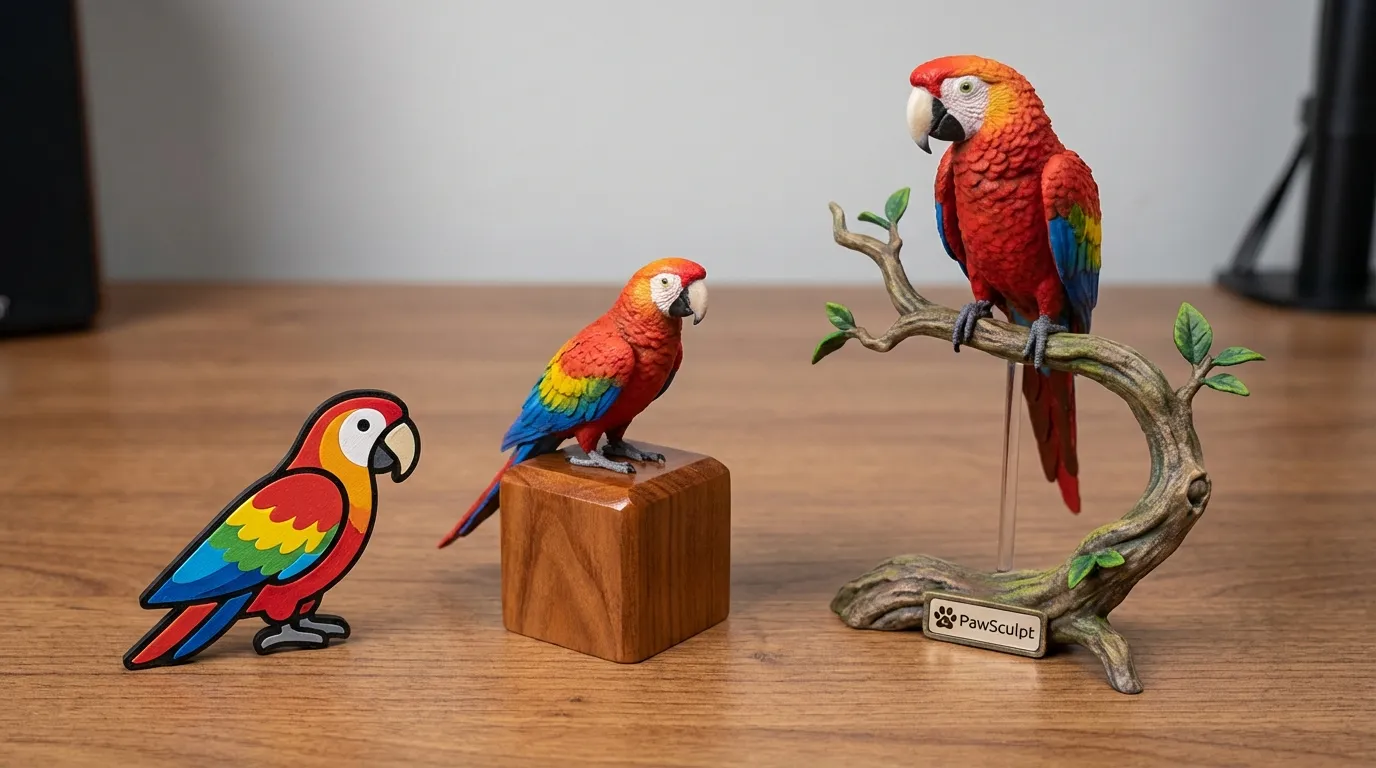
Most parrot owners don't realize that the average macaw’s tail accounts for nearly half its total body length, creating a center of gravity that makes standard flat-footed figurines physically unstable. When you commission a custom parrot figurine, you aren't just capturing their colors; you are engineering a miniature statue that needs to fight gravity exactly like the real bird does.
Quick Takeaways
- Anatomy dictates geometry — Parrots are top-heavy with long tails; flat bases often lead to tipping or broken tail tips.
- Perching looks natural — A branch or abstract perch allows the tail to hang freely, mimicking natural posture.
- Material safety — Elevating the model protects delicate tail feathers from snapping during cleaning or handling.
- Stability engineering — Integrated bases allow us to shift the center of mass for a safer, longer-lasting custom figurine.
The Physics of a Parrot Figurine
In my 15 years working in additive manufacturing and model making, I’ve seen thousands of four-legged animals—dogs, cats, even hamsters—that sit perfectly fine on a flat surface. Their center of gravity is low, distributed across four points of contact.
Parrots are a nightmare for physics.
Consider an African Grey or a Cockatoo. Their mass is concentrated in the chest and head. Their feet are tiny contact points located centrally under the body. And then there is the tail—a long, rigid lever extending backward.
If we simply 3D print a parrot standing on a flat surface without a base, we encounter two immediate failure modes:
- The Tipping Point: The figurine becomes incredibly sensitive to vibration. A heavy footstep near the shelf can send a flat-footed bird toppling forward (beak heavy) or backward (tail heavy), depending on the species.
- The "Tripod" Problem: To make a bird stand flat, the tail often has to touch the ground to act as a third leg. This looks unnatural for many species that rarely sit on flat ground, and it puts stress on the thinnest part of the print—the feather tips.
"A figurine that falls is a figurine that breaks. A proper base isn't just aesthetic; it's an insurance policy for your art."
Why "Flat" Doesn't Work for Feathers
In full-color resin 3D printing (the technology we use at PawSculpt), the material is cured by UV light. It’s durable, but like any resin, thin parts can be brittle.When a parrot is sculpted standing flat, the tail feathers are often forced into an unnatural angle to clear the "floor." Or worse, they drag. In the real world, a macaw on the ground holds its tail up. In a figurine, that suspended tail acts like a cantilever beam. If the model tips backward, the entire shock load goes into the tip of the tail. Snap.
The "Perch" Advantage: Engineering for Longevity
The solution isn't just glueing the bird to a disc. It's about integration.
When our digital artists sculpt a parrot, we almost always recommend an integrated perch or branch. This isn't just an artistic choice; it's a structural one.
1. The Tail Clearance Factor
By elevating the bird even just 20mm off the "ground" on a branch or rock, the tail can hang naturally.- Aesthetic Benefit: The bird looks relaxed, not tense or crouching.
- Structural Benefit: The tail is no longer a point of impact. If the figurine is set down hard, the base takes the hit, not the delicate feather tips.
2. Increasing the Footprint
A parrot's feet might cover an area of maybe 1 square inch. A proper base can expand that footprint to 3 or 4 square inches.- Center of Mass: We can manipulate the base shape to ensure the center of gravity falls dead center.
- Adhesion: In the printing process, a wider base ensures better adhesion to the build plate, reducing the risk of warping or print failures that could distort the bird's anatomy.
3. Support Removal Scars
This is a detail most people don't talk about until they see it. In resin printing, we use support structures (like scaffolding) to hold up overhangs.If a bird is printed standing on its own feet, the support structures have to attach to the belly and the underside of the tail. Removing them can leave tiny marks.
- With a Base: We can route supports to the bottom of the base—an area you'll never see. The bird itself remains pristine because the base acts as the primary support structure.
| Feature | Flat-Footed Figurine | Integrated Base/Perch |
|---|---|---|
| Stability | Low (High tipping risk) | High (Wide footprint) |
| Tail Safety | Low (Tail often touches ground) | High (Tail hangs freely) |
| Realism | Low (Birds rarely stand flat) | High (Natural perching posture) |
| Durability | Vulnerable to tip-overs | Protected by weighted bottom |
| Print Quality | Supports often touch belly | Supports hidden under base |
Choosing Your Base Style
When you design a piece with us, you aren't limited to a generic brown circle. The base is part of the story.
The Naturalist (Driftwood or Branch)
This is the gold standard for arboreal birds like Amazons, Macaws, and Conures. The digital sculptor creates a textured branch that mimics wood grain. Because we print in full color, this branch will have mossy greens, deep browns, and weathered grays printed directly into the resin.- Why it works: It allows for "gripping" feet. Parrots have zygodactyl feet (two toes forward, two back). Seeing them grip a branch is deeply satisfying and anatomically correct.
The Modernist (Geometric/Abstract)
For a cleaner look, we can use a simple geometric block or cylinder. This works well for minimalist homes.- Why it works: It provides the height needed for the tail without distracting from the bird's plumage.
The Ground Dweller (Textured Rock/Sand)
Some birds, like Caiques or certain parakeets, do play on the ground. In this case, we sculpt a "ground" base rather than a perch.- Why it works: It widens the footprint to prevent tipping but keeps the bird low. We can add texture like carpet (for the indoor birds!) or sand.
"We often see customers try to save money by requesting 'no base,' only to realize later that their bird won't stand up on a shelf without museum wax."
— The PawSculpt Team
Counterintuitive Insight: Weight Distribution
Here is something that surprises most people: We often hollow out the bird but keep the base solid.
- The Bird: We might print the body with a slight hollow or lattice structure to reduce top-heaviness.
- The Base: We print this 100% solid.
This lowers the center of gravity drastically. It’s the same principle as a Weeble-Wobble toy. You could bump the shelf, and the bird might rock, but it won't fall. You cannot achieve this physics trick without a base.
A Note on "Hand-Painting" (And Why We Don't Do It)
I need to clear up a misconception about how these bases (and birds) get their color.
In traditional model making, you print a gray shape and then hire an artist to paint it. That works for Warhammer, but it's terrible for gradients.
Parrot feathers have iridescence and subtle transitions—think of the shift from yellow to green on an Amazon's shoulder. A paintbrush creates hard lines.
Our process is full-color additive manufacturing. The printer jets tiny droplets of colored resin (cyan, magenta, yellow, black, white, and clear) and cures them instantly. The color is inside the object, not just on top.
This means the "wood" of your base isn't painted brown; it is brown resin, layer by layer. The transition from the bird’s foot to the branch is seamless. There is no paint to chip off if you accidentally knock it over.
Caring for a Perched Figurine
Even with a base, these are art pieces, not action figures.
- UV Light: While we use UV-cured resin, prolonged exposure to direct, harsh sunlight (like a windowsill in July) can eventually cause "bloom" or slight yellowing of the clear coat over years. Keep them on a shelf out of direct beams.
- Dusting: Because of the complex geometry of a perched bird (the gap between the tail and the branch), dust loves to hide there. Use a soft camera lens brush or compressed air (gently!) to clean the gap. Do not use a cloth, which can snag on a claw or feather tip.
Frequently Asked Questions
Can I choose the type of wood for the base?
Since we digitally sculpt the base, we can mimic almost any texture—weathered driftwood, smooth oak, or even a specific perch your bird loves. Just remember, the final product is printed in full-color resin, not made of actual wood, though the texture will feel and look incredibly realistic.Will the figurine break if it falls?
Resin is a rigid material, similar to ceramic or hard plastic. While the base significantly reduces the chance of tipping over, a fall from a high shelf onto a hardwood or tile floor could still cause damage, particularly to fine details like crests or tail tips. We recommend using a small dab of museum wax on the bottom of the base for extra security.Can you print my bird flying instead of perching?
We can! However, flying poses present different engineering challenges. To suspend a bird in "mid-air," we usually incorporate a clear resin support rod or sculpt a stylized element (like a cloud or abstract swirl) that connects the bird to the base. This ensures the model is supported without defying gravity.How heavy is the base compared to the bird?
We intentionally engineer the weight distribution. In many of our parrot models, the base accounts for roughly 40-60% of the total weight. This low center of gravity is crucial for preventing the "top-heavy" wobble that plagues cheaper, hollow plastic toys.Ready to Celebrate Your Pet?
Every pet has a story worth preserving. Whether you're honoring a beloved companion who's crossed the rainbow bridge or celebrating your furry friend's unique personality, a custom PawSculpt figurine captures those details that make your pet one-of-a-kind.
Free instant AI preview • 3D artist preview within 7 days • 5 free revisions