How to Pose a Great Dane Sculpt: Scaling, Accessories, and Picking the Right Photo
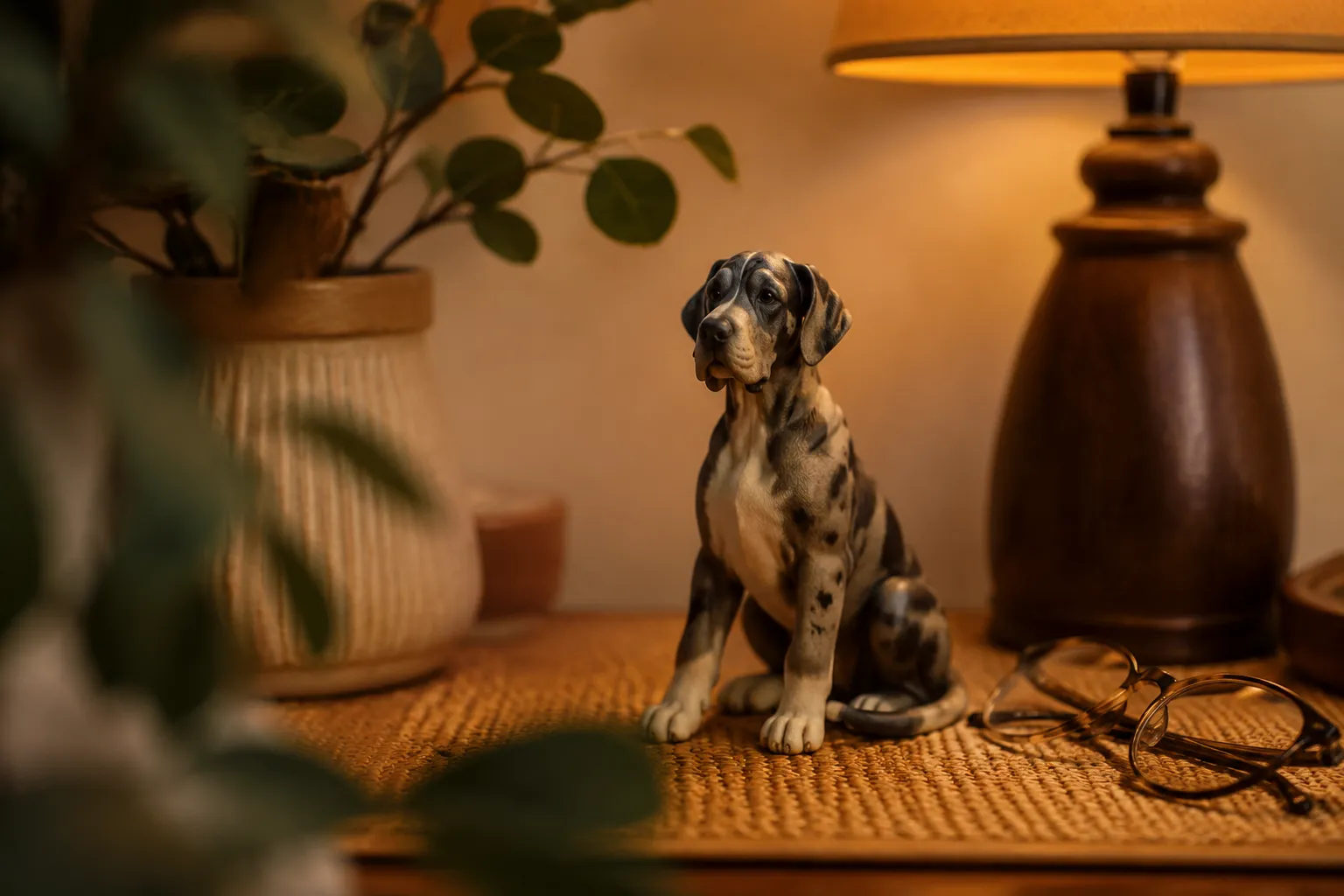
"Dogs are not our whole life, but they make our lives whole." — Roger Caras. That lands heavy when the dog is a Great Dane. Which is the whole puzzle behind a custom Great Dane figurine: how do you scale down a hundred-pound gentle giant without scaling down what makes him unmistakably him?
To pose a Great Dane sculpt well, choose a photo shot at the dog's eye level, then match the pose to the scale. A seated or lying pose reads more naturally at small sizes than a full stand, because it keeps the breed's long legs proportional and structurally strong in full-color resin 3D printing.
Quick Takeaways
- Shoot at eye level, not from above — high angles shrink the chest and distort Great Dane proportions.
- Seated or "sphinx down" poses beat majestic stands at small scale for realism and durability.
- Scale by proportion, not footprint — a Dane needs longer legs and a deeper chest to read right.
- Great markings survive the process because color prints into the resin, not onto it — see how custom pet sculptures handle merle and harlequin coats.
- A raking-light photo shows fur flow that helps the sculptor place muscle and coat direction.
Why Great Danes Break the Usual Scaling Rules
Here's the thing most guides skip: a Great Dane doesn't scale like a normal dog.
Shrink a beagle to palm size and it still looks like a beagle. Do the same math on a Dane, keeping the same footprint you'd give a spaniel, and you get something that reads as "big Labrador." The magic of the breed lives in the ratios. Leg length. Chest depth. That long, noble skull sitting high above the shoulders.
We've sculpted a lot of large breed sculpt scaling jobs, and the Danes are the ones where the numbers lie to you. A photo can flatten a 34-inch-tall dog into something stubby if the camera was even a little high. So the sculptor isn't just copying the photo. They're reconstructing the animal's real geometry from it.
The counterintuitive part: the bigger the real dog, the more its miniature depends on getting the thin parts right. Those famously slender Dane legs and that whip of a tail are what tell your eye "giant breed." Get them a hair too thick and the whole thing looks like a mastiff.
Scaling by proportion, not by size
When our digital artists (they hand-model your pet in software like ZBrush or Blender before anything gets printed) block out a Dane, they're checking a handful of ratios against your reference photos.
| What we check | Why it matters on a Dane | Common photo distortion |
|---|---|---|
| Leg length vs. body depth | Defines the "tall" silhouette | Overhead shots shorten legs |
| Skull height above shoulders | The regal head carriage | Front shots flatten it |
| Chest depth | Reads as breed mass | Side light hides it |
| Tail taper | Signals giant-breed elegance | Motion blur thickens it |
None of this is guesswork you need to worry about. But knowing it helps you understand why the photo you send matters so much.
Picking the Right Photo (The Part Everyone Underestimates)
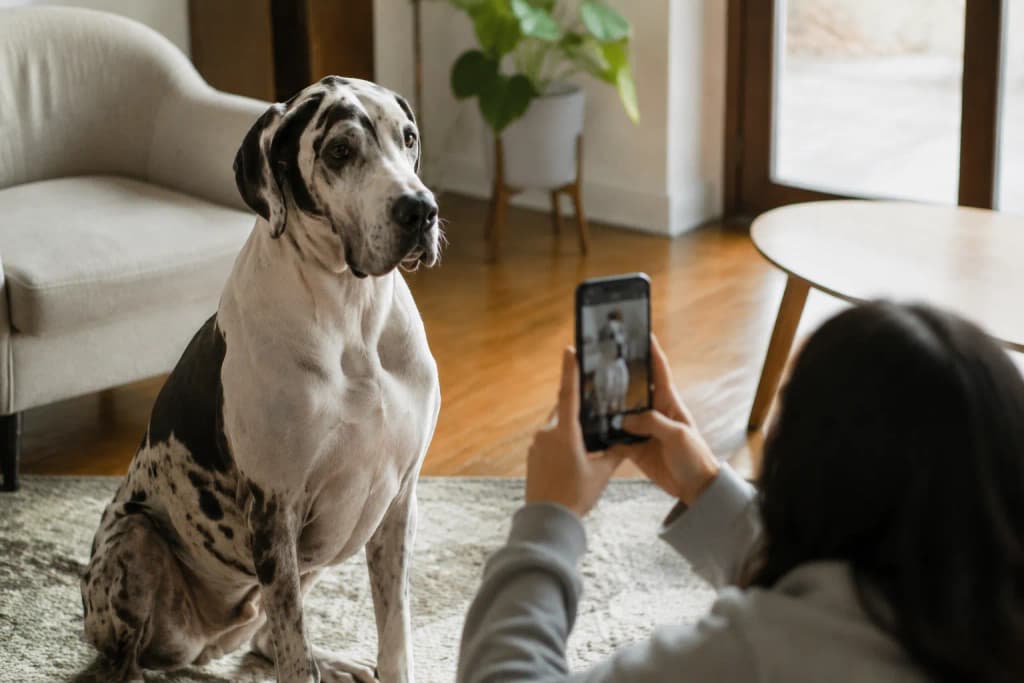
One order stuck with us: a family sent twelve gorgeous photos of their Dane, and every single one was taken looking down at him while he gazed up adoringly. Sweet pictures. Terrible references. From that angle, his legs vanished and his head ballooned.
The photo is the foundation. A blurry or badly angled reference forces the artist to invent, and invention drifts away from your dog.
Our top pick for a reference angle: camera at the dog's chest height, dog in profile or three-quarter turn, standing or sitting naturally. That single frame carries more usable information than a dozen cute overhead snaps.
Here's what actually works, ranked by how much it helps the sculptor:
| Priority | What to capture | Why it helps |
|---|---|---|
| Must-have | Side or 3/4 profile at eye level | Establishes true proportions |
| Must-have | Sharp focus on the head and face | Expression is the whole ballgame |
| Strongly helps | Even, soft daylight (window light) | Reveals coat color honestly |
| Strongly helps | A second angle of the face | Confirms muzzle and ear shape |
| Nice bonus | One raking-light shot (low side light) | Shows fur direction and muscle |
That last one is the insider trick. Light coming across the coat from a low angle throws tiny shadows that map how the fur lies and where the muscle sits under it. A vet-style flat photo tells the truth about color. A raking-light photo tells the truth about form.
"Send the boring photo. The one where he's just standing in the yard at eye level tells us more than the one where he looks like a movie poster."
A quick word on markings. Danes come in coats that terrify a lot of makers. Harlequin. Merle. Mantle. Brindle. If you own one of these dogs, you already know no two are patterned alike. That randomness is exactly why a clear, well-lit photo matters more for a Dane than for a solid-colored breed. The pattern is the portrait. The American Kennel Club's Great Dane breed standard lays out the recognized color families if you're curious where your dog fits.
Posing: What the Sculpt Should Actually Say
Most people ask for the standing hero pose. We get it. It's how you picture a Dane, all height and presence.
But at figurine scale, the full stand is the hardest pose to pull off convincingly, and honestly not always the most flattering. All that height gets compressed. The legs carry the whole weight of the model on tiny contact points. And a stiff four-square stance can read as taxidermy rather than personality.
Personal Aside: Between us, the sculpts our team gets quietly attached to are almost never the majestic stands. They're the "sphinx down" poses. The Dane lying with front legs stretched out, head up, that slightly goofy alert-but-relaxed look every Dane owner knows. Those are the ones that make us go "there he is."
Matching pose to personality
A pose is a sentence about your dog. Choose it on purpose.
- The seated pose — calm, dignified, the "good boy waiting" look. Stable to print, flattering to proportions. Our most-recommended for first-timers.
- The sphinx down — relaxed and characterful. Reads beautifully at small sizes because it lowers the center of gravity.
- The natural stand — striking, but demands a great reference and sturdier engineering. Worth it when the standing photo is genuinely excellent.
- The head tilt — a small tweak that carries huge personality. We love it on the goofier Danes.
Why pose choice matters structurally: in figurine pose customization, the pose isn't only about mood. It decides how the model gets printed and how tough it ends up. We'll get to that, because it's where the engineering and the emotion actually meet.
There's a version of this where you overthink it. Don't. Pick the pose that makes you smile when you picture it on the shelf. That instinct is usually right.
The Engineering Behind a Giant on Slim Legs
This is where a Great Dane gets interesting to make.
PawSculpt uses full-color resin 3D printing. In plain terms: after the artist finishes the digital sculpt, a printer builds the model up in extremely thin layers of UV-cured photopolymer resin (a liquid plastic hardened by ultraviolet light), and the color is printed into the material as it goes. There's no painting step. The merle on your dog's shoulder is baked into the resin itself, not brushed on top.
That matters for a Dane specifically. A hand-finished color layer on a slender leg would be the first thing to chip. Color embedded in the material doesn't wear off the high points the way surface color would.
Orientation, supports, and those legs
Every 3D print has to be angled on the build plate and held up by temporary scaffolding called supports while it prints. Where those supports touch, they leave faint marks after removal, little dimples we call support scars. Part of the craft is hiding them.
- Orientation logic: we tilt the model so support contact points land on hidden surfaces (belly, underside of the base) rather than the face or the front of the legs.
- The Dane problem: slim legs are both fragile during printing and prone to warping as the resin cures. A slight lean in the pose, or a naturalistic connection between legs and body, adds strength without looking engineered.
- Why seated poses win again: more contact with the ground means less cantilevered weight on thin points. Better prints, fewer failures.
This is the honest tradeoff of the whole craft: detail versus durability. We could sculpt a Dane rearing up on impossibly delicate ankles. It would look incredible for about a week until someone dusted the shelf too hard.
"A Great Dane's legs are the truth-teller. Get them right and the giant reads as a giant. Get them wrong and you've made a very large dog."
— The PawSculpt Team
Hollowing, curing, and the finish
Bigger breed, more material, more things that can go wrong. A solid resin Dane would be heavy, slow to cure, and more likely to warp as thick sections shrink unevenly. So larger models are often hollowed (printed with an empty interior) with small drain holes so uncured resin can escape. Layer heights typically sit somewhere in the 25–50 micron range, which is roughly the thickness of a human hair or finer. That's what keeps coat texture readable at small scale.
After printing comes the part no one sees:
- Wash — clearing away leftover liquid resin.
- Cure — a final UV bath to fully harden the material. Under-cure and it stays tacky and soft. Over-cure and it turns brittle. There's a window, and hitting it is experience, not luck.
- Support removal and light sanding — cleaning off those scars.
- Clear coat — the one manual step. A protective varnish that seals the surface, adds a subtle sheen, and guards the printed color against UV fading.
Then quality control. We check dimensions against the sculpt, eyeball symmetry (Dane skulls are unforgiving, a crooked ear jumps out immediately), and inspect the surface under raking light, the same low-angle trick we asked you to use for photos. It catches "bloom" (a hazy surface film) and any pitting the eye would miss under flat light.
None of this makes a photocopy. It makes a portrait. The sculptor's read on your dog's expression is in there, interpreted, the way a good drawing captures someone better than a passport photo does. If you're weighing a keepsake for a dog you've lost, that interpretive quality is often what families tell us brings the most comfort. Some choose pet memorial figurines; others prefer a portrait of their dog in his prime. Neither is wrong.
What to Expect From Photo to Shelf
We won't quote exact prices or promise a rush, because those things shift and we'd rather you see the current details straight from the source. But the shape of the process is worth knowing so you can plan.
| Stage | What happens | Typical timing |
|---|---|---|
| AI preview | Free instant preview on the website | Immediate |
| Artist 3D preview | A master sculptor's digital model for your review | Within 7 days of deposit |
| Printing & finishing | Full-color print, cure, clear coat, QC | Part of the build window |
| Delivery (US) | Insured, tracked, carefully packed | ~27–40 days after final payment |
| Delivery (international) | Same care, longer transit | ~33–47 days after final payment |
The 3D preview is your leverage. That's the moment to speak up about the head tilt, the ear set, the exact pose. Danes owners are wonderfully particular about ears, and they should be. For the full process and current specifics, pawsculpt.com keeps it all in one place, and the FAQ page answers the rest.
A note on caring for the finished piece: keep it out of direct, all-day sun (UV is the enemy of any pigment over years), dust it with a soft dry brush rather than a wet cloth, and don't grab a large model by the legs. Support the body. Same rule as picking up the real dog, honestly.
When a Sculpt Isn't the Right Call
We'd rather be straight with you. A figurine isn't for everyone or every moment.
If you're in the raw first weeks after losing a dog, a tangible keepsake helps some people and overwhelms others. There's no correct timeline, and organizations like the Association for Pet Loss and Bereavement exist precisely because grief doesn't follow a schedule. Many owners tell us they waited months, then knew. Others wanted something to hold right away. Both are normal.
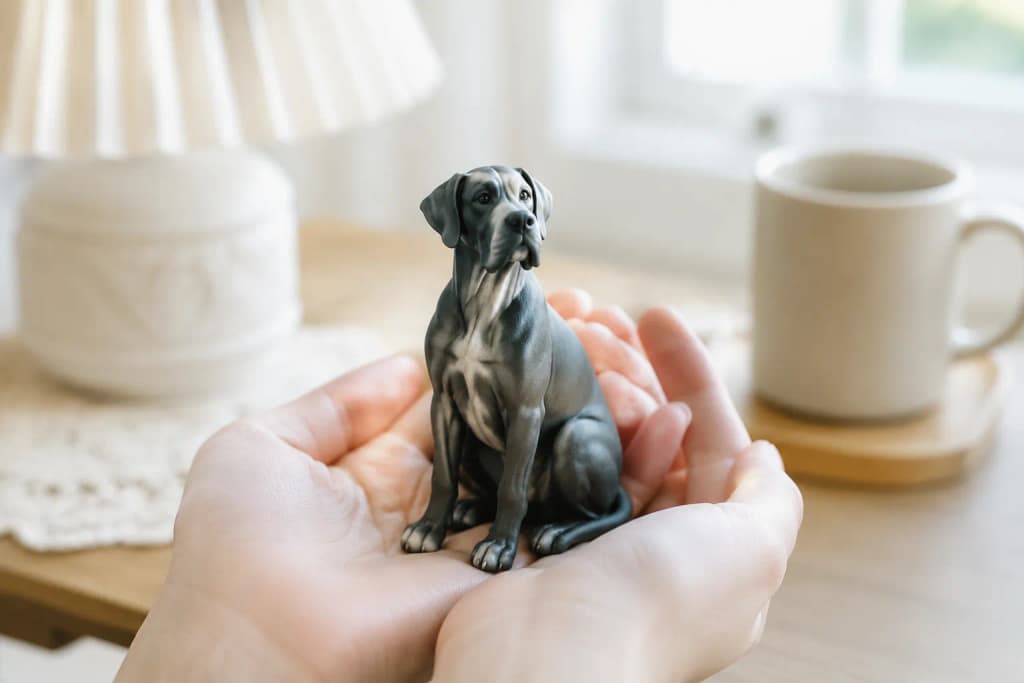
And if what you really want is a flat image on the wall, a pet portrait or a good photo print might serve you better and cost less. A sculpt earns its keep when you want the dog present in the room, something with weight and dimension you can turn in your hands. For a breed as physically commanding as a Dane, that dimensionality is a big part of the appeal. But it's your call, and there's no wrong answer.
Frequently Asked Questions
What photo works best for a custom Great Dane figurine?
Take it at your dog's chest height, in profile or a three-quarter turn, in soft natural light. That single frame carries more usable proportion information than a stack of overhead snapshots. A sharp, well-lit shot of the face is non-negotiable, since expression is what makes it look like your dog.
Why do Great Danes need special scaling?
Because their charm lives in ratios, not raw size. If a sculptor keeps the same footprint they'd use for a mid-size breed, the Dane loses its height and elegance. Leg length, chest depth, and that high head carriage all get checked and scaled by proportion so the miniature still reads unmistakably as a Dane.
What pose should I choose?
For most first-time orders, a seated or sphinx-down pose. They flatter the proportions, print more reliably, and capture the relaxed personality Dane owners love. A full standing pose is gorgeous when your reference photo is excellent, but it's the most demanding to execute well at small scale.
Will the sculpt capture my dog's exact markings?
It captures them faithfully as an artist's interpretation, which is the point of "a portrait, not a photocopy." Because color is printed into the resin, complex Dane coats like merle and harlequin come through in the material itself. A clear, evenly lit reference photo is what makes those patterns sing.
How should I care for the finished figurine?
Keep it out of prolonged direct sunlight, dust it with a soft dry brush, and lift it by the body rather than the legs. The clear coat protects the surface and color, but UV over years is the main thing to guard against, same as with any pigmented keepsake.
Ready to Celebrate Your Pet?
Every pet has a story worth preserving. Whether you're honoring a beloved companion who's crossed the rainbow bridge or celebrating your furry friend's unique personality, a custom PawSculpt figurine — a sculpted portrait, not a photocopy — captures the character that makes your pet one-of-a-kind. For a giant breed especially, a well-posed custom Great Dane figurine brings all that presence down to a scale you can keep on the shelf and hold in your hands.
Free instant AI preview, then an artist's 3D preview to review before printing. Every order ships insured, tracked, and carefully packed.