
How Busy Owners Can Mentally Enrich a Border Collie Puppy by National Dog Day
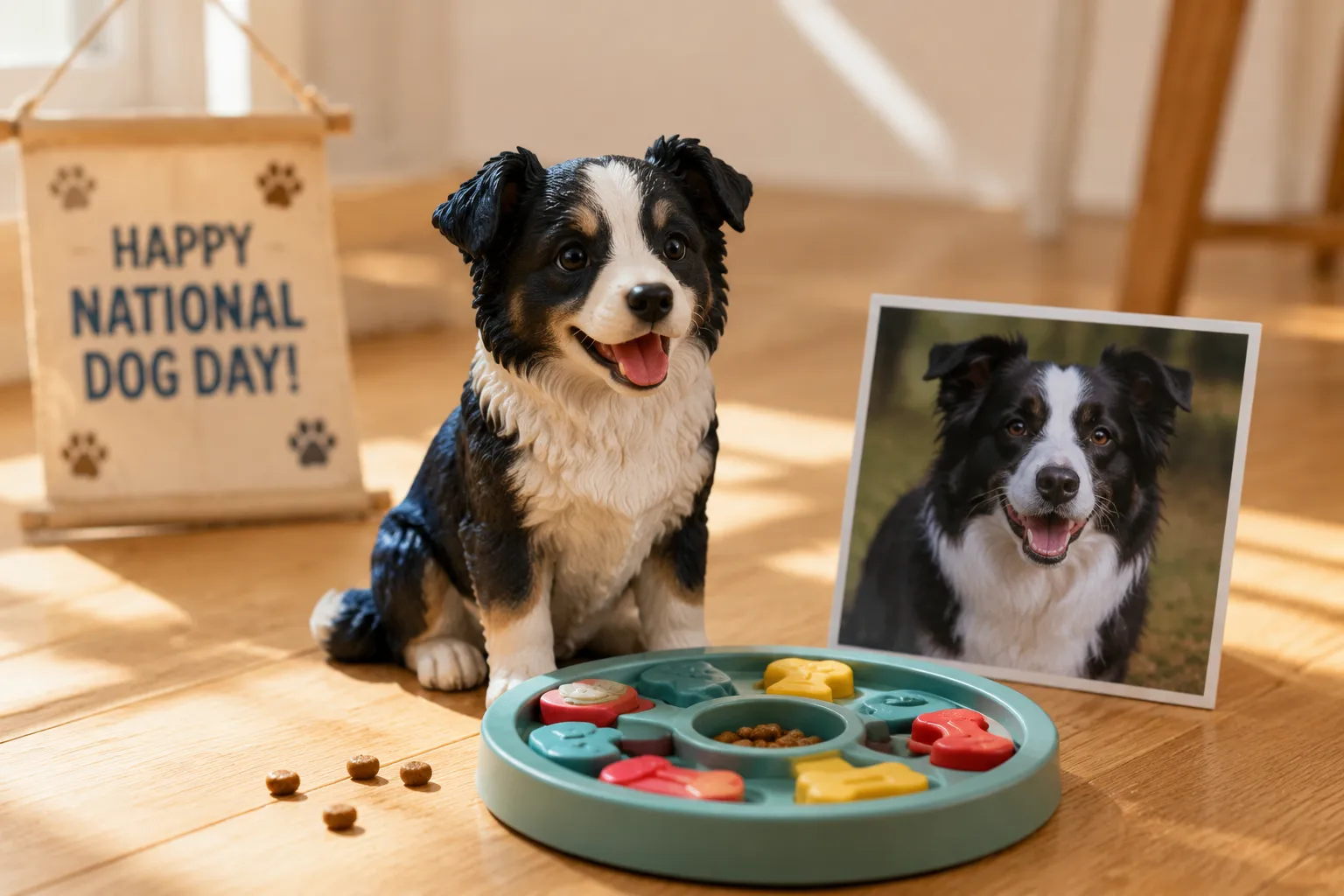
You're folding laundry on the living room rug when the puppy drops a single sock at your feet, sits, and stares—and in that small standoff lies the whole quiet truth of border collie puppy enrichment. He doesn't want the sock. He wants a job. He wants you to notice him thinking.
Quick Takeaways
- A tired body isn't a tired Border Collie — mental work exhausts them faster than a run ever will.
- Enrichment fits into time you already have — folded into meals, doorways, and walks, not added on top.
- Five focused minutes beats an hour of distracted play — intensity and intention matter more than duration.
- National Dog Day works best as a checkpoint — measure the bond, not the performance, and consider marking this fleeting puppy chapter with a custom pet figurine before it changes.
- Frustration is data, not failure — a puppy that "won't settle" is usually a mind asking for more, not less.
Why a Tired Body Is Never a Tired Border Collie
Here's the thing most new Border Collie owners discover around week three, usually somewhere between exhausted and bewildered: you can walk this dog for two hours, throw the ball until your shoulder aches, let him sprint the length of the yard a hundred times—and he'll come inside, drink some water, and then look at you like the day is just getting started.
You did everything right. And he's more wired than before.
This is the part nobody warns you about clearly enough. With most breeds, physical exercise is the lever. Tire the body, calm the dog. But a Border Collie is a working brain that happens to come attached to a body. The body is the easy part. The brain is the engine, and the brain doesn't get tired from running. It gets tired from deciding.
We've talked with hundreds of Border Collie families over the years, and the same story surfaces again and again. They're not struggling because they're lazy or uncommitted. They're struggling because they've been handed the wrong instruction manual—one written for Labradors and golden retrievers, breeds that genuinely do settle after a good run. The Collie owner follows that advice faithfully and ends up with a dog that's somehow both physically drained and mentally frantic. Pacing. Whining. Herding the kids. Nipping at heels. Inventing problems to solve because nobody gave him a real one.
"A Border Collie doesn't misbehave out of spite. He misbehaves out of unemployment."
That single reframe changes everything. Once you stop thinking how do I wear this dog out and start thinking how do I give this mind something worthy of it, the whole project gets easier. And—this is the good news for anyone reading this with a calendar that's already overcommitted—it also gets a lot less time-consuming.
The intelligence that's also a liability
The Border Collie consistently ranks at the very top of canine intelligence assessments. The American Kennel Club's breed profile describes them as remarkably bright and energetic herding dogs bred to make split-second decisions on the hillside, often working a quarter-mile from their handler with total independence.
Sit with that for a second. You're not living with a pet. You're living with a freelance decision-maker who was engineered, over centuries, to assess a situation, choose an action, and execute—without waiting for permission.
Now put that creature in a quiet suburban living room with nothing to manage, and watch what happens. That magnificent problem-solving capacity doesn't switch off. It just turns inward, or sideways. It starts solving problems you didn't know you had. The "problem" of the cat existing. The "problem" of a child running across the yard. The "problem" of the vacuum cleaner being allowed to live.
So the goal of enrichment isn't to suppress that brain. It's to aim it.
What Busy Owners Get Wrong About Puppy Mental Stimulation
Let's be real about who's actually reading this. You're not a professional sheepdog trialist with a farm and forty open hours a week. You've got a job, maybe a commute, maybe kids, maybe a partner who thinks the puppy was already a questionable idea. You love this dog. You also have to answer emails.
And somewhere along the way, the internet convinced you that good puppy mental stimulation requires a dedicated training session, a specific time block, and ideally a basement full of agility equipment. So when you can't find that block, you feel guilty, you skip it, and the puppy fills the vacuum with chaos. Round and round.
Here's the reframe we want to offer, and it's the heart of this whole piece:
"Enrichment isn't a thing you add to a busy day. It's a way of moving through the day you already have."
The mistake most people make is treating mental work as a separate appointment. The owners who actually thrive with this breed do the opposite. They thread enrichment through ordinary moments—the thirty seconds before a meal, the doorway before a walk, the commercial break, the time it takes the coffee to brew. They turn the architecture of an ordinary day into a series of tiny puzzles.
The counterintuitive math of attention
Here's something that surprised even us, drawn from what behaviorists understand about canine cognition and what we've heard echoed by countless owners: five minutes of fully engaged mental work tires a Border Collie puppy more than an hour of distracted fetch.
Why? Because intensity beats duration when the currency is focus. When your puppy has to actually think—solve, choose, restrain an impulse, read your body language—he's burning the expensive fuel. That's the fuel that, when spent, produces the deep, contented sleep you've been chasing.
A distracted hour where you're half on your phone and he's half watching a squirrel? That's a lot of motion and very little thought. Lots of calories, no cognition. He comes back unsatisfied, and so do you.
So the busy owner's secret weapon isn't more time. It's denser time. Smaller windows, fully present, fully intentional. That's a trade almost anyone can make, even on a brutal Tuesday.
Consider this small evening vignette, the kind we hear about constantly. You get home at 6:40, fried. Instead of guiltily tossing a ball you don't have the energy to keep throwing, you spend three minutes scattering his dinner kibble across the living room rug and let him hunt each piece down nose-first. You sit on the floor with a glass of water and just watch. By the time the last kibble is found, he's panting lightly, tail loose, and he flops down in the corner he likes—the one by the bookshelf—and exhales. You did almost nothing. He's a different dog.
That's the whole game, honestly.
The 15-Minute Framework for Busy Owner Dog Care
Alright. Let's get concrete, because vague encouragement helps no one. The framework we're about to lay out assumes you have roughly fifteen total minutes of intentional enrichment to give per day, broken into pieces, not one block. If you have more, wonderful. But fifteen scattered minutes, done well, is genuinely enough to keep a Border Collie puppy's mind nourished. This is the realistic floor for sustainable busy owner dog care.
The trick is matching the type of enrichment to the moment you're already in. Here's how that maps out across a typical day.
| Time of Day | Enrichment Type | Duration | Why It Works |
|---|---|---|---|
| Morning (pre-work) | Breakfast in a snuffle mat or scatter-fed | 5 min | Engages scent-tracking, slows fast eaters, starts the day with a "win" |
| Midday (if home/lunch) | Frozen stuffed Kong or lick mat | Self-directed | Sustained licking lowers arousal and self-soothes during alone time |
| Evening (after work) | Shaping game or trick training | 5 min | High-focus problem solving burns the "expensive" mental fuel |
| Pre-bed wind-down | Calm sniff walk (nose, not pace) | 5 min | Decompression; sniffing is to dogs what reading is to us |
Notice what's not on that list: no marathon runs, no two-hour park sessions, no elaborate gear. Notice also that three of the four slots are attached to things you were already doing—feeding, eating lunch, settling down for the night. You're not finding new time. You're upgrading existing time.
Start with the food bowl (and then throw it away)
The single highest-leverage change a busy owner can make takes zero extra minutes: stop feeding from a bowl.
A bowl delivers a Border Collie's most motivating resource—food—in exchange for absolutely no thought. It's the cognitive equivalent of handing a brilliant kid a worksheet that's already filled in. Wasted opportunity, twice a day, every single day.
Instead, make every meal a small job:
- Scatter feeding: Toss kibble across a rug or the lawn and let him nose it out. Engages the natural foraging drive Border Collies have in spades.
- Snuffle mats: A fabric mat with fabric strips that hide kibble. Five to ten minutes of dedicated sniffing, completely hands-off for you.
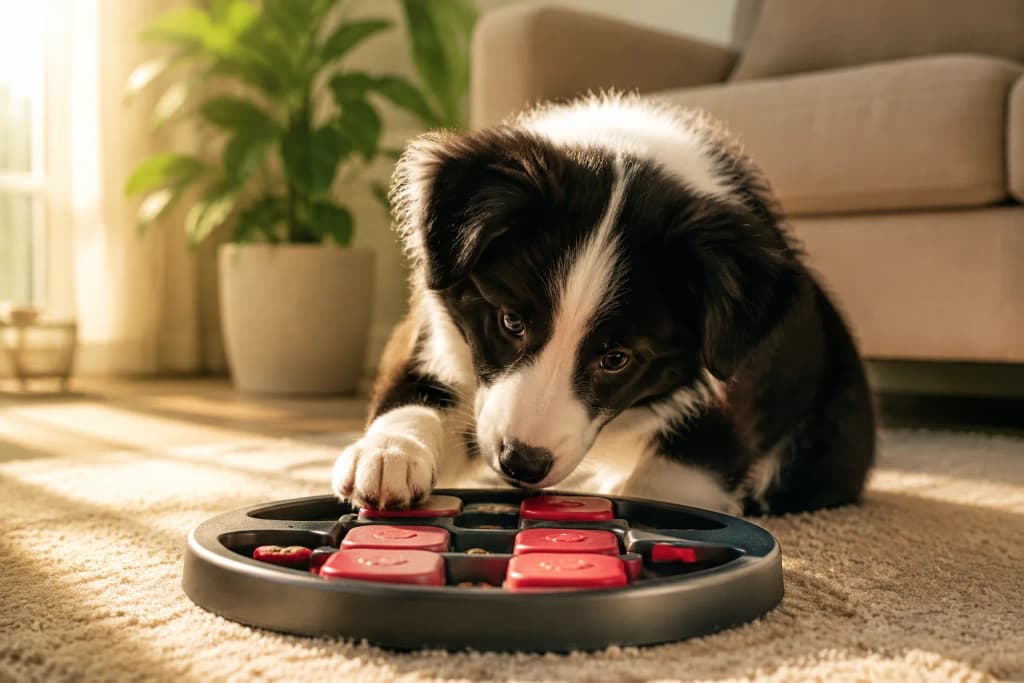
- Puzzle feeders: Sliding, flipping, lifting compartments that release food when solved. Start easy so he wins, then escalate difficulty.
- The hunt: Hide small portions in three or four spots around a room and cue him to "find it." This one's our favorite because it scales with his skill.
So what? Here's the so-what. You've just converted two of the day's most reliable, non-negotiable events—breakfast and dinner—into mental workouts that cost you nothing extra. That's roughly twenty enrichment minutes a day you generated by changing how you do a thing you already do. For a swamped owner, that's the whole ballgame.
The doorway protocol
Doorways are dead time we throw away constantly. The Border Collie owners who turn pros at this start treating every threshold as a micro training rep.
Before you open the door for a walk, ask for a sit. Two seconds. Before he comes through from the yard, a brief "wait." Before the food bowl goes down (if you're not scatter-feeding that meal), eye contact. These aren't training "sessions." They're seconds. But a puppy who navigates a dozen tiny impulse-control checkpoints a day is building the single most valuable trait this breed can have: the ability to pause and think instead of react.
That's the difference between a Border Collie who herds your guests and one who watches them with interest and stays put.
A Day in the Life: Enrichment That Doesn't Add an Hour
Let me walk you through what this actually looks like on a real workday, because the abstraction only goes so far.
The alarm goes off. Before coffee, you sprinkle the puppy's breakfast into the snuffle mat and set it down in the living room. While the machine gurgles and you're scrolling the news you swore you'd stop scrolling, he's working that mat, nose deep, tail going—five solid minutes of scent work you spent ninety seconds setting up. You haven't even had caffeine yet and he's already had a meaningful morning.
You head to work. He gets a frozen lick mat smeared with a little wet food, which keeps him calm and occupied during the hardest stretch—the leaving. The licking itself lowers his arousal; it's genuinely self-soothing, not just a distraction.
Evening, you're home and depleted. Five minutes on the floor: you grab a handful of his dinner and teach him to nose-target your palm, then build it into a little chain—touch, spin, touch, down. He's thinking hard, eyes locked on you, and you're sitting still, which honestly you needed too. Then a short sniff-walk around the block where the rule is he sets the pace and gets to read every fence post like it's the morning paper.
By 9 p.m., he's curled in his corner, that loose-jawed, deep-breathing sleep. Total intentional time you spent: maybe twelve minutes, none of it requiring energy you didn't have. That's the model. Not heroic. Sustainable.
The Enrichment Menu: Matching Activity to Energy You Actually Have
Some days you've got nothing left. Some days you're weirdly energized. The smart move is having a menu sorted by your available capacity, not the dog's. Pick from the column that matches how you actually feel, guilt-free.
| Your Energy Level | Enrichment Option | Setup Effort | Puppy Payoff |
|---|---|---|---|
| Running on fumes | Scatter feed + frozen Kong | Near zero | Moderate–high (scent work is deeply tiring) |
| Average / tired-ish | Trick shaping, "find it" games | Low | High (problem-solving burns mental fuel) |
| Actually got some energy | New trick + decompression sniff walk | Medium | Very high (novelty + scent + bonding) |
| Weekend / day off | Intro to a "real job" (treibball, scent box, basic herding ball) | High | Maximum (channels the working instinct fully) |
The reason this matrix matters: guilt is the enemy of consistency. Owners who demand the "weekend tier" of themselves every single day burn out by week two and quit entirely. Owners who let themselves serve "running on fumes" enrichment on a hard Wednesday—and feel fine about it—are the ones still doing this in month six. Consistency at a low bar beats perfection that collapses.
The "almost a job" upgrade for weekends
When you do have a free morning, introduce something that taps the herding instinct directly. Treibball—where the dog "herds" large exercise balls into a goal—is brilliant for this, because it gives the gathering-and-driving instinct a legal outlet. So does basic scent-box work, where you teach him to indicate which of several boxes hides a treat.
These activities matter because they speak the breed's native language. A Border Collie wasn't built to fetch a tennis ball; he was built to read a flock, anticipate movement, and influence it. Treibball is fetch's smarter cousin—it asks him to control an object's path, not just retrieve it. The light that goes on behind his eyes when he gets it is the light his whole genetics were waiting for.
"Give a Border Collie a real job for ten minutes and you'll see two hundred years of breeding wake up at once."
What This Breed Teaches Us About Our Own Restlessness
I want to slow down here for a moment, because there's something underneath all the practical tips that's worth naming.
Living with a Border Collie puppy is, weirdly, a daily confrontation with the question of purpose. Here is a creature who is visibly, almost painfully unhappy when he has nothing meaningful to do—and visibly, deeply content when given work that matches his capacity. He cannot fake satisfaction. He cannot scroll through an evening to numb the restlessness. When his mind is underused, he tells you, loudly, with his whole body.
And if we're honest, a lot of us recognize the feeling.
We fill our own days with motion that isn't quite meaning. We mistake being busy for being engaged. We come home tired but not fulfilled-tired, the way the puppy is tired after he's solved something real. The Border Collie, in his demanding way, is a small mirror. He won't let you confuse activity with purpose, because he refuses to be fooled by it himself.
There's a tenderness in that, once you stop fighting it. This dog is asking you, every single day, to be present for short, real moments rather than absent for long, hollow ones. Five intentional minutes on the living room floor, fully there, beats an hour of half-attention. He's not just teaching you to train him. He's teaching you something about how to spend a life.
"The dogs that demand the most of our attention often give us back the most of ourselves. A Border Collie won't let you sleepwalk through his puppyhood."
— The PawSculpt Team
That's also why this particular chapter is worth marking. Puppyhood with this breed is intense and short and so fully alive—and then one day you realize the gangly, sock-stealing, problem-inventing baby is a calm, capable adult, and you can't quite remember when the change happened. It happens in the corners and the doorways and the ordinary mornings, almost invisibly.
National Dog Day as a Checkpoint, Not a Performance
National Dog Day falls on August 26th, and the internet will, predictably, turn it into a competition. Who walked the most miles, who bought the fanciest gear, who staged the cutest photo. For a Border Collie owner, that framing misses the point entirely.
Use the day as a checkpoint instead. A quiet audit of the bond, not a public performance of it.
Here's a different way to spend it. Ask yourself a few honest questions:
- Can my puppy settle? Not "is he exhausted," but can he choose calm in a stimulating environment? That's the real fruit of good enrichment.
- Does he look to me for direction? A well-enriched Border Collie checks in, offers behaviors, treats you as a partner rather than an obstacle.
- Am I dreading the day or enjoying him? Your honest answer tells you whether your current routine is sustainable.
- What does he know now that he didn't a month ago? Progress, however small, is the whole point.
The owners we've seen build the deepest relationships with this breed aren't the ones with the most impressive highlight reels. They're the ones who treat days like National Dog Day as a chance to step back and feel the accumulation of a thousand tiny shared moments.
Capturing the chapter before it changes
There's a particular ache that comes with Border Collie puppyhood specifically, and it's tied to how fast they grow up mentally. The body stays gangly for a while, but the brain matures at a startling clip. The clumsy, oversized-paws, head-tilt-at-everything phase is genuinely brief.
A lot of families reach National Dog Day and realize they want to hold onto this version of their dog—the puppy-soft coat, the particular way the ears half-fold, the specific markings before the coat fully comes in. Some keep a photo wall. Some put together a little video. And increasingly, families come to us wanting a tangible keepsake of the puppy phase specifically, which is part of why we built PawSculpt the way we did.
We create museum-quality figurines that are digitally sculpted by master 3D artists, then precision 3D printed in full color—so the markings, the proportions, the slightly-too-big ears of a real growing Collie come through honestly, texture and all. You can explore how the custom pet figurine process works if marking this chapter resonates with you. We won't pretend it's the only way to remember a puppyhood. It's just one that lasts longer than a phone full of photos you'll never print.
"Puppyhood with a Border Collie isn't slow enough to feel long. Mark the moment before the moment's gone."
Common Mistakes That Quietly Sabotage Enrichment
A few traps we see over and over. None of these come from bad intentions. They come from good instructions applied to the wrong breed.
Over-exercising the body to "tire him out." We covered this, but it bears repeating because it's so common. Endless physical exercise can actually build a fitter, more durable athlete who needs even more to feel tired. You can accidentally train a marathoner. Lead with the brain.
Free-feeding from a bowl. You're throwing away your single best enrichment currency twice a day. Even just scattering kibble on the floor instead reclaims it instantly.
Inconsistent rules across the household. Border Collies are pattern-detection machines. If one person enforces the doorway "wait" and another doesn't, the puppy doesn't get confused—he gets strategic, learning exactly who to ignore. Align the humans first.
Enrichment only when there's a problem. Waiting until he's already frantic to give him a puzzle teaches him that frantic behavior produces enrichment. Front-load it. A mind that's been fed regularly doesn't get desperate.
Skipping decompression. This one's overlooked constantly. A sniff walk where the dog sets the pace and reads the environment isn't a lesser walk—it's a different kind of enrichment, and arguably more important for a high-arousal breed. According to veterinary behavior resources like those at PetMD, sustained sniffing and scent work are powerfully calming for dogs. Let him read the world. It settles the nervous system in a way speed never will.
A quick note on what we're not
We'll be real with you: we're a figurine company, not a veterinary clinic. Everything here is enrichment and behavior guidance grounded in what we've learned alongside thousands of pet families and from established breed and behavior resources. But if your puppy's restlessness tips into something that worries you—obsessive shadow-chasing, compulsive spinning, genuine anxiety—that's a conversation for a vet or a certified behaviorist, not a blog. Border Collies are prone to some compulsive behaviors when chronically understimulated, and a professional can tell the difference between "needs more enrichment" and "needs intervention."
Building Your Sustainable Weekly Rhythm
Let's bring this all together into something you can actually run with. The goal isn't a rigid schedule that breaks the first time life gets in the way. It's a flexible rhythm with a few non-negotiable anchors.
The three daily anchors (these never skip, even on the worst days):
- Both meals delivered through some form of foraging or puzzle, not a bowl
- One five-minute focused thinking game (trick, shaping, or "find it")
- One decompression sniff opportunity, even if it's just the backyard
The weekly additions (when capacity allows):
- One or two longer "real job" sessions—treibball, scent work, intro agility
- A new trick or skill introduced and built over the week
- A novelty outing: a new walking route, a different surface, a new environment to read
That's it. That's the entire system. Three small anchors that ride along with things you already do, plus a few richer experiences when you've got the bandwidth. No basement gym. No quitting your job. No guilt on the hard days, because the floor is genuinely low enough to hit even when you're running on empty.
The families who stick with this past the first hard month aren't superheroes. They just stopped believing enrichment had to be big to be real. They learned to see the doorway, the food bowl, the brewing coffee, the corner of the living room as opportunities hiding in plain sight. And they let a brilliant, demanding, sock-stealing little dog teach them to be present in five-minute increments.
Frequently Asked Questions
How much mental stimulation does a Border Collie puppy actually need?
For most busy households, around fifteen minutes of focused mental work per day, split into small sessions, is genuinely enough. The key is that those minutes are intense and intentional rather than long and distracted. Scent work, puzzle feeding, and short training games tire this breed far more efficiently than time alone suggests.
Is mental exercise really more important than physical exercise for this breed?
Both matter, but mental work does the heavy lifting for calmness. A Border Collie puppy can run for hours and stay wired, because physical exercise builds fitness without satisfying the problem-solving drive. Lead with the brain—then physical activity becomes a complement rather than your only tool.
What's the easiest enrichment to start with if I have almost no time?
Stop feeding from a bowl. Scatter the kibble across a rug or use a snuffle mat instead, and you've converted a meal you were already serving into five to ten minutes of nose work for roughly ninety seconds of setup. It's the highest-leverage, lowest-effort change there is.
Why is my puppy more hyper after exercise, not less?
Because you're tiring the body, not the mind, and with a Border Collie the mind is the engine. Long runs can actually build a more durable athlete who needs even more activity over time. Swap part of that physical routine for scent games and shaping work, and you'll see the deep, satisfied tiredness you've been chasing.
When do Border Collie puppies start to calm down?
Their minds mature surprisingly fast, often outpacing their gangly bodies, but genuine settling usually comes with consistent enrichment over the first one to two years rather than at a fixed age. A puppy who's mentally fed daily learns to choose calm much earlier than one who isn't. Consistency matters more than waiting for a magic birthday.
How can I make National Dog Day meaningful instead of just another photo op?
Treat it as a quiet checkpoint on your bond and your puppy's progress. Try one new enrichment activity, take a slow decompression walk, and reflect on what he's learned in the last month. Many families also use the day to capture the fleeting puppy phase, since this breed grows up mentally so fast.
Ready to Celebrate Your Pet?
Every pet has a story worth preserving. The Border Collie puppy chapter is intense, brilliant, and gone before you're ready—those oversized ears, the puppy-soft coat, the head tilt at every new sound. As you build your border collie puppy enrichment routine ahead of National Dog Day, consider holding onto this exact version of your growing companion. A custom PawSculpt figurine is digitally sculpted by master 3D artists, then precision 3D printed in full color, capturing your puppy's real markings and proportions—texture and all.
Visit pawsculpt.com to learn more about our process, revisions, and quality guarantee.