
How to Prep Your Mid-Life Bengal for the Vet, Backed by Feline Stress Science
"An animal's eyes have the power to speak a great language." — Martin Buber
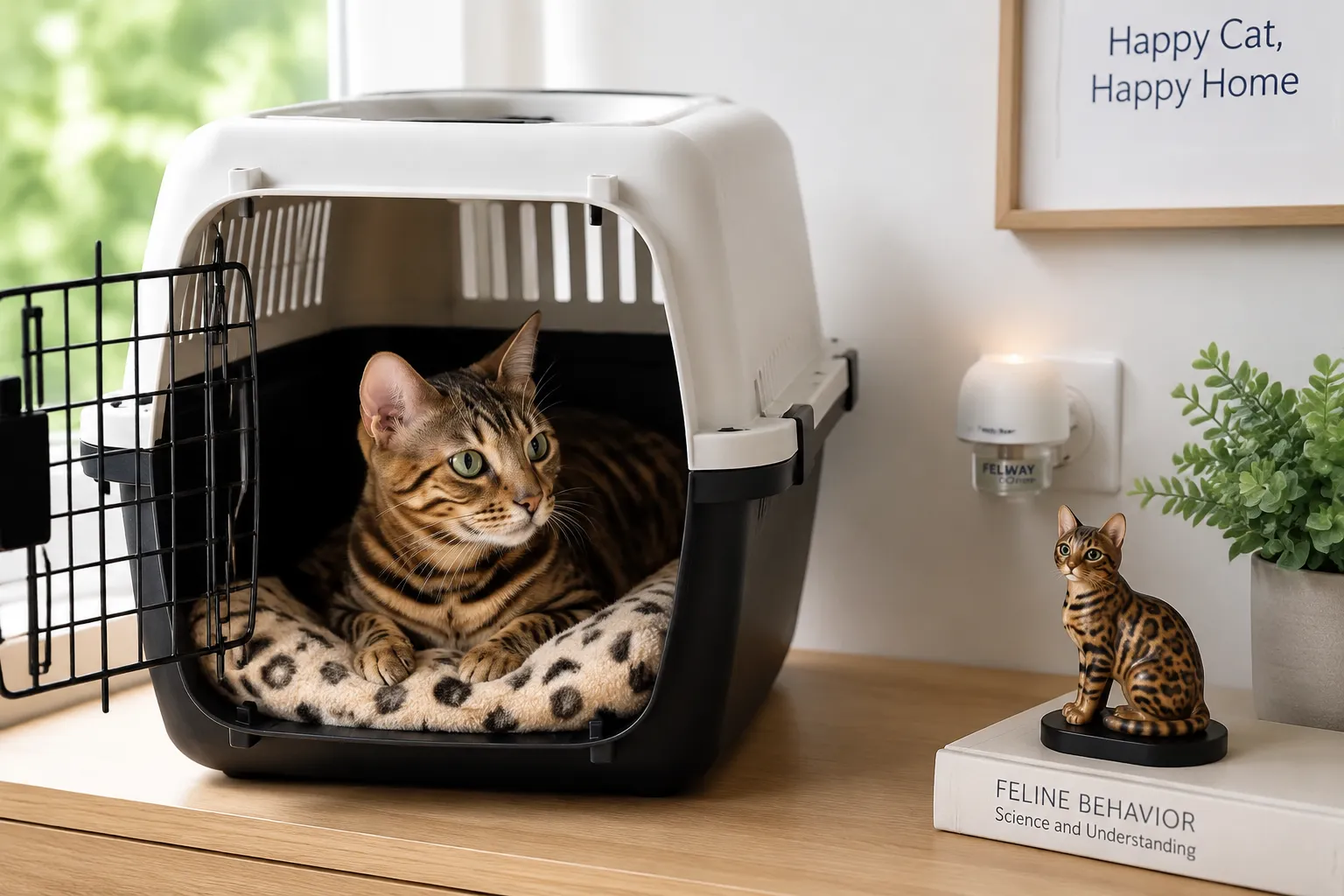
At the park, a Bengal on a harness flattens at the rumble of a passing stroller, ears pinned, paw frozen mid-step. That single flinch is why bengal vet visit prep matters more for this breed than almost any other. The cold click of a carrier latch can undo weeks of trust.
Quick Takeaways
- Start carrier conditioning 2-3 weeks early — Bengals need a slow runway, not a sudden ambush.
- Skip the "calm down" instinct — suppressing a Bengal's energy raises stress instead of lowering it.
- Mid-life Bengals (6-10 years) hide pain on purpose — vet prep is about reading subtle shifts, not waiting for symptoms.
- Capture your cat at full health now — many families preserve their pet's prime through custom pet figurines before age changes their coat and frame.
- Texture beats treats — a familiar blanket's feel does more to anchor a Bengal than any high-value snack.
Why a Bengal Brain Treats the Vet Like a Threat Map
Here's the thing most guides miss. A Bengal isn't just a cat with leopard spots. It's a cat with a leopard's vigilance wired into a domestic body, and that changes everything about how it experiences a vet visit.
Domestic cats descend from a single subspecies of African wildcat. Bengals are different. They carry Asian leopard cat ancestry just a handful of generations back, and that genetic recency shows up in behavior — heightened environmental scanning, faster startle responses, and a deep need to control their own movement.
When you scoop most cats into a carrier, they're annoyed. When you scoop a Bengal, a part of its nervous system reads "captured by predator." Same action, very different internal experience.
This is where feline stress science gets useful. The feline stress response runs through the same machinery ours does — the amygdala fires, the hypothalamic-pituitary-adrenal axis kicks in, and cortisol floods the bloodstream within seconds. Cortisol is the slow-burn stress hormone. It sharpens senses, tenses muscles, and prepares the body to fight or flee.
In a Bengal, that cascade tends to fire harder and recover slower.
"A Bengal doesn't panic because it's fragile. It panics because it's paying attention to everything you're not."
We've talked to hundreds of Bengal families through our work, and one detail comes up again and again: the cat seems "fine" right up until it isn't. That's not a sudden break. That's a threshold. The stress was building the whole time, quietly, under a surface of stillness.
The vigilance tax nobody warns you about
Think of your Bengal as running a constant background process. It's always cataloging the room — exits, sounds, smells, the location of every living thing. Behaviorists sometimes call this environmental hypervigilance.
That process costs energy. And on vet day, you're stacking new threats onto an already-busy mind: a strange car, a waiting room full of dog smell, a stainless steel table that's cold and slick under the paws.
The mistake most owners make is treating the vet visit as a single event. Your Bengal experiences it as a chain of escalating threats, each one adding to the cortisol load before the doctor ever walks in.
So what? It means the visit doesn't start at the clinic. It starts the moment the carrier appears. If you want to reduce the stress that matters, you have to intervene early in that chain — not at the end.
The Mid-Life Bengal Problem: When "Fine" Stops Being True
Let's talk about the years no one prepares you for. Mid-life cat care for Bengals — roughly ages six through ten — is its own challenge, and it's where vet prep quietly becomes most important.
A kitten's problems are loud. A senior's problems are expected. But the mid-life Bengal lives in a blind spot. It looks healthy. It plays. It leaps to the top of the fridge like it always has. And underneath, the early machinery of age is already turning.
One family we worked with brought their seven-year-old Bengal in for a figurine commission, mentioning offhand that "he's slowed down a little but he's basically the same." Two months later they messaged us: a routine senior panel had caught early kidney changes. The "slowing down" was the only sign. They almost missed it.
Why Bengals are master pain-hiders
Cats evolved to conceal weakness. A limping animal in the wild becomes a target. Bengals, with their stronger wild inheritance, took this instinct and ran with it.
So your mid-life Bengal won't tell you it hurts. It'll compensate. It'll adjust its jumps, change where it sleeps, groom a little less on one side. These shifts are so gradual that they hide in plain sight — which is exactly why the vet visit is your safety net, and why prepping for it well actually saves lives.
Here's what we mean by reading subtle shifts. Watch for these mid-life changes and bring them to your vet:
| Subtle Change | What It Might Signal | When to Note It |
|---|---|---|
| Hesitating before a familiar jump | Early joint or muscle decline | After it happens 3+ times |
| Sleeping in new, lower spots | Pain, vision changes, weakness | Within the first week of noticing |
| Drinking more water | Kidney or thyroid changes | Track for 5-7 days |
| Grooming less on one side | Discomfort reaching that area | Note immediately |
| Subtle weight loss despite eating | Metabolic or digestive issues | Weigh monthly at home |
That last row matters more than people think. A Bengal can lose a meaningful percentage of body weight while still finishing every meal. The muscle is going somewhere you can't see under all that sleek fur.
"The body remembers what the calendar forgets. Mid-life is when small signals deserve big attention."
The emotional weight of the middle years
There's something deeper here, and we'd be doing you a disservice to skip it.
Mid-life is the moment you first feel the clock. Your Bengal is still gorgeous, still electric, still leaping — but you've started doing the quiet math. You've noticed the first white hairs near the muzzle. You've felt, just once, a flicker of the future.
This is mono no aware in the most ordinary form: loving something precisely because it won't last. The Japanese have a word for that bittersweetness. Pet owners just call it Tuesday.
We mention this because the way you handle vet visits in these years is partly about health and partly about something larger — about being fully present for an animal whose time is finite, and refusing to sleepwalk through the good years.
Carrier Conditioning: The Three-Week Runway That Changes Everything
Most vet-stress advice tells you to "introduce the carrier slowly." True, but uselessly vague. Let's get specific, because the specifics are where Bengals are won or lost.
The principle behind all of this is desensitization paired with counter-conditioning — two well-established behavioral tools. Desensitization means exposing your cat to a trigger at an intensity so low it doesn't fire the stress response. Counter-conditioning means pairing that trigger with something good, so the brain rewrites its meaning over time. This is neuroplasticity in action: the brain physically rewiring an association through repetition.
You're not tricking your Bengal. You're rebuilding what the carrier means.
Week one: The carrier becomes furniture
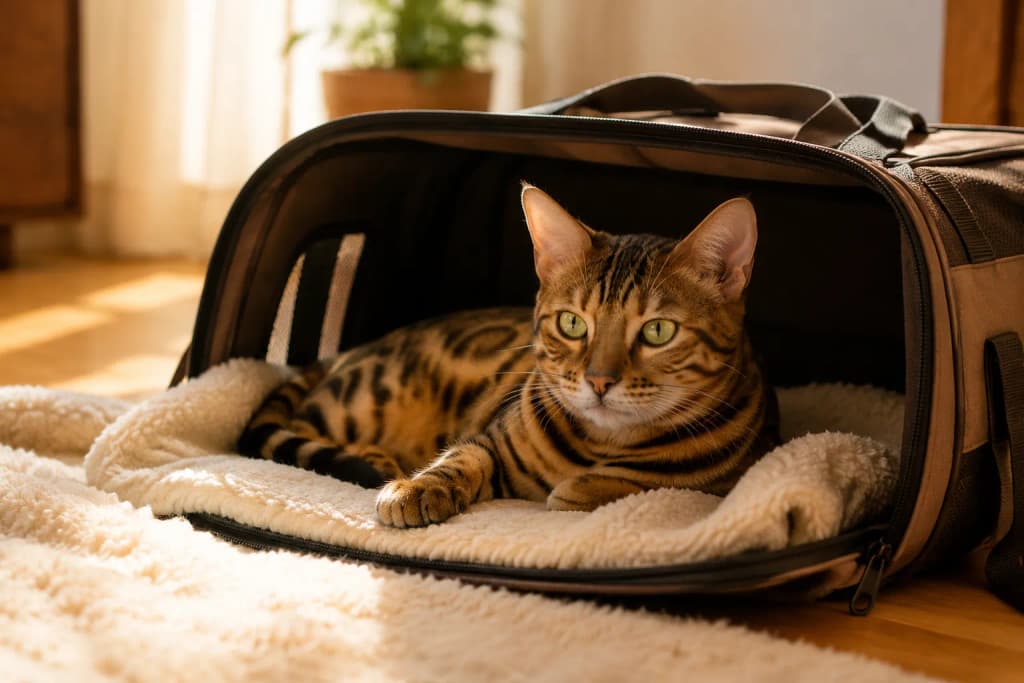
Pull the carrier out and leave it in a high-traffic room. Door off or tied open. Don't make a thing of it.
Then weaponize texture. Bengals are intensely tactile cats — they investigate the world through their paws and whiskers as much as their eyes. Line the carrier with a blanket your cat already sleeps on, something that carries home scent and a familiar nap-worn softness.
- Day 1-2: Carrier in the room, untouched, full of familiar bedding.
- Day 3-4: Drop a few treats or kibble inside, near the opening, then deeper.
- Day 5-7: Feed at least one meal with the bowl just inside the threshold.
The goal this week is simple. The carrier should stop being an event and start being scenery.
Week two: Inside becomes safe
Now you build positive associations inside the space.
Move the food bowl fully into the carrier. Toss a favorite toy in during play so your Bengal chases it inside on its own terms — that "on its own terms" part is non-negotiable for a control-sensitive breed.
Run short sessions where you gently close the door for five seconds, then open it before any tension builds. Five seconds. Then ten. Then thirty. You're staying under the stress threshold every single time.
If your cat freezes or bolts, you went too fast. Back up a step. There's no shame in it — there's only the cat's nervous system, telling you the truth.
Week three: Motion and the world beyond the door
Bengals don't just fear the carrier. They fear the transport — the swaying, the unfamiliar car hum, the loss of stable ground under their feet.
So once the carrier itself is neutral, add gentle motion. Lift the carrier, walk a lap of the house, set it down. Reward. Next session, a short trip to the car with the engine off. Then engine on, no driving. Then a two-minute drive around the block that ends back home, not at the vet.
That final detail is the counterintuitive one. If every car trip ends at the vet, the car becomes the threat. Break that pattern with drives that go nowhere stressful, and you keep the whole chain from collapsing into one big fear.
"You can't command a cat to relax. You can only build a world where relaxing makes sense."
The Counterintuitive Truth: Stop Trying to Calm Your Bengal Down
This is the section we wish every Bengal owner would read twice.
When your cat gets anxious, your instinct is to soothe it. Hold it tighter. Speak in that high, reassuring voice. Pet faster. Cancel the energy.
For a Bengal, this often backfires.
Why suppression raises stress
A Bengal is a high-arousal, high-energy animal by design. Its nervous system runs hot. When you try to force stillness onto a body built for motion, you create a kind of internal conflict — the cat wants to move, to assess, to act, and you're physically preventing it.
That restraint reads as another threat. Now the cat is stressed about the vet and stressed about being held down. You've doubled the load.
The science term loosely fitting here is cognitive dissonance — though in a cat it's more visceral than mental. The instinct says "move," the environment says "you can't," and the mismatch spikes arousal further.
What actually works: drain the tank first
Here's the better play, and it surprised even us when we first saw Bengal behaviorists recommend it.
Exercise your Bengal hard before the vet trip. A solid 15-20 minute play session that morning — wand toys, chase, a real cardio burn. You're not trying to calm the cat. You're trying to spend its surplus energy before the stressful event, so there's less fuel for the panic fire.
A physically satisfied Bengal has a lower baseline arousal. The same trigger lands softer. Think of it as lowering the volume on the whole nervous system before you turn on the stress.
This single shift — from "suppress the energy" to "spend the energy" — changes more vet visits than any calming spray we've ever heard about.
Myth vs. Reality
Let's bust a few stubborn beliefs, because misinformation here genuinely hurts cats.
Myth: "If my cat hisses or growls at the vet, it's being aggressive and needs discipline."
Reality: That's fear, not dominance. Punishment deepens the fear and makes the next visit worse. The growl is communication — listen to it.
Myth: "Treats during the vet visit will calm my Bengal down."
Reality: A truly stressed cat won't eat. If your cat refuses high-value treats at the clinic, that's a stress reading, not pickiness. The treats need to work before the fear peaks, not during.
Myth: "Bengals are too wild to ever be calm at the vet."
Reality: Bengals are more trainable than average cats, not less. Their intelligence cuts both ways — they learn fear fast, but they learn safety fast too, if you teach it right.
That third one is the hopeful truth. The same sharp mind that catastrophizes the carrier can be retrained to tolerate it, sometimes faster than a "calmer" breed would manage.
Vet Day Logistics: The Hours That Make or Break the Visit
You've done the three-week work. Now don't fumble the day itself. The details here are small and they matter enormously.
The morning-of timeline
| Time Before Visit | Action | Why It Works |
|---|---|---|
| Night before | Place carrier out, bedding in | Familiar scent lowers next-day novelty |
| 3-4 hours before | Light meal only (ask your vet) | Reduces nausea, keeps treat-motivation high |
| 1-2 hours before | 15-min hard play session | Spends surplus energy, lowers arousal |
| 30 min before | Spray carrier with feline pheromone | Synthetic facial pheromones signal safety |
| At departure | Cover carrier with a familiar towel | Visual blocking reduces threat scanning |
That towel trick deserves a note. A Bengal's stress is fed by what it sees — every unfamiliar movement in the waiting room reloads the threat map. Draping a soft, home-scented towel over the carrier cuts the visual input. Less to scan, less to fear. The weight and texture of fabric they know does quiet work.
At the clinic
Ask for the first appointment of the day or a quiet slot. Fewer animals, less dog noise, less waiting-room chaos.
Keep the covered carrier elevated on your lap or a chair, never on the floor where dog faces appear. Bengals read floor-level approach as predatory.
And if your clinic offers it, ask about Fear Free certified practices. A growing number of vets train specifically in low-stress handling — warmed exam tables, non-slip mats, slow movements, the works. The American Animal Hospital Association and Fear Free initiative have pushed these standards into the mainstream, and they make a real difference for a sensitive breed. It's worth calling ahead to ask.
"We've photographed thousands of cats, and the calmest ones always belong to owners who prepared the moment, not just the appointment."
— The PawSculpt Team
The thing nobody tells you about the cold table
Stainless steel is cold and slick. For a cat already braced for threat, that loss of grip under the paws triggers another small panic — the body can't find stable footing, and instability reads as danger.
Bring your own towel and ask the vet to place it under your cat. A familiar texture and a surface the claws can actually grip lowers stress in a way that's almost absurdly simple. We've heard vets say it changes the whole exam.
Preserving the Prime: Why Mid-Life Is the Moment to Capture Your Bengal
Let's step back from logistics into something we feel strongly about.
Mid-life is the most photogenic, most fully-realized version of your Bengal — and it's the version most likely to slip away before you think to preserve it. The coat is at its richest. The rosettes are crisp. The musculature is defined. This is the cat at the height of itself.
Then age arrives, the way it always does, on quiet feet. The coat softens and dulls. The frame thins. The leap shortens. None of it sudden. All of it sure.
We work with families at every stage of this journey. Some come to us in grief, wanting to hold onto a cat that's gone. But the ones we quietly admire most are the families who act now — who capture their Bengal at full health, mid-leap energy still in its eyes.
That's part of why we do what we do. Our team digitally sculpts each pet, then brings it to life through full-color 3D printing — the markings, the rosette patterns, the exact set of the ears all reproduced directly in resin. For a breed defined by its coat, that color fidelity matters. A Bengal's pattern is its signature, and a custom pet figurine that captures it preserves something a photo flattens.
We're not saying buy a figurine. We're saying: don't sleepwalk through the prime. Whether it's a sculpture, a proper photo session, or just a habit of really looking at your cat each day — find your way to mark this chapter while it's still being written.
What good Bengal reference photos look like
If you do decide to preserve your Bengal in any visual form, here's what helps most:
- Natural daylight, no flash — flash blows out the rosette contrast that makes a Bengal a Bengal.
- Side profile plus a three-quarter angle — captures both the pattern flow and the facial structure.
- Shoot at the cat's eye level — overhead shots distort proportions and flatten the spine line.
- Get the whole coat in frame — the pattern runs differently across shoulders, flank, and legs.
You can always explore the full process and what works best for capturing markings over on our pet figurine blog. The same photo principles that help a sculptor help you, too — they train your eye to see your cat clearly.
Reading the Stress After You Get Home
The visit's over. You're not done.
A Bengal's cortisol doesn't reset the second you walk through your door. Recovery takes hours, sometimes a full day. And during that window, your cat is raw — over-aroused, easily startled, sometimes irritable in ways that have nothing to do with you.
The non-recognition aggression nobody expects
Here's a strange one that catches multi-cat households off guard. Your Bengal comes home smelling like the vet — antiseptic, dog, fear pheromones from other animals. Your other cats may not recognize it. They might hiss, swat, or refuse to let it back into the social group.
This is called non-recognition aggression, and it's about scent, not malice. The returning cat smells wrong, so the home cats treat it as an intruder.
What helps:
- Bring the carrier home and let your Bengal exit on its own — never dump it out.
- Give it a quiet, separate room for a few hours to decompress and self-groom.
- Swap scents gently — rub a soft cloth on each cat and let them re-acclimate before full reunion.
- Don't force interaction — the home scent will return within a day, and so will the peace.
The texture of home does the healing here. A Bengal that's allowed to curl into its own bedding, knead its familiar blanket, and rebuild its scent layer will settle far faster than one that's fussed over.
When to call the vet back
We're not vets, and we'll always say that plainly. But behaviorally, a few signs warrant a follow-up call: refusing food for more than 24 hours, hiding beyond a single day, litter box changes, or any lethargy that outlasts the expected recovery window. Trust your read of your own cat. You know its baseline better than anyone.
For breed-specific health context, the resources at PetMD are a solid, non-commercial starting point — though they're a supplement to your vet, never a replacement.
A Quick Reference: Building Your Bengal's Calm
Pulling it together, here's the rhythm of good Bengal vet prep — energy spent, trust built, signals read.
The work isn't in any single trick. It's in the sequence: the early carrier runway, the spent energy, the familiar textures, the covered carrier, the gentle re-entry home. Each piece lowers the cortisol load a little. Stacked together, they turn a breakdown into a manageable Tuesday.
And the deeper work — the part that has nothing to do with vets — is simply paying attention. To the hesitation before a jump. To the white hairs near the muzzle. To the version of your cat that exists right now and won't again next year.
Frequently Asked Questions
How early should I start prepping my Bengal for a vet visit?
Start carrier conditioning two to three weeks ahead. Bengals respond to a gradual runway, not a last-minute scramble. Leave the carrier out as furniture, fill it with familiar-smelling bedding, and build positive associations before you ever need to close the door. The slow approach rewires what the carrier means to your cat.
Why does my Bengal get more stressed at the vet than other cats?
It's in the genetics. Bengals are only a few generations removed from the Asian leopard cat, which gives them sharper environmental vigilance and a more intense stress cascade. Their cortisol spikes harder and clears slower, so the same vet experience that mildly annoys a regular cat can genuinely overwhelm a Bengal.
Should I exercise my Bengal before a vet visit?
Absolutely, and it's one of the most overlooked tactics. Instead of trying to calm your high-energy cat, spend its energy with a vigorous 15-20 minute play session a couple hours before leaving. A physically satisfied Bengal has lower baseline arousal, so the stress of the visit lands softer and recovers faster.
Why won't my Bengal eat treats at the vet?
Because it's too stressed to eat. Appetite is one of the first things the fight-or-flight response shuts down. If your Bengal ignores treats it loves at home, that's a reliable stress reading. This is why treat-based conditioning works best at home during prep, before the fear ever peaks at the clinic.
What changes should I watch for in a mid-life Bengal?
Mid-life Bengals, roughly six to ten years old, are master pain-hiders. Watch for hesitation before familiar jumps, sleeping in new lower spots, increased water intake, reduced grooming on one side, and subtle weight loss even while eating normally. Bring any of these to your vet — small signals often catch issues early.
Ready to Celebrate Your Pet?
Every pet has a story worth preserving. Whether you're honoring a beloved companion who's crossed the rainbow bridge or celebrating your furry friend's unique personality, a custom PawSculpt figurine captures those details that make your pet one-of-a-kind. As you navigate mid-life cat care and master your bengal vet visit prep, there's no better moment to preserve your Bengal at the absolute height of its health, color, and energy.
Visit pawsculpt.com to learn more about our process and guarantees