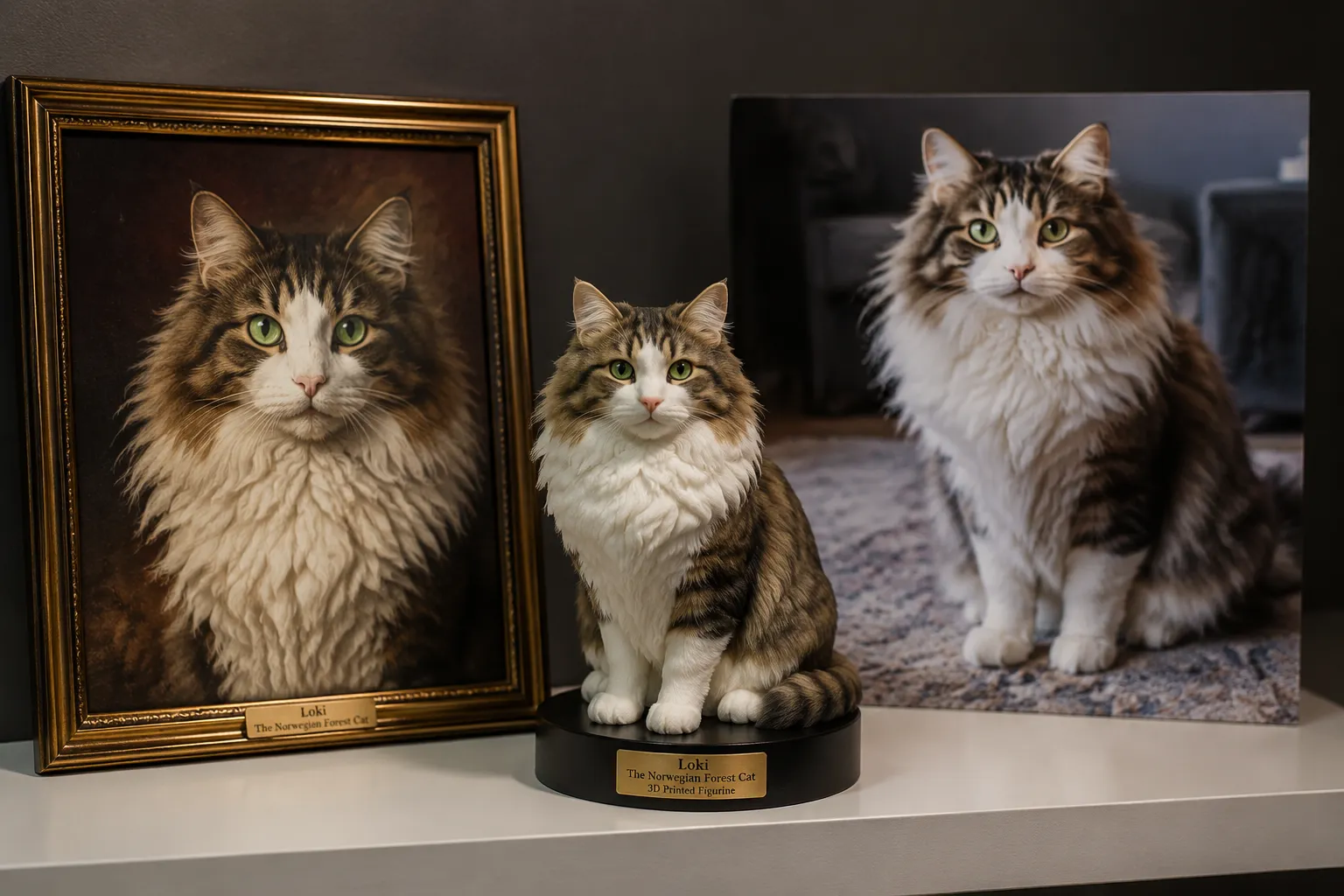
Painted Portrait vs 3D Figurine: Why a Norwegian Forest Cat Deserves Resin
Gull cry, low tide, and a Norwegian Forest Cat planting her huge tufted paws in the wet sand like she owns the whole beach. Watching her, you start the quiet pet portrait vs figurine argument in your head: which one could ever hold all that?
Quick Takeaways
- A flat portrait shows the surface — a figurine shows the volume that makes a Norwegian Forest Cat unmistakable.
- The breed's triple coat is 3D by nature, so a 3D object reads more "true" than any framed image.
- Resin color isn't a coating — in full-color 3D printing the pigment lives inside the material itself.
- Vet the customer service before you order, because a keepsake is only as good as the people behind the preview.
- See how dimensional capture actually works by exploring custom pet figurines and comparing them to a painting you already own.
Here's What the "Portrait vs Figurine" Debate Usually Gets Wrong
We've watched a lot of pet families stand at this exact crossroads. Portrait or figurine. Wall or shelf. And almost every guide you'll find frames it as a style question — modern versus classic, painterly versus realistic, that kind of thing.
That framing misses the point entirely.
The real question isn't aesthetic. It's dimensional. A portrait and a figurine are not two flavors of the same dessert. They're solving two completely different problems, and which one fits depends less on your taste and more on the actual animal you're trying to preserve.
And honestly? For a Norwegian Forest Cat specifically, the math tilts hard in one direction. We'll get into why.
Here's the thing most people don't realize until the package arrives: a Norwegian Forest Cat is one of the worst possible subjects for a flat image and one of the best possible subjects for a three-dimensional one. The very trait that makes the breed jaw-dropping — that enormous, layered, light-catching coat — is the trait a painting has to fake and a figurine gets to actually build.
"A painting describes the fur. A figurine occupies the same space your cat used to."
Let that sit for a second. Because that's the whole article in one line.
Why a Norwegian Forest Cat Breaks the Rules of Flat Art
Let's talk about what you're actually looking at when you look at a "Wegie."
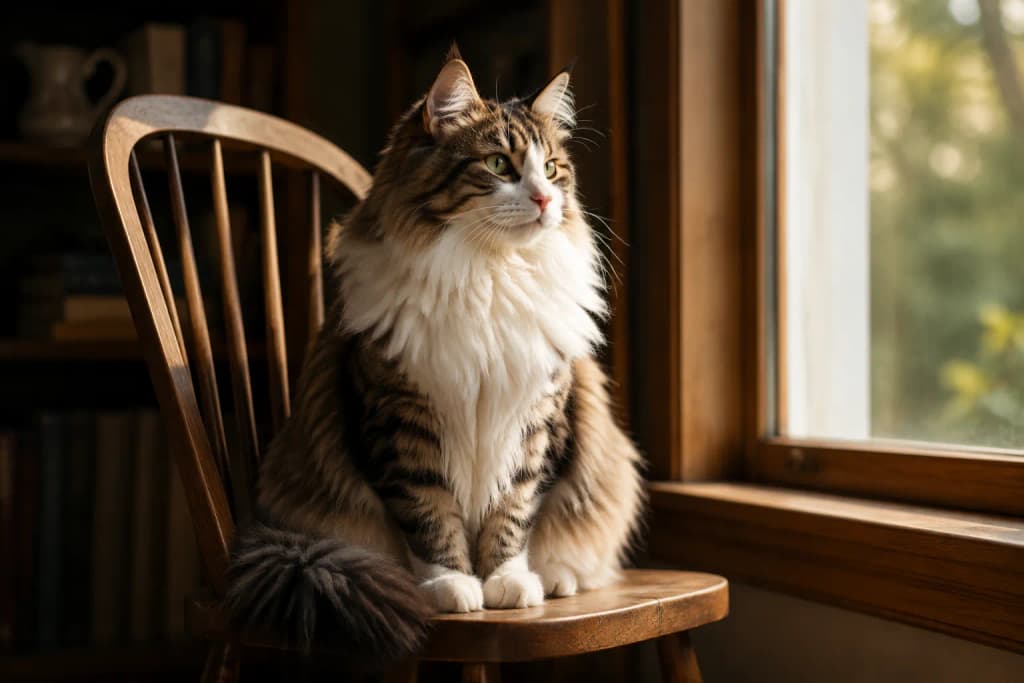
The Norwegian Forest Cat didn't get that coat for looks. It evolved in Scandinavian winters, and according to PetMD's breed overview, that signature look comes from a dense double layer — a water-resistant top coat over a wooly undercoat — plus the ruff around the neck, the "knickerbockers" on the back legs, and that ridiculous plume of a tail.
So here's the problem for a portrait.
All of that volume lives in depth. The ruff puffs forward. The tail bows out. The undercoat sits behind the guard hairs and only shows when light slips between them. A flat surface — canvas, paper, screen — has no depth to give. It can only suggest depth using shadow and highlight.
That's a trick. A good one, when done well. But a trick.
The light test that nobody tells you about
Want to know if a subject suits a portrait or a figurine? Do the light test.
Move your pet (or their photo) near a window in the late afternoon. Watch what the light does. On a short-coated cat — say a Siamese or a Bengal — the light lands flat and clean. The color is the surface. A painting captures that beautifully because there's barely any depth to lose.
Now do it with a Forest Cat. The light doesn't land. It scatters. It dives into the undercoat, bounces off the guard hairs, and turns a single "brown tabby" into maybe fifteen browns, three golds, and a cool gray nobody can name. The whole coat glows from inside.
A flat image flattens that glow into one painted-on impression of light. A physical object, lit by the real lamp in your real living room, recreates the actual scatter — every single day, at every angle, with whatever light you happen to have.
That's not a small difference. For this breed, it's the difference.
"Some cats are pictures. A Forest Cat is a sculpture that happens to be alive."
The "wrong from the side" giveaway
We hear this from families more than you'd think: they ordered a beautiful framed piece, loved it head-on, and then walked past it from an angle and felt a little pang of that's not quite her.
Of course it wasn't. From the side, a flat image is just an edge. But a Forest Cat from the side is a totally different animal — the tail fans out, the ruff stacks up, the back legs go full floof. Those profiles are where the breed lives. A figurine keeps all of them. A portrait, by definition, picks one and discards the rest.
Pet Portrait vs Figurine: What Each One Is Actually For
Okay, we've been hard on portraits. Time to be fair, because we're not here to sell you a one-size-fits-all answer.
Both formats are legitimate. They just do different jobs. Here's how we'd break it down after seeing both land in a lot of homes.
| Factor | Painted/Printed Portrait | 3D Figurine |
|---|---|---|
| What it captures | Surface, expression, mood, color | Volume, posture, coat depth, every angle |
| Best for | Short-coated pets, stylized art, gallery walls | Fluffy/long-coated breeds, "presence" pieces |
| Interacts with light | Fixed, baked-in highlights | Real-time, changes with your room |
| Space it needs | Wall space (vertical) | Shelf, desk, mantel (occupies a footprint) |
| Emotional register | Observational — "a beautiful image of her" | Physical — "she's here" |
| Best viewing angle | One (the front) | All of them |
See what happened there? It's not better-versus-worse. It's surface-versus-volume.
If your pet was a sleek short-hair and you want a statement piece for the wall, a portrait might genuinely be the better call. We'd tell you that to your face. But if your whole heart lives in the fluff — the coat, the size, the way they took up actual space in a room — that's a job for three dimensions.
A micro-story from the studio
One family came to us after commissioning a gorgeous framed piece of their Wegie, Solveig. They loved it. But the wife told us she kept setting her coffee mug down next to the empty spot on the windowsill where the cat used to sun herself — and the wall art, across the room, didn't fill that spot.
They wanted something on the sill. Something the light would hit at 4 p.m. the way it used to hit her. That's a volume problem. A portrait, however lovely, couldn't solve it.
Resin Material Science: What's Actually Holding the Color
This is the part the industry stays weirdly quiet about, so let's pull the curtain back. If you understand resin material science, you'll understand why a good figurine doesn't fade, chip, or look like a cheap toy — and why some do.
First, the big misconception. Most people assume a colored figurine is sculpted, then coated in color on the outside, like a model car. Layer of plastic, layer of paint on top.
That's not how modern full-color 3D printing works. And the distinction matters more than you'd guess.
Color inside the material, not on it
In advanced full-color 3D printing, the piece is built up in microscopic layers, and the color is deposited voxel by voxel as the object forms. A voxel is just a 3D pixel — think of a pixel that has depth. So the pigment isn't sitting on the surface waiting to scrape off. It's part of the cured resin itself, distributed through the material as it's built.
Why does that matter for you, practically?
- It can't flake off the way a surface coat can, because there's no separate coat to flake.
- Fine detail keeps its color — a single whisker or the tip of an ear holds its exact tone instead of getting clogged by a coating.
- Markings stay crisp, because the color follows the geometry at print resolution, not at the mercy of how steady a coating goes on.
The only manual step in a quality piece is a clear protective coat — a varnish-style finish that adds durability and a subtle sheen, and on UV-resistant materials, helps guard against light over time. That's it. The vibrancy you see is printed-in, not applied.
"Real durability isn't about what you put on top. It's about what's baked all the way through."
The texture truth (this one surprises people)
Here's an honest one. A full-color resin print has a texture. Look closely and you'll see an incredibly fine grain — the natural signature of layered printing, sealed under that clear coat.
Some companies airbrush their marketing photos until the piece looks like flawless glass. We think that's a mistake, and we'll tell you why: fur isn't flawless glass. That faint grain actually reads more like real coat than a dead-smooth plastic surface ever could. It catches light in tiny irregular ways — exactly like, well, hair.
So if you're comparing options and one looks suspiciously perfect in every photo, ask yourself whether you want a figurine of your cat or a figurine of a glossy idea of your cat.
Here's a quick reference for what separates a keepsake-grade resin piece from a novelty one:
| Quality Marker | Keepsake-Grade | Cheap Novelty |
|---|---|---|
| Where the color lives | Inside the resin (printed-in) | Coated/sprayed on surface |
| Detail resolution | Whisker- and marking-level | Blobby, "good enough" |
| Finish | Clear protective coat, subtle sheen | Bare or uneven gloss |
| Light response | Natural fine grain, fur-like | Plastic-flat or over-glossy |
| Longevity | UV-resistant materials | Fades, yellows, chips |
If you want to go deeper on how the dimensional capture process turns photos into a printed object, the breakdown of how custom 3D pet sculptures are made is worth a read before you commit to anything.
The Norwegian Forest Cat Keepsake Nobody Plans For
Let's talk about the part people don't expect.
When most folks think about a Norwegian Forest Cat keepsake, they picture a memorial — something for after. And yes, a huge number of the pieces we help create are for families who've lost a companion. That grief is real and we hold it carefully.
But here's a pattern we've noticed, and it's worth saying out loud: the people happiest with their keepsake are often the ones who made it while their cat was still around.
Why "while they're alive" hits different
A micro-story. A college student ordered a figurine of her family's senior Wegie, Bram, as a surprise for her mom's birthday — cat very much alive, very much demanding breakfast at 5 a.m. When the piece arrived, the mom set it on the kitchen windowsill. The real Bram walked over, sniffed it, and flopped down next to it in the sun.
That photo — the living cat napping beside his own figurine in the same patch of afternoon light — is the kind of thing you can't plan and can't fake. And two years later, when Bram did pass, that same figurine stopped being a cute gift and became the family's anchor. Same object. Completely different weight.
"The best time to capture them is while they're still demanding dinner at five."
What a Forest Cat keepsake preserves that photos can't
You have hundreds of phone photos. We know. Everyone does. So why does a physical piece hit differently?
Because scale is part of the breed. A Norwegian Forest Cat is big — males can be genuinely substantial — and that heft is a core part of who they were in your home. A photo shrinks everyone to the same size. A figurine, sized and proportioned correctly, brings back the sense of presence. The way they filled a lap. The way the tail draped off the edge of the couch.
It also preserves the specific pose. Not "a cat." Your cat, with that exact tilt of the head, the particular way they sat with one paw tucked. Our team works from your photos to digitally sculpt that individual posture, then brings it to life through full-color 3D printing so the markings land where they actually belong — the white bib exactly as wide as it really was, the tabby stripes breaking exactly where they really broke.
"Every Forest Cat we've worked on has one detail the family didn't even know they'd memorized — until they saw it captured."
— The PawSculpt Team
That detail is usually something tiny. A nick in one ear. An asymmetric blaze. The slightly crossed eyes that the family swore made him look perpetually skeptical. Getting that right is the entire job.
Counter-Point: When We'd Tell You to Skip the Figurine
We promised straight talk, so here's some.
A figurine is not always the right answer, and any company that tells you otherwise is selling, not helping. A few honest situations where we'd nudge you elsewhere:
You only have one blurry, low-angle photo. Dimensional capture needs information. If all you've got is a single dark, far-away shot, a skilled illustrator working in a more forgiving flat medium may actually serve you better than forcing a 3D reconstruction out of thin data. More on photo reality in a minute.
You're a wall-art person, full stop. Some people live with their memories vertically. Galleries, frames, that's their language. If a shelf object would just get dusty and ignored while a framed piece would get looked at daily, the framed piece wins. Use what you'll actually see.
You need it by Thursday for a funeral. Quality dimensional work takes time — sculpting, review, printing, finishing. If you're against a hard, immediate deadline, be realistic. (We'd rather you have something meaningful late than something rushed and wrong. But you should know the tradeoff going in.)
Budget genuinely matters right now. A museum-quality piece is an investment. There's zero shame in starting with a beautiful print today and commissioning the figurine when the timing's right. Grief and love don't have a deadline.
We'd rather lose an order than sell someone the wrong thing. A keepsake you regret isn't a keepsake. It's a reminder of a bad decision sitting on your shelf.
Customer Service Quality: The Make-or-Break Nobody Talks About
Alright. This is the section we wish someone had written for us before we knew the industry from the inside.
When you're comparing where to order, you'll obsess over photos and prices. Almost nobody evaluates customer service quality — and it's arguably the single biggest predictor of whether you'll love the final piece.
Here's why. A custom figurine isn't a product you pick off a shelf. It's a collaboration. The company is interpreting your photos, your descriptions, your "no, his ruff was fluffier than that." If the people behind the process can't communicate, the technology doesn't matter.
What good service actually looks like (the green flags)
After a lot of orders, the patterns are clear. Strong studios share these traits:
- They show you a preview before they print. This is non-negotiable. You should see a digital proof and have a real chance to say "the tail's too short" before anything becomes a physical object.
- They ask you questions you didn't think to answer. "Which photo shows his eye color most accurately?" A studio that asks good questions is a studio that's paying attention.
- They explain the revision process plainly. You shouldn't have to decode policy. (For the current specifics on previews and revisions, check the PawSculpt FAQ rather than trusting any number you read in a blog — those details change, and we won't pretend to quote them.)
- They tell you what they can't do. Honesty about limitations is a green flag, not a weakness.
The red flags that should make you walk
- No preview offered, or a "trust us" attitude about the proof stage.
- Stock-photo-perfect marketing with zero real customer pieces shown.
- Vague or evasive answers when you ask how revisions work.
- Pressure tactics and fake-urgency countdowns.
A micro-story on this one. A customer came to us after a rough experience elsewhere — she'd approved nothing, received a figurine with the wrong eye color, and the company treated her like the problem. By the time she reached us, she didn't want a figurine. She wanted to know she'd be heard. The piece mattered, sure. But the relief in her voice when we walked her through the preview step first? That was the real product.
"The technology builds the figurine. The people decide whether you'll love it."
That's why we'd argue service quality belongs right next to material science on your checklist. Maybe above it.
What to Expect: Getting the Photos Right
Since we keep mentioning photos, let's make this concrete. The quality of your figurine starts with the quality of what you send. Garbage in, garbage out — even master 3D sculptors can't invent detail that isn't there.
Here's what genuinely helps when you're photographing a Norwegian Forest Cat (or any pet) for dimensional capture:
| Photo Element | What Works | Why It Matters |
|---|---|---|
| Lighting | Soft, natural daylight (near a window) | Reveals true coat colors and depth |
| Angles | Front, both sides, and a 3/4 view | 3D sculpting needs all dimensions |
| Distance | Close enough to see markings clearly | Captures the details that make them them |
| Pose | A natural, characteristic position | Preserves personality, not a stiff pose |
| Eyes | At least one shot with clear eye color | Eye color is hard to guess from shadow |
| Coat | A shot showing the ruff and tail fully | These are the breed's signature volumes |
The single best photo tip we've got
Shoot at their level. Get down on the floor. Phone at cat-height, not looming over them from human-height.
Why? A top-down shot foreshortens the body and flattens exactly the volume we're trying to preserve. A level shot gives the sculpting team the true proportions — the real length of the back, the real fan of the tail, the real puff of the chest ruff. Five minutes on the floor with a handful of treats beats fifty rushed snaps from above.
And don't toss the "imperfect" candid shots. That photo of him mid-yawn, or caught looking grumpy in the morning light — those casual ones often carry more personality than any posed portrait. We can work magic from a great candid.
The general flow, without fake promises
We won't quote you turnaround times or policies, because they shift and we'd rather you get current info straight from the source. But the shape of the process is consistent:
- You share photos and the story of what made your cat them.
- A digital sculpt is created by the 3D modeling team, capturing pose and markings.
- You review a preview and request adjustments — this is your moment, use it.
- The piece is precision 3D printed in full color, then sealed with a clear protective coat.
- It arrives, and ideally, it stops you for a second in your own living room.
For the current specifics on each stage, the team details everything on the main PawSculpt site — that's the place to confirm anything time-sensitive.
So Which One Wins for a Norwegian Forest Cat?
Let's land the plane.
If we're being decisive — and we said we would be — for this breed specifically, the figurine usually wins. Not because portraits are bad. Because a Norwegian Forest Cat is, fundamentally, a three-dimensional creature whose entire signature is volume, depth, and the way light moves through a coat that exists in real space.
A flat image has to translate all of that into an illusion. A figurine doesn't translate. It rebuilds.
But — and this is the honest close — the best choice is the one you'll actually live with. The one that fills the empty spot on the windowsill. The one that catches the 4 p.m. light the way she used to. The one that makes a visitor stop and say "oh, who's this," giving you the gift of telling her story one more time.
That's not a style decision. It's a love decision. And only you know where your love lives — on the wall, or right there at eye level, taking up space, the way the real one always did.
Frequently Asked Questions
Is a portrait or a figurine better for a Norwegian Forest Cat?
For this breed, a figurine usually has the edge. The Norwegian Forest Cat's whole signature is volume — the ruff, the leg "knickerbockers," that enormous tail — and a 3D object rebuilds that depth in real space. A flat portrait can only imply it through painted shadow. If your pet was short-coated, though, a portrait can be a wonderful and sometimes better choice.
Is the color painted onto a resin figurine?
No, and this trips a lot of people up. In modern full-color 3D printing, the pigment is built into the resin itself, deposited as the piece forms layer by layer. The only manual step is a clear protective coat for durability and sheen. Because the color isn't a surface layer, it can't chip or flake off the way sprayed-on color can.
What photos work best for a custom cat figurine?
Soft natural daylight near a window, and shots from multiple angles — front, both sides, and a three-quarter view. Get down to your cat's eye level rather than shooting from above, since top-down angles flatten the body. Include at least one clear shot of eye color and one that shows the ruff and tail fully extended.
Should I make a keepsake while my pet is still alive?
Honestly, we'd encourage it. Some of the most treasured pieces we've helped create were made while the cat was still demanding breakfast. It captures their genuine posture and personality, and it carries quiet meaning later too. There's no wrong time, but "while they're here" has a magic that's hard to beat.
How do I know if a figurine company has good customer service?
Look for a real preview step before anything gets printed, thoughtful questions about your specific photos, and plain-language explanations of how revisions work. A studio willing to tell you what it can't do is showing you honesty. Walk away from no-preview policies, fake urgency, and answers that dodge your questions.
Will a resin figurine fade or yellow over time?
Quality pieces use UV-resistant materials and a clear protective coat to guard against light exposure, which helps preserve vibrancy. Cheaper novelty pieces with surface-applied color are far more prone to fading and yellowing. As with anything, keeping it out of harsh direct sunlight all day helps it last.
Ready to Celebrate Your Pet?
Every pet has a story worth preserving. Whether you're honoring a beloved companion who's crossed the rainbow bridge or celebrating your Norwegian Forest Cat's larger-than-life personality, a custom PawSculpt figurine captures the volume, the markings, and the presence a flat image can't. When you weigh the pet portrait vs figurine question for a coat this dimensional, a full-color resin keepsake gives you something you can actually live alongside.
Visit pawsculpt.com to learn more about our preview process, revisions, and quality guarantee.