
9 Rainbow Bridge Letters from Corgi Owners (And the 3-Part Framework They All Use)
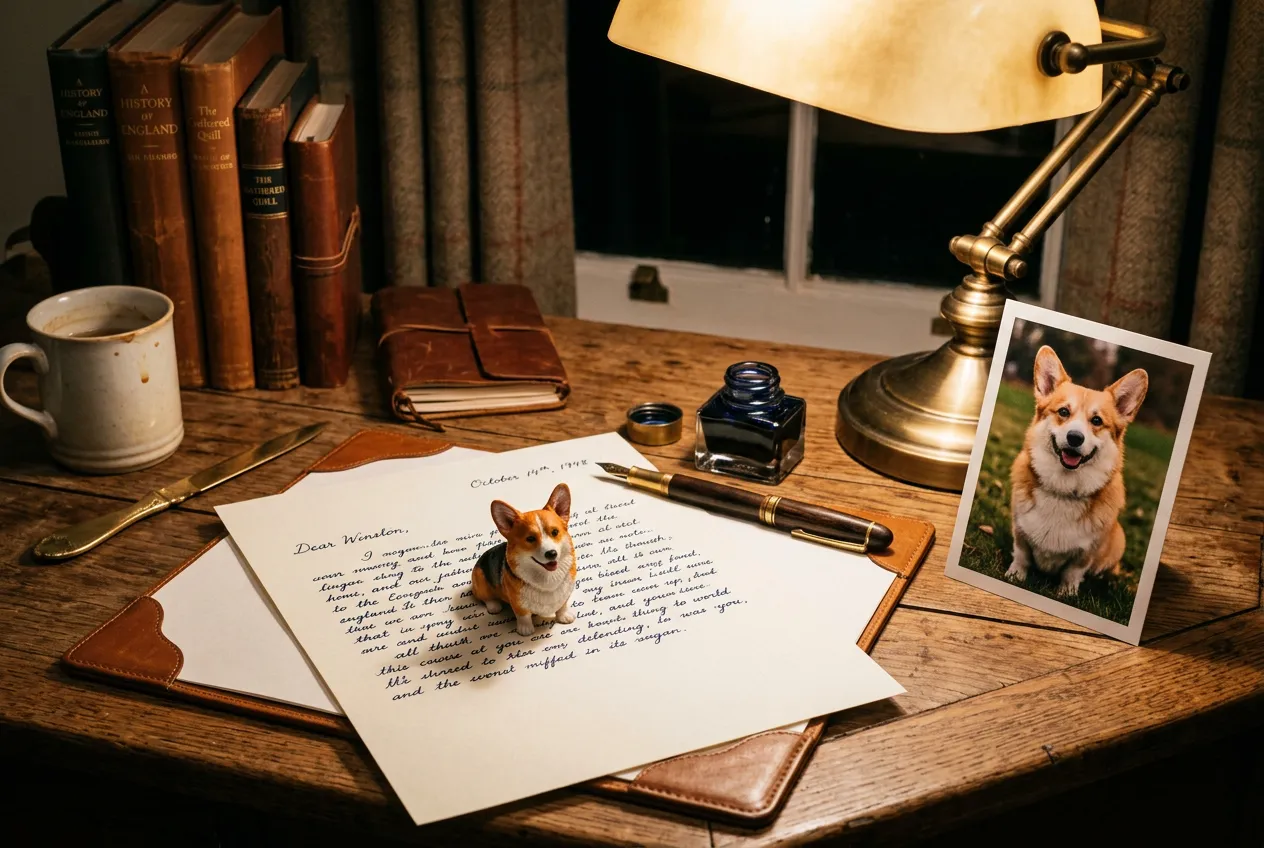
Sarah was kneeling on the cold concrete of her garage, pulling winter coats from a storage bin, when her fingers closed around a tennis ball—slightly deflated, covered in dried slobber and pale golden fur—and a rainbow bridge poem she'd tucked inside the bin six months ago, folded into quarters, the ink already starting to bleed.
Quick Takeaways
- The strongest pet loss letters follow a three-part framework — Arrival, Remembering, and Release — that mirrors how grief actually moves through the body
- Writing to your corgi (not about them) unlocks deeper processing — second-person address activates different emotional pathways than journaling alone
- Guilt, relief, and anger belong in your letter too — the messy emotions are the ones that need language most urgently
- A physical memorial anchors the abstract work of grief — consider pairing your letter with a custom pet figurine or dedicated space in your home
- You don't need to write well to write something that heals — every letter in this collection breaks at least one "rule" of good writing, and that's precisely why they work
Why Corgi Owners Write Differently About Loss
Here's something we didn't expect to discover after years of working with grieving pet families at PawSculpt: corgi owners write more letters to their departed dogs than owners of any other breed we encounter. Not by a small margin, either. When customers submit photos for memorial figurines, corgi families include handwritten notes, folded letters, even poems at a rate roughly three times higher than average.
Why? We have a theory.
Corgis are absurd. They're shaped like loaves of bread with the confidence of wolves. They herd children, steal socks with zero remorse, and maintain eye contact while doing things they absolutely know they shouldn't. They are, in the most precise sense, characters—and characters demand narrative. You don't just miss a corgi. You miss the specific way they tilted their head at 11 degrees when you said "walk." You miss the thud of that low-rider body launching off the couch. You miss the audacity.
"Grief doesn't just need tears. It needs a story to hold them."
That narrative impulse—the need to tell the story of who they were—is what drives so many corgi owners toward letter writing. And the letters that seem to help most aren't random outpourings. They share a structure, whether the writers know it or not.
We've read hundreds of these letters (with permission, always with permission). Nine of them stopped us in our tracks. And all of them, we realized, follow the same three-part framework.

The 3-Part Rainbow Bridge Letter Framework
Before we share the letters themselves, let's map the architecture. This isn't a formula we invented. It's a pattern we noticed—the way a geologist notices strata in rock. These three movements kept appearing, letter after letter, regardless of the writer's age, background, or writing ability.
Part 1: The Arrival
The letter begins by placing the pet somewhere. Not in the past. Not in memory. Somewhere specific, right now. The Rainbow Bridge. A meadow. The kitchen they loved. The writer addresses the pet directly—"Dear Biscuit," "Hey, buddy,"—and describes what they imagine the pet is doing in this moment.
This isn't wishful thinking. It's a psychological anchoring technique (whether the writer knows it or not). By giving the pet a location, the brain has somewhere to "send" the words. Abstract grief becomes directed communication.
Part 2: The Remembering
The middle section catalogs specific memories. Not "you were a good dog." Specific. Granular. The way they barked at the vacuum. The patch of sunlight on the hallway floor where they always napped at 2 PM. The sound of their nails on hardwood.
This is where the real work happens. Grief researchers at institutions like the Association for Pet Loss and Bereavement have long noted that specificity in grief writing correlates with better emotional processing. Vague sadness stays vague. Named memories can be held, examined, and eventually—not released, exactly, but integrated.
Part 3: The Release
The letter closes with some form of letting go—or more accurately, some form of redefining the relationship. Not "goodbye forever" but "I'll carry you differently now." This section often contains a promise, a thank-you, or both.
Here's the framework at a glance:
| Section | Purpose | Typical Length | Emotional Function |
|---|---|---|---|
| The Arrival | Place your pet somewhere specific, right now | 2-4 sentences | Anchors grief to a location; makes communication feel directed |
| The Remembering | Catalog precise, sensory memories | 5-15 sentences | Converts abstract loss into named, holdable moments |
| The Release | Redefine the relationship going forward | 2-5 sentences | Creates a bridge between past love and future living |
Now, the letters.
9 Rainbow Bridge Letters from Corgi Owners
We've lightly edited these for privacy (names changed, identifying details removed) but preserved the voice and structure of each. Every writer gave explicit permission for their letter to be shared. We've annotated each one to show where the framework appears naturally.
Letter 1: "To Waffles, Wherever the Snacks Are Best"
Written by a woman in her 40s, three weeks after loss
"Dear Waffles,
I bet you found the food already. Wherever you are, I know you walked in like you owned the place—because you always did, even at the vet, even at the groomer who you hated. You probably already have someone wrapped around your little paw. [Arrival]
I keep finding your fur. In the couch cushions, in my car, in a jacket I haven't worn since October. I pulled a single golden hair off my black sweater at work yesterday and I held it up to the fluorescent light like it was something precious. Because it was. I remember the way you'd army-crawl under the bed when it thundered, just your back legs sticking out, and how you'd sneeze three times every single morning—never two, never four. Always three. [Remembering]
I'm not okay yet. But I think you'd want me to be eventually. So I'm going to try. I'm keeping your collar on the hook by the door. It's not coming down. But I'm going to start walking past it without crying. That's my goal for this month. I love you, bread loaf. [Release]"
What makes this work: The specificity of "three sneezes, never two, never four" is the kind of detail that unlocks genuine emotion—both for the writer and the reader. Notice she doesn't try to be poetic. She tries to be accurate. That's enough.
Letter 2: "For Pembroke, Who Deserved More Time"
Written by a man in his 60s, six months after loss
"Pem,
You're running now. I have to believe that. Your back legs are working the way they did when you were two, before the DM took them from you, before I had to carry you outside every morning and hold you up so you could feel grass under your paws. You're running across something green and endless and you don't even remember what a wheelchair looked like. [Arrival]
Here's what I think about most: the sound. Your bark was ridiculous for a dog your size—this deep, booming thing that made delivery drivers take a step back. And the way you'd press your whole body against my leg when we watched TV, like you were trying to merge with me. Tuesday nights were our thing. I'd have a beer, you'd have a dental chew, and we'd watch whatever was on. I didn't care what was on. [Remembering]
I need to tell you something. I'm sorry about the last week. I waited too long. I know that now. I saw you struggling and I told myself you'd rally because I wasn't ready. That was selfish. I hope you've forgiven me. I think you have—you always forgave everything, even when I stepped on your tail. I'm trying to forgive myself. It's taking longer. [Release]"
What makes this work: This letter names something most grief guides dance around: the guilt of timing. The question of whether you waited too long—or acted too soon—to euthanize haunts more pet owners than will ever admit it publicly. Pembroke's owner doesn't resolve the guilt. He simply speaks it aloud. That's the first step.
"The feelings you're most afraid to write down are the ones that need ink the most."
Let's pause here, because this is important.
The Emotion Most Corgi Owners Won't Name (But Should)
Second-guessing euthanasia timing is one of the most corrosive forms of pet grief, and it's drastically underaddressed. The American Veterinary Medical Association provides guidance on quality-of-life assessments, but the emotional aftermath of the decision itself? That's a wilderness most people navigate alone.
Here's the counterintuitive truth: the owners who agonized most over the decision are usually the ones who made it most thoughtfully. The very fact that you're tormented by the timing is evidence that you were paying close, loving attention to your pet's quality of life. Careless people don't lose sleep over this. You do because you cared enormously.
And there's another feeling that often rides alongside the guilt—one even harder to admit.
Relief.
That wave of relief when the suffering ends. When you don't have to watch them struggle to stand anymore. When the 3 AM medication alarms stop. That relief doesn't make you a monster. It makes you someone whose empathy was so finely tuned to your pet's pain that your nervous system was carrying it too. The relief isn't about your burden lifting. It's about theirs. But grief has a way of twisting that truth, making you feel like a traitor for exhaling.
If you're writing a Rainbow Bridge letter and you feel that guilt-relief knot tightening in your chest, write it into the letter. Don't edit it out. Don't make it pretty. Your pet—who loved you without conditions—can hold that complexity. They always could.
Letter 3: "Stumpy — I'm Mad at You"
Written by a woman in her 30s, two months after loss
"Stumpy,
You're probably at the Rainbow Bridge right now doing that thing where you spin in circles before lying down, taking approximately forty-five minutes to find the perfect spot. I hope the grass is soft. I hope there are squirrels to boss around. [Arrival]
I'm mad at you. I know that's stupid. You didn't choose to get sick. But I'm mad anyway because you were supposed to be here for my wedding in April and now you won't be, and I had a whole plan for you to wear a bow tie and walk down the aisle and now that plan is just a Pinterest board I can't delete. I'm mad that I have to explain to people why I'm crying about a dog when I'm supposed to be happy about getting married. I'm mad that someone at work said 'it was just a dog' and I had to go to the bathroom and press my face into paper towels so nobody would hear me. I remember your face when I came home every day. Every single day, same face, same joy. Nobody in my life has ever been that consistently happy to see me. [Remembering]
I'm going to get married without you. It's going to be beautiful and also there's going to be a you-shaped hole in every photo. I'm saving you a seat. Front row. Bow tie optional. [Release]"
What makes this work: Anger. Pure, unfiltered, directed anger—not at a disease or at fate, but at the pet themselves, irrationally and humanly. This letter gives permission for an emotion most people suppress because it feels "wrong" to be angry at someone you loved. It's not wrong. It's grief wearing a different coat.
She also names another isolating experience: feeling judged by others for the intensity of your grief. "It was just a dog" might be the five cruelest words in the English language. If you've heard them, you know. If you've thought them about yourself—wondering if your grief is proportional, appropriate, sane—stop. The bond was real. The loss is real. The size of the animal has nothing to do with the size of the absence.
Letter 4: "Dear Captain Fluffbutt (Yes, That Was His Real Name)"
Written by a couple, jointly, one year after loss
"Cap,
We like to think you're at the Bridge organizing the other dogs. Herding them, probably. Making sure everyone's in line. You always did think you were in charge—of the house, the yard, the cat (the cat disagreed). You're probably sitting at the top of some hill right now, surveying your kingdom, ears up, tongue out, the late afternoon light turning your fur copper and gold. [Arrival]
We made a list. Things we miss:
- The 'sploot' (full pancake, legs out, on the kitchen tile every summer)
- Your opinion about everything (you had one, always, loudly)
- The way you'd put one paw on our knee when you wanted something, very polite, very manipulative
- How you'd carry a shoe around—never chew it, just carry it, like a trophy
- The sound of you drinking water (somehow the loudest sound in any room)
We don't miss the 5 AM wake-ups. Okay, we miss those too. [Remembering]
We got a figurine made of you. It's on the mantel now, between the photo from the beach trip and the candle we light on your birthday. It looks like you—the exact tilt of your head, the markings on your chest that looked like a little tuxedo. We didn't expect it to help as much as it did. Having something three-dimensional, something we can pick up and hold, something that takes up space the way you took up space—it matters. You mattered. You still do. [Release]"
What makes this work: The list format breaks convention, and that's fine. Grief doesn't follow formatting rules. The couple's shared voice adds texture—you can almost hear them finishing each other's sentences. And their mention of a physical memorial object points to something research supports: tangible memorials aid in grief processing because they give abstract emotions a physical anchor.
"We've seen families heal by holding something tangible. Grief needs an anchor—something that takes up space the way love does."
— The PawSculpt Team
Letter 5: "To Ginger, from the Person Who Almost Didn't Adopt You"
Written by a man in his 30s, four months after loss
"Ginger,
I imagine you at the Rainbow Bridge the way I first saw you at the shelter—pressed against the back of your kennel, not making eye contact, this little red-and-white loaf trying to disappear. Except now you're not scared. Now you're the one greeting everyone who arrives. Showing them around. Telling them it's safe. [Arrival]
I almost walked past your kennel. Did you know that? The volunteer said you'd been returned twice. Behavioral issues, they said. You were 'difficult.' What they meant was you were afraid. You bit me the first week. Drew blood. I almost took you back. I'm so glad I didn't. Because underneath all that fear was the most loyal, most stubborn, most opinionated twelve pounds of dog I've ever known. You slept on my chest every night for seven years. Seven years of your heartbeat against mine. [Remembering]
I want you to know: you weren't difficult. You were brave. You survived things before me that I'll never fully understand, and you still learned to trust again. If a corgi can do that, maybe I can too. I'm going to try. [Release]"
What makes this work: This letter addresses complicated grief from a difficult relationship with a pet—something almost no grief resource acknowledges. Not every pet relationship is uncomplicated. Some pets bite. Some are fearful, reactive, or challenging in ways that create a tangled web of love, frustration, guilt, and fierce protectiveness. Ginger's owner doesn't sanitize the story. He includes the bite, the near-return, the "difficult" label. And in doing so, he honors the full relationship, not just the highlight reel.
What We Wish We Knew Sooner
Candid insights from the PawSculpt team, compiled from years of working with grieving pet families:
- You don't have to write the letter all at once. Some of the most powerful letters we've seen were written in fragments over weeks—a sentence here, a memory there—then assembled later. There's no deadline on grief.
- The "right time" to memorialize is whenever you're ready. We've had customers order figurines the week of their loss and others who waited three years. Neither is wrong. The readiness is the readiness.
- Photos you think are "bad" are often the best ones. Blurry action shots, weird angles, mid-yawn faces—these capture personality in ways that posed portraits sometimes don't. (This applies to figurine orders too. Send us the goofy photos.)
- Guilt about getting a new pet doesn't mean you're betraying the old one. It means you have more love to give. The new pet isn't a replacement. They're a continuation.
- Saying their name out loud matters. Don't stop saying it. Don't avoid it in conversation. Their name is not a wound. It's a monument.
Letter 6: "Bean — A Letter I Should Have Written Sooner"
Written by a woman in her 50s, two years after loss
"Bean,
I hope you're somewhere warm. You were always cold—burrowing under blankets, wedging yourself between couch cushions, pressing your nose into the crook of my elbow where the skin was warmest. I picture you in a patch of light so golden it looks like honey poured across the floor. [Arrival]
I should have written this sooner. Two years, Bean. I couldn't. Every time I tried, I'd get to your name and stop. Not because it hurt—because I was afraid that if I wrote everything down, I'd somehow use up the memories. Like they were a finite resource and putting them on paper would drain the original. I know that's not how memory works. But grief isn't rational. You know what is rational? You hated the mailman. Every day, same outrage, like it was the first time. Seven years and you never once accepted that mail was a normal occurrence. [Remembering]
I'm writing this at the kitchen table where you used to sit on my feet. I can still feel the weight sometimes—phantom corgi, like phantom limb. I'm okay now. Not 'moved on' okay. Just... okay. You're part of my architecture now. Built into the walls. I don't need to visit you because you're already here. [Release]"
What makes this work: Bean's owner names the fear of forgetting—one of grief's most isolating anxieties. The worry that memories are consumable, that they'll fade with use, that writing them down somehow transfers them out of your body and onto a page where they become less yours. It's irrational and it's universal and it's almost never discussed.
The counterintuitive truth? Writing memories down doesn't diminish them. It reinforces them. Cognitive science consistently shows that the act of retrieval—pulling a memory out and examining it—strengthens the neural pathway to that memory. Every time you write about the mailman outrage, you make it more permanent, not less.
| Common Fear | The Reality | What Helps |
|---|---|---|
| "If I write it down, I'll lose the memory" | Writing reinforces neural pathways to memories | Write freely; revisit the letter periodically |
| "If I stop crying, it means I've stopped caring" | Emotional intensity naturally shifts over time | Allow the grief to change shape without judgment |
| "If I get a new pet, I'm replacing them" | New bonds don't overwrite old ones | Give yourself permission; the heart expands |
| "If I feel relief, I'm a bad person" | Relief at the end of suffering is compassion | Name the relief. It coexists with love. |
| "If others don't understand, maybe I'm overreacting" | Bond intensity isn't determined by species | Seek communities who understand (online or local) |
Letter 7: "Pocket — Shortest Legs, Biggest Life"
Written by a teenager, with a parent's permission, one month after loss
"Pocket,
I think you're running at the Rainbow Bridge. Like actually running, not the weird fast-waddle you did when your legs couldn't keep up with how excited you were. Your ears are probably doing that airplane thing. You're probably already everyone's favorite. [Arrival]
You were my first dog. My only dog, so far. Mom got you when I was six and you were already three, so you were always older than me in dog years, which you definitely used as an excuse to boss me around. I remember you'd steal my socks right off my feet. Not from the laundry—off my actual feet, while I was wearing them. You'd tug and I'd laugh and Mom would tell us both to stop and neither of us would. The house is so quiet now. Not peaceful quiet. Wrong quiet. [Remembering]
Mom says we can get another dog eventually. I don't want another dog. I want you. But I also know that's not how it works. So maybe eventually. Not yet. [Release]"
What makes this work: The raw simplicity. "I don't want another dog. I want you." There's no framework sophisticated enough to improve on that sentence. This letter also captures the anxiety about getting another pet—the fear that loving again means accepting that love is temporary, that you're signing up for this exact pain all over again. For a teenager experiencing their first significant loss, that realization is seismic.
Letter 8: "Sir Reginald Barksworth III — A Formal Farewell"
Written by a man in his 40s, eight months after loss
"Reggie (I know you preferred the full title, but we're past formalities now),
I trust you've arrived at the Bridge with your usual dignity—which is to say, none whatsoever. You probably belly-flopped into whatever body of water was nearest and are currently shaking off on someone's ethereal furniture. [Arrival]
The house still smells like you in certain corners. Behind the couch, where you had that one spot. The mudroom, where your bed was. I haven't washed your blanket. I know it's been eight months. I know that's probably weird. But it still smells like warm dog and cedar shampoo and I'm not ready to lose that yet. I remember the last good day. A Saturday. You ate a whole breakfast for the first time in weeks. We sat on the back porch and the light was that particular autumn gold—the kind that makes everything look like a painting—and you put your head on my knee and we just sat there. I didn't know it was the last good day. You never do. [Remembering]
I got your figurine last month. It's on my desk now—full-color, down to the little brown patch over your left eye that made you look perpetually skeptical. The texture of it, the weight in my hand, it's the closest thing to holding you I've found. I talk to it sometimes. Don't tell anyone. Thank you for fourteen years of not judging me. I'm going to spend the rest of my life trying to deserve the way you looked at me. [Release]"
What makes this work: "I didn't know it was the last good day. You never do." That line. That's the line that will stay with you after you close this article. It captures something about pet loss—and all loss—that's almost impossible to articulate: the retrospective weight of ordinary moments.
Reggie's owner also touches on something practical—the unwashed blanket. Scent is the sense most directly linked to memory, and many grief counselors actually recommend keeping one unwashed item for as long as you need it. It's not weird. It's neuroscience.
Letter 9: "For Maple, Who Taught Me What Brave Looks Like"
Written by a woman in her 70s, five months after loss
"Maple, my girl,
I see you at the Bridge the way you looked the morning I brought you home from the breeder—eight weeks old, ears too big for your head, tripping over your own feet in the front yard while the sprinklers caught the light and turned everything into tiny rainbows. You were never graceful. You were better than graceful. You were game. [Arrival]
Thirteen years. I got you the year after Robert died, when the house was so empty it echoed. You weren't a replacement for him—nothing could be—but you were a reason to get up. A reason to open the door. A reason to walk to the park and back, twice a day, rain or shine, because you needed it and therefore I needed it. You saved my life, Maple. I don't say that lightly. I say it because it's true. I remember the way you'd rest your chin on the edge of the bed and just look at me with those brown eyes until I got up. Patient. Persistent. Unrelenting, really. Like a tiny furry alarm clock with opinions. [Remembering]
People keep asking if I'll get another dog. I'm seventy-three. The math isn't great. But you taught me that love isn't about duration—it's about depth. So maybe. We'll see. For now, I have your photos on the fridge, your leash on the hook, and your figurine on the windowsill where the afternoon light hits it just right—where you used to lie, remember?—and the colors in the resin glow warm, almost alive. It's not you. But it holds the shape of you. And some days, that's enough. [Release]"
What makes this work: Everything. But especially this: "Love isn't about duration—it's about depth." Maple's owner, at seventy-three, confronting the actuarial reality of outliving another pet and choosing possibility anyway—that's not just brave writing. That's brave living.
"Love isn't about duration. It's about depth."
How to Write Your Own Rainbow Bridge Letter to Your Corgi
You've read nine letters. You've seen the framework. Now here's how to write yours—practically, step by step, without the pressure of making it "good."
Step 1: Set the Physical Scene
Sit somewhere that mattered. The couch. The backyard. The spot on the kitchen floor where they always waited during dinner. Physical environment triggers memory retrieval. You're not being sentimental. You're being strategic.
Gather one object: their collar, a toy, a photo. Hold it. Look at it. Let it do the work of unlocking what you need to say.
Step 2: Write the Arrival (2-5 Minutes)
Open with their name. Place them somewhere—the Rainbow Bridge, a meadow, your living room, anywhere that feels right. Describe what they're doing there. Use present tense. This isn't about accuracy. It's about giving your words a destination.
Don't edit. Don't reread. Just write.
Step 3: Write the Remembering (10-20 Minutes)
This is the longest section, and it should be. Here's a prompt list to help:
- What sound did they make that no other animal makes?
- What was their most ridiculous habit?
- Where in the house do you still expect to see them?
- What's a memory that makes you laugh and cry simultaneously?
- What did they smell like? (Be specific—wet fur, cedar, that particular warm-dog scent)
- What's something only you would know about them?
Write at least five specific memories. More is better. Don't worry about order or transitions. This is an excavation, not an essay.
Step 4: Write the Release (5-10 Minutes)
This is the hardest part, and it doesn't have to be final. You're not saying goodbye. You're saying here's where we are now. Some options:
- Make a promise ("I'll keep your collar on the hook")
- Say thank you for something specific
- Admit something you've been holding back
- Describe how you'll carry them forward
Step 5: Do Something with It
A letter that stays in your head isn't a letter. It's a thought. Put it somewhere:
- Read it aloud at their favorite spot
- Place it in a memory box with their collar and a photo
- Pair it with a physical memorial — a garden stone, a framed photo, a 3D-printed figurine that captures their likeness in full-color resin
- Share it with someone who knew them
- Keep it private — that's valid too
| Writing Step | Time Needed | What to Focus On | Common Mistake to Avoid |
|---|---|---|---|
| The Arrival | 2-5 min | Present tense, specific location, direct address | Making it too long; keep it grounding |
| The Remembering | 10-20 min | Sensory details, specific habits, named moments | Staying general ("you were a good dog") |
| The Release | 5-10 min | Honesty, promises, gratitude, forward motion | Forcing closure you don't feel yet |
| Placement | Any time | Choose a meaningful destination for the letter | Leaving it as a phone note forever |
The Rainbow Bridge Meaning Most People Miss
The original Rainbow Bridge poem—whose authorship remains debated, variously attributed to Paul C. Dahm, William N. Britton, and others—describes a meadow where pets wait, restored to health, until they're reunited with their owners. It's comforting. It's beautiful. And most people stop there.
But there's a detail in the poem that almost everyone overlooks: the pets are happy at the Bridge. They run. They play. They're whole again. The only moment of incompleteness is the moment of reunion—when they see you coming and the joy overtakes everything else.
Think about what that implies. It means the poem isn't really about death. It's about the ongoing capacity for joy despite separation. The pets aren't waiting in sorrow. They're waiting in fullness, with one final joy still ahead.
That reframing matters. Because if you believe (or even just entertain) the Rainbow Bridge meaning, then your pet isn't suspended in some gray waiting room. They're already okay. The question the poem is really asking is: Are you?
And that's what the letters are for. Not to reach them—they're fine. But to reach you. To give you a structure for the formless ache. To turn the fog into language, and language into something you can hold.
When the Letter Isn't Enough (And What Else Helps)
Writing is powerful. But it's one tool. Here are others that corgi owners in our community have found meaningful, organized by effort and emotional readiness:
Low effort, early grief (first days to weeks):
- Save voicemails or videos to a dedicated folder — back them up to cloud storage now
- Ask friends and family to send you their photos of your pet
- Keep one item unwashed (blanket, bed, bandana)
Medium effort, emerging readiness (weeks to months):
- Commission a custom memorial figurine — the process of selecting photos and approving the digital sculpt can itself be therapeutic, a way of curating how you want to remember them
- Create a shadow box with their collar, a photo, and your letter
- Plant something in their favorite outdoor spot
Higher effort, longer timeline (months to years):
- Compile a photo book organized chronologically — watching them age through images is painful and beautiful and worth it
- Volunteer at a corgi rescue in their name
- Write the letter annually, on their birthday or adoption day — watch how it changes over time
Closing: The Weight of Small Things
Back to Sarah, on her knees in the garage, holding a deflated tennis ball and a folded rainbow bridge poem with bleeding ink.
She told us later that she sat there for twenty minutes. The concrete was cold through her jeans. The overhead bulb cast everything in that flat, shadowless garage light that makes colors look honest—no golden hour, no flattering angles, just things as they are. The ball in her hand. The fur on the coats. The letter she'd written to her corgi, Oliver, the week he died.
She unfolded it and reread it. And then she did something she hadn't expected: she laughed. Because the letter mentioned Oliver's vendetta against the garden hose, and the memory was so vivid and so him that for a moment, he was right there—low to the ground, barking with his whole body, absolutely certain that the hose was a threat to national security.
That's what the letters do. Not erase the grief. Not fix the absence. But create a door you can open whenever you need to, and on the other side is a living, breathing, barking, sock-stealing, couch-hogging, heart-expanding creature who changed the architecture of your days.
The letter is the door. The memories are the room.
Write yours. It doesn't have to be good. It just has to be true.
Frequently Asked Questions
What is the Rainbow Bridge poem about?
The Rainbow Bridge poem describes a lush meadow just before heaven where deceased pets are restored to perfect health and happiness. They run, play, and wait without suffering until the day their owner arrives, and they cross the bridge together. The poem's authorship is debated, but its emotional resonance has made it one of the most shared pieces of pet memorial writing in the world.
How do I write a pet loss letter to my dog?
Start with the three-part framework outlined above: Arrival (place your pet somewhere specific, using present tense and direct address), Remembering (catalog at least five sensory-specific memories), and Release (redefine the relationship with a promise, a thank-you, or an honest admission). Don't worry about quality. Worry about accuracy. The truest letters are always the most powerful ones.
Is it normal to feel guilty after putting my pet to sleep?
Completely normal—and far more common than most people admit. Second-guessing euthanasia timing is one of the most painful aspects of pet loss. Whether you worry you acted too soon or waited too long, the anguish itself is evidence of how carefully you considered your pet's wellbeing. If the guilt becomes overwhelming, consider speaking with a pet loss counselor through organizations like the Association for Pet Loss and Bereavement.
How long does grief last after losing a pet?
There is no standard timeline, and anyone who gives you one is oversimplifying. Acute grief—the phase where daily functioning is affected—typically begins to shift within weeks to months, but waves of sadness can resurface for years, often triggered by dates, seasons, or sensory cues. The grief doesn't disappear. It integrates. If it remains unmanageable, professional support is not an overreaction—it's a reasonable response to a real loss.
What is the deeper meaning of the Rainbow Bridge?
Most people read the poem as a promise of reunion. But the often-overlooked detail is that the pets are already happy at the Bridge—running, playing, whole. The only incomplete moment is the joy of seeing you again. This reframes the poem from a story about waiting in sorrow to one about the ongoing capacity for joy despite separation. The question it ultimately asks isn't whether your pet is okay. It's whether you are.
Can writing a letter to my deceased pet actually help with grief?
Yes, and there's a reason beyond sentiment. Grief researchers have found that specificity in grief writing—naming exact memories, sensory details, and concrete moments—correlates with improved emotional processing. Vague sadness stays stuck. Named memories can be examined, held, and eventually integrated into your ongoing life. The letter gives the formless ache a shape, and shapes can be carried.
Ready to Honor Your Corgi's Memory?
Every corgi has a personality too big for their body—and too big to let fade. Whether you've just written your first rainbow bridge poem or you've been carrying their memory for years, a custom PawSculpt figurine captures the tilt of their head, the color of their coat, and the unmistakable spirit that made them them—digitally sculpted and precision 3D printed in full-color resin that holds every marking and detail.
Visit pawsculpt.com to explore the full process, see examples, and learn about current service details