
The First Anniversary Protocol: 6 Ways to Honor Your German Shepherd (Without Reopening Wounds)
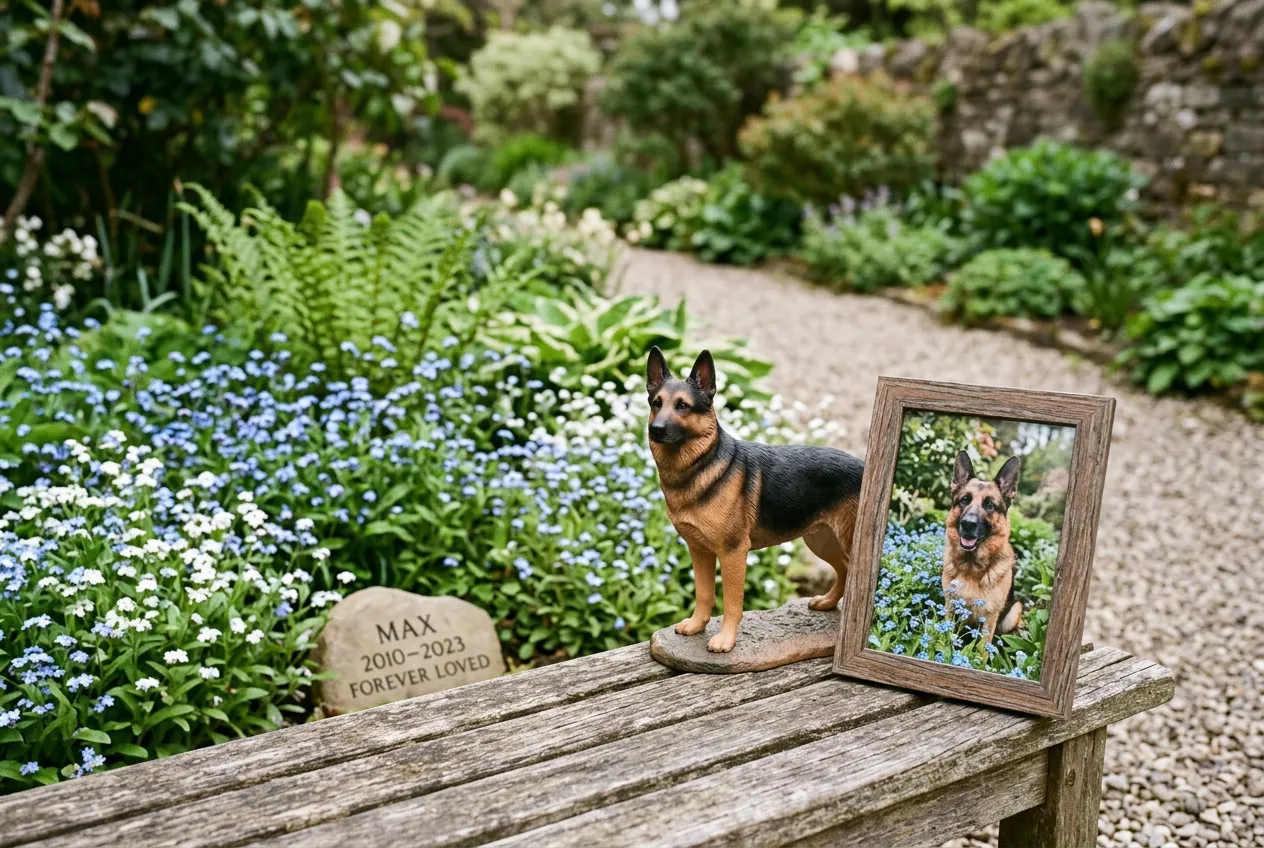
You're walking down the hallway toward the kitchen when your bare foot catches on something small and hard pressed into the carpet—a dried kibble piece, wedged against the baseboard where the vacuum never quite reaches. And just like that, you're on the floor, a single piece of dog food in your palm, and it's been almost a year since your German Shepherd last ate from that bowl. The pet loss anniversary hits before you're ready. It always does.
Quick Takeaways
- Grief anniversaries aren't setbacks—they're proof your bond still matters, and planning for them reduces emotional ambush
- Rituals work best when they engage your hands, not just your heart—physical action grounds grief in something manageable
- Avoid the "perfect tribute" trap—the most healing memorials are imperfect, personal, and sometimes even funny
- A tangible keepsake like a custom 3D-printed figurine gives grief a physical anchor—something to hold when the absence feels too abstract
- Your German Shepherd's anniversary is also yours—honor what their life taught you, not just what their loss took away
Why German Shepherd Loss Hits Different (And Why Nobody Talks About It)
Here's something most grief articles won't tell you: the breed matters. Not because one dog's life is worth more than another's, but because the shape of your daily life with a German Shepherd is fundamentally different from life with, say, a Cavalier King Charles Spaniel. And when that shape disappears, the void it leaves has very specific edges.
German Shepherds don't just live in your house. They run it. They patrol the perimeter of your yard at 6:47 every morning. They position themselves between you and the front door when someone knocks. They follow you from room to room—not because they're clingy, but because they've assigned themselves a job and that job is you.
So when they're gone, you don't just lose a pet. You lose your shadow. Your schedule. Your sense of being watched over.
We've worked with thousands of families who've lost German Shepherds, and there's a pattern we see over and over: the loss feels disproportionately large, and the owner feels guilty for feeling that way. They think, "It's just a dog. Why does my house feel like it's missing a wall?"
It's not just a dog. It was a partnership. And the first anniversary of losing that partnership deserves more than a generic "light a candle and journal" suggestion.
That's what this guide is actually about. Not six pretty ideas pulled from a Pinterest board, but six protocols—specific, grounded, sometimes counterintuitive—that we've seen genuinely help people move through the anniversary instead of being flattened by it.
"Grief doesn't need a solution. It needs a shape—something your hands can hold when your heart can't make sense of it."

The Emotional Ambush: What Actually Happens at the One-Year Mark
Most people expect the first anniversary to be the hardest day. And for some, it is. But here's the counterintuitive truth that grief counselors and pet loss communities consistently report: the weeks leading up to the anniversary are often worse than the day itself.
Your body remembers before your mind does. Around the 10- to 11-month mark, you might notice a creeping agitation. Trouble sleeping. A shorter fuse. You might snap at your partner over something trivial and not understand why until you check the calendar and realize—oh. It's almost the day.
This is called anticipatory grief, and it's not a regression. It's your nervous system doing exactly what it's supposed to do: preparing you.
The Feelings Nobody Admits
Let's talk about the thing that sits in the room like a German Shepherd–sized ghost: the complicated emotions.
Many owners, especially those whose German Shepherds suffered from degenerative myelopathy, hip dysplasia, or cancer, experience something brutal at the one-year mark. It's not just sadness. It's a cocktail of feelings that seem to contradict each other:
Relief mixed with grief. Your dog was suffering. You made the call. And somewhere underneath the sorrow, there was a breath—a terrible, involuntary exhale of relief that their pain was over. That relief doesn't make you a monster. It makes you someone who carried an impossible weight and finally set it down. But the guilt that chases that relief? That's one of grief's cruelest tricks, and it often intensifies around the anniversary because you've now had a full year of living in the "after"—and part of you notices that life got... easier. And you hate yourself for noticing.
Second-guessing the timing. "Did I wait too long?" "Did I do it too soon?" A full year later, and these questions can still circle like vultures. The American Kennel Club's resources on end-of-life decisions can help provide some clinical grounding, but here's what we'll say from years of sitting with grieving families: the fact that you're still asking means you cared enough to agonize over it. That's not failure. That's love doing its painful, imperfect work.
Jealousy. You see someone at the park with a young German Shepherd, all ears and energy and clumsy paws, and something hot and sharp twists in your chest. You're not a bad person. You're a person who knows exactly what that owner has—and exactly what it feels like to lose it.
Here's a table that maps what we consistently see from families approaching their first pet loss anniversary:
| Timeline Before Anniversary | Common Experience | What Helps |
|---|---|---|
| 6-8 weeks before | Vague anxiety, sleep disruption, irritability | Name it: "My body is remembering before I am" |
| 2-4 weeks before | Vivid dreams about your dog, crying spells | Begin planning your ritual (gives grief a channel) |
| Week of | Hypervigilance, emotional numbness OR intensity | Reduce obligations, tell someone your plan |
| Day of | Often calmer than expected (the dread was worse) | Follow your planned protocol, stay flexible |
| 1-2 weeks after | Emotional "hangover," fatigue, sometimes relief | Rest. Don't judge how you feel. |
Protocol 1: The Morning Walk (Without the Dog)
This one sounds masochistic. It's not.
On the anniversary morning, walk your German Shepherd's route. The same streets. The same turns. The same fire hydrant they checked every single day like it might have moved overnight.
But here's the specific part that makes this work: bring something in your hand that has texture. A piece of their old leash, cut to a short length. A tennis ball with the fuzz worn down to smooth rubber from their teeth. A collar you've kept in a drawer.
Hold it while you walk. Feel the weight of it. The roughness or the smoothness. The warmth it absorbs from your palm.
This isn't about wallowing. It's about completing a loop. German Shepherds are creatures of routine, and so are you—your body still expects this walk. Giving it the walk, one final time on purpose, is different from accidentally wandering the route and being ambushed by it.
The mistake most people make is avoiding every place that reminds them of their dog. Avoidance doesn't prevent pain; it just delays it and adds a layer of fear on top. Walking the route deliberately, on your terms, with an object in your hand that grounds you—that's not reopening a wound. That's choosing when and how you touch it.
One family we worked with told us they walked their Shepherd's route on the anniversary and stopped at every spot where he used to sit and refuse to move (German Shepherd owners, you know the spot). They stood there for thirty seconds each time. Not crying. Not performing grief. Just... standing where he stood. They said it was the first time in months they felt close to him instead of just far from him.
Protocol 2: The Counterintuitive Dinner Party
Most grief anniversary guides will tell you to spend the day quietly. Reflect. Be still.
We're going to suggest the opposite.
Invite people over. Not for a somber memorial. For dinner. And make the only rule this: everyone has to tell a story about your German Shepherd. Funny ones preferred.
Here's why this works, and why it's especially powerful for German Shepherd owners: these dogs had personality for days. The head tilts. The dramatic sighs. The way they'd herd children at family gatherings like tiny, disobedient sheep. The time they stole an entire rotisserie chicken off the counter and showed zero remorse.
Grief gets heavy when it's only yours to carry. And the specific shape of German Shepherd grief—the loss of a dog who was known by everyone who visited your home, who greeted (or intimidated) every guest—means other people are grieving too. They just don't know if they're allowed to bring it up.
Give them permission. Set the table. Pour the drinks. And let the room fill with stories instead of silence.
"The best memorial isn't a moment of silence. It's a room full of laughter about the time your dog ate an entire birthday cake."
The counterintuitive insight here: joy and grief aren't opposites. They're dance partners. Laughing about your dog doesn't diminish your loss. It proves the loss was worth having—because the life was that good.
Protocol 3: The Letter You Don't Send
Write a letter to your German Shepherd. But not the letter you think.
Don't write about how much you miss them. You already know that. They already know that. Instead, write them a status update. Tell them what's happened in the year since they left.
Tell them about the squirrel that moved into the backyard and has no idea how lucky it is. Tell them the mail carrier asks about them. Tell them you finally fixed the screen door they broke through that one time.
Tell them the hard stuff too. Tell them about the morning you reached for the leash before you remembered. Tell them about the new scratch on the hardwood floor you found behind the couch—one of theirs, preserved under a dust bunny like a tiny archaeological discovery.
This works because it reframes the anniversary from an ending to a continuation. You're not writing a eulogy. You're writing a letter to someone you still have a relationship with—it's just a different kind of relationship now.
Be specific. German Shepherds were specific dogs. They didn't just "sit by you." They pressed their full 80 pounds against your left thigh while you watched TV, and if you shifted, they shifted. Write about that. Write about the exact texture of the fur behind their ears—that impossibly soft patch that felt like a secret only you knew about.
What to Do With the Letter
Three options, all good:
- Bury it in a meaningful spot (their favorite digging area has poetic justice)
- Burn it safely and watch the smoke carry the words upward
- Keep it in a box with their collar—start an annual tradition
Protocol 4: Create a Sensory Anchor (Why Physical Memorials Matter More Than Digital Ones)
Here's something we've learned from years of working with grieving pet owners that surprised even us: digital memorials fade in effectiveness over time, while physical ones gain power.
A photo on your phone gets scrolled past. An Instagram tribute gets buried under new posts. But a physical object—something you can pick up, feel the weight of, run your thumb across—becomes more meaningful with each passing year. It accumulates touch. It warms in your hands. It exists in three-dimensional space, just like your dog did.
This is why so many families we work with at PawSculpt choose to mark the anniversary with a custom pet figurine. Our master 3D artists digitally sculpt your German Shepherd from your photos—capturing the exact tilt of their ears, the specific pattern of their saddle markings, the way their coat caught the light. Then it's precision 3D printed in full-color resin, where the color is embedded directly in the material itself, not applied on top. The result is something that feels real in your hands. Substantial. Present.
But here's the thing—and this is where we differ from a sales pitch—a figurine is one option among many. The point isn't what you buy. The point is that grief needs a physical anchor.
| Memorial Type | Sensory Engagement | Longevity | Emotional Impact Over Time |
|---|---|---|---|
| Social media tribute | Visual only (screen) | Fades as feed updates | Decreases—gets buried |
| Printed photo in frame | Visual | High if maintained | Stable—becomes part of the room |
| Paw print impression | Touch (texture of the print) | Very high | Increases—becomes more precious |
| Custom 3D figurine | Touch + visual (weight, texture, color) | Very high (UV-resistant resin) | Increases—becomes a family heirloom |
| Memorial garden stone | Touch + outdoor sensory context | Weather-dependent | Stable—connected to nature |
| Wearable memorial jewelry | Touch (constant contact) | Moderate to high | Increases—becomes part of you |
The best choice is the one that engages your hands. Grief lives in the body—in the empty space next to your leg where 80 pounds of fur used to press against you. Give your hands something to hold.
"We've seen families pick up a figurine and just go quiet for a moment. That pause—that's where healing lives. In the weight of something real."
— The PawSculpt Team
Protocol 5: The "What They Taught Me" Inventory
This is the one that changes people. We've seen it happen.
Sit down—anniversary morning, evening, whenever feels right—and make a list. Not of memories. Not of things you miss. But of what your German Shepherd taught you about yourself.
German Shepherds, more than almost any other breed, mirror their owners. They reflect your energy back at you. If you were anxious, they were vigilant. If you were calm, they were steady. They watched you with those dark, intelligent eyes and they learned you—and in the process, you learned yourself.
So what did they teach you?
Maybe they taught you that you're capable of more patience than you thought. Housebreaking a German Shepherd puppy who's smarter than some of your coworkers requires a specific kind of endurance.
Maybe they taught you that you need to go outside more. That your best thinking happens on walks. That you're a morning person after all, because someone needed to go out at 6 AM and it turned out you liked the quiet.
Maybe they taught you something harder. That you can make impossible decisions. That you can hold a living being you love and choose to let go because staying would be selfish. That's not a lesson anyone wants, but it's one that reshapes you.
Write the list. Keep it somewhere you can find it next year. Add to it. This is the living document of your dog's legacy—not a frozen moment of grief, but an evolving record of how they changed you.
The Commonly Overlooked Truth
Here's what most anniversary guides miss entirely: the goal isn't to "get through" the day. The goal is to let the day mean something.
There's a pervasive myth in pet grief culture that the anniversary is an obstacle—something to survive, endure, push past. But what if it's actually an opportunity? Not in a toxic-positivity, "everything happens for a reason" way. In a real, grounded, "this day exists whether I plan for it or not, so I might as well give it a purpose" way.
The difference between being ambushed by grief and walking toward it intentionally is enormous. It's the difference between a wave knocking you down and diving under it.
Myth vs. Reality: What Most People Get Wrong About Pet Loss Anniversaries
Myth 1: "The first anniversary is the hardest—after that, it gets easier."
Reality: For many people, the second anniversary is actually harder. The first year has a strange momentum to it—everything is a "first without them." First Thanksgiving. First snow. First time you hear a dog bark that sounds like theirs. By the second year, the novelty of grief has worn off, but the absence hasn't. People expect you to be "over it." You're not. And now you're grieving alone. Plan for year two as deliberately as year one.
Myth 2: "You should spend the anniversary quietly reflecting."
Reality: Quiet reflection works for some people. For others, it's a trap door into rumination. If sitting still with your thoughts leads you into a spiral of second-guessing euthanasia timing or replaying their final days, movement and social connection are better medicine. There is no single right way to grieve—but there is a wrong way, and it's doing what someone else told you to do instead of what actually helps you.
Myth 3: "Getting a new dog before the anniversary means you didn't grieve properly."
Reality: This one makes us genuinely frustrated. There is no timeline for when it's "appropriate" to welcome a new dog. Some people need years. Some people need weeks. The ASPCA's resources on pet loss emphasize that readiness is individual, not calendar-based. A new dog doesn't replace the old one any more than a new friendship replaces an old one. If the anxiety about getting another pet is eating at you, that anxiety is worth examining—but not because you need permission from a timeline.
Protocol 6: The Annual Object
This is our favorite. It's simple, it's specific, and it builds over time.
Each year, on the anniversary, acquire one physical object that represents your German Shepherd. Not a generic dog item. Something specific to them.
Year one: maybe it's a figurine. A custom 3D-printed memorial that captures the exact way they held their head when they were listening to something only they could hear. Full-color resin that reproduces their unique black-and-tan pattern, their specific ear set, the way their coat texture caught the light. Something you can pick up and feel the smooth, solid weight of in your hands.
Year two: maybe it's a plant. The specific variety that grew in the spot where they always lay in the yard—whatever survived being flattened by 80 pounds of napping Shepherd.
Year three: a piece of art. A donation in their name. A new walking stick for the trail you used to hike together.
The point is accumulation. Over the years, you build a small collection of objects, each one tied to a specific year of remembering. Each one tells a chapter of the story—not just who your dog was, but who you've been in the years since.
This works because it transforms the anniversary from a single point of pain into a tradition. And traditions have momentum. They carry you forward. They give you something to plan for, something to look forward to—even when "looking forward" feels impossible.
Making the First Object Count
If you're approaching your first anniversary and you don't yet have a physical memorial, this is the year to invest in one that matters. Something with weight. Something with texture. Something that, when you pick it up ten years from now, will still feel like holding a piece of them.
We're biased, obviously, but we've seen what happens when a family receives their PawSculpt figurine. There's a moment—always the same moment—when they pick it up for the first time and their thumb finds the curve of the ear or the ridge of the spine, and they go still. Because the weight of it is right. The proportions are right. The color embedded in the resin catches the markings they thought they'd already started to forget.
That moment isn't about a product. It's about the physical proof that someone else saw your dog. Really saw them. And took the time to get the details right.
For specifics on the process—how photos are used, what the preview looks like, how the finished piece arrives—visit pawsculpt.com and explore at your own pace. There's no rush. The anniversary will come whether you're ready or not. But having a plan makes the difference between drowning and swimming.
Building Your Anniversary Protocol: A Framework
You don't have to do all six. You don't even have to do two. But having a plan—any plan—is the single most protective thing you can do for yourself as the date approaches.
Here's a framework for building your own protocol:
- Choose one active ritual (the walk, the dinner, the letter)—something that involves your body, not just your mind
- Choose one creative ritual (the inventory, the annual object)—something that produces a tangible result you can revisit
- Tell one person your plan—accountability isn't just for gym goals; it works for grief too
- Build in an escape hatch—give yourself permission to abandon the plan entirely if the day demands something different
That last one matters more than you think. The protocol isn't a contract. It's a scaffold. If you wake up on the anniversary and the only thing you can do is lie on the floor in the hallway where your Shepherd used to sleep—the spot where the carpet is still slightly flattened, where if you press your face close enough you swear you can still catch the faintest ghost of their scent—then that's your protocol for this year. And it's enough.
| Protocol | Best For | Time Required | Emotional Intensity |
|---|---|---|---|
| The Morning Walk | Owners who need physical movement to process | 30-60 minutes | Moderate to high |
| The Dinner Party | Owners who grieve better in community | 2-3 hours of prep + evening | Moderate (softened by company) |
| The Unsent Letter | Owners who process through writing | 20-45 minutes | High (cathartic) |
| The Sensory Anchor | Owners who need something tangible to hold | Varies (ordering + receiving) | Moderate (grounding) |
| The "What They Taught Me" Inventory | Owners ready to find meaning in loss | 30-60 minutes | Transformative |
| The Annual Object | Owners who want a long-term tradition | Varies by object | Low to moderate (builds over years) |
The Thing About German Shepherds and Time
German Shepherds live, on average, 9 to 13 years. That's not enough. It's never enough. But here's what those years contain that other breeds' years sometimes don't: an intensity of partnership that compresses a lifetime of relationship into a decade.
You didn't just own a German Shepherd. You were chosen by one. They chose your lap (even when they were far too large for it). They chose your side of the bed. They chose to stand between you and whatever they perceived as a threat, which sometimes included the vacuum cleaner and sometimes included actual danger and they never seemed to know the difference, and honestly, that was part of their charm.
The first anniversary of losing that kind of partnership isn't just a sad day. It's a reckoning with the fact that you were, for a brief stretch of your life, somebody's entire world. And now you have to figure out what to do with all that love that has nowhere to land.
Here's our answer, and it's not complicated: let it land on the anniversary itself. Pour it into the walk. Pour it into the letter. Pour it into the dinner table surrounded by people who also loved that ridiculous, magnificent, fur-covered tornado of loyalty.
Pour it into something you can hold.
The kibble piece you found in the hallway carpet—you could vacuum it up. You could throw it away. Or you could put it in a small jar on the shelf, next to the collar, next to the figurine, next to whatever objects accumulate over the years as proof that this dog existed and this dog mattered and this dog changed the shape of your life in ways you're still discovering.
The grief anniversary isn't a wound reopening. It's a door. And you get to decide what you carry through it.
Frequently Asked Questions
How long does pet grief last after losing a German Shepherd?
There's no expiration date. The intensity of the human-German Shepherd bond—the daily routines, the physical closeness, the working partnership—often means grief lingers longer and runs deeper than people expect. Most owners feel the sharpest pain for 6 to 12 months, but waves continue for years. The grief doesn't disappear; it changes shape. And that's not a problem to fix. It's a relationship continuing in a different form.
Is it normal to still cry one year after losing a pet?
Completely. In fact, many people are surprised to find that the one-year mark triggers tears they thought they'd already finished crying. Anniversary grief often feels different from early grief—less raw, more aching—but it can be just as intense. If someone tells you that you should be "over it" by now, that says more about their discomfort with your emotions than about your healing timeline.
What should I do on my pet's death anniversary?
The most important thing is to have a plan—any plan. Whether it's walking their old route, writing them a letter, hosting a dinner where people share stories, or simply sitting with a physical keepsake in your hands, intentional action reduces the feeling of being ambushed by grief. Choose something that involves your body, not just your thoughts. And give yourself permission to change the plan if the day demands it.
How do I memorialize my German Shepherd after one year?
Physical memorials tend to be more enduring than digital ones. A custom figurine, a garden stone, a framed paw print, or even a small jar containing a meaningful object (a piece of their collar, a tuft of fur) gives grief a tangible anchor. The key is choosing something with weight and texture—something you can hold. Digital tributes get buried in feeds; physical objects gain meaning over time.
Is it too soon to get another dog before the one-year anniversary?
There is no "too soon" that applies universally. Some people need years; some need weeks. The anxiety about getting another pet is worth examining—often it's rooted in fear of betrayal or fear of experiencing loss again—but it doesn't require permission from a calendar. A new dog isn't a replacement. It's a new relationship. Both can exist simultaneously.
Why does the pet loss anniversary feel worse than I expected?
Because your body starts grieving before your mind catches up. In the weeks leading up to the anniversary, many people experience disrupted sleep, irritability, vivid dreams, and a general sense of dread that they can't quite name. This anticipatory grief is your nervous system preparing for a date it remembers even if you haven't been consciously counting. Naming it—"my body is remembering"—can reduce its power significantly.
Ready to Honor Your German Shepherd's Memory?
Every German Shepherd has a story written in the tilt of their ears, the pattern of their coat, and the steady, watchful way they held themselves beside you. A custom PawSculpt figurine captures those details in full-color resin—a pet loss anniversary keepsake with real weight in your hands, built to last as long as the love behind it.
Visit pawsculpt.com to learn more about our process, preview options, and satisfaction guarantee