
The Grief That Waited Two Years: A Stoic Journal for Your Cavalier's Paw Print
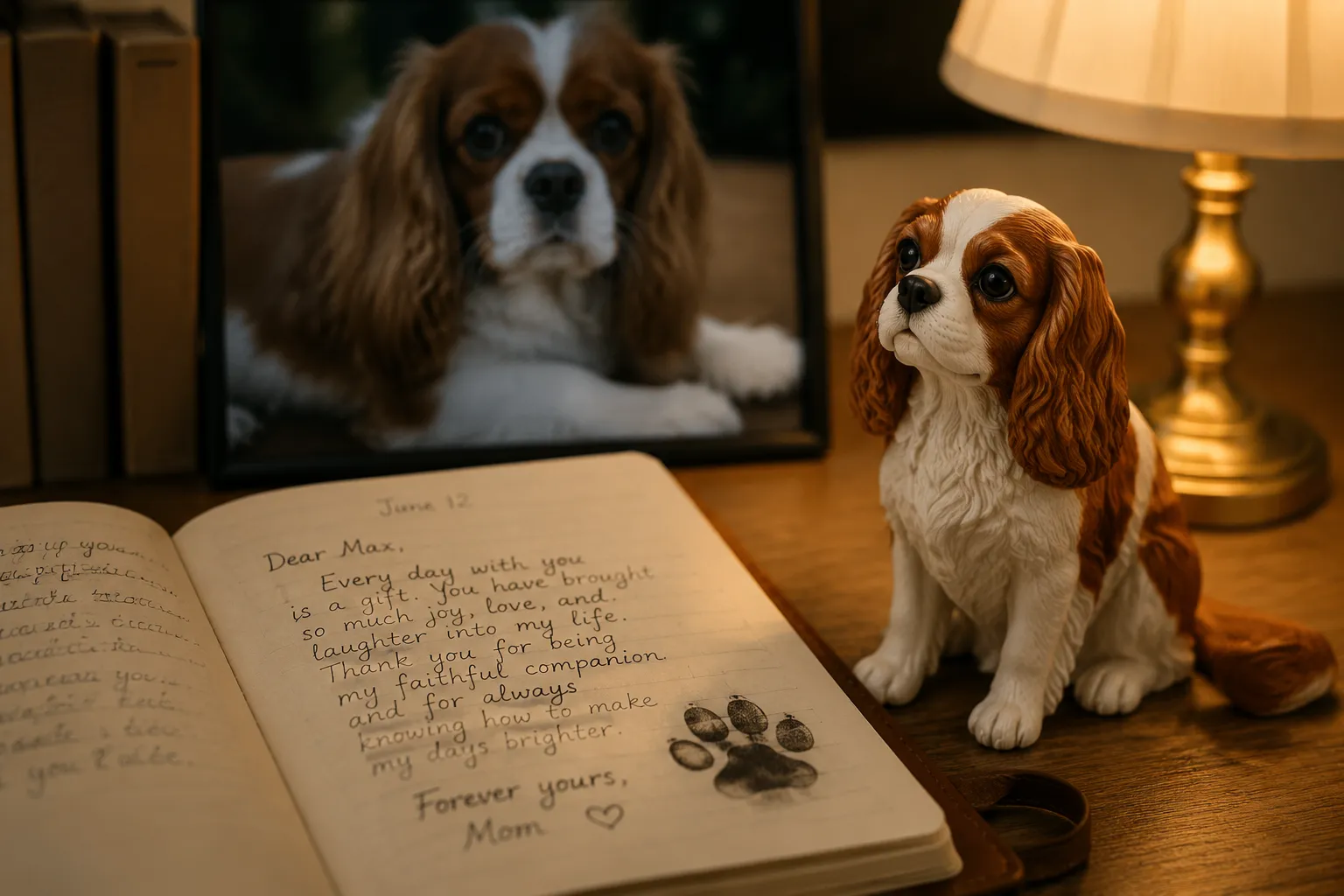
The receptionist slid the clay paw print across the counter, still warm from the press, and you signed the discharge form without reading it. That's where delayed grief often begins. Not in the crying. In the not-crying. In the strange, weightless calm of a Tuesday you'll end up replaying two years later.
Quick Takeaways
- Delayed grief isn't a failure to feel — it's your nervous system buying time it thinks you need.
- Stoicism done wrong freezes grief — the goal is processing emotion, not outlasting it.
- A structured journal beats "just write how you feel" — give grief a container, a cadence, and an exit.
- Consecutive pet losses compound silently — each unmourned goodbye stacks on the last one.
- A tangible anchor helps grief land — many families pair journaling with memorial keepsakes that hold a physical likeness.
Why the Grief Waited: The Quiet Mechanics of Delayed Grief
Here's the thing nobody warns you about. You can do everything "right" at the end—be there for the final breath, hold the small body, manage the logistics, thank the vet tech who cried with you—and feel almost nothing. Not numb exactly. Functional. Calm in a way that scares you a little later.
Then twenty-six months pass. You're reaching into the cabinet for a coffee filter and your hand brushes an old dental chew you missed in the back, and you're on the kitchen floor.
That's delayed grief. And it's not rare.
Delayed grief is the postponement of an emotional reaction that the moment was too overwhelming, too busy, or too defended to process at the time. Your brain is a triage nurse. When the loss happens, it scans the room, decides you can't afford to fall apart right now—maybe there were kids to shield, a job to keep, another sick pet at home—and it files the grief under "later." The problem is that "later" doesn't come with a calendar invite.
We've worked with thousands of pet families at PawSculpt, and the orders that arrive eighteen, twenty-four, thirty months after a loss tell a consistent story. People apologize for it. "I know this is weird, it's been two years." It isn't weird. It's the most human thing in the world.
The calm you felt wasn't strength
Let's name the uncomfortable part. A lot of folks who experience delayed grief secretly believe their early composure meant they didn't love their pet enough. That the dry-eyed efficiency at the vet's office was evidence of some defect in them.
It wasn't. The composure was a circuit breaker. It tripped to protect the house from burning down.
"The calm after a loss isn't healing. Sometimes it's just grief holding its breath."
When the breaker resets—and it always resets—the current you deferred comes through all at once. That's why delayed grief frequently hits harder than grief that arrives on time. You're not feeling two years of distance. You're feeling the original wound plus the interest.
Why pets, specifically, trigger the delay
Pet loss sits in a strange social blind spot. You can't take three days of bereavement leave for a Cavalier. The world expects you back at your desk Monday, maybe with a sympathetic "aw, that's sad" and then straight into the quarterly numbers.
So you comply. You perform okay-ness because okay-ness is what's permitted. The grief doesn't disappear—it just goes underground, where it has no expiration date. This is one of the most overlooked aspects of pet loss: the delay is often manufactured by a culture that never gave you permission to fall apart in the first place.
The American Veterinary Medical Association has acknowledged that the human-animal bond carries real psychological weight, and that grief over a pet can mirror grief over a person. Knowing that won't make the floor feel less cold when you're sitting on it. But it might make you stop apologizing for being there.

The Cavalier-Shaped Hole You Didn't Let Yourself Feel
A Cavalier King Charles loss carves a very particular kind of absence, and it has to do with proximity.
Cavaliers are velcro dogs. They don't live across the room from you—they live against you. On the lap, on the chest, draped over your feet under the desk, pressed into the crook of your knees at 2 a.m. They occupy space differently than most breeds. They occupy your space.
So when they're gone, the loss isn't abstract. It's spatial. It's the four inches of mattress that stays cold now. It's the specific weight that used to settle onto your sternum during a movie, the one your body still expects and your arm still curves to receive.
"Some dogs leave a hole in your life. Cavaliers leave a hole in the shape of your own body."
One family we worked with described it perfectly. For months after their Cavalier passed, the wife kept catching herself walking around a spot on the living room rug—a spot where the dog's bed used to sit. The bed was long gone. Her feet still knew the path.
The breed's health story complicates the grief
Here's something specific to this breed that tangles the mourning further. Cavaliers are predisposed to mitral valve disease and syringomyelia, conditions many owners spend years managing. According to breed health information from organizations like the American Kennel Club, a significant portion of the breed develops heart issues with age.
What that means in practice: if you loved a Cavalier, you probably spent the final stretch as a part-time cardiac nurse. Pills crushed into food. Coughing fits counted in the dark. Vet bills that made your stomach drop. A constant, low-grade vigilance.
And when it finally ended, there was relief. Real, physical relief.
That relief is the source of some of the cruelest guilt in pet loss. You felt your shoulders drop when the vigilance ended, and then you hated yourself for the relief. Let's be clear about this: the relief was for their suffering, not your loss. Feeling lighter when a long ordeal ends doesn't mean you wanted them gone. It means you were carrying something heavy for a long time, and your body noticed when you finally set it down.
That relief, suppressed and unexamined, is often what comes back as delayed grief. You never let yourself feel the loss because you were too busy feeling guilty about the relief. Two years later, both arrive together.
When Losses Stack: The Brutal Arithmetic of Consecutive Pet Losses
Now layer this. A lot of households don't lose one pet. They lose two, sometimes three, inside a short window—because pets adopted together often age together.
Consecutive pet losses create a specific kind of grief that almost no article addresses, and it's the angle most guides miss entirely.
When the second loss comes close on the heels of the first, you don't get to finish mourning number one. You're handed number two before the first grief has a place to live. So you do what overwhelmed people do—you stack them. You shove the first loss into the back of the closet to deal with the second, and then maybe a third.
The closet doesn't have infinite shelf space. Eventually the door bursts.
Why the second loss often hurts in the wrong order
This surprised even us. Many people who experience consecutive losses report that grieving the second pet unexpectedly cracks open the grief for the first—sometimes the first one hits harder, even though more time has passed.
That's because the second goodbye is the key that unlocks the room where you stored the first. You sit down to cry for the dog you just lost, and out walks the grief for the one from eighteen months ago, fully formed, furious about being kept waiting.
"Stacked grief doesn't add. It multiplies—and it always collects the debt eventually."
Here's a comparison we put together based on patterns we've observed across families navigating this:
| Grief Scenario | What It Feels Like | Common Hidden Emotion | What Helps Most |
|---|---|---|---|
| Single, timely loss | Sharp, then gradually softening | Sadness, longing | Ritual, talking, time |
| Delayed grief (one pet) | Calm, then sudden ambush | Guilt, self-blame for "not feeling it" | Naming the delay, structured processing |
| Consecutive losses | Overwhelm, then numbness | Resentment, decision-fatigue | Mourning each pet separately, on purpose |
| Compounded delayed grief | Floodgate years later | Shame about intensity | A container: journaling + a physical anchor |
The big takeaway from that bottom row: when delayed grief and consecutive losses combine, you get a flood. And floods need channels, not dams.
The decision fatigue nobody talks about
When you lose pets back to back, you also make a lot of hard calls in a row. When to stop treatment. When to let go. Whether you waited too long, or—the question that haunts people most—whether you let go too soon.
Second-guessing euthanasia timing is one of the most common and least-discussed parts of this. You replay the appointment. Was she still wagging that morning? Could we have had one more good week? Did I rob him of time, or spare him pain?
We'll be real with you: there is no perfect day. There's no clean answer that retrospect will validate. The fact that you agonized over the timing is itself the proof that you made the decision with love, not convenience. People who don't care don't lie awake doing the math. You did the math because you couldn't bear to get it wrong. That's not a failure. That's devotion under impossible conditions.
How to Actually Keep a Stoic Grief Journal
Okay. Let's get practical, because this is where most grief advice goes soft and useless. "Journal your feelings" is not instructions. It's a shrug with a pen attached.
A stoic grief journal is something more specific, and the word "stoic" trips people up, so let's fix that first.
What "stoic" actually means here (and what it doesn't)
Most people hear "stoic" and picture a clenched jaw. Suppression. Stiff upper lip. That's the pop-culture version, and honestly it's the exact thing that causes delayed grief. If you white-knuckle your way through, you're just scheduling the breakdown for later.
Real Stoicism—the philosophy—is almost the opposite. It's about examining your emotions clearly, separating what you can control from what you can't, and giving structured attention to your inner life. It's not "don't feel." It's "feel, then look at the feeling honestly."
"Stoicism isn't refusing to cry. It's looking your grief in the eye and asking it what it needs."
So a stoic grief journal isn't a sad diary. It's a disciplined practice with a structure. Here's the difference: a regular journal lets you spiral. A structured one gives the spiral somewhere to land.
The actual framework: a four-part daily entry
This is the system we've seen work best for the families who've shared their process with us. It takes about ten to fifteen minutes. Do it at the same time each day—consistency matters more than length.
- The Fact (2 minutes): Write one concrete memory, stated plainly. Not "I miss her so much." Instead: "Today the 7 a.m. light hit the window and she wasn't in it." Specifics, not abstractions. Facts give grief edges to hold.
- The Feeling (3 minutes): Name the emotion underneath, and be precise. Not "sad." Try "ashamed that I felt relief," or "angry at the vet," or "scared I'm forgetting her bark." Precision is the whole game. Vague feelings stay stuck; named ones start moving.
- The Control Line (3 minutes): Write down what you can and cannot control about this. You cannot control that she's gone. You can control whether you say her name out loud today. This is the stoic core—it stops the loop of "what if" and redirects energy toward the doable.
- The Gratitude Pivot (2 minutes): End with one specific thing the relationship gave you. Not a platitude. "She taught me to take the 5 p.m. walk even when I didn't want to, and I'm healthier for it." Close the entry forward-facing, not in the hole.
The structure matters because open-ended grief journaling can deepen rumination instead of relieving it. Research on expressive writing suggests that structured reflection tends to help, while unstructured venting can sometimes reinforce distress. The container is the medicine.
Practical setup that makes you actually stick with it
Here's the no-nonsense logistics, because a beautiful system you abandon in four days helps nobody.
- Pick the physical notebook over the app. The friction of opening an app invites doom-scrolling. A notebook on the nightstand, pen clipped to it, opens itself.
- Set a hard stop. Use a timer. Fifteen minutes, then close it. Grief expands to fill the time you give it; a boundary teaches it to show up and then leave.
- Same chair, same time. Ritualize the location. We've heard from people who journal in the spot their pet used to sleep. The proximity helps. It tells your body this is the designated room for this feeling.
- Don't reread for the first month. Resist flipping back. You're composting, not curating. Looking back too soon pulls you into the spiral you're trying to drain.
Here's a simple cadence guide for how this practice tends to evolve:
| Phase | Timeframe | What the Journal Does | What to Watch For |
|---|---|---|---|
| Excavation | Weeks 1-3 | Surfaces the deferred emotion | Don't binge—stick to the timer |
| Sorting | Weeks 4-8 | Separates control from no-control | Resentment may peak; name it |
| Integration | Months 3-6 | Memory shifts from painful to warm | The gratitude pivot gets easier |
| Living with it | 6 months+ | Becomes occasional, not daily | Drop to weekly when it feels right |
"We've seen families heal by holding something tangible. Grief needs an anchor as much as it needs words."
— The PawSculpt Team
The fear of forgetting—and how the journal fights it
There's a specific terror that drives a lot of late-night grief: the fear that you're losing the details. The exact pitch of the bark. The particular way she tilted her head at the word "treat." The smell of her paws, which—weird as it sounds—a lot of people miss desperately.
This fear of forgetting is normal, and it's actually useful. It's your love trying to preserve itself. The stoic journal is the perfect tool for it, because the "Fact" step every day banks one concrete detail before it fades. Six months in, you've got a hundred small, specific resurrections of your dog that your memory alone would have let slip.
That's the part you can control. You can't keep them. But you can keep the record.
The Counter-Point: When a Journal Isn't the Answer
Now let me argue against myself for a second, because intellectual honesty matters more than selling you a tidy solution.
Journaling is not a cure-all, and for some people it's actively the wrong tool.
If your delayed grief comes with symptoms that don't shift over months—persistent inability to function, intrusive thoughts you can't redirect, a grief that feels like it's getting worse rather than slowly integrating—that's not a journaling problem. That might be complicated grief, and it deserves a professional, not a notebook.
We're a figurine company. We're not therapists, and we won't pretend a daily writing habit replaces real mental health care. Organizations like the Association for Pet Loss and Bereavement offer grief support and hotlines specifically for this. Use them. There's no prize for white-knuckling it alone.
And here's another honest wrinkle. Some people process grief through action, not reflection. They don't want to sit and write—it makes them feel worse. For those folks, the channel might be a memorial walk, volunteering at a shelter, building something with their hands. The journal framework is a strong default, not a universal law.
"There's no wrong way to carry love. There are only ways that help you walk, and ways that don't."
The point isn't the notebook. The point is giving the deferred grief a channel. For most people that's writing. For some, it's motion. Know which one you are.
Giving Grief Something to Hold
Words on a page do a lot. But grief is also stubbornly physical, especially with a breed like the Cavalier whose whole presence was about touch and weight and warmth.
This is why so many families reach a point—often right when the delayed grief breaks open—where they need something they can actually hold. A clay paw print in a drawer is a start. But for a lot of people it isn't enough, because a paw print is an absence pressed into clay. It's the shape of where she was.
What helps more, for many, is the shape of who she was. The specific tilt of the head. The exact pattern of the Blenheim markings, that little lozenge spot some Cavaliers carry on the crown. The proportions only your dog had.
That's the gap custom pet figurines fill. At PawSculpt, your pet is digitally sculpted by master 3D artists, then precision 3D printed in full color, so the markings, the coloring, the particular set of the ears get reproduced directly in the resin rather than approximated. The color is part of the material itself, sealed under a protective clear coat with a natural, authentic finish—not a glossy plastic toy, but a real likeness with genuine texture.
We'll be straight about why this matters for delayed grief specifically. When the flood finally comes two years out, people often feel they have nothing to point it at. The bed's been donated. The photos are buried in a phone. A physical likeness gives the returned grief a destination—somewhere to put your eyes and your hands instead of the cold spot on the rug.
A note on timing, and not rushing it
Here's an insider observation that runs counter to what you might expect. The people happiest with a memorial figurine are usually not the ones who order it in the first raw week. They're the ones who waited until they knew which version of their dog they wanted preserved—the goofy play-bow, the dignified sit, the head-tilt.
So there's no pressure to decide anything while you're on the kitchen floor. When you're ready, you can explore the process and what's involved through their pet memorial keepsakes—and not a moment before. The journal can come first. The anchor can come when the words have done their early work.
"A photo shows you a moment. A figurine gives the moment back its weight."
What actually makes a good source photo
Since people always ask, here's the practical bit. For the best likeness:
- Eye-level, not top-down. Get on the floor. A photo shot down at your dog flattens the face; eye-level captures the real proportions.
- Natural light, no flash. A window on a bright-but-not-harsh day shows true coloring. Flash blows out a Cavalier's markings.
- Multiple angles beat one perfect shot. Front, both sides, and a three-quarter view give the artists what they need to build the whole dog, not just one face.
- Pick the pose that is them. The most-loved figurines capture a signature posture, not a stiff "sit." Think about how your dog actually held themselves.
You don't need a professional camera. Honestly, the slightly imperfect everyday phone photos—the ones where they're mid-yawn or side-eyeing you—often carry the most personality, and personality is the whole point.
Putting It All Together: A Realistic Path Through
Let me bring the threads back together, practically, because that's what this no-nonsense friend is here for.
If you're reading this two years after a Cavalier King Charles loss and the grief just arrived out of nowhere, here's the honest sequence that tends to work:
- Stop apologizing for the timing. Delayed grief is biology, not weakness. The clock was never the point.
- Separate your losses if there were several. Mourn each pet on purpose, individually. Stacked grief stays stuck until you un-stack it.
- Build the container. Start the four-part journal. Same time, same chair, hard stop. Let the structure hold what feels unholdable.
- Name the ugly emotions out loud. The relief, the guilt, the second-guessing, the resentment. They lose their grip the moment they're named.
- Give it an anchor when you're ready. A photo book, a memorial walk, a figurine—something physical for the feeling to land on.
- Get help if it's not moving. A notebook is a tool, not a treatment. Reach out to grief support if the weight isn't shifting.
None of this "fixes" the loss. There's no fixing it, and anyone promising that is selling you something. What it does is turn a flood into a river—something with a direction, something you can stand beside.
The Tuesday, Two Years Later
Go back to that vet's office. The paw print, still warm from the press. The form you signed without reading. The calm that felt like strength and was really just your nervous system buying time.
Two years later, you're on the kitchen floor with an old dental chew in your hand, and the grief you filed under "later" has finally arrived to collect. Here's what we want you to know, sitting there: this is not a relapse. It's a delivery. The love you couldn't afford to feel back then is being returned to you, with interest, because it had nowhere else to go.
So let it land. Open the notebook. Write down the fact—the 7 a.m. light, the missing weight on the mattress, the four cold inches. Name the feeling, even the ugly ones. Find the line between what you can't control and the one small thing you can. And when you're ready—not today, not from the kitchen floor, but when the words have done their work—give that love something to hold.
The grief waited two years because it trusted you'd be strong enough eventually. Turns out it was right.
Frequently Asked Questions
Is it normal to grieve a pet two years after they died?
Completely normal. Delayed grief happens when the original moment was too overwhelming, busy, or defended for you to process it. Your brain files the emotion under "later" to protect you, and it can resurface years afterward—often more intensely than grief that arrived on time. The timing says nothing about how much you loved them.
What exactly is a stoic grief journal, and how is it different from a regular diary?
A stoic grief journal is a structured daily practice, not free-form venting. You record one concrete memory, name the precise emotion underneath, write what you can and cannot control about the loss, then close with one specific gratitude. The structure matters because open-ended grief journaling can deepen rumination, while structured reflection tends to help the emotion move rather than loop.
Why does a Cavalier King Charles loss feel so physical?
Cavaliers are intensely affectionate lap dogs who live pressed against you—on your chest, your feet, the crook of your knees. The loss registers spatially rather than abstractly. People describe walking around a spot where the bed used to be, or reaching for a weight that isn't there anymore. The grief lives in your body because the dog did too.
How do you handle consecutive pet losses without falling apart?
Mourn each pet separately and deliberately. When losses come close together, grief stacks—you shove the first aside to cope with the second, and it stays unprocessed. Often the second goodbye unlocks the buried grief from the first. Giving each pet its own space to be mourned, rather than treating it as one big loss, is what un-stacks the pile.
Is it wrong to feel relieved when my sick pet passed away?
Not at all. If you spent months as a part-time nurse managing a chronic condition, your body will feel lighter when that vigilance ends. That relief is for their suffering, not your loss—and it doesn't mean you wanted them gone. The guilt that follows relief is one of grief's cruelest tricks, and it's worth naming so it loses its grip.
When is the right time to order a memorial figurine?
There's no deadline, and rushing rarely helps. The families happiest with their keepsake usually waited until they knew which version of their pet they wanted preserved—the signature head-tilt or play-bow rather than a stiff pose. Let the early grief work happen first. You can explore the process whenever you feel ready, with no pressure to decide in the rawest weeks.
Ready to Honor Your Pet's Memory?
The grief that waited two years deserves somewhere to land. Whether you're navigating a Cavalier King Charles loss, processing consecutive pet losses, or finally feeling delayed grief surface long after goodbye, a custom PawSculpt figurine gives that love a tangible anchor—your pet's true markings and posture reproduced in full-color resin, built to be held.
Visit pawsculpt.com to learn more about our process, revision options, and quality guarantee