
When the House Goes Quiet: A Grounding Ritual After Losing Your British Shorthair
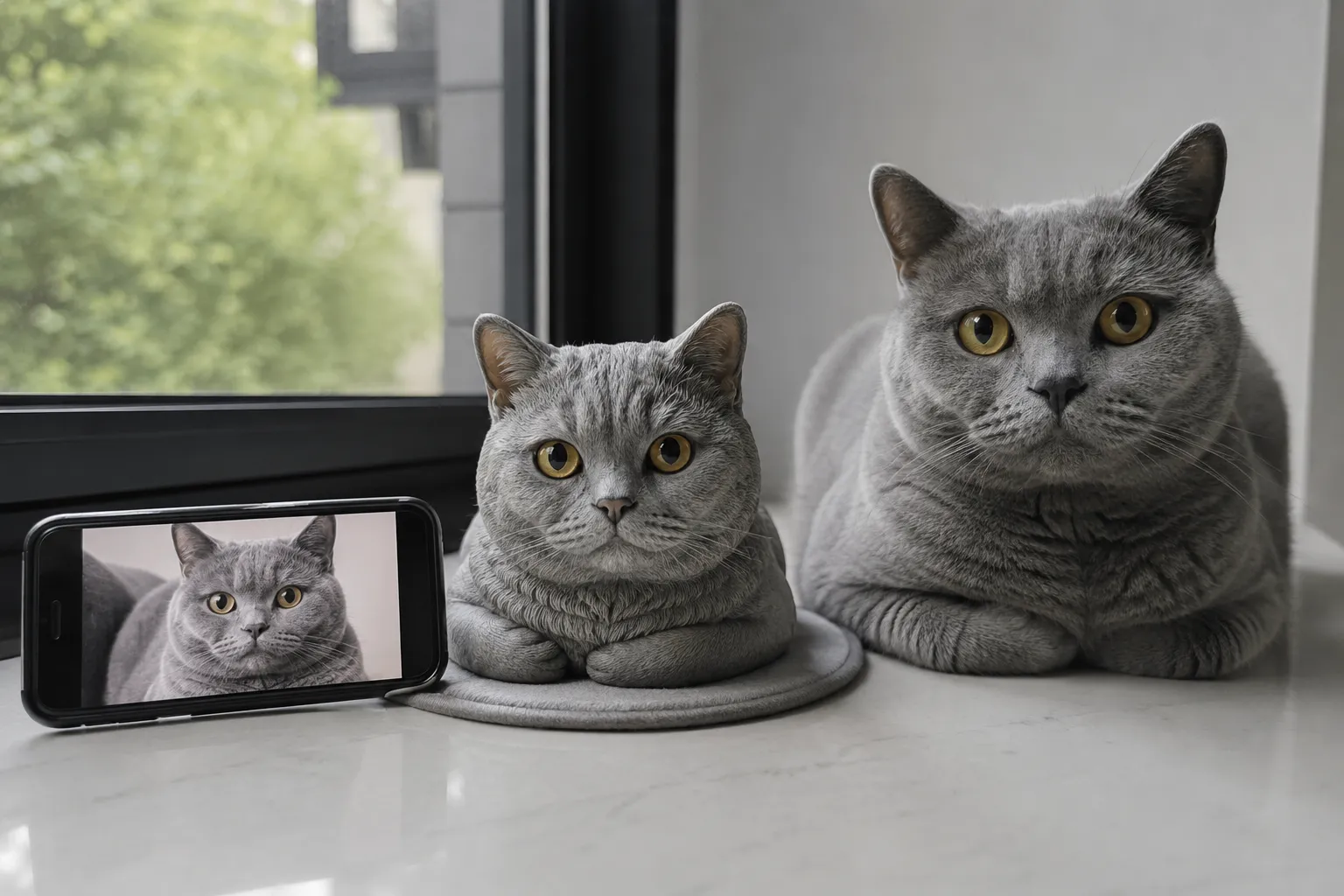
A British Shorthair's dense double coat holds scent longer than most breeds—which is why, weeks after a british shorthair loss, you can still bury your face in their blanket on the living room couch and smell them there. That phantom warmth on the cushion is the first thing grief takes.
Quick Takeaways
- Shock has a biological purpose — your brain floods with cortisol to delay pain you can't yet handle.
- Sudden illness grief hits harder — no anticipatory mourning means your mind lags behind reality for weeks.
- A grounding ritual gives grief structure — a fixed daily action stops the spiraling.
- Relief after suffering ends is not betrayal — it's the final act of loving them well.
- Tangible anchors help the brain accept loss — many families find comfort in custom pet figurines that hold a pet's likeness in three dimensions.
Why Sudden Loss Breaks Something Different
Here's the thing most grief articles won't tell you: the way you lost your British Shorthair changes the shape of your grief almost as much as the loss itself.
When a pet declines slowly over months, the brain does something quietly merciful. It begins anticipatory grief—a kind of rehearsal where you mourn in small installments while they're still breathing beside you. You say goodbye a hundred small times.
Sudden pet illness grief denies you that runway entirely.
One week your cat is loafing on the windowsill, that round-cheeked Shorthair face doing its permanent half-smile. The next, a vet is using words like "aggressive" and "we did everything we could." Your nervous system simply cannot process the gap between those two realities fast enough.
"Shock isn't weakness. It's your brain buying time it doesn't yet know how to spend."
So it doesn't try. It freezes instead.
The Science of the Freeze
What you're experiencing in those first hours and days has a name: acute stress response. Your body dumps cortisol (the stress hormone) and adrenaline into your bloodstream, narrowing your focus to pure survival mode.
This is why people describe the moment of sudden loss as feeling "underwater" or "behind glass." You might handle the practical tasks—the vet bill, the phone calls, the small body wrapped in a towel—with eerie calm, then collapse three days later over something tiny like finding a single whisker on the bathroom tile.
That delay is not denial in the dismissive sense. It's your prefrontal cortex protecting itself from an emotional load that would otherwise be too much to carry all at once.
So what? Understanding this matters because the people around you—and worse, your own inner critic—will misread your calm as "handling it well" or your later collapse as "falling apart." Neither is true. Both are just your brain metabolizing shock on its own timeline, not yours.
Shock and Denial Are Not the Same Thing
We need to separate two ideas that get lumped together. Shock and denial grief often travel as a pair, but they do different work.
Shock is physiological—the numbness, the tunnel vision, the strange efficiency.
Denial is cognitive—the part of you that still listens for the thump of a heavy cat landing on the hardwood, or sets out two food bowls by reflex. We worked with one family who admitted they kept the automatic feeder running for nine days because turning it off felt like a second death.
That's not irrational. That's attachment behavior outliving the attachment figure. Your routines were built around a living creature, and routines don't update as fast as facts do.

The Feelings Nobody Warns You About
Let's talk about the emotions that make people whisper, the ones that arrive uninvited and make you wonder if something's wrong with you.
There's nothing wrong with you.
The Guilt Spiral After Sudden Illness
When illness comes fast, guilt comes faster. The questions start almost immediately: Did I miss something? Was that "picky eating" last month actually the beginning? Why didn't I take her in sooner?
British Shorthairs are famously stoic. They mask illness with an almost frustrating talent—it's baked into their temperament. A cat that hides discomfort until it's severe is following thousands of years of feline instinct, not punishing you for inattention.
Here's what we've learned from thousands of families: the guilt isn't really about facts. It's your mind trying to claw back a sense of control over something that was fundamentally uncontrollable. If you could have prevented it, then the universe still makes sense. The alternative—that you did everything right and lost them anyway—is somehow harder to sit with.
"Guilt is the price your mind pays to pretend the loss was preventable. It wasn't."
According to the Association for Pet Loss and Bereavement, this self-blame is one of the most common and most isolating features of sudden pet loss. You are not the exception. You are the rule.
Relief Mixed With Grief
This one stays in the shadows because saying it out loud feels monstrous.
If your British Shorthair suffered at the end—labored breathing, refusing food, that particular dull look in eyes that used to track a laser dot across the room—there may have been a flash of relief when it ended. When the suffering stopped.
And then the guilt about the relief.
We'll be real with you: that relief doesn't make you cold. It makes you someone whose love was bigger than your need to keep them here. You wanted their pain gone more than you wanted your own comfort. That's not the opposite of grief. That's grief in its most generous form.
The relief and the sorrow can occupy the same breath. Psychologists call this emotional ambivalence—holding two contradictory feelings at once—and it's a sign of a mind processing complexity, not a heart that's failed to love correctly.
When the Relationship Was Complicated
Not every pet relationship is a greeting card. Maybe your Shorthair was aloof in that classic breed way, or maybe the last year was all medication schedules and litter box accidents and a low simmer of resentment you'd never admit.
When the relationship was hard, the grief gets tangled with regret, and that combination—complicated grief—can feel even heavier than straightforward sorrow. You're not just mourning them. You're mourning the relationship you wish you'd had, and grieving the chance to make it right.
That's valid too. Don't let anyone tell you that you didn't love them "enough" to grieve. Love and difficulty have always lived in the same house.
Building Your Grounding Ritual
Now for the part that actually helps. Not "be patient." Not "take your time." A concrete, repeatable practice.
A grounding ritual is a small, fixed, daily action that gives your unmoored grief something to hold onto. The neuroscience here is real: repetitive, predictable actions lower cortisol and re-engage the prefrontal cortex, gently pulling you out of pure survival mode.
Think of it as a handrail on a staircase in the dark. It doesn't carry you down. It just keeps you from falling.
Why Rituals Work Better Than "Moving On"
The common advice—keep busy, distract yourself, get back to normal—often backfires. Suppressing grief doesn't dissolve it; it just relocates it. Suppressed grief tends to resurface as insomnia, irritability, or that hollow exhaustion that sleep won't fix.
A ritual does the opposite. It gives grief a scheduled, contained place to exist so it doesn't flood every other hour of your day.
Here's a comparison of common memorial approaches and what each actually asks of you:
| Memorial Option | Daily Effort | Emotional Weight | Best For |
|---|---|---|---|
| Lighting a candle at dusk | 2 minutes | Gentle, meditative | Those who need a soft daily pause |
| Journaling to your pet | 10-15 minutes | Cathartic, sometimes heavy | Processing guilt and unsaid things |
| Visiting a memorial spot | 5-30 minutes | Variable | People comforted by place |
| Keeping a physical keepsake | Passive, always present | Steady, grounding | Fear of forgetting their face |
| Memorial garden planting | Seasonal | Slow-building | Those who heal through growth |
Notice there's no "best" row. The right ritual is the one you'll actually return to.
A Grounding Ritual You Can Start Tonight
Here's a specific four-step practice we've seen bring real steadiness to families in the rawest weeks:
- Choose a fixed time and spot. Same chair, same corner of the living room couch where they used to curl against your leg. Consistency signals safety to the nervous system.
- Engage one sense deliberately. Hold their blanket. That faint, warm, slightly nutty smell of a clean British Shorthair coat is a powerful memory anchor—smell routes directly to the brain's emotional center, bypassing logic entirely.
- Speak or write one sentence to them. Out loud or on paper. "I'm still angry you left so fast." "I hope you weren't scared." Whatever's true that day.
- Close the ritual the same way each time. A deep breath, blowing out the candle, a hand on their photo. The closing tells your brain the container is sealed until tomorrow.
A Day-in-the-Life of this ritual looks quieter than you'd expect: It's 9 p.m., the dishes are done, and you sink into the armchair with the gray throw blanket that still carries their scent. You tell them about your day—the dumb meeting, the rain on the porch where you both used to sit. Then you press your palm flat against the cushion, breathe once, and let the day close.
That's it. Five minutes. But those five minutes give the other twenty-three hours and fifty-five minutes somewhere to drain.
"We've seen families steady themselves not by forgetting, but by giving grief a daily home. An anchor changes everything."
— The PawSculpt Team
The Fear of Forgetting
Almost everyone hits this around week three or four. The panic that you're already losing them—that you can't quite recall the exact pitch of their chirp, or whether the white patch was on the left paw or the right.
This terror is real and it's neurological. Memories aren't recordings; they're reconstructions, rebuilt slightly differently each time you access them. The brain naturally lets emotional intensity fade to protect you, but it can feel like a betrayal.
This is where many families turn to something physical. Photos help, but they're flat. A three-dimensional likeness—something you can pick up, turn in the light, place where they used to sit—engages spatial memory in a way a screen never will.
It's one reason 3D pet sculptures have become a meaningful part of memorial rituals. At PawSculpt, pets are digitally sculpted by master 3D artists and then precision 3D printed in full color, so the dense blue-gray coat and those round copper eyes are reproduced directly in the resin itself—not as a coating, but as part of the material. The result has a natural, authentic texture rather than a glossy plastic sheen, finished with a protective clear coat. For a breed as distinctive as a British Shorthair, capturing that specific roundness and plush density actually matters.
Helping the Other Animals in the House Grieve
Here's something the first five Google results almost never cover: your surviving pets are grieving too, and they may grieve differently than you expect.
Cats and dogs form attachment bonds with each other, not just with humans. When one disappears suddenly, the survivor often searches—pacing to the spots where their companion slept, vocalizing at night, or going off their food.
A surviving British Shorthair might become uncharacteristically clingy, or the opposite: withdrawn and flat. We worked with a family whose second cat sat in the empty cat tree perch for hours a day for nearly two weeks. They thought she'd "gotten over it" when she finally stopped. She hadn't. She'd just finished searching.
Here's how to read and support a grieving animal companion:
| Sign in Surviving Pet | What It Means | How to Help |
|---|---|---|
| Searching, pacing, vocalizing | Active confusion, looking for the lost one | Keep routine identical; don't rearrange yet |
| Loss of appetite | Stress, broken eating ritual | Warm food slightly to boost aroma; hand-feed |
| Increased clinginess | Seeking security | Offer 15 min of dedicated floor-time daily |
| Withdrawal, sleeping more | Processing, low mood | Gentle invitation to play, no forcing |
| Litter box changes | Stress response | Rule out medical issues with your vet first |
The counterintuitive part: many owners want to immediately rearrange the house, hide the bowls, erase the reminders to spare themselves pain. But for a surviving pet, sudden environmental change stacks a second loss on top of the first. Keep things stable for the first couple of weeks. Grieve the décor changes later.
If a surviving pet stops eating for more than 24-48 hours, that's not just grief—cats especially can develop serious liver complications from not eating. We're not vets, so that's a call-the-clinic situation, full stop.
What to Expect Emotionally Over Time
Grief has no tidy schedule, and anyone selling you a five-stage staircase is oversimplifying a model that was never meant for this. That said, families ask us constantly what's "normal," so here's a loose map—emphasis on loose.
| Timeframe | Common Experience | Grounding Focus |
|---|---|---|
| First 48 hours | Shock, numbness, autopilot | Basic self-care, hydration, one ritual |
| Week 1-2 | Waves, denial reflexes, searching | Keep routine; lean on your daily ritual |
| Week 3-6 | Fear of forgetting, guilt peaks | Create a tangible anchor or memory record |
| Month 2-3 | Slow re-engagement, ambivalence | Allow good days without guilt |
| Month 4+ | Integration, softened pain | Memory becomes comfort, not just ache |
Two honest caveats. First, these phases overlap and loop—you'll feel "better" then get ambushed by their food bowl in a cabinet you forgot to clear. That's not regression. That's how grief actually moves.
Second, if after several months you can't function—can't work, sleep, or engage with people—that may be complicated or prolonged grief, and a therapist (yes, pet loss counseling exists and it's legitimate) can genuinely help.
The Guilt About Moving On
Around month two or three, a new guilt arrives: the guilt of catching yourself laughing. Of going a whole afternoon without thinking of them. Of—heaven forbid—wondering if you might want another cat someday.
Let us be clear about this. Healing is not forgetting, and joy is not betrayal.
Your capacity to love again is the proof of how well they were loved, not evidence that the bond meant less. The pet you lost taught you how to love a creature like that. Using that lesson again honors them. It doesn't erase them.
"You're not replacing them by loving again. You're proving they taught you how."
Turning Grief Into Something You Can Hold
We've circled this idea a few times, so let's name it directly: humans process loss better when grief has a physical anchor.
This isn't sentimentality. The human-animal bond research collected by institutions like the NIH consistently shows that our attachment to pets activates the same neural pathways as our attachment to human family members. When that bond is severed, the mind genuinely struggles to "file" the loss without something concrete to attach the memory to.
That's why so many cultures, across history, built physical memorials. A grave marker, a locket, a portrait. The object isn't the point—the holding is the point.
For pet families today, the options are richer than they've ever been. Some plant a tree. Some commission a watercolor. Some keep paw-print impressions or a tuft of that unmistakable blue-gray fur in a small box.
And increasingly, families choose memorial keepsakes that capture not just a likeness, but a personality—the specific tilt of the head, the loaf position, the particular grumpy-sweet expression British Shorthairs wear so well. A figurine that sits on the shelf where they used to perch gives the eye somewhere to land and the hand somewhere to rest.
When the house goes quiet, that small weight in your palm becomes a different kind of presence. Not a replacement. A continuation.
Frequently Asked Questions
Is it normal to feel guilty after losing my British Shorthair suddenly?
Absolutely, and it's one of the most universal reactions we encounter. Guilt is your mind's way of trying to reclaim control over something that was genuinely outside your control. British Shorthairs are masters at hiding illness—it's a breed trait—so "missing" early signs often means there were barely signs to catch. The guilt is real, but the blame usually isn't.
How long will this grief last?
There's no honest fixed answer, and anyone who gives you a precise number is guessing. For many people, the sharpest acute pain begins to soften somewhere in the three-to-six-month range, though waves can return for a year or longer—often triggered by smells, dates, or finding a forgotten toy. Sudden loss can extend the early shock phase because your mind never got the chance to rehearse the goodbye.
Is it wrong that I felt relieved when it was over?
No. If your cat was suffering, relief is the natural response of someone who loved them enough to want their pain to stop. That relief doesn't compete with your grief—it sits right alongside it. The guilt that often follows the relief is, frankly, one of grief's cruelest tricks, and it deserves no power over you.
What can I do with the fear that I'm forgetting them?
This fear peaks for most people around weeks three to six, and it's neurological—memories naturally soften over time as the brain protects you. Creating a tangible anchor helps enormously: a memory journal, a dedicated photo album, or a physical likeness like a custom figurine you can actually hold. Three-dimensional keepsakes engage spatial memory in ways flat photos can't.
How do I help my other cat who seems to be grieving?
Keep everything as stable as possible for the first couple of weeks—resist the urge to immediately clear away bowls and beds, since that adds a second loss to their confusion. Offer extra focused attention, and watch their eating closely. Cats who stop eating for more than 24-48 hours need a vet, because grief-related appetite loss can lead to real medical complications.
Ready to Celebrate Your Pet?
Every pet has a story worth preserving. Whether you're navigating a british shorthair loss and need a tangible anchor for your grounding ritual, or simply want to hold onto that round-faced, plush-coated presence that filled your home, a custom PawSculpt figurine captures the details that made your companion unmistakably theirs—reproduced in vibrant full-color resin through advanced 3D printing.
Visit pawsculpt.com to learn more about our process, preview turnaround, and quality guarantee.