
A Journal, a Paw Print, and Peace: A Family Accepts Their Ragdoll's Sudden Loss
The cardboard box in the attic still smells faintly of her — that warm, biscuit-dough scent Ragdolls leave on soft things. A retractable wand toy pokes out one flap. A blue collar coils beside it like a question no one wants to ask. And there, folded in tissue, the fleece blanket she claimed the first week she arrived.
Grieving a Ragdoll cat after a sudden loss means giving yourself permission to feel everything — including anger — without a deadline. There is no correct way and no normal timeline for pet grief. Journaling, a paw print, art, or a figurine can hold the memory while you and your family heal at your own pace.
Quick Takeaways
- Grief after losing a pet is normal, and the process is not linear — it rarely follows a straight path (Humane World for Animals).
- There is no "correct" way and no "normal" timeline to grieve a cat (Cornell Feline Health Center).
- Writing and art are among the ways remembrance can help some people cope (Cornell).
- Free and fee-based pet-loss support helplines and virtual groups exist, and talking with a non-judgmental person can help (Tufts, Lap of Love).
- A memorial keepsake — a framed print, a journal, or a sculpted figurine — is one option among many, not a required step.
The Anger You Didn't Expect
Most people brace for sadness. Fewer are ready for the sharp, hot flash of anger that arrives with a sudden loss — anger at the vet, at yourself, at the universe, at the cat for leaving without warning. If that surprises you, know this: anxiety, tiredness, guilt, and even relief are all normal parts of grieving a cat, and anger belongs in that same family of feelings (Cornell Feline Health Center).
There's a reason anger feels so physical. When a loss lands without warning, the mind is left holding two truths that refuse to fit together — she was fine yesterday and she is gone today. Psychologists call that friction cognitive dissonance (the discomfort of holding two contradictory beliefs at once). Your brain built a model of the world with her curled on the windowsill in the afternoon light, and reality just deleted that model without asking. Anger is often the mind pushing back against a story it cannot yet accept.
Picture the scene many families know: the late-day sun cuts a gold stripe across the family room floor, the exact spot where she used to stretch and flatten into a puddle of white and cream fur. The stripe is still there. She isn't. The gap between those two facts is where the anger lives. It is not a flaw in your character. It is a signal that your attachment was real and your mind is working hard to update itself.
Sudden pet loss acceptance doesn't mean deciding you're okay with what happened. It means slowly letting the new, terrible fact take its place in your understanding of the world — and that takes time your brain gets to set, not you.
Why Writing Helps More Than It Seems
When a feeling has no words, it tends to circle. It shows up as a tight jaw at breakfast, a snapped reply to your teenager, a night of staring at the ceiling. Loss and bereavement can genuinely disturb sleep and daily routine (Humane World for Animals). Writing is one of the ways remembrance and art can support that process (Cornell).
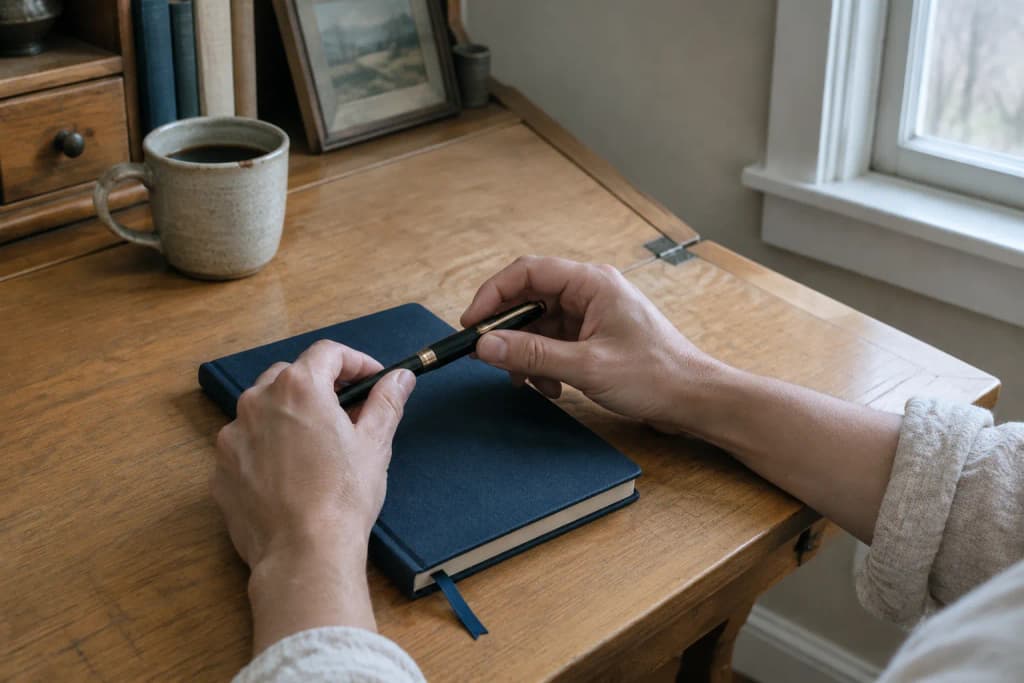
Think of pet loss journaling as a place to set the heavy thing down. You don't need beautiful sentences. You need honesty on a page that will not argue back, judge you, or tell you it's been long enough.
Here are a few gentle prompts to start with. Use the ones that fit and leave the rest:
- The last ordinary day. Describe the last completely normal moment — the sound of her thumping down the stairs, the weight of her landing on the bed. Ordinary memories are the ones that fade first, so catch them in the light while they're vivid.
- The thing I'm angriest about. Name it plainly. Anger loses some of its heat once it's on paper instead of loose in your chest.
- What I wish I'd said. Not to fix anything. Just to say it.
- One color that was her. Ragdolls carry such specific coloring — the smoky points, the pale body, the deep blue eyes. Describe the exact shade of her fur where the sun hit it. Sensory detail anchors memory better than summary.
- A letter to whoever comes next. Even if that's years away, or never.
Writing works partly because naming a feeling gives your thinking brain something to do with it, rather than leaving it to run wild in the body. The page becomes a container. The circling slows.
Grief in a House With Teenagers
Family pet grief with teens is its own weather system. A younger child may cry openly and be done in an hour. A teenager may go quiet, spend more time behind a closed door, or seem strangely unaffected before falling apart weeks later — because grief responses vary between people and follow no set schedule (Cornell).
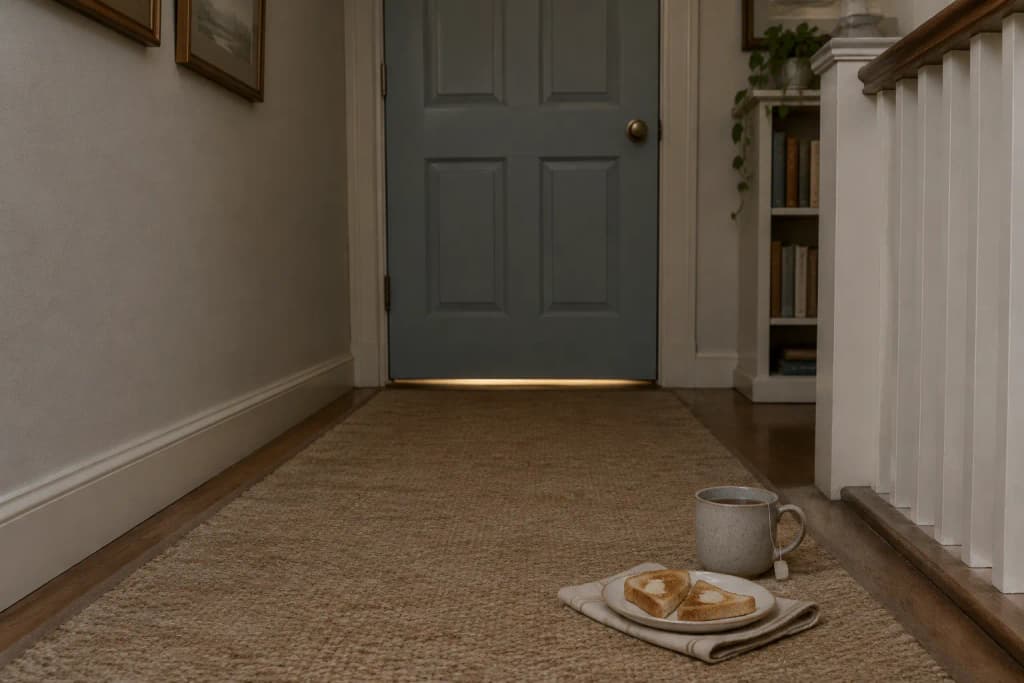
That variation can make a household feel out of sync. One person wants to talk about her constantly; another can't bear to hear her name. Both are grieving. Neither is doing it wrong.
A few things that tend to help families move through it together:
Let each person grieve in their own currency. A teen who won't talk might still write. Offer a shared journal on the side table where anyone can add a memory when they feel like it, unsigned if they prefer. No pressure to perform sadness on a schedule.
Name the anger out loud, gently. If your teenager snaps at dinner, it may not be about dinner. You don't have to fix it. Sometimes "I'm angry too, honestly" does more than a lecture ever could.
Protect the routines that hold. When sleep and daily rhythm get disturbed by loss (Humane World for Animals), the small anchors matter — regular meals, a walk, lights out at a reasonable hour. Structure is a quiet form of comfort.
Make room for a shared ritual, not a mandatory one. Framing a paw print together, choosing a photo for the wall, or picking out a keepsake can give scattered grief a single place to gather. Offer it. Don't require it.
A Decision Checklist: Is a Memorial Keepsake Right for Your Family Right Now?
Answer yes or no. There are no wrong answers — this is just a way to check your own readiness.
- Do you find yourself wanting a single, tangible place to focus the family's memory of her? (Yes / No)
- Would a shared object — a print, a journal, a figurine — give quieter family members a way to participate without having to talk? (Yes / No)
- Are you drawn to remembering how she looked — her coloring, her favorite curled-up pose — rather than only her photos? (Yes / No)
- Can you sit with the idea of a keepsake without feeling rushed or pressured to "move on" faster than you're ready to? (Yes / No)
- Is the household mostly in agreement that a shared memorial would help rather than reopen the wound too soon? (Yes / No)
If you answered yes to three or more, a memorial keepsake may genuinely help. If most of your answers were no, that's a complete and healthy answer too. Grief is a gradual journey that rarely follows a straight path (Cornell), and there's no version of it that requires an object.
When to Reach for More Than a Journal
A page and a paw print are enough for many people. Sometimes they aren't, and that's important to recognize without shame.
Professional grief counseling is a reasonable option when loss begins affecting daily functioning or sleep (Cornell Feline Health Center). Talking with a caring, non-judgmental person can help (Tufts) — and you don't have to be in crisis to earn that support.
Some resources worth knowing about:
- Tufts Pet Loss Support Hotline. A free helpline staffed by veterinary students, available from 6 pm to 9 pm Eastern, Monday through Thursday, with 24-hour voicemail (Tufts).
- Virtual pet-loss support groups. Some are free, some fee-based, led by certified pet-loss coaches in small-group or one-on-one formats — with support that lets people heal at their own pace (Lap of Love).
- Veterinary social work programs. Some veterinary centers run programs to support owners through illness, loss, and grief, and some hold annual remembrance ceremonies for pets that have died (Ohio State University Veterinary Medical Center).
Reaching out is not a sign that you loved her too much. It's a sign you're tending the wound with the care it deserves.
Choosing a Keepsake That Holds Her Likeness
For families who answered yes to the checklist, the question becomes: what kind of keepsake actually helps?
Photographs are irreplaceable, and they should be the foundation of any memorial. But some people find they want something with dimension — something that occupies the room the way she did, something you can pick up and hold. That's where options branch. A framed paw print. A shadow box of her collar and favorite toy. A commissioned drawing. Or a sculpted figurine.
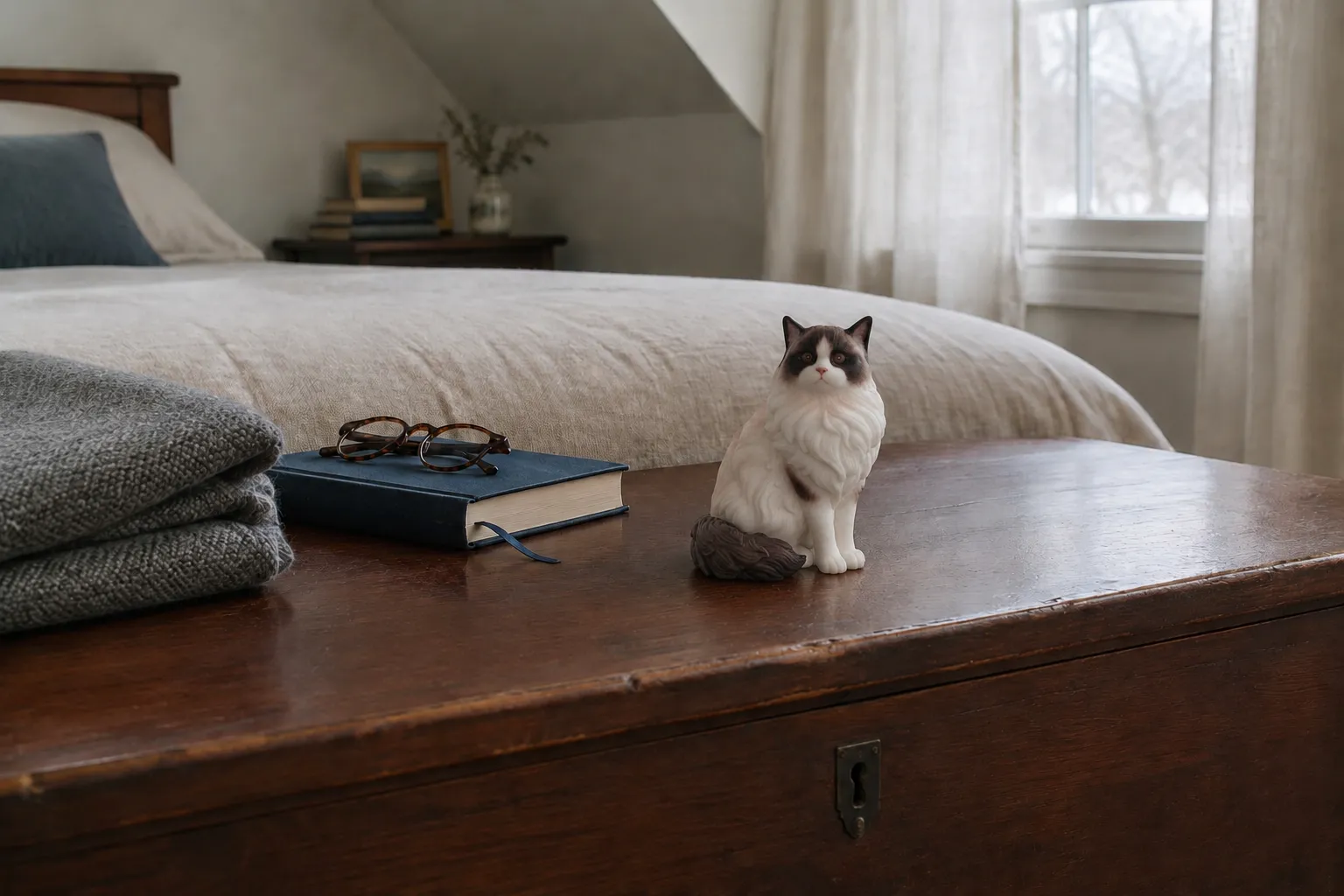
A figurine is worth understanding clearly before you decide, because it's a different kind of remembrance than a photo. At PawSculpt, the result is a sculpted portrait — an artistic interpretation of your cat, not a photocopy and not a photo-exact replica. For a Ragdoll, that distinction matters. So much of the breed lives in form: the loose, boneless way they drape, the soft curl of the tail tucked in close, the roundness of a face at rest. A sculpted portrait can catch that shape in a way a flat image can't.
The process is straightforward and keeps you in control at each step. Reference photographs are reviewed. An artist digitally sculpts the portrait. You confirm the artist preview before anything is printed. The approved model is printed in full color, the supports are removed, the surface is inspected, and a transparent protective coat is applied. The first artist preview is typically delivered within about 7 days after your complete references are in and the order enters design, and five revisions on that preview are included — so if the color of her points or the tilt of her head isn't quite right, you have room to get it there.
The Mimaki 3DUJ-553 printer used for these figurines supports more than 10 million colors as an equipment capability, which is part of why full-color detail — the gradient from pale body to smoky points — can be carried into the model rather than approximated. Figurines range from 2.5 to 6 inches tall, and they're made for indoor shelf display, finished with that transparent protective coat.
One honest note for grieving families: a preview lets you see the portrait before it becomes permanent, which some people find gentler than committing sight-unseen. And for a cover concept like a Ragdoll curled softly with her tail tucked and eyes closed — the pose of a cat asleep in a sunbeam — that dimensional stillness can be its own small comfort on a side table beside her journal and paw print.
A keepsake will never bring her back or shorten your grief. It simply gives the memory a place to live in the light.
The Slow Work of Acceptance
Acceptance is often misunderstood as a finish line — the day you stop hurting. It isn't. It's closer to the way a season turns: not a single morning, but a gradual shift in the light until one day you notice the air has changed. Grief rarely follows a straight path (Cornell), and it's okay — even important — to mourn the relationship you had with her (Humane World for Animals).

The anger softens. Not all at once, and not because you forced it. It softens because your mind slowly finishes the hard work of updating its model of the world — a world that now holds her memory instead of her presence. The gold stripe of afternoon sun on the floor stops feeling like an accusation and starts feeling like a place she used to be, which is a different and more bearable kind of ache.
You will find your own pace. There is no correct way to grieve the loss of your cat, and no normal timeline you're falling behind (Cornell Feline Health Center). Whatever you're feeling today — sadness, anger, exhaustion, numbness, or a strange and guilty relief — it belongs to you, and it's allowed.
Frequently Asked Questions
Is it normal to feel angry after suddenly losing my cat?
Yes. Anger, along with sadness, anxiety, guilt, and even relief, is a normal part of grieving a cat. There is no correct way to grieve, according to the Cornell Feline Health Center.
How long should grieving a Ragdoll cat take?
There is no normal timeline. Grief rarely follows a straight path and varies between people, so give yourself and your family time to heal at your own pace (Humane World for Animals).
Can journaling really help with pet loss?
For some people, yes. Writing and art are among the ways remembrance can support coping after pet loss, according to Cornell's pet loss resources.
Where can my family find pet-loss support?
Free helplines like the Tufts Pet Loss Support Hotline, virtual support groups through providers like Lap of Love, and veterinary social work programs are all valid options.
How is a PawSculpt figurine made?
An artist digitally sculpts a portrait from your photos, you approve the artist preview, then the model is printed in full color, cleaned, inspected, and given a transparent protective coat.
Is a figurine a photo-exact replica of my cat?
No. It is a sculpted portrait — an artistic interpretation of your pet, not a photocopy. Five preview revisions are included so you can refine the likeness before printing.
If You're Ready, One Gentle Next Step
There's no timeline you have to meet and no keepsake you're obligated to make. But if your family answered yes to that checklist — if you find yourselves wanting a single, tangible place to hold her memory, curled and peaceful the way she was in the afternoon light — you can explore a sculpted pet memorial figurine when the time feels right for you.
Take it slowly. Keep writing in the journal. Frame the paw print. Reach out to a support helpline if the days feel too heavy. And when you're ready to see her likeness take shape, you'll have room to review the artist preview and make it feel like her before anything becomes permanent. She deserves to be remembered with care. So do you.