The Ferret's Curve: Why Spine Flexibility is the Hardest (and Most Important) Thing to Sculpt
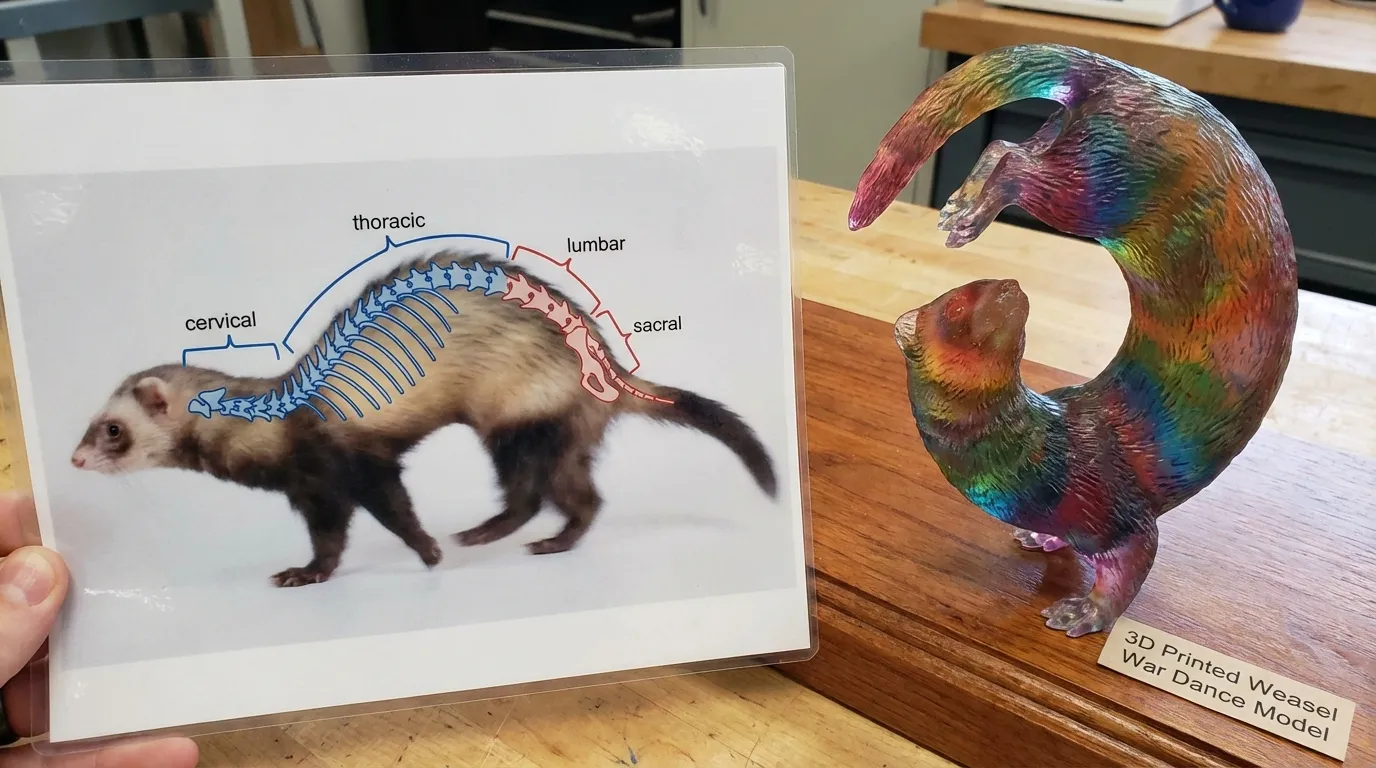
Does the spine of your ferret seem to pour over furniture rather than climb it? Capturing that distinct, liquid motion in static ferret anatomy art is the ultimate test of a sculptor's understanding of biomechanics.
Quick Takeaways
- The "Liquid" Illusion — A rigid figurine must mimic a spine that compresses and elongates.
- Support Strategy — Long, thin bodies require complex 3D print support structures to prevent warping.
- Digital Fur Flow — We map color patterns voxel-by-voxel to mimic undercoat depth.
- Preserving Personality — Custom figurines capture the "war dance" energy that photos often miss.
The Biomechanics of the "Carpet Shark"
In the world of additive manufacturing and digital sculpting, we often talk about "primitive shapes." A dog is roughly a box (chest) and a cylinder (abdomen). A cat is two spheres connected by a fluid tube. But a ferret? A ferret is a physics problem.
From a biological perspective, the challenge lies in the ferret’s evolutionary design. They are mustelids, built for subterranean hunting. Their vertebrae are spaced differently than a cat’s or a dog’s to allow for extreme flexion—up to 180 degrees in a U-turn within a tight tunnel. When we look at a ferret, our brains don't register a static object; we register a trajectory. We expect them to move.
This creates a phenomenon known in cognitive science as implied motion. When you look at a statue of a runner, your brain's mirror neurons fire as if you are running. If the sculpture is anatomically incorrect—if the center of gravity is off, or the spine creates a sharp angle where there should be a curve—your brain rejects it. It creates a sense of cognitive dissonance. You might not know why the figurine looks wrong, but it feels lifeless.
For a ferret, that "lifelessness" usually comes from treating the spine like a rod instead of a slinky. In our digital sculpting lab, we spend hours studying the "ferret slump"—that moment when they pick up a toy and their entire skeletal structure seems to dissolve.
"A ferret isn't just a shape; it is a trajectory caught in a moment of chaos."
The Engineering Challenge: Printing the Impossible Curve
Let’s get technical about why this is hard to manufacture. I’ve spent over a decade running industrial 3D printers, specifically PolyJet and Multi-Jet Fusion (MJF) style machines. These aren't the filament printers you see in hobby shops; these are machines that jet millions of droplets of photopolymer resin, curing them instantly with UV light.
When we print a 3d printed ferret, we are fighting against the physics of the resin itself.
The Aspect Ratio Problem
Ferrets are essentially long cylinders with a high aspect ratio (length vs. width). In resin printing, long, thin parts are susceptible to two major failure modes:- Warping during cure: As the resin cures, it shrinks slightly. On a compact shape like a pug, this shrinkage is uniform. On a long shape like a ferret, uneven shrinkage turns a straight spine into a banana.
- Cantilever stress: If we print the ferret standing on its hind legs (the classic "begging" pose), the head is a heavy weight at the end of a long lever arm. During the printing process, the movement of the print head can cause microscopic wobbles in that tall, thin structure, leading to layer shifts or visible lines.
Orientation Logic
To solve this, we don't just hit "print." We have to orient the digital model in 3D space to minimize stress.Common Orientation Strategies for Ferret Models:
| Orientation Strategy | Pros | Cons | Best For |
|---|---|---|---|
| Vertical (Head Up) | Cleanest surface finish on the sides; minimal support scarring on the back. | High risk of wobble; requires heavy supports at the base; susceptible to gravity during printing. | "Begging" or "Standing" poses. |
| Horizontal (Flat) | Lowest center of gravity; fastest print time; strongest structural integrity. | Requires supports along the entire belly or back, leaving texture marks that need sanding. | Sleeping or "Speed Bump" poses. |
| 45-Degree Angle | A compromise that reduces layer lines on curved surfaces (the "stair-step" effect). | Complex support generation; higher material usage. | Running or "War Dance" poses. |
We often choose the 45-degree angle. It allows the "grain" of the 3D print (the layer lines) to run diagonally across the fur texture, making them virtually invisible to the naked eye after the clear coat is applied.
Digital Sculpting: The Anatomy of the Arch
Before a single drop of resin is fired, the battle is won or lost in the digital sculpting phase. Our artists use software like ZBrush to hand-model the pet in a virtual environment. This is not "scanning"—scans of furry animals usually look like melted blobs because scanners can't resolve individual hairs. This is artistic reconstruction based on anatomy.
The Floating Shoulder
Here is the secret to the ferret's liquidity: the shoulder girdle. Unlike humans, whose clavicles (collarbones) attach the arms firmly to the sternum, ferrets have a highly reduced clavicle. Their front legs are attached mostly by muscle.When an amateur sculpts a ferret, they often stick the front legs onto the body like a doll. But in reality, when a ferret reaches forward, the entire shoulder blade slides forward along the ribcage. When we sculpt, we have to "detach" the shoulders in our mind and slide them to match the motion. If we don't, the ferret looks stiff, like a dog in a ferret costume.
The "Tube" Fallacy
A common mistake in ferret anatomy art is modeling the body as a perfect tube. A healthy ferret is actually pear-shaped, but the pear changes orientation.- Sitting: The weight settles into the hips (bottom-heavy pear).
- Running: The organs shift, and the chest expands for oxygen (top-heavy pear).
- Turning: The ribcage is rigid, but the lumbar region (lower back) is incredibly flexible. The "twist" happens almost entirely behind the ribs.
If a sculptor twists the ribcage area, it looks broken. The twist must originate from the mid-section. We pay obsessive attention to this. We look at the reference photos you send us and map the spine's curve against the ribcage's rigidity.
"We don't just look at the fur pattern; we look at the tension in the skin. That tells us where the bones are."
— The PawSculpt Team
Color Without Paint: The Voxel Difference
This is the part of the process that usually surprises pet owners. At PawSculpt, there are no paintbrushes. There are no acrylics. There is no "waiting for the paint to dry."
We use full-color 3D printing.
How It Works
Imagine a standard 2D inkjet printer. It mixes Cyan, Magenta, Yellow, and Black (CMYK) to create an image on paper. Now, imagine that printer doesn't just put ink on paper, but deposits tiny droplets of colored plastic, layer by layer, thousands of times, to build a 3D object.The color is not a shell. If you were to cut one of our figurines in half (please don't), you would see the color goes all the way through, or at least deep into the surface.
The Challenge of Ferret Coats
Ferrets present a unique challenge for this technology: the dual coat. A sable ferret, for example, has a creamy/white undercoat and dark brown guard hairs.- Traditional Painting: A painter would lay down a cream base and dry-brush brown over the top.
3D Printing: We have to simulate this volumetrically*.
We use a technique called "dithering" in the digital model. We create a texture map where the dark pixels (guard hairs) are suspended slightly above the light pixels (undercoat) in the digital geometry, or we blend them at the voxel level (a voxel is a 3D pixel).
Because the resin is slightly translucent, light penetrates the surface, hits the lighter color underneath, and bounces back through the darker surface color. This mimics the actual physics of fur, giving the figurine a depth that opaque paint often lacks. This is why we say our process is "biologically inspired"—we are replicating the way light interacts with organic material.
The Psychology of the "War Dance"
Why do so many ferret owners choose the "Weasel War Dance" pose for their figurines? From a psychological standpoint, it comes down to peak shift.
The "peak shift effect" is a principle where a caricature of a thing is often more recognizable than the thing itself. The War Dance—arched back, mouth open, feet off the ground—is the "peak" of ferret-ness. It represents pure, unadulterated joy.
However, sculpting this is a nightmare of balance.
- Center of Mass: A dancing ferret is often on two legs, or all four are off the ground in a hop.
- The Solution: We often use "tactical terrain." We might sculpt a small digital blanket, a tube, or a toy that connects to one of the paws. This acts as a structural anchor. It looks like a cute accessory, but to us, the engineers, it’s a load-bearing column that prevents the model from snapping at the ankles.
Structural Risks of Common Poses:
| Pose | Emotional Impact | Engineering Risk | Solution |
|---|---|---|---|
| The War Dance | High Energy / Joy | Tipping over; weak ankles. | Weighted base or "tactical" terrain connection. |
| The Speed Bump (Flat) | Relaxed / "Pancaking" | Low risk; very stable. | Ensure clear coat is applied evenly to prevent pooling in crevices. |
| The Dook (Mouth Open) | Vocal / Interactive | Thin jaw walls can be fragile. | Thickening the jaw slightly on the interior (invisible from outside). |
| The Sleeper (Curled) | Peaceful / Memorial | "Blobbing" (loss of definition). | Deepening the sculpt lines between limbs to hold shadow. |
Post-Processing: The Human Touch in a Digital Process
While we don't hand-paint, there is still craftsmanship involved after the print finishes.
When a ferret figurine comes out of the printer, it is encased in a jelly-like support material. This material held up the ferret's chin, belly, and tail during the printing process.
The Excavation
Removing this support is like archeology. We use high-pressure water jets and chemical baths to dissolve the support. This is the most dangerous moment for a ferret figurine. The tail of a ferret is long and slender. If the technician is too aggressive with the water jet, the hydraulic pressure can snap the tail.We treat every ferret tail with the same delicacy as a piece of fine jewelry.
The Clear Coat
Once cleaned and UV-cured (hardened), the surface has a matte, slightly chalky finish. The colors look muted. This is where the magic happens. We apply a specialized clear coat. This isn't just varnish; it's a UV-resistant optical coupler. It "wets" the surface of the resin, filling in microscopic layer valleys. Instantly, the sable brown deepens, the pink nose pops, and the eyes get that characteristic ferret shine.This step is critical for longevity. UV resin can yellow over time if exposed to direct sunlight. Our clear coat blocks UV radiation, preserving the color fidelity of your 3d printed ferret for years.
"Grief is love with nowhere to go. A figurine gives that love a physical place to land."
Why Accuracy Matters for Grief and Celebration
We talk a lot about engineering, but why does it matter? Why do we obsess over the curvature of the spine or the translucency of the ears?
Because of attachment theory. When you lose a pet, or even when you just miss them while you're at work, your brain is constantly scanning your environment for them. It’s a background process running in your subconscious.
If you buy a generic ferret figurine from a big-box store, your brain sees "a ferret."
If you have a custom PawSculpt figurine that captures the specific way your ferret crooked their tail to the left, or the unique mask pattern they had, your brain sees "Bandit."
That recognition triggers a release of oxytocin. It helps resolve the cognitive dissonance of their absence. It turns a piece of resin into a vessel for memory.
We aren't just printing plastic. We are printing the physical anchor for your memories. And because ferrets are such dynamic, kinetic creatures, capturing their energy requires every ounce of technical skill and artistic empathy we possess.
Frequently Asked Questions
How do you capture my ferret's unique markings without painting?
We use full-color 3D printing technology. The colors are embedded directly into the resin as it prints, based on the digital map our artists create from your photos. This allows for complex patterns like roaning, mitts, or masks that are part of the material itself, not just a layer on top.Are the figurines fragile?
They are made of cured UV resin, which has properties similar to a high-quality collectible statue or ceramic. While they are durable enough for gentle handling, thin parts like ferret tails, toes, or open jaws can break if dropped on a hard surface. We recommend displaying them in a safe spot away from edges.What kind of photos do you need for a ferret?
Ferrets are notoriously wiggly subjects! Ideally, we need a clear shot of the face (to see the mask details), the back (to see the stripe or pattern spread), and the side. If you want a specific pose like the "war dance," a video of them moving is incredibly helpful for our sculptors to understand their specific body mechanics.Can you fix a "bad" photo where my ferret is blurry?
To an extent, yes. Because our artists have years of experience with ferret anatomy art, they can infer the underlying structure even if the photo is blurry. However, we will need your guidance on specific markings. We offer unlimited digital revisions, so you will see a 3D preview and can tell us, "His mask is a little wider" before we ever hit print.Ready to Celebrate Your Pet?
Every pet has a story worth preserving. Whether you're honoring a beloved companion who's crossed the rainbow bridge or celebrating your furry friend's unique personality, a custom PawSculpt figurine captures those details that make your pet one-of-a-kind.
Free instant AI preview • 3D artist preview within 7 days • 5 free revisions