
The Parrot Paradox: 6 Colors Your Camera Misses but Our Resin Printers Catch (If You Use This Lighting Trick)
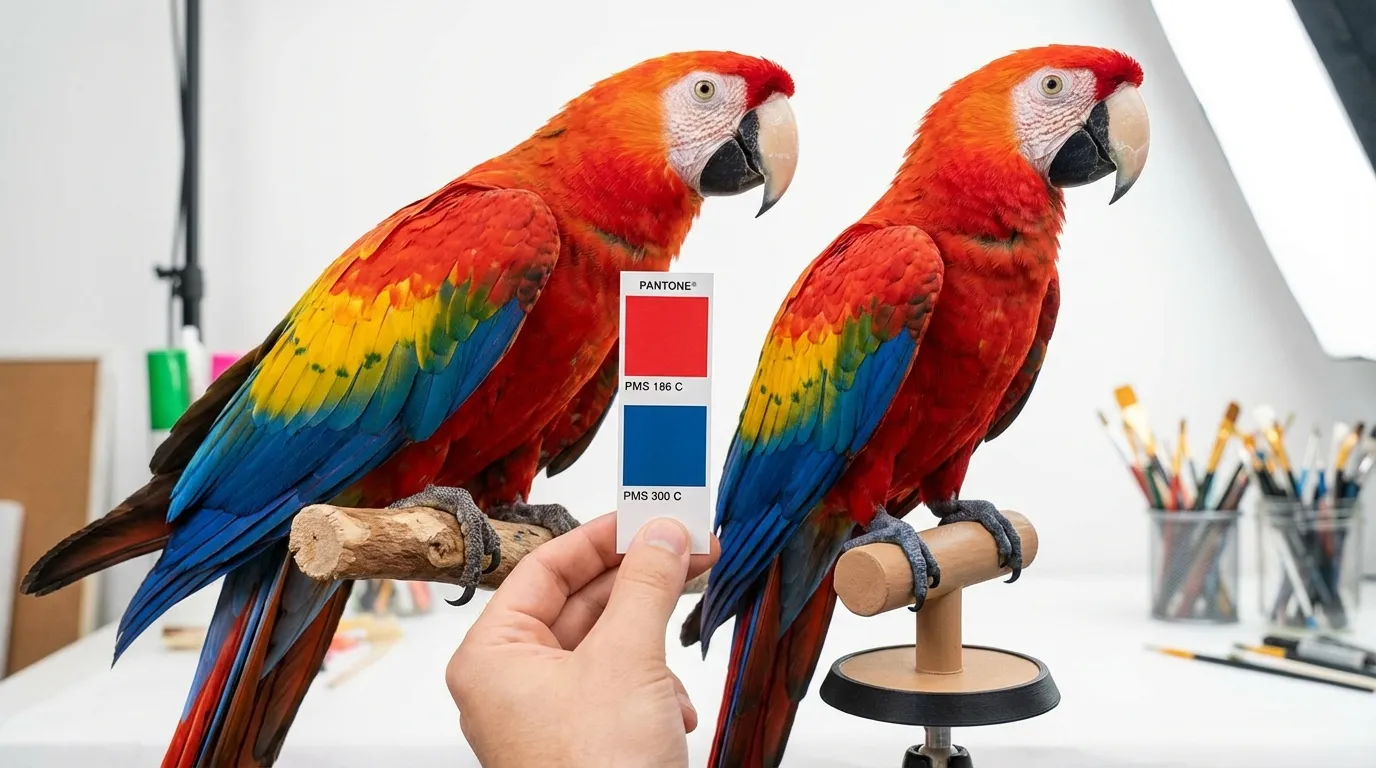
You’re holding a photo of your Blue-and-Gold Macaw, but something feels wrong. The feathers in the picture look flat, almost muddy, while the bird sitting on the perch in front of you is shimmering with iridescence that seems to shift every time he turns his head. This is the "Parrot Paradox"—cameras flatten what eyes perceive, often losing the very soul of the bird's plumage.
Quick Takeaways
- Iridescence isn't pigment — it’s structural light refraction that cameras struggle to capture in a single frame.
- Lighting is 80% of the battle — diffuse, indirect sunlight reveals feather detail better than harsh flash.
- Our printers work in voxels — unlike a 2D photo, we print color in 3D space, mimicking how feathers layer.
- Reference photos need variety — we need multiple angles to map the "color shift" correctly on a custom figurine.
Why Your Phone Camera Fails Your Bird
We see this constantly in the shop. A customer sends us a photo of their Amazon Parrot, and they add a note: "He looks greener in real life, and there's a bit of red on the wing you can't really see here."
It's not that you're a bad photographer. It's that birds are optical illusions with wings.
Mammal fur is generally pigmented—a brown dog is brown because the hair contains brown pigment. But parrot feathers? They are engineering marvels. Many blues and greens in birds aren't pigments at all; they are produced by the microstructure of the feather refracting light (Tyndall scattering). When you snap a 2D photo, you are freezing that refraction at a single angle, often killing the vibrancy.
"A photo captures a millisecond of light. A figurine captures the memory of how that light moves."
When we digitally sculpt a bird for full-color 3D printing, we aren't just copying a JPEG. We are rebuilding the geometry of the bird to catch the light the way the real animal does.
The 6 "Invisible" Colors We Hunt For
After years of staring at reference photos and running our full-color resin printers, we’ve identified six specific color complexities that standard photography flattens, but our additive manufacturing process can replicate.
1. Structural Blue (The Tyndall Effect)
If you grind up a blue macaw feather, it turns gray. The blue is created by air pockets in the keratin. Cameras often render this as a flat, solid blue.- The Printing Fix: We don't just pick "Pantone Blue." In our digital sculpting phase, we layer translucent blues over darker base layers in the model's texture map. The resin printer then deposits these colors voxel-by-voxel (think 3D pixels), creating a depth that mimics that structural scattering.
2. UV-Reflective Plumage
Birds see in UV. While we can't print UV colors visible to humans, the patterns on birds often rely on contrast that our eyes miss but cameras blur together.- The Printing Fix: We heighten the contrast in the digital model. If a budgie has cheek patches that glow in UV, we slightly oversaturate those areas in the print file so they "pop" to the human eye the way they might to another bird.
3. Sub-Surface Scattering on Beaks
A healthy beak isn't a solid block of gray or black. It has blood flow and keratin layers. Flash photography makes beaks look like plastic.- The Printing Fix: We use the translucency of the resin to our advantage. By adjusting the shell thickness of the beak in the 3D model, we allow a tiny amount of light to penetrate the surface, giving it that organic, "living" look rather than a painted toy appearance.
4. The "Oil Slick" Black
Ravens, crows, and certain parrots have black feathers that shimmer with greens, purples, and blues.- The Printing Fix: This is the hardest thing to do. We use a jitter algorithm in the texture mapping. Instead of printing pure black resin, the printer mixes microscopic dots of cyan and magenta into the black layers. Under the clear coat we apply during post-processing, this creates a subtle sheen that breaks up the monotony.
5. Eye Pinning (Iris Depth)
Parrot owners know the "pinning" look—when the pupil contracts in excitement. Photos usually result in "demon eyes" (red-eye reflection) or flat black discs.The Printing Fix: We model the eye with a physical concave lens shape clear-coated to high gloss. We print the iris color behind* a clear resin layer, giving the eye actual physical depth.
6. The Powder Down Haze
Cockatoos and African Greys have a dusty, matte finish due to powder down.- The Printing Fix: This is where our post-processing differs. While we usually clear coat for protection, for "dusty" birds, we use a satin or matte finish varnish to replicate that soft, chalky texture of the feathers, distinct from the glossy beak.
The Lighting Trick That Changes Everything
If you want a figurine that truly looks like your bird, don't send us a photo taken with a flash in a dark room. The flash blows out the structural color, turning complex iridescence into white glare.
Here is the "Window Wedge" technique we recommend to every bird owner:
- Wait for an overcast day or a time when the sun isn't blasting directly into your window.
- Place your bird between you and the window (but slightly to the side, so they aren't a silhouette).
- Turn off all indoor lights. You want one light source: the window.
- Take a video, not a photo. Move your phone in a slow arc around the bird.
Why video? Because our sculptors can pause the video frame-by-frame to see how the colors shift on the neck and wings. That movement tells us more about the feather structure than 50 still photos ever could.
3D Printing vs. Hand-Painting: The Feather Texture
There is a misconception that high-end figurines must be hand-painted. In the world of avian replicas, hand-painting is actually a disadvantage.
Paint has thickness. If you paint a macaw, the layers of acrylic fill in the tiny grooves of the feather sculpting. You lose the texture.
Our process is different:
- Digital Sculpting: We model the feather flow in ZBrush.
Full-Color Resin: The color is injected into* the resin as it prints.
- Zero Paint Thickness: Because the color is part of the material, the microscopic ridges of the feathers remain crisp. You can feel the texture of the wing coverts.
Comparison: Capturing Avian Detail
| Feature | Hand-Painted Clay | Full-Color 3D Resin (PawSculpt) |
|---|---|---|
| Color Transitions | Hard lines or brush strokes | Smooth gradients (dithering) |
| Feather Detail | Often obscured by paint thickness | Crisp, varying layer heights (25-50 microns) |
| Translucency | Opaque (paint blocks light) | Semi-translucent (mimics keratin) |
| Accuracy | Dependent on painter's interpretation | Projected directly from your photos |
| Durability | Paint chips over time | Color is embedded in the material |
The "Frankenstein" Method for Perfect Color
We often ask customers for what we call a "Frankenstein map."
Since no single photo captures a parrot perfectly, we ask you to circle parts of different photos.
"Use the beak shape from Photo A."*
"Use the chest color from Photo B (taken outside)."*
"Use the eye expression from Photo C."*
Our digital artists then composite these instructions. We aren't limited by the physics of a single camera lens. We can build a composite truth—a figurine that looks like your bird feels to you.
"We don't just print pixels; we print the personality that gets lost in the flash."
— The PawSculpt Team
Why This Matters for Memorials
When a bird passes, the silence in the house is deafening. Parrots are loud, messy, vibrant creatures. Losing that color is a shock to the system.
We have found that for bird owners, accuracy is tied to grief. If the blue on the wing isn't that specific electric blue they remember, the figurine feels like a toy. But when the light hits the resin and that structural color shifts just right? It triggers a recognition in the brain. It feels like them.
We recently did a Hyacinth Macaw for a family in Florida. These birds are massive, deep cobalt blue with bright yellow accents. The owner was worried about the blue looking flat. By using our multi-layer resin printing technique, we created a deep, rich indigo that lightened to azure on the edges of the feathers. When she opened the box, she told us she instinctively went to offer it a peanut.
That split-second of "is it real?" is what we chase every day in the print lab.
Frequently Asked Questions
Can you print the exact pattern of my bird's mutations?
Yes. Because we digitally sculpt the texture map directly from your provided photos, we can replicate specific pied markings, pearl patterns, or unique color mutations exactly where they appear on your bird. We don't use generic "species templates" for the color—it's custom mapped to your pet.Do 3D printed figurines fade in the sun?
Our full-color resin is UV-cured during the printing process, making it chemically stable and robust. However, like any fine artwork or photograph, prolonged exposure to direct, harsh sunlight (like a dashboard or window sill) can cause slight fading over many years. We recommend displaying them indoors for maximum longevity.How do you handle the tiny feet and claws?
Bird feet are incredibly delicate structures. In the engineering phase, we often thicken the toes slightly (measured in microns) to ensure structural integrity, or we design the bird gripping a perch or base. This allows us to print the legs as part of a solid unit, preventing the brittleness that would occur if they were free-standing thin resin.My bird has missing feathers or a deformity. Should I fix it?
That is entirely up to you. We can digitally "heal" the bird to show them in full plumage, or we can accurately sculpt the unique traits—like a crooked beak or a plucked chest—that made them who they were. Many owners find comfort in the "perfect" version, while others want the raw reality. Just let us know your preference in the design notes.Ready to Celebrate Your Pet?
Every pet has a story worth preserving. Whether you're honoring a beloved companion who's crossed the rainbow bridge or celebrating your furry friend's unique personality, a custom PawSculpt figurine captures those details that make your pet one-of-a-kind.
Free instant AI preview • 3D artist preview within 7 days • 5 free revisions