
Still Filling the Bowl: Cooking Your Labrador's Favorite Meal as a Quiet Still Life
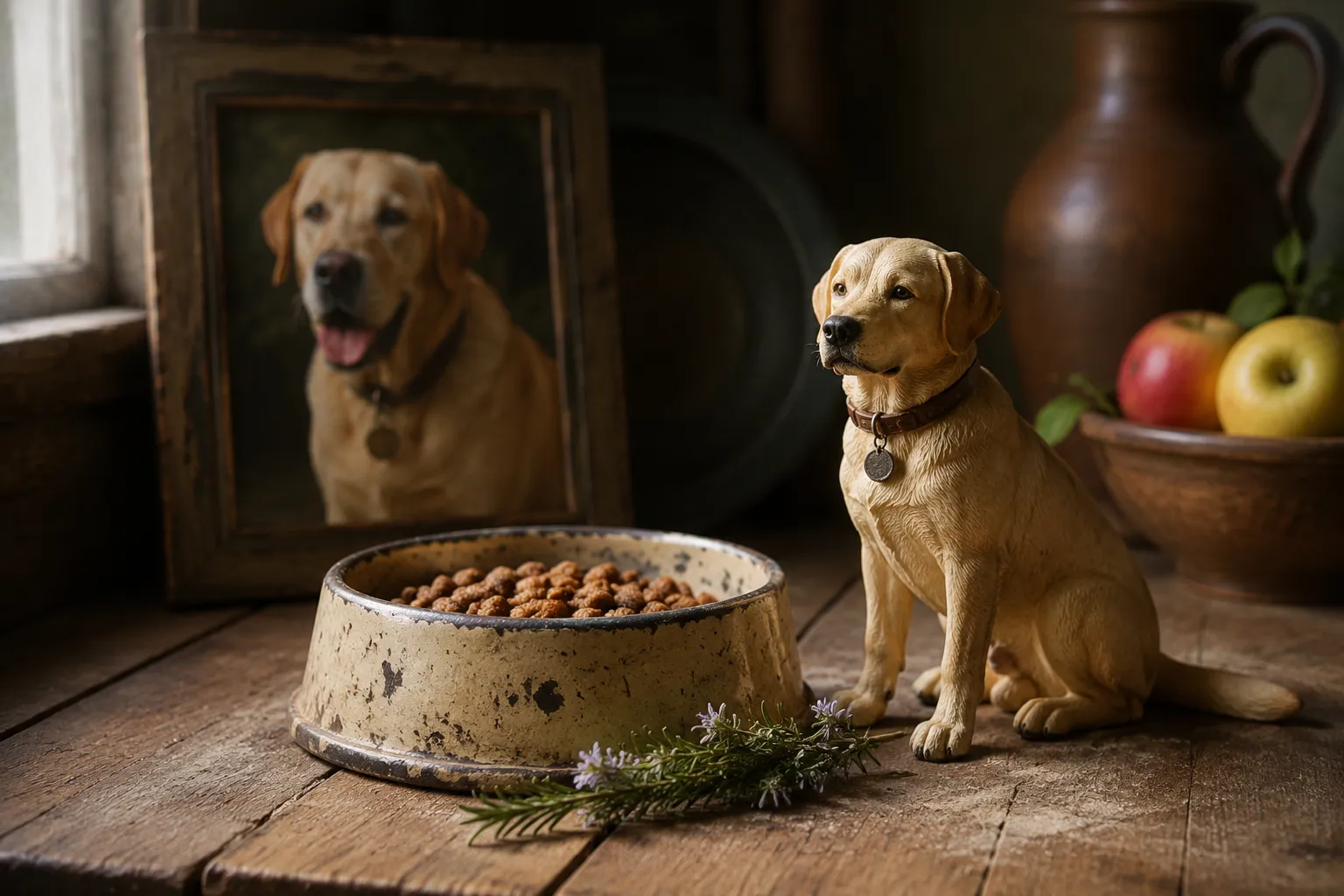
The metal bowl still clinks against the tile when you set it down—that same bright note your Labrador used to sprint toward. Cooking their favorite meal has quietly become your labrador memorial ritual, a still life made of steam, salt, and the sound of a kitchen that used to have an audience.
Quick Takeaways
- Cooking engages procedural memory, giving grief a task for your hands instead of just your head.
- Treat the prepared meal as a still life, not leftovers—plate it, photograph it, let it mean something.
- The kitchen disarms grieving teens who won't sit for a "feelings talk" but will stir a pot beside you.
- Pair the ritual with a tangible keepsake, like a custom pet figurine, so the memory outlasts the meal.
- The empty bowl hurts more than a used one—repurposing it transforms a wound into a small daily ceremony.
Why a Food Bowl Becomes the Loudest Object in the House
We've worked with thousands of families saying goodbye to a dog, and one detail surfaces again and again: it's never the bed or the leash that breaks them first. It's the bowl.
Here's the thing about food bowl grief—the bowl was the percussion section of your home. The morning scrape across the floor. The frantic toenail-skid on hardwood at the sound of kibble hitting steel. The contented metallic nudge as they pushed it around chasing the last crumb. A Labrador, in particular, makes the bowl loud. They're a breed bred to be motivated by food, and the American Kennel Club's breed profile doesn't undersell their appetite. Your kitchen had a soundtrack, and that bowl was the downbeat.
Then it goes silent. And silence, it turns out, has a volume of its own.
"An empty food bowl isn't the absence of a dog. It's the presence of everything they used to be at 6 a.m."
Most grief guides tell you to put the bowl away. Box it up, tuck it in a closet, spare yourself the reminder. We'll be honest—we think that advice is well-meaning and often wrong. Removing the object doesn't remove the grief; it just removes your control over when it ambushes you. You'll find it later behind the holiday platters and lose an afternoon.
What helps more, for a lot of people, is the opposite. You give the bowl a job again.
The science of why your hands need something to do
There's a reason stirring a pot feels different from staring at a photo. Psychologists distinguish between declarative memory (facts and images you consciously recall) and procedural memory (the things your body knows how to do without thinking). Grief tends to flood the declarative channel—the photos, the dates, the last vet visit playing on a loop.
Cooking routes around that. When your hands measure rice or shred chicken, you're working in procedural memory, the same low-stress system that lets you tie your shoes while thinking about something else. It's not that you stop grieving. It's that grief finally has somewhere to go besides your chest.
Researchers who study ritual point to something called continuing bonds—the now widely accepted idea (a correction to older "just let go" models) that healthy grief often means maintaining a relationship with the deceased in a new form. A labrador memorial ritual built around food isn't denial. It's a structured, repeatable way to keep the bond active without pretending they're coming back.
The Still Life: Cooking to Remember a Pet as a Small Act of Devotion
Let's talk about the word in your title that does the heavy lifting: still life.
A still life isn't a snapshot of leftovers. It's an arrangement—a deliberate composition of ordinary objects elevated by attention. Dutch painters spent months on a bowl of fruit because the act of looking that closely was itself a form of reverence. When you cook your Lab's favorite meal and actually plate it—the way they'd never have let you, because they'd have inhaled it in four seconds—you're doing the same thing.
You're slowing down a thing that used to be fast.
"Devotion isn't the grand gesture. It's the small thing you keep doing when no one is watching."
One family we worked with told us they cook their Golden's birthday meal every year—a specific recipe of ground turkey, sweet potato, and a single crumbled dog biscuit on top—and they set it on the counter on a real plate for ten minutes before anyone touches it. Not because they think she's eating it. Because the making of it is the point. The smell fills the kitchen, and for those ten minutes, the house sounds full again.
That's the counterintuitive part most people miss. The ritual isn't about the meal. It's about reclaiming your senses on your own terms. Grief hijacks your nose—a whiff of wet dog or a particular treat can drop you to your knees in a grocery aisle. Cooking lets you summon those smells deliberately, in a safe space, where you're the one who decided to invite them in.
Why smell hits harder than any photo
Of all the senses, smell has the most direct line to memory and emotion. The olfactory bulb (the part of your brain that processes scent) wires straight into the limbic system, which handles emotion and memory, skipping the usual cognitive filters. That's why a smell can yank you backward in time more violently than any picture.
You can use this. The aroma of their favorite meal isn't an enemy to avoid. Handled on purpose, it becomes a doorway you can choose to walk through, then close.
What Actually Goes in the Bowl
Here's where our selective-editor instinct kicks in, because the internet is full of "dog-safe recipes" that are either dangerous or joyless. We're not vets—for any health questions, especially if you're cooking to share with a living pet, talk to yours—but we've gathered the components that show up most in the memorial meals families describe to us.
The standout principle: recreate the meal they actually loved, not the one a recipe blog says they should have had. If your Lab's joy was a scrambled egg on Sunday, that's the meal. Authenticity beats nutrition here, because nobody's eating it.
Below is a quick reference for common components families build their memorial meals around. Treat it as a starting palette, not a prescription.
| Component | Why It Resonates | Worth Noting |
|---|---|---|
| Plain shredded chicken | The universal "good dog" reward smell | Skip onions, garlic, heavy seasoning |
| Sweet potato or pumpkin | Often a "settle the stomach" comfort food | Plain, no spice mix or marshmallow |
| Scrambled or boiled egg | The Sunday-morning treat for many dogs | A scent strongly tied to weekend routine |
| Rice | The base of countless "sick day" meals | Carries memory of care and recovery |
| A single dog biscuit, crumbled | The sound and crunch they came running for | The most emotionally loud ingredient |
| Peanut butter (xylitol-free) | The Kong-stuffing, pill-hiding hero | Check the label—xylitol is toxic to dogs |
A pro move from families who've done this a while: cook the version that matches the season you miss most. A summer dog gets the post-walk, panting-in-the-shade meal. A senior dog who left you in winter gets the soft, warm, easy-to-chew version you made when their teeth got tender. The specificity is what makes it yours.
"We've learned that the smallest details carry the heaviest love. A crumb of biscuit can hold a decade of mornings."
— The PawSculpt Team
Myth vs. Reality
We hear a lot of received wisdom about food and pet grief. Some of it deserves a harder look.
Myth: Keeping food rituals alive "keeps you stuck" and prevents healing.
Reality: Modern grief research (the continuing-bonds framework) suggests structured remembrance often speeds adjustment. What keeps people stuck is usually avoidance, not ritual.
Myth: Cooking their meal will just make you cry every time, so why do it.
Reality: Crying during a chosen ritual is regulated grief, not random ambush grief. You set the time, the place, and the exit. That control is what makes it bearable—and over weeks, the tears often soften into something closer to warmth.
Myth: A memorial ritual has to be solemn and sad to "count."
Reality: Some of the best ones we've heard are funny. One family narrates the meal in their dog's imagined voice while they cook. Grief and laughter aren't opposites. They're roommates.
The Fear You Don't Say Out Loud: Forgetting
Here's a feeling almost nobody admits, and we want to name it directly because naming it takes away some of its teeth.
You're afraid you'll forget.
Not forget that they existed—forget the specifics. The exact pitch of their bark when the mail came. The particular weight of their head dropping onto your foot under the table. The sound their collar made—that soft tag-jingle—when they shook off after a nap. People rarely say this out loud because it feels like a betrayal, like the love should be permanent enough to make memory automatic. It isn't, and that's not a failure of love. It's a function of neuroplasticity—your brain literally rewires around the absence, pruning the sensory details it no longer uses daily.
This is exactly why a cooking ritual earns its place. Repetition is how the brain decides what's worth keeping. Every time you remake that meal, you're rehearsing the memory, refreshing the neural pathway before it fades. You're not being morbid. You're maintaining the file.
"You're not afraid of grief. You're afraid the grief will end, and take the details with it."
And here's the gentle truth underneath the fear: you will forget some things. The edges blur. That's allowed. The point of a ritual isn't to preserve every pixel—it's to keep the feeling accessible, the warmth retrievable, even after the specifics soften. The meal becomes a key. You don't have to hold the whole house in your head as long as you know where the key is.
Some families anchor that feeling in something they can hold the other 364 days a year. Photo books, memorial gardens, a paw-print in clay. Increasingly, pet parents pair the meal ritual with a 3D pet sculpture that captures the exact posture they're afraid of losing—the head-tilt, the sit, the way one ear flopped. We'll come back to that, because the why matters more than the what.
Family Grief With Teens: Why the Kitchen Works When Talking Doesn't
If there are teenagers in your house, you already know the standard grief advice falls flat. "Let's all share a memory" gets you a shrug and a closed bedroom door. Family grief with teens is its own animal, and the kitchen is one of the few rooms in the house where it loosens.
Here's why, and it's rooted in adolescent development. The teenage brain is in the middle of a massive renovation, with the prefrontal cortex (judgment, emotional regulation) still under construction well into the mid-twenties. Direct emotional confrontation can feel genuinely threatening to a teen—it spikes the very self-consciousness they're wired to avoid. So they go quiet, or they get angry, and parents read it as "they're not grieving." They are. They just can't do it through your front door.
The kitchen offers a side door.
Why stirring beats sitting
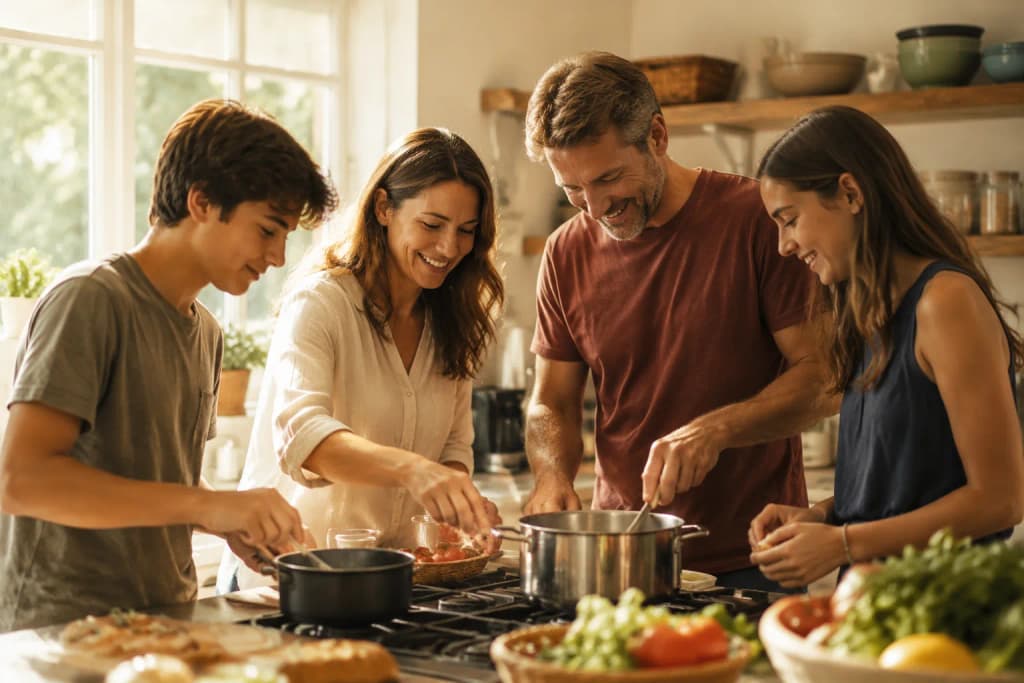
When you and a teenager are both facing a stove—shoulder to shoulder, hands busy, eyes on the pot instead of each other—you've removed the thing that makes them shut down: the face-to-face spotlight. Therapists who work with adolescents call these side-by-side conversations, and they're not a trick. The reduced eye contact lowers the social-threat response, and suddenly the kid who wouldn't talk is telling you the thing they actually remember.
One parent told us the breakthrough came mid-recipe. Her sixteen-year-old, mid-stir, said quietly, "He used to sleep on my feet when I had a panic attack. How did he always know?" She'd been trying to get him to "open up" for three weeks. It took a wooden spoon and a pot of their dog's chicken-and-rice to do it.
"Teenagers won't perform their grief for you. But they'll let it slip out sideways, over a stove, if you let them."
A few specifics that actually work, from families who've navigated this:
- Assign a real job, not a token one. "Shred the chicken" beats "watch me cook." Agency matters to teens.
- Don't narrate the emotional significance. The second you say "isn't this special, doing this for him," you've turned a refuge into a performance. Just cook.
- Let them set the music. The teen who controls the soundtrack feels ownership of the ritual. The kitchen sounds like them, which means they'll come back.
- Build it into a fixed cadence. Predictability is regulating for a grieving brain of any age. "First Sunday of the month" beats "whenever we feel like it."
- Keep the exit open. If they need to leave mid-cook, let them go without comment. The door staying unlocked is what brings them back next time.
The counterintuitive insight here: don't make the ritual about the grief, and it'll do more grief work than any sit-down ever could. Teens process through action, not announcement. Hand them a task, stand beside them, and let the steam do the talking.
Building Your Ritual: A Framework, Not a Formula
We're allergic to one-size-fits-all grief advice, so think of this less as instructions and more as a menu you assemble. The families whose rituals stick tend to share a structure, even when the specifics differ wildly.
The table below maps the rhythm we see most often—how a food-based memorial ritual tends to evolve over the first year. Your timeline is yours; this is a pattern, not a deadline.
| Phase | Typical Window | What the Ritual Looks Like | The Sound of It |
|---|---|---|---|
| Raw | First 2–3 weeks | You may not be able to cook it yet—and that's fine | The silence you're avoiding |
| Tentative | Weeks 3–8 | First attempt, lots of tears, maybe abandoned halfway | A quiet kitchen, one person |
| Anchoring | Months 2–6 | A fixed cadence forms (weekly, monthly) | A pot bubbling, music on |
| Integrated | 6 months+ | The ritual feels warm more than wrenching | Laughter, stories, full room |
Notice that the early phases include not doing it. If you can't face the recipe in week one, that's not failure—the raw phase is real, and forcing the ritual before you're ready can backfire. Wait until the task feels possible. The bowl will still be there.
A simple starting structure
- Choose the one meal. Not a menu. The single dish most tied to joy. Specificity is the whole game.
- Set a fixed time. A birthday, a "gotcha day," the first Sunday of the month. The brain loves a schedule.
- Make it sensory on purpose. Use the real bowl. Let the smell fill the room. Put their favorite song or the TV show that used to play during dinner.
- Plate it as a still life. Ten quiet minutes where the meal just is. Photograph it if you want—many families build a yearly album.
- Close the ritual deliberately. A word, a touch of the bowl, blowing out a small candle. Rituals need an ending as much as a beginning, or grief doesn't get the "we're done for now" signal.
Where a tangible keepsake fits
The meal is temporary by design—that's part of its honesty. But many families want something that stays on the counter the other days, presiding over the kitchen the way their Lab used to. That's a genuine emotional need, not a sales pitch, and there are good options: framed photos, custom illustrations, ceramic paw casts.
For families who want the dog present in three dimensions, this is where we come in—honestly, and as just one option among several. PawSculpt creates memorial keepsakes that are digitally sculpted by master 3D artists from your photos, then precision 3D printed in full color. The color is part of the resin itself, not a coating, so your Lab's exact markings—the white chest patch, the graying muzzle, the chocolate-versus-black depth of their coat—come through with a natural texture and a protective clear coat for sheen.
What families tell us matters most isn't realism for its own sake. It's posture. The specific way your dog sat, begged at the counter, or waited by the bowl. A photo flattens that. A figurine standing watch over your still life gives the ritual a guardian. If that resonates, you can see how the process works at pawsculpt.com—we'd rather you understand the craft than rush a decision.
For the broader emotional terrain of pet loss, the Association for Pet Loss and Bereavement offers free chat support and grief resources, and we point families there often. We make keepsakes; they hold space for the harder hours. Both have a place.
The Bowl, Reconsidered
Go back to that clink against the tile.
For weeks, maybe months, that sound was a small daily cruelty—proof of the absence, the silence where the toenail-skid used to be. But a ritual changes what a sound means. Fill that bowl with the meal they loved, set it down with intention, and the clink stops being an accusation. It becomes a bell. The opening note of a ceremony you control, on a day you chose, for a love that didn't end just because the dinners did.
You are not keeping the wound open. You're keeping the door open—the side door, the kitchen door, the one grief actually walks through. Every time you remake that meal, you rehearse the details before they fade, you give your teenager a place to set down what they can't say, and you turn the loudest, loneliest object in the house back into something that means welcome.
So this week, or this month, or whenever the raw phase loosens its grip: take the bowl down. Cook the one meal. Let the kitchen smell like them again. Plate it as a still life, sit with it for ten quiet minutes, and notice that the house, for a little while, sounds full.
That's not holding on too tight. That's a labrador memorial ritual doing exactly what love is supposed to do—outlasting the last meal, and finding somewhere new to live.
Frequently Asked Questions
Is it healthy to keep cooking my deceased dog's favorite meal?
For most people, yes. Modern grief research around continuing bonds shows that structured remembrance often helps you adjust, rather than keeping you "stuck." The key is intention—set a time, make it deliberate, and give the ritual a clear ending so your brain registers a beginning and a close. If the ritual ever feels like it's deepening rather than easing your distress over many months, that's worth raising with a grief counselor.
How do I help my grieving teenager who won't talk about losing our dog?
Stop trying to talk at them and start doing something beside them. Cooking your dog's favorite meal shoulder-to-shoulder removes the face-to-face spotlight that makes teens shut down, lowering the social-threat response their developing brain is wired to avoid. Give them a real job, let them control the music, and don't narrate the emotional meaning. The grief tends to slip out sideways, over a stove.
Why does an empty food bowl hurt more than other reminders?
Because the bowl was the percussion of your daily life—the scrape, the skid of nails, the metallic nudge. It's wired into routine and into your dog's most joyful, enthusiastic moments, so it triggers procedural and emotional memory at once. That's also why repurposing it through a cooking ritual works so well: you give the painful object a new, comforting job.
What if I'm scared I'll forget the little details about my dog?
That fear is incredibly common and almost never spoken aloud. Some specifics will soften over time—it's your brain rewiring around the absence, not a failure of love. Repeating a sensory ritual like cooking their meal rehearses those memories and keeps the feeling retrievable. Many families also create a custom pet figurine to preserve the exact posture they're most afraid of losing.
How often should I do the memorial cooking ritual?
There's no correct frequency, but a fixed cadence helps more than "whenever I feel like it," because predictability is regulating for a grieving brain. Many families land on a monthly rhythm or tie it to meaningful dates—a birthday, a gotcha day. In the first few weeks, it's also completely fine not to do it at all until you're ready.
Ready to Celebrate Your Pet?
Every pet has a story worth preserving. Whether you're building a labrador memorial ritual around their favorite meal or simply celebrating a companion who still skids across your kitchen floor at dinnertime, a custom PawSculpt figurine captures the details that make your dog one-of-a-kind—the exact posture, the markings, the head-tilt a photo can't quite hold.
Visit pawsculpt.com to learn more about our full-color 3D printing process, preview turnaround, revisions, and quality guarantee.