
The Last Video Clip: Finding Secular Comfort After Losing Another Russian Blue
Two years ago, that same steel exam table held Misha's gray paw under the flat fluorescent light. Now it held Nikolai—another Russian Blue, another goodbye—and the search for secular pet grief comfort started before we'd even reached the parking lot.
Quick Takeaways
- Consecutive pet loss compounds grief — name the second loss as its own wound, not a repeat.
- Secular comfort works without rituals — meaning comes from memory and routine, not the afterlife.
- Capture motion, not just stills — the last video clip often holds more than any photo.
- Tangible keepsakes give grief an anchor — many families find peace in custom pet figurines that hold a pet's exact posture.
- The "second Russian Blue" guilt is real — comparing two beloved cats is normal and forgivable.
Why Losing a Second Russian Blue Hits Differently
Here's something the grief books rarely tell you: the second loss doesn't add to the first. It multiplies it.
We've worked with thousands of pet families over the years, and the ones who've lost a second cat of the same breed describe something specific. It's not just "I lost Nikolai." It's "I lost Nikolai, and losing him made me lose Misha all over again." The grief stacks. Old scar tissue tears open right next to the fresh wound.
Russian Blues make this worse, honestly. And we mean that as a compliment to the breed.
If you've loved one, you know. That silver-tipped coat that catches window light like brushed pewter. Those wide green eyes that seem to track your mood across a room. The way they pick one person and shadow them through the house. So when you bring home a second Russian Blue after the first one's gone, you're not really replacing anyone. You're trying to hold onto a feeling. And then that one leaves too.
"The second goodbye reopens the first. You're not grieving twice. You're grieving deeper."
The breed's quiet intensity is part of why the loss lands so hard. These aren't aloof cats. The American Kennel Club's breed overview describes Russian Blues as gentle, loyal, and deeply bonded to their families—and that bond is exactly what makes the empty spot on the windowsill so loud.
The comparison trap nobody admits to
Let's be real about something most people won't say out loud. When you lose a second pet of the same breed, you compare them. Constantly.
Nikolai was needier than Misha. Misha never knocked things off the counter; Nikolai treated gravity like a personal project. You catch yourself ranking them, then feel sick about it, like you're betraying both. That comparison instinct is normal. Your brain is trying to make sense of two overlapping shapes of love, and the only tool it has is contrast.
You're not loving one less by noticing the difference. You're proving you saw each of them as an individual. That's the opposite of betrayal.

Secular Pet Grief: Finding Comfort Without the Rainbow Bridge
A lot of grief resources lean hard on the spiritual. Your pet is "waiting at the bridge," "watching over you," "in a better place." And for some people, that's a genuine comfort. No judgment here.
But if you don't believe any of that, those phrases can feel hollow. Worse, they can make you feel like grief itself is off-limits to you—like you don't get the soft landing because you don't buy the story.
You do get the soft landing. It just looks different.
Secular pet grief is built on what was real, not what comes next. The warmth of a cat sleeping on your chest at 6 a.m. happened. The specific weight of him. The vibration of the purr against your sternum. None of that requires an afterlife to have mattered. It mattered because it was true, and true things leave permanent marks.
"You don't need to believe in forever to know that what you had was real."
Where meaning actually comes from when you don't pray
Most secular folks we've talked to find comfort in three concrete places, and none of them involve faith:
- Continuity of memory — the dog-eared edge of who you became because of them.
- The physical record — videos, fur clippings, the collar that still smells faintly of them.
- Acts of meaning — donating to a Russian Blue rescue, fostering, planting something that outlives the season.
Notice what these have in common. They're all anchored to something you can return to. Faith gives believers a place to put their grief. Secular grievers need to build that place themselves, with their hands. That's not a downgrade. It's actually a more active, more deliberate kind of remembering.
Here's the counterintuitive part: the lack of a built-in story can become a strength. You're not waiting passively for a reunion. You're deciding, on purpose, how this love continues to shape your daily life. That's agency. And agency is one of the few things that genuinely helps in early grief.
The Association for Pet Loss and Bereavement offers secular-friendly support resources, and one theme runs through their guidance: there's no single correct framework for mourning an animal. Yours counts.
The Last Video Clip Is More Powerful Than You Think
We want to talk about something specific, because almost nobody prepares you for it.
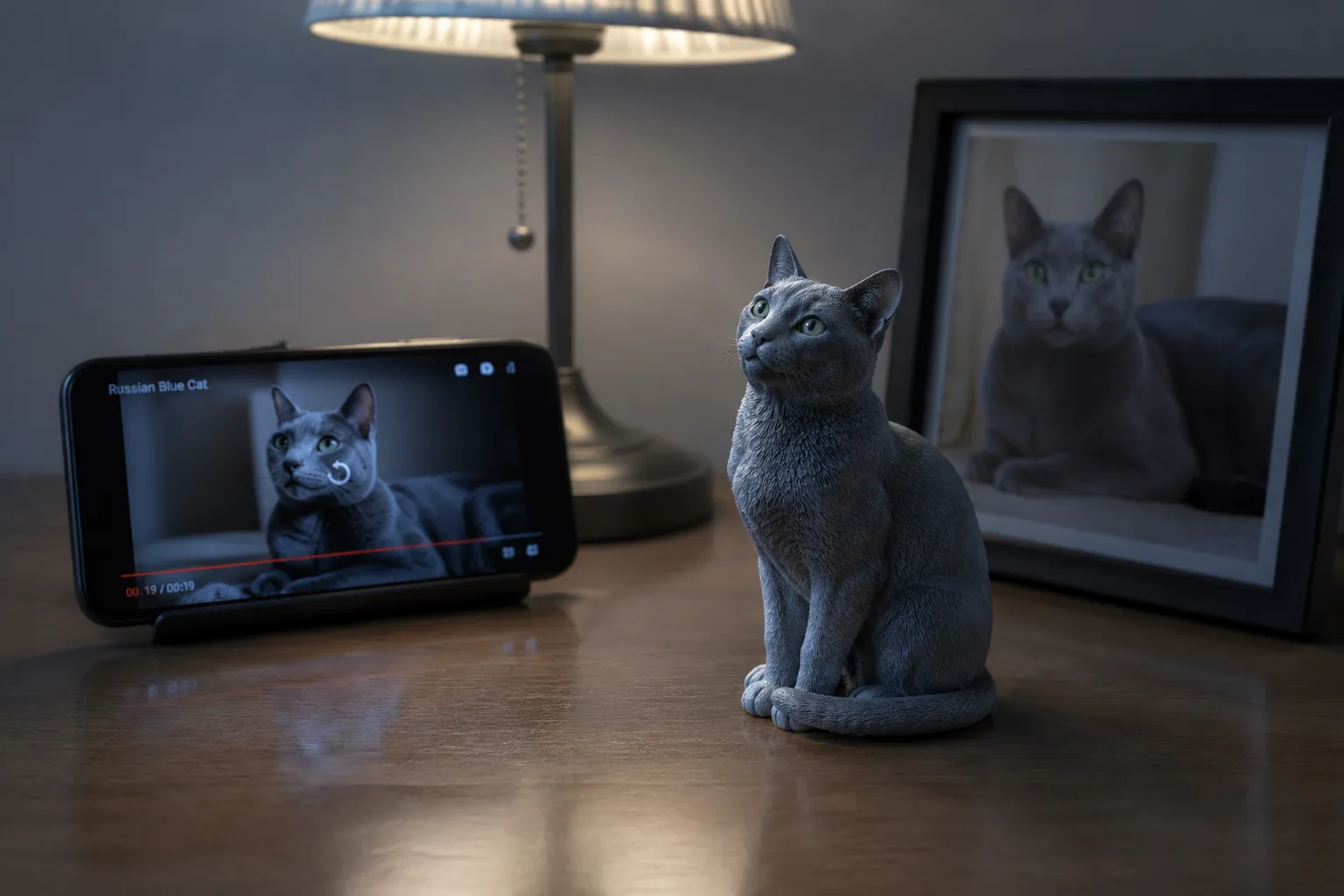
When Nikolai's family went looking for comfort that first sleepless night, they didn't reach for a framed photo. They reached for a 9-second video. Him chirping at a bird through the glass, tail flicking, that ridiculous half-meow Russian Blues do. They watched it forty times.
Photos freeze a face. Video keeps a personality alive. That distinction matters more than the entire greeting-card industry wants you to know.
Why motion outlasts the still image
A still photo is a Russian Blue. A video is your Russian Blue. The difference is in the micro-movements—the specific way he turned his head, the rhythm of his walk across the kitchen tile, that little stretch-and-yawn combo he did every morning by the radiator.
Those details fade from memory faster than faces do. Within about 3 to 6 weeks, many people report they can still picture their pet's face clearly but can no longer quite "hear" them or recall exactly how they moved. The video holds what your memory will eventually drop.
"A photo shows you what they looked like. A video reminds you who they were."
Here's our genuinely useful, do-it-tonight advice if you still have a living pet reading this over your shoulder:
- Film 15 seconds of pure ordinary — not a trick, not a holiday. Just them eating, blinking, existing.
- Get audio — the purr, the chirp, the specific creak of their meow. Voices are the first thing to vanish.
- Film at their eye level — crouch down. The world from their height feels intimate later.
- Label and back it up — name the file with the date. Future-you will be desperate to find it.
The mistake most people make is waiting for a "good" moment to film. The good moment is the boring Tuesday. The boring Tuesday is the one you'll ache for.
A day-in-the-life of grief, and where the clip fits
Picture this. It's 6:15 a.m., still dark, and the radiator ticks where a gray cat used to fold himself into the warm spot. The apartment has that blue pre-dawn light, the kind that makes everything look underwater. You reach for your phone out of habit, and instead of the alarm, you open the clip. Nine seconds. The chirp. You breathe for the first time since waking.
That's not wallowing. That's a controlled dose of connection that lets you start the day. Grief responds well to small, intentional touchpoints like this far better than to either total avoidance or all-day immersion.
Honoring Two Russian Blues Without Erasing Either One
This is where consecutive pet loss gets logistically and emotionally tricky. How do you memorialize the second without it feeling like you're stacking him on top of the first? Or worse, replacing the first in the memory shrine?
We've seen families wrestle with this in real time, and the ones who land somewhere peaceful tend to follow one principle: separate but equal honoring.
Don't blend them into a single "the cats" memory. Give each his own object, his own clip, his own small ritual. Misha gets the windowsill photo and the spring crocus. Nikolai gets the video and the radiator spot. They were two distinct souls. Honor them as two.
A comparison of secular memorial options
Different families need different things, and budget, effort, and emotional payoff vary a lot. Here's an honest breakdown of what we've seen work for secular grievers specifically:
| Memorial Option | Effort Required | Emotional Anchor | Best For |
|---|---|---|---|
| Memorial video montage | Low–Medium | Very high (motion + sound) | People who want to feel the pet again |
| Pressed-paw or fur keepsake | Low | High (tactile) | Those comforted by physical touch |
| Custom 3D-printed figurine | Medium | Very high (3D presence) | Families wanting a daily visual anchor |
| Memorial donation/foster | Medium–High | High (meaning-making) | Action-oriented, purpose-driven grievers |
| Memory journal | Medium | Medium–High (narrative) | Writers and processors |
There's no winner in this table. The "right" one is whichever you'll actually return to. A gorgeous urn you can't look at helps no one. A scrappy phone video you watch every morning is doing real work.
When a figurine helps more than a photo
We'll be straight with you about why physical 3D keepsakes have become so popular for memorial purposes, especially for breeds with distinct silhouettes like the Russian Blue.
Grief needs something to land on. A flat photo lives behind glass, in the past tense. A three-dimensional figurine sits in your space, in the present tense. You can pick it up. Turn it. Put it on the desk where they used to sit during your work calls.
At PawSculpt, our team digitally sculpts each pet using master 3D modeling, then brings it to life through full-color 3D printing, where the color is printed directly into the resin itself rather than added on top. For a Russian Blue, that means the specific silver-blue of the coat and those green eyes get reproduced as part of the material, with a natural print texture sealed under a protective clear coat. It's vibrant and authentic—not glossy plastic-perfect, but real.
"We've learned that grief needs an anchor. Something with weight you can hold when the room feels empty."
— The PawSculpt Team
One detail families tell us matters most: capturing the pose. Not a generic cat sitting upright, but Nikolai's specific loaf, Misha's specific stretch. If you're exploring memorial pet figurines, the personality is in the posture. Send the reference photo that looks most like them, not the most flattering one.
The Guilt, Relief, and Anger Nobody Warns You About
Now we need to go somewhere uncomfortable, because pretending these feelings don't exist is how people end up suffering alone.
The relief you're ashamed of
If your second Russian Blue declined slowly—kidney disease, the slow fade so common in older cats—there's a good chance that when it ended, somewhere underneath the grief, you felt relief.
Relief that the 3 a.m. medication schedule was over. Relief that you didn't have to watch him struggle on the stairs. Relief that the financial bleed stopped, then immediate shame for even thinking about money.
That relief doesn't make you cold. It makes you someone who carried a heavy, sustained load of caregiving and finally got to set it down. The relief and the grief are not opposites. They're roommates. Nearly every long-illness pet family feels both, and almost none of them admit it. You're in a very large, very quiet club.
"Relief when their suffering ends isn't betrayal. It's the last gift your love could give."
Second-guessing the timing
Here's the one that keeps people up at night: Did I do it too soon? Did I wait too long?
With consecutive loss it gets sharper, because now you have a previous experience to measure against. "With Misha I waited until the very end and watched her suffer—so this time I chose earlier, and now I wonder if I stole good days from Nikolai." Or the reverse.
There is no clean answer, and we won't insult you with a fake one. But here's what we've observed: families who agonize over the timing are, without exception, families who were paying close, loving attention. The agonizing is the love. A careless owner doesn't lose sleep over the calendar. The second-guessing is proof you took the decision as seriously as it deserved.
If the medical specifics haunt you, talk to your vet—they can walk you through what was actually happening in the body. We're not vets, and quality-of-life decisions belong in that conversation, not a blog post.
The anger that surprises you
Some people get angry. At the disease. At the vet. At the universe for taking two of the same breed, like some cruel pattern. At themselves. Occasionally—and this one shocks people—at the pet, for leaving.
Anger is grief wearing armor. It shows up when sadness feels too vulnerable to face head-on. If you're snapping at people or seething at nothing, you're not broken. You're grieving with your fists up for a while. It usually softens.
How Grief Moves Through Time (and Why It's Not Linear)
People want a timeline. We get it. So here's a realistic one, with the heavy caveat that grief loops backward constantly and anyone who promises a tidy progression is selling something.
| Phase | Rough Timeframe | What It Often Feels Like | What Helps |
|---|---|---|---|
| Acute shock | First 48–72 hours | Numb, foggy, autopilot | Basic care: water, sleep, one small task |
| Raw grief | Weeks 1–3 | Waves, habit-triggers, crying spells | The video clip, talking, gentle routine |
| The settling | Weeks 4–8 | Quieter ache, fear of forgetting | A tangible memorial, journaling |
| Integration | Months 2–6+ | Memory without collapse | Meaning-making, helping other animals |
Notice the fear of forgetting in weeks 4 to 8. That's a real and specific phase. Around the one-month mark, many people panic because the sharp pain is easing, and they mistake healing for forgetting. They almost want the pain back, because the pain felt like connection.
It isn't forgetting. The love converts from an open wound into something you carry. That conversion feels like loss, but it's actually how you survive.
"Healing doesn't mean you loved them less. It means the love finally has room to breathe."
The habit-triggers that ambush you
The hardest moments aren't the planned ones. It's the muscle memory.
You buy the wrong cat food at the store before you remember. You step over the spot where the bowl used to be. You go quiet at 9 p.m. because that's when he used to appear for the evening lap-sit, and the lap is empty. These ambushes peak around weeks 2 through 4 and then gradually thin out.
One small, concrete tactic: physically move the feeding station within the first few days. Don't leave the bowls in the exact spot to be tripped over a dozen times a day. You can keep one item out as a chosen memorial. But the accidental, repeated gut-punches help no one.
The Anxiety About a Third Russian Blue
Eventually—weeks or months later—the question surfaces. Could I do this again?
For consecutive-loss families, this question carries extra weight. You've now buried two of the same breed. Part of you wants the specific feeling back: that silver coat, that loyal shadow. Part of you is terrified of signing up for a third goodbye.
Hesitation here is wisdom, not weakness. The families who rush to fill the silence often struggle, because they're asking a new cat to be a patch over an unprocessed wound—and that's not fair to anyone, including the cat.
A useful internal test we've heard: Are you wanting a cat, or wanting that cat back? When you can genuinely picture loving a new individual for who they are—not as a Misha replacement, not as a Nikolai 2.0—you're closer to ready. There's no rush. The breed will still exist when your heart catches up.
And if you choose never to do it again, that's a complete and valid choice too. Loving two Russian Blues fully is not a lesser life than loving four.
What to Expect If You Choose a Memorial Figurine
Since we get asked about this constantly, here's the honest, non-salesy version of how a custom memorial keepsake comes together, without quoting specifics that change over time.
The photos do the heavy lifting. The single most important thing you provide is reference images. For a Russian Blue specifically:
- Pick the most them pose — the signature loaf, sit, or stretch that says "that's him."
- Good, even light — natural daylight beats flash, which flattens that silver coat.
- Multiple angles — front, side, and a face close-up help our 3D artists capture the real proportions.
- Show the eyes — those green eyes are a breed signature; a clear eye shot matters.
From there, our team digitally hand-models the sculpt and produces it through full-color resin 3D printing, so the coat color and markings are built into the material itself. The only manual step afterward is a protective clear coat for durability and a soft sheen.
For current details on the creative process, preview turnaround, revisions, and the quality guarantee, it's best to check PawSculpt's custom figurine service directly, since those specifics evolve. What stays constant is the goal: a keepsake that looks like your cat, posture and all, not a generic gray figurine.
A quiet tip from experience—some families order a figurine of their living senior pet before the end. Having it made while you can still confirm "yes, that's exactly how she sits" produces a likeness that means more later. It's a hard thing to think about. It's also one of the most loving acts of foresight we see.
Building Your Own Secular Ritual
Believers inherit rituals. Secular grievers get to invent them, which is harder and, weirdly, more meaningful—because every element is one you chose on purpose.
Here's a simple framework that's helped a lot of the families we've talked with:
- Choose an anchor object — the video, the figurine, the collar. One primary thing you return to.
- Choose a time — maybe that 6 a.m. radiator moment, maybe a Sunday. Predictability soothes grief.
- Choose an action — watch the clip, hold the keepsake, say their name out loud. Yes, out loud.
- Choose a meaning — what they taught you that you'll carry. Name it specifically.
This isn't religion. It's structure. And structure is what keeps grief from becoming a formless fog that swallows whole weeks. You're not praying to anything. You're keeping a promise to yourself about how this love continues to live in your daily life.
Do it for each cat separately when you've lost more than one. Misha's ritual and Nikolai's ritual. Two souls, two practices. They earned individual remembrance, and giving it to them is how you honor that they were never interchangeable.
Frequently Asked Questions
Is it normal to grieve a second pet even harder than the first?
Completely normal. Consecutive pet loss tends to compound rather than add—losing your second Russian Blue can reopen the grief from the first one. You're not being dramatic or weak. You're carrying two losses that have merged into one heavier weight, and that deserves real acknowledgment.
How do I find comfort after pet loss if I'm not religious?
Secular pet grief leans on what was real instead of what comes after. Anchor your comfort in continuity of memory, tangible keepsakes like a saved video or a figurine, and meaningful action such as donating to a breed rescue. You don't need to believe in a reunion to honor a love that genuinely shaped your life.
Why does watching the last video of my pet help so much?
Because video holds personality, not just appearance. Within roughly three to six weeks, many people find they can still picture their pet's face but can no longer recall exactly how they moved or sounded. A short clip preserves the chirp, the walk, the specific little habits—the things that made them unmistakably them.
Is it normal to feel relief when my pet passed away?
Yes, and it doesn't make you cold. After a long illness and an exhausting caregiving routine, relief that the suffering is over is one of the most common feelings pet owners carry—and one of the least admitted. Relief and grief live side by side. Feeling both is a sign of how much you gave.
Should I get another Russian Blue after losing two?
There's no right answer, only the honest one for you. A helpful test is asking whether you want a cat or want that specific cat back. When you can picture loving a new individual for who they are, you may be ready. Choosing never to adopt again is equally valid.
What photos work best for a memorial figurine?
Pick the pose that most says "that's him"—the signature loaf, sit, or stretch—shot in even natural light from a few angles, with at least one clear shot of the eyes. For a Russian Blue, good lighting captures the silver-blue coat, and a strong eye photo preserves that green-eyed gaze that defines the breed.
Ready to Celebrate Your Pet?
Every pet has a story worth preserving. Whether you're honoring a beloved Russian Blue who's crossed the rainbow bridge or finding secular comfort after pet loss, a custom PawSculpt figurine captures the exact posture, coat, and personality that made your companion one-of-a-kind—built into full-color resin through advanced 3D printing.
Visit pawsculpt.com to learn more about our preview process, flexible revisions, and quality guarantee.