
Walking the Same Trail Without Your Beagle: How Movement Rewires a Grieving Mind
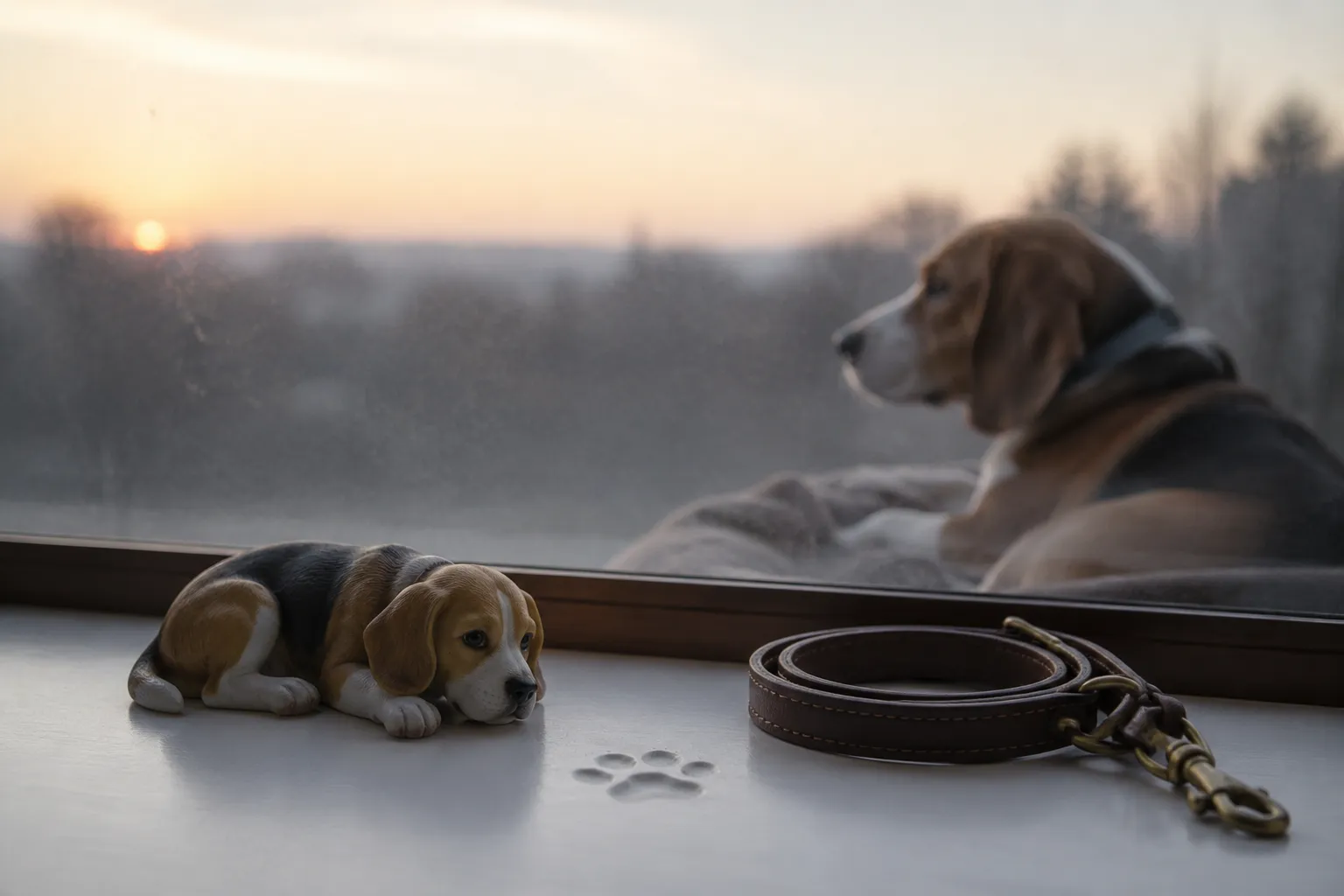
Why does your hand still reach for two leashes when you only need one now? Beagle loss rewires the smallest rituals first. You stand on the front porch at six in the morning, breath fogging the cold, waiting for a nose that won't nudge the screen door open.
Quick Takeaways
- Walking the same trail reopens grief on purpose — and that controlled exposure can actually help your brain heal.
- Grief lives in your motor memory, not just your heart — your body expected your beagle at heel.
- The other dog in your home is grieving too — watch for searching behavior in the first 2-3 weeks.
- Anchor the memory in something physical, like a custom pet figurine, so remembering doesn't depend on a fading photo.
The Trail Knows Before You Do
Here's something nobody tells you about grief and walking: the house is hard, but the trail is harder.
At home, the absence is quiet. A bowl you haven't moved. A dent in the couch cushion. But the trail? The trail was where your beagle was most himself — nose down, tail like a metronome, pulling you toward some scent story only he could read.
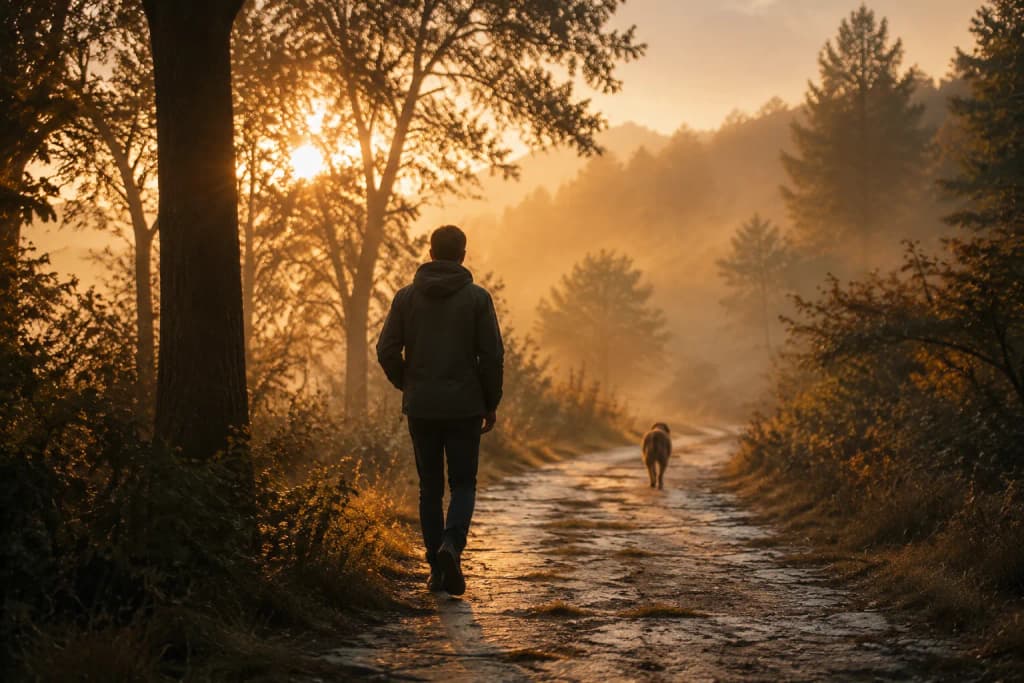
You round the bend by the third fence post. That's where he always stopped. Your feet slow down before your mind remembers why. And then it lands.
"Grief doesn't live only in your heart. It lives in your hips, your hands, the rhythm of your own two feet."
That stopping point is muscle memory. For years, your body learned a choreography — pause here, wait there, shorten the leash near the road. The beagle is gone, but the choreography isn't. Your nervous system is still running a duet for a partner who left the stage.
This is the part most grief articles skip. They talk about feelings. They don't talk about the fact that your body kept a map of your dog, and now every step recalculates around a hole.
Why beagles, specifically, leave this kind of mark
Beagles are scent hounds bred to lead. According to the American Kennel Club's breed profile, the beagle's nose drives nearly everything they do — which means your walks weren't really your walks. They were his investigations, and you were lucky enough to be invited.
So the trail isn't just a place you went together. It's a place he authored. Every shrub had meaning. Every mailbox post was a chapter. Walking it now feels like reading a book in a language you only half learned, the translator suddenly gone.
That's why the trail hits differently. You're not just missing a companion. You're missing the one who gave the route its purpose.
The Neuroscience of Grief, Translated for People Who Hurt
Let's get practical about what's happening inside your skull, because understanding it actually helps.
When you lose someone you love — and yes, your beagle counts, fully — your brain doesn't immediately update its files. Researchers who study the neuroscience of grief describe something almost stubborn about the grieving brain: it holds two contradictory beliefs at once. He's gone and he'll be at the door any second now.
That gap between knowing and believing is where the ache lives.
Your brain built a model of the world that included your dog as a permanent fixture — a prediction engine that expected his weight against your leg, the jingle of his tags, the specific clatter of his nails on the kitchen floor. Grief, in neurological terms, is the slow and painful work of rewriting those predictions.
"Grief is your brain updating a map it never wanted to redraw."
Here's the counterintuitive part. The expectation is updated through experience, not avoidance. Every time you walk the trail and he isn't there, your brain logs another data point. Still gone. Still gone. Still gone. It's brutal. It's also exactly how the prediction model gets corrected.
Why walking does what scrolling can't
You could grieve on the couch. Plenty of people try. But movement does three specific things that staying still does not:
- Bilateral stimulation. The left-right-left rhythm of walking engages both brain hemispheres, similar to the mechanism behind certain trauma therapies. It helps the emotional brain and the thinking brain talk to each other.
- Cortisol regulation. Sustained, moderate movement lowers the stress hormones that grief spikes. You're not "walking it off." You're chemically resetting.
- Memory integration during motion. The brain consolidates and reframes memories more readily when the body is in rhythmic motion. Walking literally helps you file the memory in a place that hurts less to access.
So when people say "go for a walk, it'll help," they're accidentally right — but for reasons far more interesting than fresh air.
The mistake most people make is waiting until they "feel ready" to walk the old trail. Readiness rarely arrives on its own. The walking is what builds the readiness, not the other way around.
This table lays out what tends to happen, and roughly when — though every person and every dog is different.
| Timeframe | What's happening in your brain | What helps |
|---|---|---|
| First 48-72 hours | Shock; prediction model still fully intact | Gentle movement, no pressure to "process" |
| Week 1-3 | Acute searching; body expects the dog everywhere | Short walks, ideally the familiar route |
| Week 3-8 | Prediction model slowly updating; waves of grief | Consistent routine, new sensory anchors |
| Month 2-6 | Memory integrating; pain less sharp, more tender | Ritual walks, memorial keepsakes |
| Beyond 6 months | Reorganization; love without constant ache | Honoring the bond on your own terms |
A quick, honest caveat: we're a team of pet people and 3D artists, not neuroscientists or grief counselors. If your grief feels like it's swallowing you — if you can't function for weeks — please reach out to a professional. The Association for Pet Loss and Bereavement offers real support, and it helps.
The Feelings You Haven't Said Out Loud
We need to talk about the feelings that don't make it onto the sympathy cards.
In our years creating keepsakes for grieving families, we've read thousands of notes from customers. And the feelings they confess — quietly, almost apologetically — are rarely the simple sadness everyone expects.
"Did I wait too long? Did I not wait long enough?"
If you made the decision to let your beagle go, there's a specific torture reserved just for you: second-guessing the timing.
You replay the vet's office. The weight of him in your arms. The question of whether that last good week was worth the bad days that followed, or whether you stole a month you should have given.
Here's the truth we've watched hundreds of families arrive at: there is no perfect day. The "right time" is a comfortable fiction. You made the most loving choice available with the information you had, through tears that blurred everything. Loving someone enough to end their suffering is not a failure of timing. It's the final, hardest act of care.
The second-guessing isn't a sign you got it wrong. It's a sign of how much you wanted to get it right.
The relief you're afraid to admit
And then there's this one. The one almost nobody says out loud.
If your beagle was sick for a long time — the medications, the messes, the 3 a.m. wakeups, the watching — you might have felt something sharp and shameful when it ended. Relief.
That wave of relief when the suffering stopped, when the constant vigilance finally released its grip on you? It doesn't make you cold. It makes you someone who carried a heavy load with love for as long as your arms could hold it. The guilt that chases that relief is one of grief's cruelest tricks — it punishes you for being human while you were busy being heroic.
"The relief you felt wasn't betrayal. It was the exhaustion of loving someone through their hardest season."
Feel both. The relief and the grief can share the same breath. They usually do.
Feeling foolish for grieving "just a dog"
Maybe a coworker said it. Maybe a relative implied it. It was just a pet.
So you grieve in private. You schedule your crying around other people's comfort. You feel judged, and the judgment makes you feel isolated, and the isolation makes the grief heavier.
Let us be plain: the bond you shared was real, measurable, and worth mourning. The human-animal bond is studied seriously by institutions like the National Institutes of Health for a reason — it changes our brains and bodies in genuine ways. You are not overreacting. You're reacting exactly as someone does when they lose a daily companion of many years.
Anyone who shrinks your grief is telling you about their capacity for love, not yours.
"We've learned that grief needs an anchor. Something to hold when the missing gets too big for the heart alone."
— The PawSculpt Team
Same Trail or New One? A Real Decision, Made Practically
So now the question every grieving dog walker faces. Do you keep walking the trail that hurts, or find a new one that doesn't?
There's no universal right answer, but there is a useful framework. It comes down to what you need that trail to be.
| Your situation | Better choice | Why |
|---|---|---|
| You want to feel close to him | Same trail | The route holds your shared memories; presence in absence |
| Every step is unbearable right now | New trail, temporarily | Reduce acute pain while you stabilize, then return later |
| You have another dog who's struggling | Same trail | Familiar routes comfort grieving dogs too |
| The trail triggers panic, not sadness | New trail | Panic needs distance; sadness can be sat with |
| You want a fresh start, not avoidance | New trail, intentionally | A new route for a new chapter, chosen not fled |
Notice the difference between the last two new-trail options. Avoidance and intention look identical from the outside but feel completely different inside. Avoidance says "I can't." Intention says "I'm choosing." If you take a new route, do it because you're writing a new chapter — not because you're running from the old one.
Here's our honest recommendation, from watching this play out across countless families: return to the old trail within the first few weeks, even if only partway. Walk to the third fence post. Stand there. Let it hurt. Then turn around if you need to.
The "so what" of this: avoiding the trail forever doesn't protect you from the pain. It just freezes the pain in place. The trail becomes a haunted house instead of a memory garden. Controlled return — small doses, on your terms — is how it slowly transforms from a wound into a place you can visit and feel love instead of only loss.
Multi-Pet Household Grief: When the Other One Searches Too
If your beagle wasn't your only dog, you're navigating something especially tender. Multi-pet household grief is grief in stereo — yours, and theirs.
We remember one customer who told us her older retriever sat by the front door for eleven straight days after their beagle passed. Not whining. Just sitting. Watching the spot where the second leash used to hang.
Dogs grieve. Not in human metaphors, but in real, observable ways: searching, appetite changes, clinginess, lethargy, vocalizing at odd hours. Your surviving pet built a prediction model too, and theirs is also being painfully rewritten.
What surviving pets actually need
Here's where the practical, no-nonsense approach matters most, because your grieving dog can't read self-help articles.
- Keep the walking routine identical for now. Same time, same route, same length. Their nervous system craves the predictable when one variable just vanished.
- Don't over-comfort the searching. Showering an anxious dog with extra attention every time they look for their lost friend can accidentally reward the anxiety. Comfort, yes — but keep your own energy calm and matter-of-fact.
- Add 15 minutes of structured activity each evening. A training session, a sniff-walk, a puzzle feeder. Mental work tires the grieving brain in a good way, theirs and yours.
- Watch the food bowl. A day or two of reduced appetite is normal grief. More than 48 hours of refusing food warrants a vet call — that's medical, not just emotional.
The counterintuitive insight here: your surviving dog takes emotional cues from you. If you fall apart on the trail, they read the route as dangerous. If you can walk it with calm, sad steadiness, you teach them the trail is still safe. You're co-regulating. You're grieving as a small, broken, healing pack.
This is the overlooked truth of multi-pet households — you don't get to grieve alone, and honestly, that can be a gift. Their need for routine pulls you off the couch when your own grief would keep you there.
Building the New Walking Ritual, Step by Step
At some point, the trail stops being only about loss. You get to decide when, and you get to build what comes next. Here's how, concretely.
Week one to two: Walk it anyway. Same route, shortened if needed. Don't talk yourself into "feeling better first." Movement creates the readiness.
Week two to three: Add a marker moment. When you reach his stopping spot — the fence post, the bend, wherever — pause on purpose. Say something. Out loud is fine. The neighbors will live. This converts an ambush of grief into a chosen ritual, and that shift is enormous for the brain.
Week three to four: Introduce one new sensory anchor. A different morning, a slightly longer loop, a new playlist, a thermos of coffee for the porch when you get back. You're not erasing him. You're adding new layers on top of the old map so the route holds more than just absence.
Week four and beyond: Let the ritual evolve. Some people start walking for a shelter dog. Some volunteer to walk a neighbor's pup. Some simply walk in gratitude. The trail becomes a place where love continues rather than where it ended.
What We Wish We Knew Sooner
Candid retrospective insights from our team, learned the hard way — from our own losses and from thousands of families we've worked alongside:
- We wish we'd known the photos fade in your memory faster than you think. Within a year, you forget the exact angle of an ear, the specific brown of the eyes. We always tell customers now: capture the details while they're still vivid in your mind.
- We wish we'd known that crying on the trail in public is survivable. Strangers are kinder than you fear. More than one person has stopped to say "I lost mine last year too." Grief connects more than it isolates, if you let it show.
- We wish we'd known that "moving on" is the wrong phrase. You don't move on. You move forward, carrying them. The goal was never to leave the beagle behind. It was to find a way to bring him with you.
- We wish we'd known sooner that the second-guessing fades. The vet-office replay loop that feels permanent in month one is much quieter by month six. It does get gentler. Hold on.
Anchoring the Memory in Something You Can Hold
Here's a quiet truth about grief and the brain. The mind reaches for something tangible. When the loss is abstract — a void, an absence, a silence where the tags used to jingle — the brain struggles. It does better with an object. A focal point. Somewhere to put the love that has nowhere to go.
That's why memorial rituals exist across every human culture. We need a where. A place or thing that says: this mattered, this was real, this is honored.
Families handle this differently, and all of them are valid. Some plant a tree along the trail's edge. Some frame the worn-out collar. Some keep a pawprint in clay. And increasingly, pet parents choose a custom pet figurine that captures their dog in three dimensions — the specific tilt of the head, the markings no photo ever quite did justice.
What makes a figurine different from a photo is exactly what your grieving brain craves: dimension, presence, something with weight in your palm. You can put it on the windowsill that overlooks the trail. You can hold it on the hard days.
At PawSculpt, our master 3D artists digitally sculpt your beagle from your photos, then bring that model to life through full-color 3D printing in resin — the color is part of the material itself, not a coating, so your dog's exact brown-and-white pattern, the freckled muzzle, the soulful eyes, all reproduce directly in the print. The piece carries the natural fine texture of the printing process, sealed under a protective clear coat for a soft sheen. It looks authentic, not factory-plastic.
"A photo shows you who they were. Something you can hold reminds you they were real."
We're not going to pretend a figurine fixes grief. Nothing does, and anyone who tells you otherwise is selling something. But a tangible memorial gives your hands something to do with the love that has nowhere else to go. For a lot of families, that's worth everything. You can explore how the process works and see examples at pawsculpt.com — no pressure, just an option among many.
What to expect if you choose a figurine
We won't quote specific timeframes or prices here — those details live on our site and they shift, so check the PawSculpt website for current specifics. But generally, the process looks like this:
- You send photos. The clearer the better — good light, eye-level angle, a shot that captures their expression. More on that in the FAQ below.
- Our artists digitally model your pet. This is where the personality gets captured — the posture, the markings, the small details.
- You preview and refine. You see the digital model before anything is printed, with room for adjustments.
- Full-color 3D printing brings it to life. The finished resin piece arrives ready to hold.
Choosing to memorialize your beagle isn't about clinging to the past. It's about giving the love a place to land.
Frequently Asked Questions
Why does walking the same trail after losing my beagle hurt so much?
Your body built a physical map of those walks — when to pause, where to slow, how the leash felt. The trail triggers that motor memory, so the grief surfaces sharply at specific spots. It's painful, but this kind of controlled exposure is exactly how your brain updates its expectations and slowly heals.
How long does grief last after losing a beagle?
There's no fixed timeline, and anyone who gives you one is guessing. For many people, the sharpest acute grief eases over three to six months, though waves can return for a year or more, often triggered by familiar places like the trail. The pain doesn't disappear so much as soften — from sharp to tender.
Is it normal to feel relief after my dog died?
Yes, and it's far more common than people admit. If your beagle was sick or suffering, relief is a natural human response to the end of that long vigilance. It doesn't mean you loved them less or wanted them gone. Relief and grief routinely share the same breath.
Does my other dog grieve when we lose a pet?
They do, in their own way. Surviving pets often search the house, sit by doors, lose interest in food, or become unusually clingy. Keep their routine — especially walks — as consistent as possible, and watch the food bowl. Reduced appetite beyond 48 hours is worth a vet call.
Should I avoid the trail where I walked my dog?
Generally, no — at least not forever. Total avoidance tends to freeze grief in place and turn the trail into something haunted. Returning in small, intentional doses, even just to the spot where your beagle liked to stop, helps the route slowly transform into a place of remembered love.
What photos work best for a custom figurine of my dog?
Clear, well-lit photos taken at your pet's eye level capture the most personality. Aim for shots that show their markings and a natural expression, and provide a few different angles if you can. The more detail our 3D artists have, the more accurately the full-color print reproduces your dog.
Ready to Honor Your Beagle's Memory?
The trail will always hold your dog's story. But memory fades faster than we expect — the exact brown of those eyes, the specific tilt of that head. A custom PawSculpt figurine captures your beagle in full-color, three-dimensional detail, giving your hands something to hold when the missing gets too big for the heart alone. For families navigating beagle loss, it's a way to keep their companion present, not just remembered.
Visit pawsculpt.com to learn more about our process, preview options, and quality guarantee.