
When the Other Pets Search: Attachment Science After Losing Your Norwegian Forest Cat
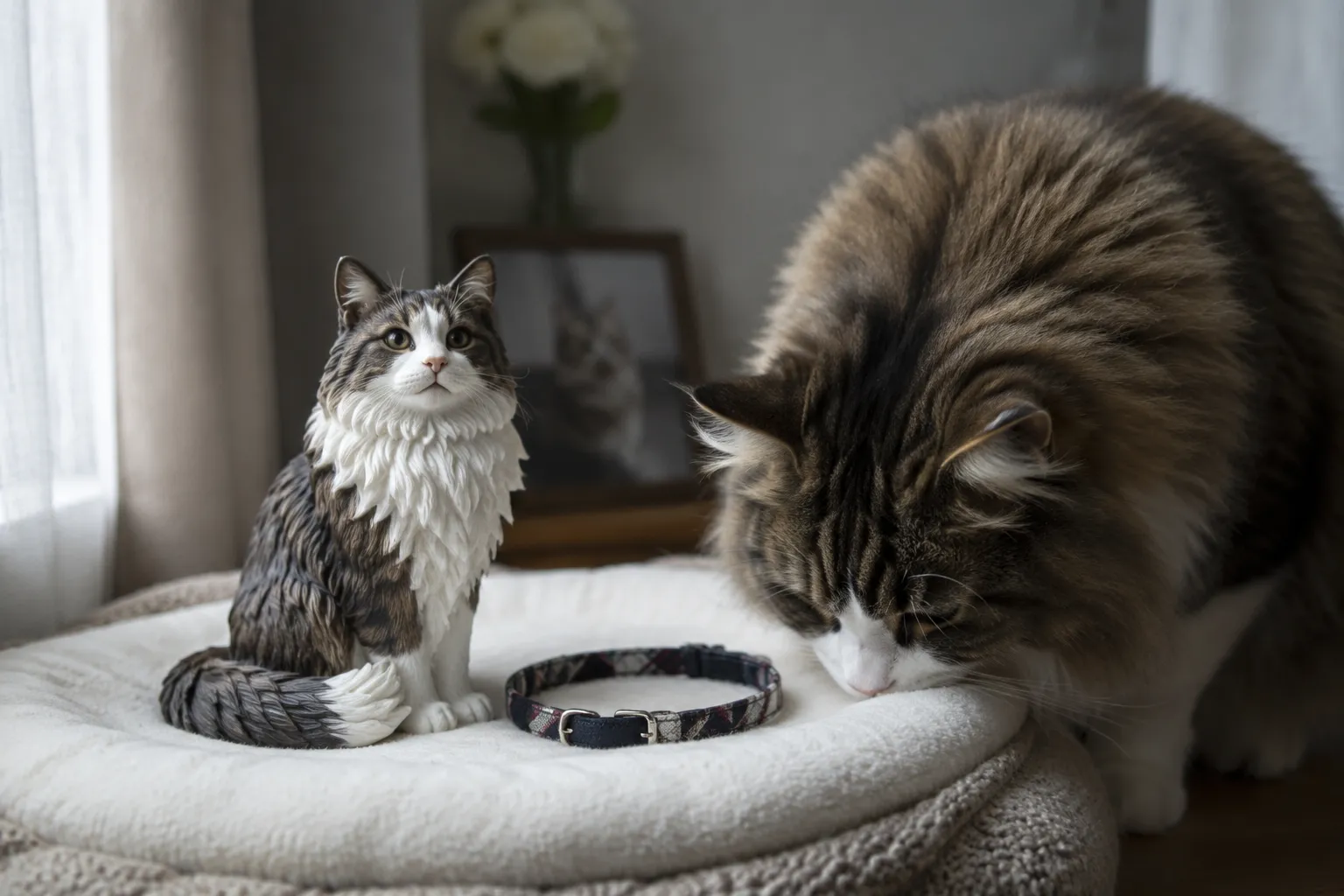
Your surviving dog plants himself at the kitchen door at 6 p.m., ears swiveled toward the hallway, waiting for the soft thud of heavy paws that won't come. And right then you understand that multi-pet household grief isn't a feeling you carry alone. The other animals are counting too.
Quick Takeaways
- Surviving pets grieve through behavior, not tears — watch for searching, vocalizing, and appetite shifts in the first weeks.
- Keep the daily soundscape intact — familiar routines and noises stabilize a confused animal faster than extra cuddles.
- Your guilt about timing is normal — second-guessing the final decision doesn't mean you got it wrong.
- Anchor the memory in something physical — a custom pet figurine gives both you and curious noses a tangible focal point.
- Norwegian Forest Cats leave loud silences — their chirps and heavy gait are often the first things a home misses.
The Search Behavior Nobody Warns You About
Here's something most grief articles skip entirely: when a cat dies in a multi-animal home, the loudest mourner is often the one who can't say a word.
We've processed a lot of memorial orders over the years, and a pattern shows up in the notes customers send us. Right alongside "she was my whole world," people write things like, "the other cat won't stop crying at night" or "our dog keeps checking her spot under the stairs." The surviving animals are running their own search algorithm, and it's heartbreaking to watch.
A Norwegian Forest Cat — a skogkatt, if you want the Old Norse — is a big presence. We're talking a long-bodied, double-coated animal that can hit sixteen pounds and announces itself with a distinctive gait. When that animal vanishes, the absence has a shape. The other pets notice the shape before you've even processed the loss yourself.
"Surviving pets don't understand death. They understand that someone who was always here is suddenly, inexplicably not."
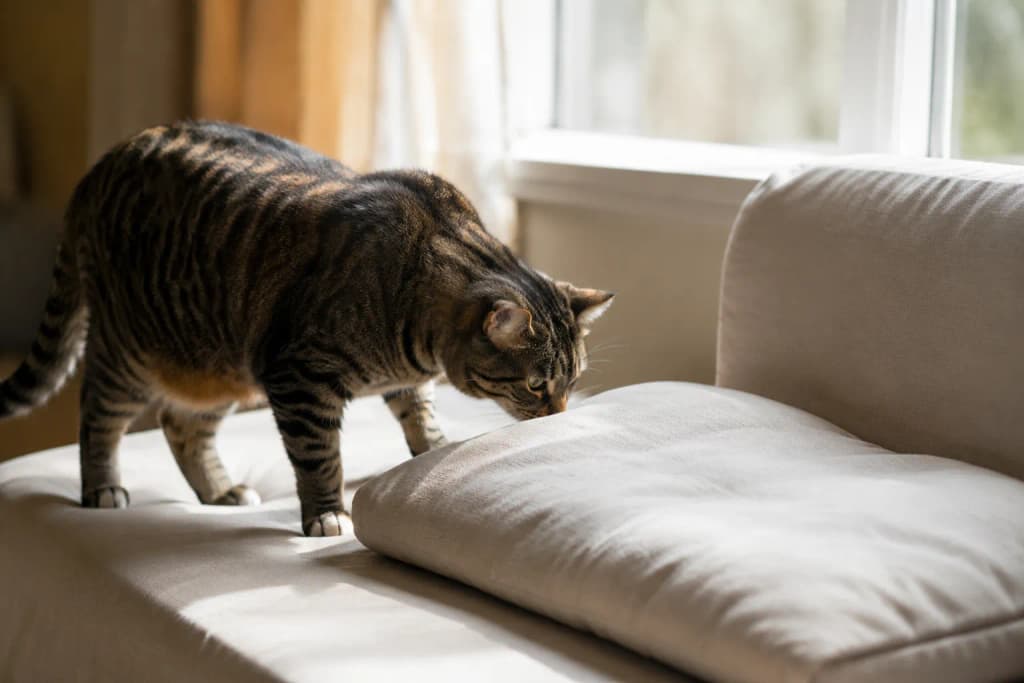
What you'll typically see in the first 24 to 72 hours is search behavior: the remaining animal patrolling, sniffing favored sleeping spots, sitting by doors, vocalizing at odd hours. This isn't your imagination projecting human grief onto a dog or cat. It's a measurable response to a broken attachment bond.
Why the Skogkatt Leaves Such a Specific Hole
Norwegian Forest Cats are not quiet roommates. They trill. They chirp. They have a way of half-meowing that owners come to read like a second language. Many of them also have a heavy, deliberate way of moving — those big snowshoe paws hitting the floor with an actual sound.
So when one dies, the house doesn't just lose a cat. It loses a specific frequency. The 5 a.m. chirp that meant "feed me." The thump off the windowsill. The other animals tuned their day to those signals, same as you did.
That's the part that catches people off guard. You brace yourself for missing the cuddles. You don't brace yourself for how loud the missing sound can be.
The Psychology of Attachment, Translated for Animals
Let's get into the actual science for a second, because understanding it changes how you respond.
The psychology of attachment — the framework most people associate with human babies and caregivers — applies to social animals more broadly than people assume. Companion animals in the same household form attachment bonds with each other, not just with you. They co-regulate. They sleep in piles, groom each other, and use one another as a secure base for exploring the world.
When one of those animals dies, the survivor experiences what researchers studying the human-animal bond would call attachment disruption. The secure base is gone. The nervous system that learned "things are safe when she's nearby" suddenly has no reference point.
This is why a surviving pet sometimes seems more distressed than you'd expect for two animals who, frankly, used to bicker over the food bowl. Attachment isn't the same as affection. You can be deeply bonded to a presence you also found annoying. (Most of us know a human like that, too.)
Reading the Signs Without Over-Reading Them
The tricky part is telling genuine grief behavior from coincidence or a medical issue. Here's a breakdown of what tends to show up, how long it usually lasts, and what actually helps.
| Behavior in Surviving Pet | Typical Duration | What Helps |
|---|---|---|
| Searching, patrolling old spots | 1–3 weeks | Keep routine identical; don't rearrange furniture |
| Increased vocalization (esp. at night) | 1–4 weeks | Respond calmly; avoid reinforcing with food |
| Reduced appetite | 2–10 days | Warm the food slightly; hand-feed if needed |
| Clinginess or shadowing you | Variable | Allow it, but maintain independent time too |
| Lethargy / more sleep | 1–3 weeks | Gentle invitations to play, no forcing |
One honest caveat: we're not veterinarians. If appetite loss runs past about 48 hours in a cat, or if any behavior change comes with vomiting, hiding, or litter box problems, that's a vet call, not a grief assumption. Cats in particular hide illness well, and "he's just sad" is a dangerous misread when something physical is happening. The ASPCA's guidance on pet loss is a solid starting point, but a physical exam rules out the scary stuff.
What Actually Helps the Surviving Animal (And What Backfires)
The instinct, when your remaining pet is clearly struggling, is to flood them with comfort. Extra treats. Constant holding. A new companion within the week to "fill the gap."
We'll be real: most of that backfires.
Keep the Soundtrack of the House Unchanged
Here's the counterintuitive part. The single most stabilizing thing you can do for a grieving animal isn't more affection — it's boring consistency. Same feeding times. Same walk route. Same TV-on-in-the-evening hum. Same order of operations when you come home.
Animals regulate through prediction. When one member of the household disappears, the predictability of everything else becomes the thing that says "you're still safe." Rearrange the furniture or change the schedule in the same week, and you've removed the second anchor right after the first one broke.
"Don't fill the silence with chaos. Fill it with rhythm."
One family we worked with told us their surviving Maine Coon settled noticeably once they simply kept playing the same morning radio station the two cats had always heard together. The sound was a thread back to normal. Small thing. Big effect.
Resist the Rebound Adoption
The mistake most people make is bringing home a new pet within days, thinking the survivor needs a friend. Sometimes they do — but rarely on your grief timeline.
A new animal introduced too early competes for resources and attention while the resident pet is already destabilized. You're asking a grieving animal to negotiate territory with a stranger. That's a lot. Most behaviorists suggest waiting until the surviving pet's baseline behavior returns — typically three to six weeks minimum — before even considering an introduction, and longer if the bond was intense.
The 15-Minute Floor Rule
Instead of all-day smothering, do this: 15 minutes of undivided, floor-level interaction, twice a day. Get down to their level. Play, brush, or just be present with no phone. Short, predictable, high-quality contact beats sporadic guilty over-attention. It gives the animal something to count on without teaching them that distress earns endless food.
The Feelings You're Not Supposed to Admit
Now let's talk about you, because the human in this equation is carrying something specific.
When you lose a Norwegian Forest Cat — or any animal you've shared years with — and especially when you made the final decision, there's a feeling that shows up that almost nobody says out loud: second-guessing the timing.
Did you wait too long? Did you not wait long enough? Was that last good day actually a sign you jumped early? You replay the vet's office, the sound of the clipper, the particular weight of the carrier on the drive home — empty on the way back.
Here's the truth from having walked alongside thousands of families through this: the second-guessing is not evidence that you got it wrong. It's evidence that you took the decision seriously. People who make careless choices don't lie awake auditing them. The replay loop is grief doing what grief does — searching for a version of the story where you had more control than you actually did.
"The fact that you're questioning the timing is proof you loved them enough to agonize over it."
That relief you might have felt when the suffering ended? When the labored breathing finally stopped, when you weren't watching them struggle anymore? That relief doesn't compete with your love. It comes from your love. You wanted their pain to end more than you wanted to keep them. Sit with that one. It's one of the few feelings in grief that actually tells you something good about yourself.
And if the relationship was complicated — if this was the cat who shredded your couch and bit you and stressed you out as often as charmed you — your grief is still valid, and so is the strange, guilty lightness you might feel. Complicated love is still love. It just grieves complicated.
A Note from Our Team
"We've learned that people don't order a figurine to remember the cat. They order it so the grief has somewhere to live besides their chest."
— The PawSculpt Team
Giving the Memory a Physical Anchor
Grief that has no object tends to float. It shows up at random — the cereal aisle, a stranger's social post, the sound of another cat chirping somewhere. One thing that consistently helps the people we work with is giving the love a physical anchor: something you can hold, place, see.
There are a lot of ways to do this, and not all of them cost money or involve us.
Memorial Options, Compared Honestly
| Memorial Option | Effort | Emotional Impact | Best For |
|---|---|---|---|
| Photo book | Low–Medium | Medium | People who process through images |
| Memorial garden / planting | Medium | High (seasonal) | Those with outdoor space, slow grievers |
| Paw print casting | Low | High (tactile) | Capturing physical detail quickly |
| Collar keepsake / shadow box | Low | Very High | Preserving the everyday object |
| Custom 3D figurine | Medium | Very High (lasting) | Capturing personality and form |
A couple of these deserve a closer look.
The Collar That Still Holds Their Sound
Don't underestimate the pet collar keepsake. A collar is the one object that carries sound — that specific jingle of the tag that announced your cat entering a room. For many people, the collar is the single hardest thing to put away and the most powerful thing to keep.
You can frame it in a shadow box, loop it around a candle holder, or keep it in a small dish by the door where it used to hang. The point isn't to build a shrine. It's to keep one honest, ordinary object that still feels like them. (And yes — surviving pets sometimes investigate the collar too. That's okay. Let them.)
When You Want the Whole Cat, Not Just a Trace
A photo flattens. A collar holds a fragment. Sometimes what you actually want is the form — the specific way your Norwegian Forest Cat sat with that lion's-mane ruff and tufted ears and improbably fluffy tail wrapped around the paws.
That's where a norwegian forest cat memorial figurine comes in. At PawSculpt, pieces are digitally sculpted by master 3D artists and then precision 3D printed in full color — the color is printed into the resin itself, voxel by voxel, not added on top. So the markings, the coat patterns, that distinctive double-coat texture get reproduced directly in the material, then sealed with a protective clear coat for sheen and durability.
What that means practically: you get a vibrant, true-to-life piece with an authentic fine print texture, not a glossy plastic toy and not something fragile that fades on a windowsill. For a breed as visually distinctive as the skogkatt — all that mane and fur and structure — capturing the actual form matters in a way a flat photo just can't manage. You can see how the process works over at pawsculpt.com.
We'll say this plainly, though: a figurine is one option among many. If a planted tree or a simple framed photo is what brings you peace, that's the right choice. The best memorial is the one you'll actually return to.
Counter-Point: When "Keeping Everything the Same" Is the Wrong Advice
We told you to keep routines identical and resist big changes. That's the right call for most homes. But intellectual honesty means admitting where it breaks down.
For some surviving pets, the old routine is the source of distress. If the daily walk always included both dogs, retracing that exact route can deepen the searching behavior rather than soothe it. If two cats always ate side by side, keeping both bowls out can keep a grieving cat fixated on the empty one.
In those cases, a deliberate gentle change — a new walk route, a single repositioned food station, a fresh sleeping setup — can actually help the animal move forward instead of looping. The skill is reading your specific pet: is the routine an anchor, or is it a reminder of what's missing?
There's no universal answer. Watch the animal. If consistency seems to calm them, hold the line. If a particular ritual seems to wind them up, adjust that one thing while keeping everything else stable. Grief care isn't a formula. It's attention.
"Routine heals confusion. But a routine built around two becomes a daily reminder of one."
The Fear That Quietly Drives a Lot of This
Underneath the searching pets, the timing guilt, and the scramble to memorialize, there's often one more feeling steering the ship: the fear of forgetting.
You're afraid the exact pitch of that chirp will fade. That you'll forget which side she slept on, or the specific weight of her settling against your legs at night, or the sound of those big paws crossing the kitchen tile. This fear is so common, and people rarely name it, because it feels like a betrayal to even worry about it.
It's not a betrayal. It's love trying to protect itself.
The honest reality is that some details do soften over time — that's how memory works, and it's not a moral failing. What you can do is make a few of them permanent on purpose. Record yourself describing her, today, while it's vivid: the sounds, the routines, the dumb specific things. Write down the chirp. Keep the collar. Capture the form. You're not building a museum. You're leaving yourself breadcrumbs back to a feeling you don't want to lose.
And the grief that comes with that fear? It doesn't shrink because you've memorialized well. It changes shape. It goes from a thing that ambushes you to a thing you can visit. That's not moving on. That's carrying them differently.
A Simple Plan for the First Month
If you want the no-nonsense version — the steps, in order — here it is.
- First 72 hours: Keep feeding times, walk times, and the evening routine exactly the same. Watch the surviving pet's appetite closely.
- Days 3–7: Allow searching behavior without correcting it. Respond to night vocalizing calmly, never with food. Book a vet check if appetite hasn't returned.
- Week 2: Introduce the 15-minute floor sessions, twice daily. Begin gentle play invitations. Resist any urge to adopt.
- Weeks 3–4: Assess baseline. Is the survivor eating, sleeping, and moving normally? If yes, you can start thinking about whether a new companion is right — for them, not for your guilt.
- Anytime: Build your memorial. The collar, the photos, the figurine, the planted thing. Do it when you're ready, not on anyone's timeline.
That's the spine of it. Everything else is reading your particular animal and trusting what you see.
A Quieter Kitchen
That dog at the kitchen door at 6 p.m., ears up, waiting for the thud of paws that won't come — he'll keep waiting for a little while. And then one evening, he won't. He'll lie down before the hour hits, because the searching has run its course and the new normal has quietly arrived.
You'll notice it before he does. You'll catch yourself listening for the chirp and realize you stopped flinching at its absence. That's not forgetting. That's the love settling into something you can carry without it knocking you over.
So here's your one actionable thing: pick a single object today — the collar, a photo, a figurine, anything — and give it a permanent place in the room where you miss her most. Make the missing visible. Animals grieve through their senses, and honestly, so do we. Multi-pet household grief ends not when the absence disappears, but when the presence finally has somewhere to live.
The kitchen will be quieter now. But quiet isn't empty. Quiet is just the room making space for what you choose to keep.
Frequently Asked Questions
Do other pets really grieve when one of them dies?
Yes, and the behavior is measurable, not imagined. Surviving animals form attachment bonds with each other, so when one dies the other often searches old spots, vocalizes more, eats less, and shadows you. These signs usually peak in the first few weeks and then ease as a new normal settles in.
How long will my surviving pet grieve?
For most pets, baseline behavior returns within three to six weeks, with searching and night-vocalizing fading earliest. There's no fixed clock, though — bonded pairs may take longer. One firm rule: if appetite loss runs past about 48 hours, or you see vomiting, hiding, or litter box issues, treat it as a vet visit, not just grief.
Should I bring home a new pet to help the one left behind?
Rarely on your timeline. A new animal introduced too early forces a grieving pet to negotiate territory with a stranger while already destabilized. Wait until your surviving pet's eating, sleeping, and movement return to normal — usually three to six weeks minimum — and make the decision for their readiness, not your guilt.
Is it normal to keep second-guessing the euthanasia decision?
Yes, and it doesn't mean you got it wrong. The replay loop is grief searching for a version where you had more control. Questioning the timing is proof you took it seriously. And if you felt relief when the suffering ended, that relief comes from love, not the absence of it.
What's the best way to memorialize a Norwegian Forest Cat?
It depends on what you're trying to hold onto. A collar keepsake preserves the familiar tag sound and is the easiest everyday object to keep. For capturing the breed's distinctive form — the mane, tufted ears, and that enormous tail — a full-color 3D printed figurine reproduces the markings and coat texture directly in resin.
How do I help two grieving pets if I lost one of three?
Apply the same principles at scale: keep routines stable, watch each survivor individually since they may grieve on different timelines, and give each one separate 15-minute floor sessions. Pets in larger groups sometimes recover faster because the social structure isn't reduced to a single lonely animal, but don't assume — read each one.
Ready to Celebrate Your Pet?
Every pet has a story worth preserving. Whether you're honoring a beloved companion who's crossed the rainbow bridge or navigating multi-pet household grief alongside the animals still searching for them, a custom PawSculpt figurine captures the details that made your Norwegian Forest Cat one-of-a-kind — the mane, the tufted ears, the form a photo can never quite hold.
Visit pawsculpt.com to learn more about our process, revisions, and quality guarantee.