
National Dog Day Photo Myths: Capturing Your Senior Rottweiler the Right Way
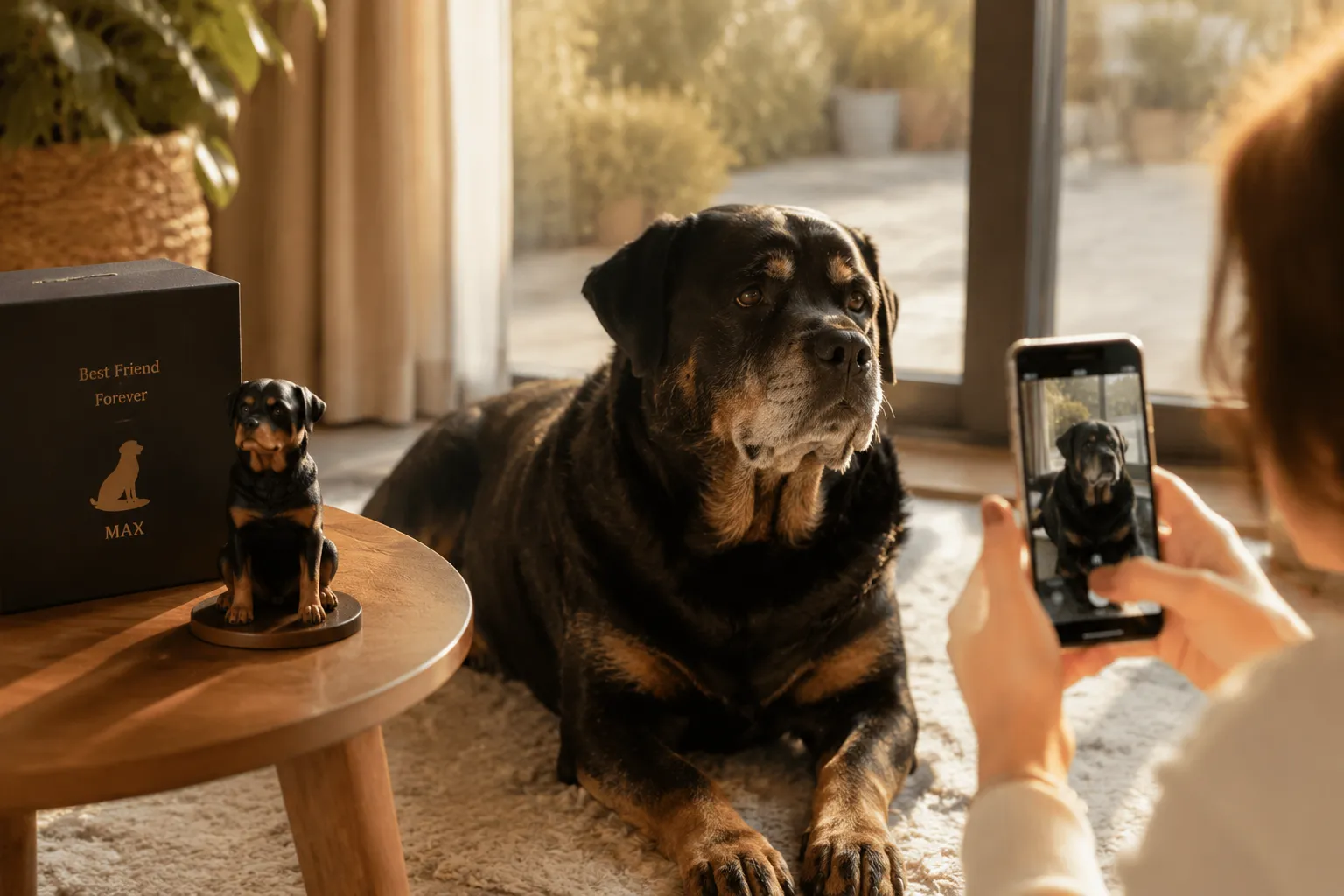
Most National Dog Day photography goes sideways in the first three seconds. The camera comes up, the gray-muzzled Rottweiler looks away, and that warm backyard scent of sun-baked fur and cut grass loses out to your frustration. The dog isn't being difficult. The advice you followed was.
Quick Takeaways
- Senior Rottweilers photograph best at their slowest — schedule shoots during their natural low-energy windows, not playtime.
- Scent calms faster than treats — a familiar blanket in frame relaxes an anxious senior dog in seconds.
- Gray muzzles need shade, not sun — flat overcast light flatters aging fur and cloudy eyes.
- Print what you capture this year — turning a great shot into a custom 3D-printed figurine preserves details photos eventually fade on.
The Real Reason Your Senior Rottweiler Won't Pose
Here's a number that reframes everything: large breeds like Rottweilers are considered seniors around age seven, and by then a dog's eyesight, hearing, and joint comfort have all shifted measurably. So when a guide tells you to "grab their attention with a squeaky toy and snap away," it's giving you advice built for a two-year-old dog.
We've worked with thousands of pet families, and the senior Rottweiler photo is one of the most common requests we see in late August. It's also one of the most commonly botched.
The mistake most people make is treating the photo session like an event. They clear the schedule, charge the phone, maybe buy a little bandana. Then they spend forty minutes saying "sit, stay, look here" while an eleven-year-old dog with stiff hips just wants to lie down in the cool dirt by the hydrangeas.
You're not failing. You're using a playbook written for puppies.
A senior Rottweiler operates on a different clock. Cause and effect: their energy peaks earlier in the day, their patience for repositioning runs shorter, and their tolerance for direct eye contact with a glowing rectangle drops as their vision softens. Work with that timeline instead of against it, and the whole thing changes.
"The best senior dog photos aren't captured. They're allowed to happen."
That's the shift. You're not directing a model. You're documenting a presence.
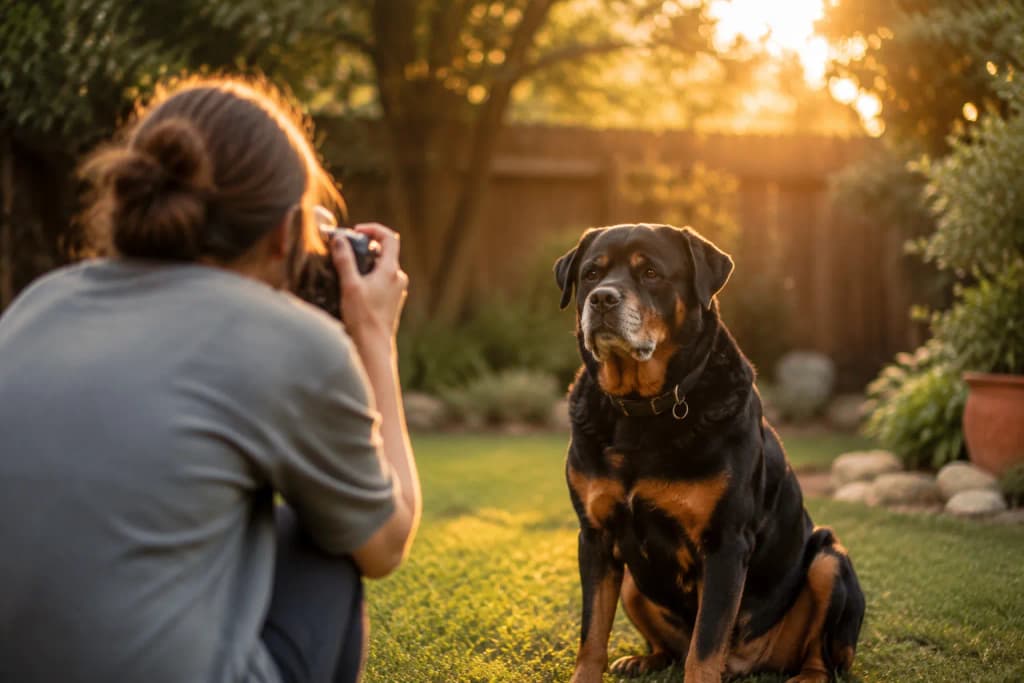
National Dog Day Photography Myths That Sabotage Senior Dogs
Let's bust the advice that keeps showing up in every listicle. Some of it is harmless for a young pup and quietly counterproductive for an old one.
Myth vs. Reality
Myth #1: "Bright, sunny days make the best photos."
Reality: Direct midday sun creates harsh shadows, makes black Rottweiler coats read as a featureless dark blob, and forces a squint. Overcast skies act like a giant softbox. Many of our favorite reference photos come from cloudy mornings, not golden hour.
Myth #2: "Get them excited so they look alert and happy."
Reality: Excitement in a senior dog often reads as panting, wide eyes, and a stress-tense face. A calm, settled Rottweiler with a soft mouth looks more dignified and more like them. Slow is the new alert.
Myth #3: "Always shoot from above so they fit in frame."
Reality: The downward "phone tourist" angle shrinks the dog and erases their depth. Get on the ground. Eye level with a senior Rottweiler's broad head turns a snapshot into a portrait.
Here's the thing about all three myths. They optimize for a dog who wants to perform. Senior dogs don't perform. They simply are, and the camera's job is to keep up.
"A black dog isn't hard to photograph. It's hard to photograph badly lit."
That single reframe fixes more senior Rottweiler photos than any gear upgrade.
Timing Beats Technique: When to Actually Shoot
If you take one practical thing from this article, make it this. The single highest-leverage decision in senior dog photography isn't your camera or your composition. It's the clock.
A Rottweiler's behavior follows a daily rhythm, and that rhythm gets more pronounced with age. Catching the right window means the difference between a relaxed subject and a tired, ear-pinned one.
We pulled together the general pattern we hear from the families we work with. Your dog's exact schedule will vary, but the shape usually holds.
| Time Window | Senior Rottweiler State | Photo Outcome |
|---|---|---|
| Early morning (after first potty + breakfast) | Calm, alert, comfortable | Best for clear-eyed portraits |
| Mid-morning | Active but settling | Good for gentle motion shots |
| Midday | Sleepy, seeking shade | Sweet sleeping/resting shots only |
| Late afternoon | Second wind, mild energy | Decent for outdoor garden shots |
| Evening | Tired, joint-stiff | Avoid for posed work |
Notice what this table is really saying. There is no universally "best" time. There's the best time for the photo you want. Want those soulful, looking-right-at-you portraits? Catch the early window when their eyes are bright and their body doesn't ache yet. Want a tender, curled-up-in-the-garden image? Midday shade is your friend.
One family we worked with had tried for weeks to get a "perfect" alert portrait of their thirteen-year-old Rottie. Every attempt happened after dinner, when the dog was already winding down. We suggested a Saturday-morning attempt instead. They got the shot in four minutes.
The "So what?" here is simple. You can have the nicest phone on the market and the steadiest hands, but if you shoot a senior dog at the wrong hour, you're photographing exhaustion. Shift the clock first.
The Sense Everyone Forgets: Smell
This one surprises people. We talk endlessly about light and angles, and we ignore the sense that actually governs how a dog feels in a moment.
A Rottweiler experiences the world nose-first. The reason your dog relaxes the instant a certain blanket appears isn't sentiment. It's chemistry. That blanket carries their scent, your scent, the layered smell of every nap they've taken on it. To a senior dog with fading vision, scent is the most trustworthy sense they've got left.
So use it.
Bring the old bed, the worn blanket, the toy that smells like a thousand backyard afternoons into the frame. Not as a prop. As an anchor. The dog settles because the world smells safe, and a settled dog photographs beautifully.
"To an aging dog, a familiar scent is more reassuring than any command you'll ever give."
There's a sensory truth here that hits hard for a lot of owners. The smell of your senior Rottweiler—that particular warm, slightly earthy, popcorn-paws scent—is something you stop noticing because it's always there. Until one day it isn't. Families tell us, again and again, that the smell is the thing they grieve most unexpectedly. The blanket in the closet that still holds it.
Photographing your dog on that blanket, in that scent-soaked spot by the garden door where you both used to sit when it rained, captures more than a face. It captures the place they felt most themselves.
You are not alone if that thought makes your chest tighten a little. It's one of the most common things we hear.
Light, Angle, and the Black-Coat Problem
Okay, technique matters too. It's just downstream of timing and comfort.
Black and mahogany Rottweiler coats are genuinely tricky to photograph, and most phone cameras handle them poorly by default. The camera sees a large dark mass and either crushes the detail into pure black or overexposes the background to compensate. Both ruin the shot.
According to the American Kennel Club's breed overview, the Rottweiler's distinct black-and-rust markings are a defining feature—and those tan points are exactly what bad lighting erases.
Here's the fix sequence:
- Find open shade. A porch, a tree canopy, the shaded side of the house. Even light, no harsh shadows.
- Put light behind you, not behind the dog. Backlighting a black dog turns them into a silhouette.
- Tap to expose on the dog's face, not the bright background. On a phone, tap the dog's muzzle on screen and slide exposure up slightly.
- Get low. Knees, elbows, belly if you have to. Eye level respects the dog.
- Fill the frame with the head and chest for portraits. Let those rust markings show.
The "So what?": those mahogany markings, the gray creeping across the muzzle, the slight cloudiness in aging eyes—these are the details that make your Rottweiler unmistakably yours. Lighting that flattens them into a black shape erases the very thing you're trying to keep.
We have a saying internally when families send us reference photos.
"Every gray hair on a senior dog's face is a chapter. Photograph the whole story, not just the cover."
— The PawSculpt Team
That mindset changes how you frame. You stop hiding the age and start honoring it.
What Photos Actually Capture a Senior Rottweiler's Character
A technically perfect photo of a dog doing nothing tells you nothing. The photos families treasure—and the ones that, frankly, make the best reference for any keepsake later—capture behavior, not just appearance.
Think about the small, specific things your dog does. The way one ear flops inside-out when they wake up. The particular slow tail-thump against the floor. The chin-on-paw pose. The grumbly sigh as they settle into the garden grass.
Here's a quick reference for the shots worth chasing on National Dog Day, ranked by how much character they preserve.
| Shot Type | What It Captures | Difficulty (Senior Dog) |
|---|---|---|
| Eye-level head portrait | Personality, gaze, gray muzzle | Easy if timed right |
| The "happy sigh" rest pose | True relaxed character | Easy |
| Action of a favorite slow habit | Identity, quirks | Medium |
| You + dog together | The bond itself | Medium |
| Full-body standing profile | Build, markings, posture | Harder on stiff days |
That last category—you and the dog together—gets skipped constantly. People hand the phone to no one and end up with hundreds of dog-only shots and zero of the actual relationship. Set the phone on a ledge, use the timer, and get in the frame. Sit on the ground next to them. That photo of your hand resting on a graying head will mean more in five years than any crisp solo portrait.
The "So what?": character-driven photos age better emotionally. A glamour shot fades into "a nice picture." A photo of your Rottweiler doing the thing only they did becomes a time machine.
Turning the Photo Into Something Permanent
Photos are wonderful. They're also fragile in a way we don't think about until it's too late. Phones get lost. Cloud accounts lapse. Files corrupt. And screens flatten a three-dimensional dog into pixels.
This is the part of the conversation where a lot of families pause. They've got the perfect National Dog Day shot. Now what? Some print a large canvas. Some build a photo book. Some plant a tree in the garden where the dog loved to dig.
And increasingly, pet parents are choosing a tangible, three-dimensional keepsake—something they can actually hold. That's the space we work in. At PawSculpt, we take your photos and our team digitally sculpts your dog, then we precision 3D print the result in full color. The color is part of the resin itself, not a coating, so those black-and-rust Rottweiler markings come through in dimensional detail.
The only manual step is a protective clear coat for sheen and durability. What you get is a vibrant, full-color figurine with an authentic natural texture—not a glossy, plastic-perfect toy, but something that looks like your dog actually stood there.
Why does this matter for a senior dog specifically? Because dimension preserves what photos lose. The broad slope of a Rottweiler's skull. The breadth of the chest. The set of the ears. A flat image can't hold those. A full-color 3D pet sculpture can.
We're not going to pretend it replaces the dog. Nothing does. But families tell us that having something physical to hold—something with weight and shape that sits on the shelf where the dog used to nap—gives their grief, or their celebration, an anchor.
If you're curious about the materials, the process, or how it actually works, the details live on the website. We'd rather you explore our custom pet figurines and see real examples than take our word for it here.
"A photograph shows you what your dog looked like. Holding something shows you they were here."
What Makes a Good Reference Photo (For Prints or Figurines)
Whether you're ordering a canvas, a figurine, or just want archival-quality memories, the same rules apply. Better input, better output. Here's what our 3D artists look for, and honestly, it doubles as a guide for great photos generally.
| Reference Element | What Works | What to Avoid |
|---|---|---|
| Lighting | Even, natural, shade | Harsh sun, heavy flash |
| Angle | Eye level, slight 3/4 turn | Top-down, extreme close-up |
| Focus | Sharp on face and markings | Blurry, motion-smeared |
| Coverage | Multiple angles of same dog | One single photo only |
| Background | Simple, uncluttered | Busy, distracting scenes |
The pro tip almost nobody mentions: take several angles of the same dog in the same session. A single front-on photo can't show a sculptor (or even your own memory) what the dog's profile or back looked like. Five photos from five angles on one calm morning is worth more than fifty random shots over a year.
Caring for Your Senior Rottweiler Around Photo Day
A quick but important note, because this whole effort starts with a comfortable dog. Senior Rottweilers have specific needs, and a photo session shouldn't override them.
Don't withhold a meal to "make them food-motivated" for treats. Don't keep them standing on hard surfaces if their hips are stiff. Don't extend the session because you "almost" got it. Ten focused minutes beats an hour of a worn-out dog.
Watch for stress signals: excessive panting in mild weather, lip-licking, yawning, turning the head away, a tucked tail. Those mean stop. The VCA Hospitals senior dog resources are a solid reference for understanding aging-related comfort and behavior, and we'd always point you to your own vet for anything medical—we make figurines, we're not veterinarians.
Here's the counterintuitive part. The dogs who photograph most beautifully are the ones who feel safest, not the ones who are most "trained" in the moment. Comfort is the technique. Everything else is secondary.
One small ritual we love: do the shoot in a spot the dog already associates with peace. The garden corner. The sunny kitchen floor. The porch step where they watch the rain. Familiar ground lowers the baseline anxiety, and it embeds a meaningful backdrop into the image for free.
The Emotional Math Most Owners Avoid
We'll be real for a second, because the practical tips are only half of why people read articles like this in late August.
If you're photographing a senior Rottweiler, some part of you is doing the math. You know the average Rottweiler lifespan. You know thirteen is a gift. And you're trying to capture something before you can't.
That awareness is heavy, and it's also exactly why these photos matter. Many owners report a complicated mix of feelings during these sessions—joy and a low hum of anticipatory grief, gratitude and a quiet ache. If that's you, you're in very good company. It's one of the most universal experiences we encounter.
Here's the gentle counterintuitive truth: the goal isn't a perfect photo. It's presence. The session itself—fifteen minutes on the floor with your dog, scratching the spot they love while the camera waits—is the gift. The image is just the receipt.
So lower the stakes. Get on the ground. Smell the warm fur and the garden air. Take the shot when it happens. And let the rest go.
Frequently Asked Questions
What is the best time of day for senior Rottweiler photos?
Early morning, right after their first potty break and breakfast, tends to be the sweet spot. Your dog is calm, their eyes are clear, and their joints haven't stiffened from a day of activity. Avoid evening sessions when most senior dogs are winding down and achy.
Why do my black Rottweiler's photos turn out as a dark blob?
Phone cameras see a large dark coat and either crush all the detail or blow out the background to compensate. Shoot in even, open shade rather than direct sun, position the light behind you, and tap your dog's face on the screen to set exposure there. That brings back the mahogany markings.
How can I get my anxious senior dog to settle for a photo?
Lean on scent rather than verbal commands. Place a familiar-smelling blanket or bed in the frame, choose a location your dog already loves, and keep the whole session short—ten focused minutes max. A dog that feels safe photographs far better than one being repositioned over and over.
What kind of photos do I need for a custom figurine?
Several clear photos from different angles of the same dog, in even natural light, with sharp focus on the face and markings. Eye-level shots with a slight three-quarter turn work especially well. One single front-on photo can't show a sculptor the full shape of your dog.
Is it normal to feel sad while taking these photos?
Absolutely, and you're not alone. Photographing an aging dog often brings up a tangled mix of joy and quiet grief at the same time. That feeling is one of the most common things pet owners describe, and it's a reflection of how deep the bond runs.
Ready to Celebrate Your Pet?
Every pet has a story worth preserving. Whether you're honoring a beloved companion who's crossed the rainbow bridge or celebrating your senior Rottweiler's gray-muzzled dignity this National Dog Day, a custom PawSculpt figurine captures the details that make your dog one-of-a-kind—from those rust markings to the broad set of their head. Great senior dog care and great senior rottweiler photos both come down to the same thing: paying attention to who they really are.
Visit pawsculpt.com to learn more about our process, revisions, and quality guarantee