
The First Hour After Goodbye: A Japanese Ritual for Your Akita's Empty Bed
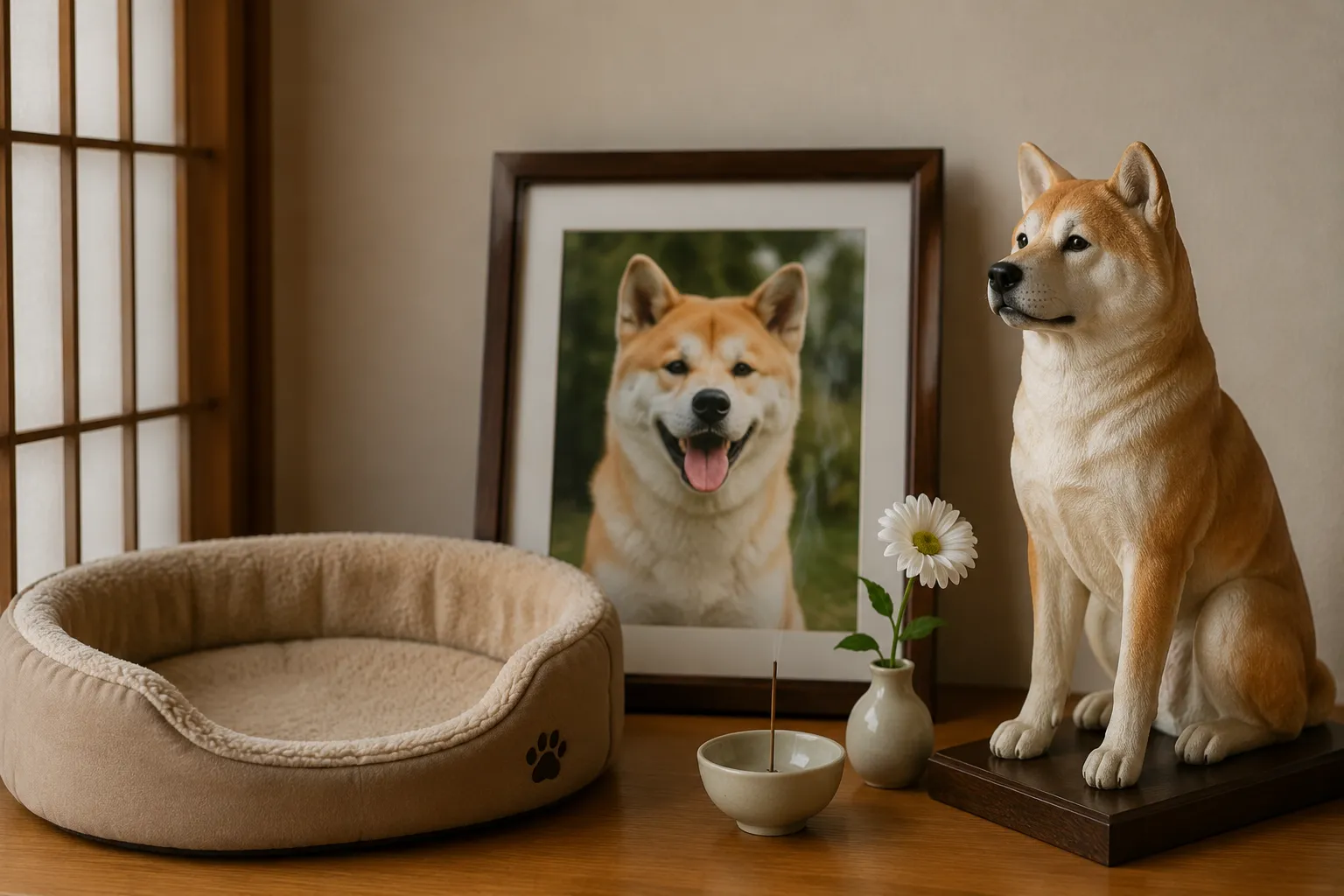
In Japan, a small Akita statue is given to new parents—a wish for health and a devotion meant to outlast one lifetime. You remember this in the attic, where the dog bed still holds the shape of a body, and the weight of euthanasia grief settles like dust in the slanted afternoon light.
Quick Takeaways
- Don't rush to clean the empty bed — the first hour deserves ritual, not erasure or tidying away.
- Name the guilt out loud — second-guessing euthanasia timing is grief's most common, least-spoken wound.
- Borrow from Japanese mourning — honoring empty space heals faster than frantically filling it.
- Preserve before memory fades — families find anchor in tangible keepsakes like custom pet figurines that hold a dog's exact markings.
- Growth and grief coexist — post-traumatic growth doesn't mean you loved them less.
Why the First Hour Matters More Than the First Year
Here's something most grief guides won't tell you. The hours immediately after you say goodbye are not the worst of it. They're the most important.
We've worked with thousands of pet families at PawSculpt, and a pattern surfaces again and again in the stories they share with us. The people who struggle longest aren't the ones who cried hardest in that first hour. They're the ones who didn't let themselves feel anything at all—who came home, stripped the bed, bagged the toys, and called it "being practical."
There's a Japanese phrase for the feeling that lives in that first hour: mono no aware (物の哀れ). It translates, roughly, to the gentle sorrow of things passing. Not despair. Not crisis. A quieter ache—the awareness that something beautiful has ended precisely because it was beautiful.
An Akita owner knows this feeling in their bones, even without the word for it. These are dogs bred in the snow country of Akita Prefecture, dogs whose loyalty became the stuff of national legend. You probably know the story of Hachikō, who waited at Shibuya Station for nearly ten years after his owner died. That kind of devotion doesn't evaporate when the heart stops beating. It lingers in the house. It pools in the empty bed.
"Grief is just love with nowhere left to go. The first hour is when it learns to find a new path."
So what do you do with that first hour? Most people's instinct is to make the pain stop—to fast-forward through it. But the ritual we're about to walk through asks the opposite of you. It asks you to slow down. To pay attention. To treat the empty space not as a wound to be bandaged, but as something almost sacred.
The Mistake of Erasing Too Soon
A family we worked with told us about the morning after their Akita, a fawn-and-white female, was put to sleep. The husband woke at 5 a.m.—their dog's old breakfast time—and his body moved on autopilot. He'd filled the food bowl before his brain caught up with his hands. He stood there in the dark kitchen holding kibble that would never be eaten.
That moment broke him open. And then it healed him a little. Because he didn't pretend it didn't happen. He set the bowl down, sat on the kitchen floor, and let himself fall apart for twenty minutes.
The instinct to immediately "deal with" a pet's belongings is a form of avoidance dressed up as strength. When you scrub away the scent, fold up the bed, and donate the food before noon, you're not coping. You're skipping a chapter your heart still needs to read.
This doesn't mean you keep a kennel set up for a year. It means the first hour isn't the time for logistics. It's the time for presence.
A Japanese Pet Ritual for the Empty Bed
The Japanese have a long, tender tradition of honoring the death of animals. At certain Buddhist temples, families hold a kuyō (供養)—a memorial service traditionally offered for departed beings, and in modern Japan, increasingly for beloved pets. The ceremony isn't about erasing loss. It's about giving the loss a shape, a place, a moment of formal attention.
You don't need a temple. You don't need to be Buddhist. What you need is the underlying wisdom: grief metabolizes better when it's given form.
Here's a ritual we've assembled, drawing from these traditions and from what we've watched genuinely help the families we serve. Think of it as a structure for that first hour—gentle scaffolding for a moment when your legs feel like they won't hold you.
Step One: Leave the Bed Untouched
Before you do anything else, don't do anything at all.
Sit beside the empty bed and look at it the way you'd look at a painting. Notice the indentation where your Akita's body pressed for years. Notice the fur woven into the fabric, catching the light—silver, cream, the deep red-brown of a good shiba-inu cousin. Notice the faint smell, which is the most primal trigger we have for memory.
This is your first act of preservation: witnessing. In the language of art, you're studying the composition before it changes forever. The Japanese concept of ma (間)—the meaningful pause, the charged empty space between things—teaches that absence itself carries weight. The empty bed isn't nothing. It's a presence shaped like absence.
"The empty bed isn't a void to fill. It's the negative space where a whole life was held."
Stay here for as long as you need. Five minutes. Twenty. There's no clock on this.
Step Two: Light a Single Flame
In Japanese memorial practice, light bridges the world of the living and the world of the departed. You don't need incense or a shrine. A single candle, set near the bed, does the work.
Light it and say their name out loud. Just the name. Then, if you want, one sentence—anything true. "You were the best part of my mornings." "I'm sorry the last week was so hard." "Thank you for waiting up for me every single night."
Saying it aloud matters more than you'd think. Grief that stays trapped behind the teeth tends to calcify. Spoken grief moves.
Step Three: Keep One Object, Release the Rest Later
Choose a single object to keep close—not the whole collection, just one. A collar. A favorite toy worn soft at the seams. The tag with their name etched into the metal.
This becomes what Japanese tradition might call a yorishiro (依代)—an object that holds a spirit, a vessel for memory. Everything else can wait days or weeks. But having one anchor in your hand right now gives the grief somewhere to land.
We've noticed the families who choose a collar often hold it during the hardest nights. The weight of it. The way it still smells faintly of the dog's neck. These sensory anchors aren't morbid. They're medicine.
Step Four: Photograph the Bed Before You Change Anything
This one surprises people, and it's the most practical step in the ritual.
Before you eventually wash that bed or pack it away, photograph it exactly as your Akita left it. The dent. The light. The scattered fur. Not for social media—for you. For the version of you, six months from now, who will desperately want to remember the precise shape of that ordinary, holy space.
Memory is not a photograph. Memory fades, edits itself, loses detail. The fear of forgetting is one of the most common anxieties bereaved pet owners carry, and it's entirely valid. You won't be able to recall the exact tilt of their ears or the specific pattern of their markings as clearly as you think. So capture it now, while the image is still sharp.
Here's a comparison of how these ritual steps map to what they actually do for your grief:
| Ritual Step | What You're Really Doing | Why It Helps |
|---|---|---|
| Leave the bed untouched | Witnessing before erasing | Prevents avoidance, honors the loss |
| Light a single flame | Marking the moment formally | Gives grief a beginning, not just an end |
| Keep one object | Creating a memory anchor | Sensory comfort during hard nights |
| Photograph the space | Preserving fading detail | Eases the fear of forgetting |
The Feelings Nobody Warns You About
Let's talk about the part of euthanasia grief that people rarely say out loud.
The Relief You're Ashamed Of
If your Akita's final months were hard—the slow decline, the medications, the 3 a.m. accidents, the watching for "the right time" that never feels right—then somewhere in that first hour, you might feel something that horrifies you.
Relief.
That breath you let out when the suffering ended? It doesn't make you cold. It doesn't mean you wanted them gone. It means you'd been carrying a weight so heavy you didn't realize how heavy until you set it down. The guilt that floods in right behind that relief is one of grief's cruelest tricks—it convinces you that feeling lighter is a betrayal.
It isn't. You can be devastated and relieved in the same breath. Both are true. Both are love.
The Question That Won't Let You Sleep: Did I Wait Too Long? Did I Rush?
Second-guessing the timing of euthanasia is, in our experience hearing from families, the single most haunting part of this kind of loss. You replay the decision endlessly. Was there one more good day you stole from them? Or did you let them suffer one day too many because you weren't ready?
Here's what we'll be real about: there is almost never a perfect moment, and the search for one is a trap. The veterinary community generally frames the goal not as choosing the perfect day, but as choosing a good day over a bad one—ending things before the suffering becomes the dominant fact of your pet's existence. The American Veterinary Medical Association offers thoughtful guidance on end-of-life care and euthanasia decisions that can help reframe this, though no resource can fully dissolve the ache.
If you're lying awake running the timeline, understand this: the fact that you agonized over it is proof you did it with love. People who don't care don't lose sleep.
"You didn't have a crystal ball. You had love and a hard choice. That has to be enough."
The Anger You Didn't Expect
Some people feel angry. At the vet. At themselves. At the unfairness of a dog's lifespan being a fraction of your own. At friends who say "it was just a dog" or, almost worse, "you can always get another one."
Anger is a legitimate stage of grief, not a malfunction. If you're furious that Akitas only live ten to fourteen years, according to the American Kennel Club's breed information, that fury is the math of love colliding with biology. Let it exist. It usually softens on its own.
Feeling Judged for Grieving "Too Much"
There's a particular loneliness in grieving a pet in a world that doesn't always grant pets the dignity of real mourning. No bereavement leave. No casserole brigade. Sometimes a coworker's raised eyebrow when you mention you cried.
The Association for Pet Loss and Bereavement exists precisely because this grief is real and often under-supported by the people around us. If you feel like you have to hide the size of your sorrow, know that the size of your sorrow simply matches the size of your love. There's nothing to apologize for.
Here's how some of these complicated emotions tend to move over time, based on what families describe to us:
| Emotion | When It Peaks | What Tends to Help |
|---|---|---|
| Relief mixed with guilt | First 48 hours | Naming both feelings as valid |
| Second-guessing the timing | First 2-3 weeks | Reframing "perfect day" vs "good day" |
| Anger | Weeks 1-4 | Letting it exist without judgment |
| Fear of forgetting | Months 2-6 | Tangible keepsakes, photos, journaling |
| Quiet acceptance | Varies widely | Time, ritual, and continued bonds |
A note of honesty: this table is a rough map, not a schedule. Some people loop back through anger months later. Some never feel relief at all. Grief is not a staircase you climb in order.
From Empty Space to Preserved Memory: The Craftsman's View
There's a reason so many cultures turn grief into objects. Headstones. Lockets with a curl of hair. Ash pressed into glass. The Egyptians, famously, buried their cats with such ceremony that we still unearth their gilded memorials thousands of years later. We like to think we've grown past that impulse. We haven't. We've just changed the materials.
The artistic instinct behind memorial-making is preservation—capturing the light before it fades. And an Akita is a remarkable subject for it. That dense double coat. The curled tail carried over the back like a question mark. The small, dark, triangular eyes set in a broad, almost bear-like face. The specific way the urajiro markings—the pale cream on the cheeks, chest, and underside—frame the deeper color above.
These details are exactly what memory loses first.
Why Tangible Keepsakes Anchor Grief
We mentioned earlier that grief metabolizes better when given form. This is the deepest reason families come to us. Not because they want a decoration. Because they want an anchor.
A photograph lives behind glass, flat and distant. But something you can hold—something with weight and dimension, something that sits at eye level on your desk where your hand can find it—engages a different, older part of the brain. The same part that wanted to keep the collar. The same part that filled the food bowl on autopilot.
Some families plant a tree. Some commission a portrait. Some keep paw prints in clay. And increasingly, pet parents choose 3D-printed memorial figurines that reproduce their dog's exact proportions, coat colors, and markings. At PawSculpt, our pieces are digitally sculpted by master 3D artists and then precision-printed in full-color resin—the color is printed directly into the material, voxel by voxel, so an Akita's layered cream-and-red coat reads as genuinely theirs, not a generic approximation. The only manual touch is a protective clear coat that gives the surface its gentle sheen. The result has an honest, tactile texture rather than a glossy plastic perfection—something that feels like memory, not a toy.
"We've learned that grief needs an anchor. Something with weight, something you can hold at 3 a.m. when the house is too quiet."
— The PawSculpt Team
What Photos Work Best for Capturing an Akita
If you're considering any kind of portrait or figurine—from us or anyone—the source photo matters enormously, and Akitas have a few specific quirks worth knowing.
- Shoot in soft, natural light. A double coat eats harsh flash; window light at the side reveals the layered texture and the urajiro markings.
- Capture the curled tail clearly. It's one of the breed's most defining features and easy to lose in a head-on shot.
- Get eye-level, not top-down. Photographing from your dog's height preserves the proper proportions of that broad head and deep chest.
- Include a shot that shows their personality. The slightly aloof "Akita stare," the play bow, the way they sat. Posture carries identity.
- More angles are better. A front, a side, and a three-quarter view give 3D artists what they need to build true dimension.
Here's a quick reference for what tends to produce the most faithful result:
| Photo Element | What Works | What to Avoid |
|---|---|---|
| Lighting | Soft, natural, side-lit | Direct flash, deep shadow |
| Angle | Eye-level, three-quarter | Top-down, extreme close-up |
| Coat detail | Visible markings, in focus | Motion blur, low resolution |
| Expression | Their characteristic look | A stiff, unnatural pose |
| Quantity | 3-5 varied angles | A single blurry photo |
If you only have one slightly imperfect photo of a pet who has already passed, don't despair—skilled 3D artists work with what's available all the time. But if your Akita is still with you, consider this a quiet nudge: take the photos now, while the light is still good.
For specifics on timelines, revisions, and the full creative process, it's best to look at the current details directly on pawsculpt.com, since those evolve over time.
What We Wish We Knew Sooner
A candid sidebar from our team—the retrospective insights we've gathered from years of standing close to other people's grief, and from our own.
We wish we'd known the bed scent fades. Within a few weeks, the smell that triggers the sharpest memories is mostly gone. Several families have told us they wish they'd sealed a small piece of unwashed fabric in a bag, just to have it. You can always throw it out later. You can't get it back.
We wish we'd known the "firsts" hurt more than the day itself. The first walk past the leash hook. The first grocery trip where you reach for the dog food aisle out of habit. The first thunderstorm with no one to comfort. The acute pain of these ambush moments often outlasts the initial shock.
We wish we'd known that growth isn't betrayal. More on this below—but the day you laugh again, the day you consider another dog, doesn't dishonor the one you lost. We watched too many people punish themselves for healing.
We wish we'd preserved the small, weird details. Not the posed holiday photos. The way they slept upside down. The specific snore. The crooked ear. These idiosyncrasies are the soul of a pet, and they're the first things to blur.
Post-Traumatic Growth: How Loss Reshapes You
There's a concept in psychology called post-traumatic growth—the idea that profound loss, while never "worth it," can fundamentally restructure a person in ways that aren't entirely negative. Researchers studying the human-animal bond have explored how pet loss, specifically, can catalyze this kind of growth.
It's a delicate thing to talk about, because it's easy to hear "growth" and recoil—as if we're suggesting your Akita's death was a gift. We're not. Let's be clear about that.
But here's the counterintuitive truth we've witnessed: the people who loved an animal deeply enough to be shattered by its loss often emerge with a heightened capacity for presence, gratitude, and connection. They love the next dog differently. They tolerate less nonsense in their lives. They learned, in the hardest way, exactly how short the good light lasts.
The Guilt About Moving Forward
Many people feel a sharp pang of guilt the first time they enjoy something after the loss. The first genuine laugh. The first morning they don't cry. The first time they think about a new puppy and feel something other than dread.
This guilt—the sense that healing is a kind of abandonment—is extraordinarily common and almost entirely misguided. Continuing to live fully is not forgetting. It's carrying them forward.
In Japanese thought, the dead aren't gone so much as transformed into something that watches over the living. Your Akita's loyalty doesn't end at death; in a sense, it becomes the very thing that gives you permission to keep going. They'd want you on the trail again. They'd want the food bowl filled—eventually—for someone new.
"Healing isn't leaving them behind. It's carrying their loyalty forward into the rest of your life."
Anxiety About Getting Another Pet
And when you do start to think about another dog—whether in three months or three years—a new anxiety often arrives. What if I can't love another one as much? What if getting a new dog means I'm replacing them? What if I'm not ready and I get it wrong?
There's no universal timeline here, and anyone who gives you a hard rule is guessing. Some people need a houseful of life again quickly. Others need the quiet first. Neither is wrong. A new Akita won't replace the one you lost any more than a second child replaces a first. Love isn't a fixed quantity that gets used up. It multiplies.
Returning to the Attic
Go back, for a moment, to where this started. The attic. The slanted light. The bed that still holds the shape of a body.
You don't have to fill that space today. You don't have to be strong, or practical, or "over it." The first hour after goodbye isn't a problem to solve—it's a threshold to cross slowly, with attention, with something like reverence. That's what the Japanese ritual offers: not a way around the grief, but a way through it that honors what you lost instead of rushing to erase it.
So light the candle. Say the name. Keep the collar. Photograph the light before it changes. And when you're ready—not today, not on anyone's schedule but your own—find a way to give that love a lasting form, whether it's a tree, a journal, a paw print in clay, or a figurine that holds their exact markings on your desk.
The empty bed will not stay empty forever. But the love that shaped it doesn't disappear when the fabric is finally washed. It just changes materials—the way it always has, the way the Egyptians knew, the way the people who carved those small Akita statues for newborns understood. Devotion outlasts a single lifetime.
Your Akita waited up for you every night. Now it's your turn to carry them home.
Frequently Asked Questions
Is it normal to feel relief after my pet's euthanasia?
Completely normal, and more common than people admit. After months of caregiving and watching a beloved Akita decline, relief is the sound of a heavy weight finally set down. It doesn't compete with your love—it confirms it. The guilt that follows is grief's reflex, not a verdict on your character.
How do I know if I waited too long to euthanize my dog?
You may never feel certain, and that uncertainty is part of the grief, not evidence of failure. Most veterinary guidance reframes the question: aim for a good day over a bad one, ending suffering before it becomes the center of your pet's life. If you lost sleep over the timing, you made the decision with love.
What is a Japanese ritual for honoring a pet's death?
Japanese culture has rich traditions for mourning animals, including kuyō memorial services and the concept of mono no aware, the gentle sorrow of impermanence. You can adapt a simple version at home: sit with the empty bed, light a single candle, say your pet's name aloud, and keep one meaningful object close as an anchor.
How long does grief from losing a pet actually last?
There's no universal timeline, and anyone who gives you a strict one is guessing. The sharpest pain often softens over weeks to a few months, but "firsts"—the first walk past the empty leash hook—can ambush you long after. Waves returning months later is normal, not a setback.
What photos work best for capturing an Akita in a figurine?
Soft, natural side-lighting reveals the layered double coat and the pale urajiro markings. Shoot at your dog's eye level rather than from above, make sure the curled tail is visible, and provide three to five varied angles. A photo that captures their characteristic expression matters as much as technical quality.
Will getting another dog mean I'm replacing the one I lost?
No. A new dog occupies its own place, the way a second child never replaces a first. Love isn't a finite resource that runs dry. When you're ready—on your timeline, not anyone else's—welcoming a new companion carries your old friend's loyalty forward rather than erasing it.
Ready to Honor Your Akita's Memory?
The empty bed eventually gets washed and put away, but the love that shaped it deserves a lasting form. Whether you're moving through fresh euthanasia grief or finally ready to preserve a companion who crossed the rainbow bridge years ago, a custom PawSculpt figurine captures the exact markings, proportions, and personality that made your Akita one-of-a-kind—digitally sculpted by master artists, then precision-printed in full-color resin.
Visit pawsculpt.com to explore our full-color 3D printing process, preview turnaround, flexible revisions, and quality guarantee.