
What Neuroscience Says About Holding Your Corgi's Favorite Toy This First Week
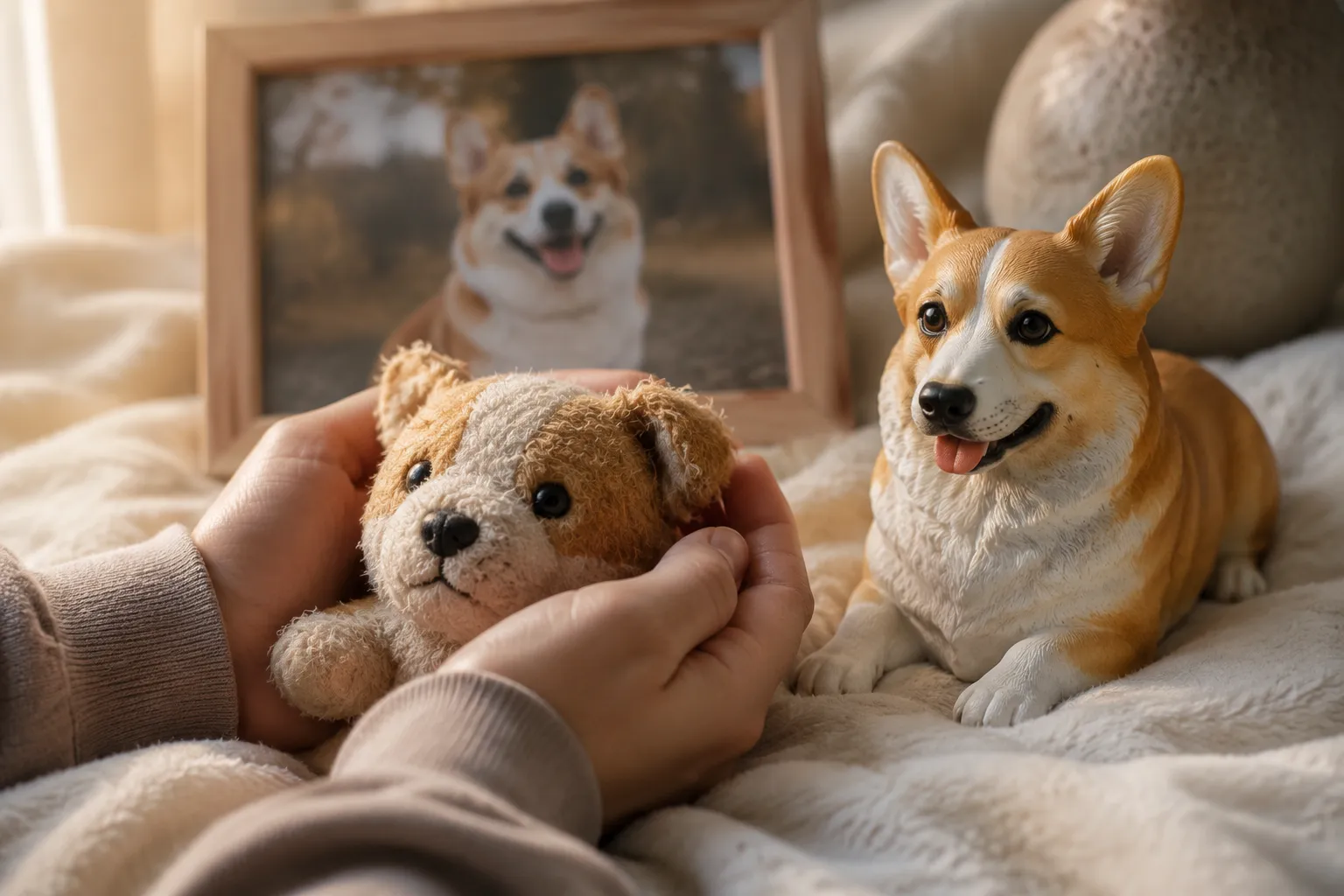
The corgi's collar still smells faintly of her when you pull it from your coat pocket in the vet's parking lot, and that small, warm coil of nylon is where the neuroscience of grief actually begins. Not in your chest. In a fold of brain older than speech.
Quick Takeaways
- Your brain literally hasn't updated its map yet — the disorientation of week one is neurological, not weakness.
- Touch processes loss faster than thought — holding a textured object engages grief-regulating brain regions directly.
- A "transitional object" ritual works better than avoidance — keep the toy out, don't pack it away.
- The relief you may feel is not betrayal — it's a sign you loved them enough to let go.
- When you're ready to give grief a permanent anchor, families often turn to custom pet figurines that hold a corgi's exact shape and markings.
The Brain Doesn't Know Your Corgi Is Gone Yet
Here's the part nobody explains in the days after.
You will walk into the kitchen and your body will brace for the click of stubby corgi nails on tile. You'll hear nothing. And for a half-second your nervous system will insist there's been a mistake.
That half-second is not denial in the psychological sense. It's a prediction error — a genuine, measurable mismatch between what your brain expected and what the world delivered. Your brain spent years building an internal model of a universe that contained your dog. That model does not delete itself overnight. It updates slowly, painfully, one disconfirmed expectation at a time.
Researchers who study the human-animal bond, including work cataloged by the National Institutes of Health, have found that the attachment systems we form with companion animals recruit the same neural machinery we use for human attachment. The same oxytocin loops. The same reward circuitry. Which means when a corgi dies, the brain doesn't file it under "pet." It files it under "loved one." The grief is not metaphorically like losing family. Biochemically, it is the loss of family.
"Grief is the brain insisting, again and again, on a door that no longer opens."
So when you feel like you're losing your mind in the first week — when you set out two food bowls, when you wake at 5:47 a.m. because that was walk time — understand what's happening. Your predictive brain is running on old code. The bug isn't you. The bug is love that outlasts its object.
We've worked with thousands of pet families at PawSculpt, and one corgi owner—we'll call her Dana, with a tri-color boy named Tuck—described week one with unusual precision. She said the worst moments weren't the crying. They were the automatic ones. Reaching for the leash. Buying the wrong dog food at the store because her hand knew the bag before her mind caught up. That's the predictive brain, misfiring with love.
Why This Matters Practically
If you understand that the disorientation is neurological, you stop fighting it.
You stop telling yourself you "should be coping better." There is no faster coping. The map redraws at the speed it redraws. What you can do is give your brain better raw material to update with — and that's where touch comes in.

Why Touch Reaches Grief Faster Than Thought
Most grief advice lives in the head. Journal your feelings. Reframe the loss. Talk it through.
All useful. All slow. And all of it routes through the prefrontal cortex (the brain's slow, verbal, reasoning region), which in acute grief is frankly underwater.
But there's a back door. The somatosensory system — your sense of touch, pressure, temperature, texture — connects to emotional-processing regions like the insula and the limbic system without waiting in line for conscious thought. This is why a hug regulates a sobbing person faster than any sentence. The body speaks a dialect the grieving brain still understands when words have stopped landing.
Which brings us to the toy.
When you pick up your corgi's favorite toy this first week — the rope frayed soft at both ends, the squeaker long dead, the plush matted into the exact topography of a thousand chews — you are not being morbid. You are handing your nervous system a piece of physical evidence it can process directly. The texture is data. The weight is data. The faint smell pressed into the fibers is the most powerful data of all, because the olfactory bulb wires almost directly into memory and emotion.
"Words tell the brain about the loss. Texture lets the brain feel it, and feeling is what finally updates the map."
The Counterintuitive Part
Here's what surprised even us. Most well-meaning friends will tell you to put the toys away. Box them up. Don't torture yourself.
For most people, that's exactly backward.
Avoidance keeps the prediction error alive. If you hide every trace, your brain never gets the repeated, gentle, embodied confirmation that the world has changed. You're left with the abstract knowledge that your dog died and none of the sensory processing that lets the knowledge sink into the body. Grief researchers call this avoidant coping, and while it brings short-term relief, it tends to prolong the rawest phase.
The opposite approach — deliberate, time-boxed contact with the physical object — is closer to what therapists mean by a transitional object (a tangible thing that holds emotional continuity during a period of change). You're not clinging. You're metabolizing.
Dana kept Tuck's rope toy on the kitchen counter for the entire first week. Every morning she'd hold it for a few minutes with her coffee. Rough fibers, the small weight of it, the give where his teeth had worked it soft. She told us those few minutes did more than the grief book she couldn't focus on.
A Physical Grief Ritual for Week One, Step by Step
Let's get concrete, because vague advice ("be gentle with yourself") helps no one at 3 a.m.
A physical grief ritual is a small, repeatable, deliberately structured contact with an object that holds your pet's presence. The structure is the point. Unbounded grief floods. Bounded grief processes.
Here's a practical seven-day framework. Adapt freely — anxious or already-overwhelmed people may want shorter sessions; that's fine.
- Choose one anchor object. Usually the favorite toy. It should be the thing your corgi's body interacted with most — the toy, the collar, the worn spot of a blanket. One object. Not a shrine of forty.
- Pick a fixed time. Morning coffee, or the old walk time. Tying the ritual to an existing daily cue gives your brain a predictable slot to do its work.
- Hold it for 5 to 10 minutes. Actually hold it. Notice the texture under your thumb. The temperature. The weight. Let yourself say their name out loud if it comes.
- Let whatever arrives, arrive. Tears, a laugh at a memory, nothing at all. No session is "done wrong."
- Set it back in its place — don't hide it. The object stays visible. The visibility is the slow, repeated confirmation your predictive brain needs.
- Add words after touch, not before. Once the body settles, then journal a sentence or two if you want. Touch first, language second. That order matters.
- At week's end, decide nothing permanent. Do not pack everything away on day seven because a calendar says so. Let the ritual taper naturally.
So What? Why a Ritual Beats "Just Grieving"
Because structure converts a flood into a current.
The grieving brain craves containment. A ritual with a beginning, a fixed duration, and an end tells your nervous system: this feeling has banks, it will not drown you, you can re-enter ordinary life when the ten minutes are up. That predictability is itself regulating.
This is the table we share with families asking what week one through month three actually tends to look like. It's not a rulebook — grief refuses rulebooks — but it orients people who feel lost in the dark.
| Phase | Typical Window | What's Happening Neurologically | What Actually Helps |
|---|---|---|---|
| Acute shock | Days 1–3 | Prediction errors fire constantly; stress hormones high | Short touch rituals; basic body care (water, sleep, food) |
| Raw processing | Week 1–2 | The "map" begins updating; waves intensify before easing | Daily anchor-object time; one trusted person to talk to |
| Searching | Weeks 2–6 | Brain still scans for the missing companion (you'll "see" them) | Permission to feel the pangs; gentle routine rebuilding |
| Reorganization | Weeks 6–12+ | New internal model forms; love stays, panic recedes | Considering a lasting memorial; honoring without avoiding |
Notice that searching phase. Catching a glimpse of corgi-colored fur in your peripheral vision and feeling your heart leap before it drops — that's not hallucination. That's an attachment system still scanning the environment for a face it's wired to find. Knowing it's coming makes it less frightening when it does.
The Feelings Nobody Warns You About
This is the section most articles skip, and it's the one that matters most.
Grief over a corgi — or any dog who's been woven into your daily routine — is rarely a clean, single emotion. It arrives tangled. And the tangle is where the shame lives.
The Relief You're Afraid to Admit
If your corgi was sick at the end — and many are, with the spinal and mobility issues the breed is prone to, as the American Kennel Club notes about the long-backed corgi build — there may have been a moment after they passed when, underneath the grief, you felt something loosen in your chest.
Relief.
And then, almost instantly, horror at yourself for feeling it.
Hear this clearly. That relief does not mean you wanted them gone. It means you'd been carrying the weight of their suffering, the 2 a.m. checks, the medication schedules, the dread of the decision — and that weight set down when theirs did. Relief is what love feels like when it finally stops bracing for the next bad day. The guilt that chases the relief is grief's cruelest sleight of hand, and nearly everyone who's nursed a sick pet feels it.
"The relief you felt wasn't betrayal. It was love, finally allowed to stop bracing."
Second-Guessing the Timing
Did we wait too long? Did we rush it? Should we have tried one more treatment?
If you made the euthanasia decision, you will probably replay it. You'll construct alternate timelines where you chose a different day. This second-guessing of timing is so common it's nearly universal, and it's worth naming why it happens: there is no objectively perfect moment, so the mind, hungry for a "right answer" that never existed, churns endlessly.
What helps is shifting the question. Not "did I time it perfectly?" but "did I make the most loving decision I could with what I knew then?" You did not have tomorrow's information yesterday. Nobody does. The decision was made in love and uncertainty, like every real decision.
The Guilt Over Ordinary Failures
The walk you cut short. The day you were too tired to play. The vet visit you put off a few weeks.
Grief audits the past with impossible standards. We've heard this from countless families — the conviction that they failed their dog in some small, unforgivable way. But a relationship is not its worst moments. Your corgi did not keep score. The dog who lit up every single time you walked through the door was not tallying your shortcomings. Only you are doing that, and only because you loved them.
"We've seen that grief needs something to hold. When the hands have something solid, the heart finds its footing."
— The PawSculpt Team
Feeling Judged, and Feeling Alone
There's a particular isolation in pet grief. The coworker who says "it was just a dog." The relative who wonders, aloud, why you took the day off. This sense of being judged for the depth of your grief can drive people to hide it, which deepens the loneliness.
So let us be plain: the intensity of your grief is proportional to the intensity of the bond, not to some social ranking of acceptable losses. Organizations like the Association for Pet Loss and Bereavement exist precisely because this grief is real, legitimate, and worthy of support. If the people around you can't hold it, find the people — or the helplines — who can.
From Favorite Toy to Lasting Form: Corgi Memorial Options
At some point, usually a few weeks in, a quiet question surfaces.
The toy won't last forever. The smell is already fading. How do I keep something of them that won't crumble?
This is a healthy question. It's the reorganization phase asking for a permanent anchor to replace the temporary one. A frayed rope toy is the right object for week one. It is not built to be the object for year ten.
Families resolve this in different ways, and there's no single correct answer. Here's an honest comparison of common paths, including their real tradeoffs.
| Memorial Option | Effort | What It Preserves | Best For |
|---|---|---|---|
| Memorial garden / planting | Moderate, seasonal | A living, growing tribute | People with outdoor space who find peace in tending |
| Photo book or framed prints | Low | Moments, expressions, the timeline of a life | Visual rememberers; easy to share with family |
| Paw print or clay impression | Low (if done early) | The literal physical trace of the body | Those who want tangible, one-of-a-kind contact |
| Custom 3D-printed figurine | Low for you (we do the work) | The full three-dimensional form, markings, posture | People who want to hold their pet's shape again |
| Jewelry with ashes/fur | Low | Closeness, portability | Those who want their pet physically near, daily |
The reason a corgi memorial figurine resonates for so many families ties directly back to the neuroscience we started with. The toy worked in week one because it gave touch something to do. A figurine works in the long run for the same reason — it returns a form to your hands. The specific silhouette of a corgi (the impossibly short legs, the upright ears, the foxy face, the loaf-shaped body) is unmistakable, and seeing and holding that exact shape again can be profoundly settling.
This is where our work at PawSculpt fits, and we'll be honest about what it is and isn't. Each piece is digitally sculpted by master 3D artists from your photos, then precision 3D printed in full color so your corgi's exact markings — the white blaze, the tan eyebrows, the sable saddle — are reproduced directly in the resin. The color is part of the material itself, not a coating that can chip. The only manual step is a protective clear coat for sheen and durability. The result has a genuine, tactile quality with a fine natural print texture rather than a glossy, factory-perfect plastic look. It's meant to be held, not just displayed.
What to Expect From the Process
People always ask how it works, so here's the general shape of it (for specifics on turnaround, revisions, and guarantees, it's best to check the current details at pawsculpt.com, since those evolve):
- Photos do the heavy lifting. The better your reference images, the more your corgi's personality comes through. More on photos below.
- A digital preview comes first. You see your pet's model before anything is printed, with room to refine details.
- The print captures dimension. Because it's full-color 3D printing, the figurine carries real depth and accurate proportions — the things flat photos flatten.
Dana commissioned a figurine of Tuck about six weeks after he passed, once the rope toy had done its early work. She told us the moment that undid her — in a good way — was holding it for the first time and feeling the familiar weight of him in her palm. Not the dog. But the shape her hands had memorized over nine years. Her brain, she said, finally had something solid to land on.
Choosing Your Reference Photos
If you go the figurine route — with us or anyone — the photos matter more than the company. A few practical notes from having processed a lot of them:
- Use natural light. A window beats a flash every time; flash flattens markings and washes out fur color.
- Get eye-level shots. Photos taken from human standing height distort a corgi's proportions badly. Crouch down.
- Capture multiple angles. Front, side, and a three-quarter view give 3D artists the information they need to build accurate dimension.
- Pick the expression that's them. The slightly open "corgi smile," the alert ears — choose the look your family would recognize across a crowded room.
- Don't worry about studio quality. A clear, well-lit phone photo of the real dog beats a blurry professional portrait.
The "aha" most families miss: you're not selecting the prettiest photo. You're selecting the most recognizable one. The expression that makes everyone in the house say "that's exactly him." That's the one worth building from.
When You're Ready — and the Honest Caveats
A few things we'd be doing you a disservice not to say.
First, don't rush a permanent memorial in the acute phase. In the first days, the toy is enough. Big decisions made in raw shock are often ones people wish they'd waited on. There's no deadline. Your corgi isn't going anywhere in your heart.
Second, we're not therapists or veterinarians. If your grief tips into something that frightens you — if you can't eat, can't function, or feel you can't go on — please reach out to a grief professional or a pet-loss support line. Some grief needs more than a ritual and a keepsake, and there's no shame in that. If you're having thoughts of harming yourself, contact emergency services or call or text 988 (the Suicide and Crisis Lifeline) right away.
Third, a figurine isn't for everyone, and that's fine. Some people find more peace in a tree they planted or a tattoo or simply the worn rope toy in a drawer they open sometimes. The best memorial is the one that fits how you remember. We'd rather you find that than feel pushed toward ours.
What we will say with confidence, after years of this work: people who give their grief a physical anchor — any anchor — tend to move through the rawest weeks with a little more steadiness than people who try to think their way through alone. The body wants something to hold. Let it hold something.
Circling Back to the Parking Lot
Go back to that collar in your coat pocket. The warm coil of nylon, the faint smell, the small weight of it.
In the vet's parking lot, that object was a wound. Every fiber of it said gone.
But here's what the neuroscience of grief ultimately promises, and it's the thing worth holding onto this first week: the same object that breaks you open is the one that slowly puts you back together. Touch doesn't just hurt. Touch heals, because it gives your brain the embodied, repeated, gentle evidence it needs to redraw its map — not to erase the dog, but to relocate them. From the doorway you keep watching, to a place inside you that no longer needs the door to open.
So this week, pick up the toy. Feel the frayed rope, the matted plush, the give where their teeth once worked it soft. Set a timer if you need to. Say their name. Then set it back where they'd expect to find it.
You're not torturing yourself. You're doing the oldest, wisest work there is — letting love change its shape without losing its weight.
Frequently Asked Questions
Is it normal to feel relief after my pet died?
Completely normal, especially after a long illness. Relief means you'd been carrying the weight of their suffering and that weight finally set down — it is not evidence that you wanted them gone. The guilt that often chases relief is one of grief's cruelest tricks, and nearly everyone who's cared for a sick pet feels it.
How long does the worst of pet grief last?
The most acute, disorienting phase usually peaks in the first one to two weeks, when your brain is still firing prediction errors and "searching" for your pet. Waves continue for several weeks after that. Many people feel reorganization begin somewhere around six to twelve weeks, but grief follows your bond, not a calendar.
Should I put my pet's toys away right after they pass?
For most people, keeping one favorite object visible actually helps. Avoidance can prolong the rawest phase because your brain never gets the repeated sensory confirmation that the world has changed. A short daily ritual of holding the toy, then setting it back in its place, tends to help more than hiding everything.
Why does holding my corgi's favorite toy help so much?
Because touch reaches grief faster than thought. Texture, weight, and especially scent connect almost directly to the brain's emotional and memory centers, while verbal reasoning lags behind in acute grief. The toy gives your nervous system physical evidence it can actually process.
When is the right time to order a memorial figurine?
There's no deadline, and we'd gently steer you away from big decisions in the first raw days. Many families wait until the acute shock settles — often a few weeks in — when a permanent keepsake starts to feel like the right next step rather than a rushed reaction.
What photos work best for a custom corgi figurine?
Eye-level, natural-light photos from multiple angles (front, side, three-quarter) give 3D artists the most to work with. Choose the most recognizable expression rather than the prettiest one — the look your whole family would know instantly. A clear phone photo of the real dog beats a blurry studio portrait.
Ready to Celebrate Your Pet?
Every pet has a story worth preserving. Whether you're honoring a beloved corgi who's crossed the rainbow bridge or celebrating your furry friend's unique personality, a custom PawSculpt figurine captures the markings, posture, and spirit that make your pet one-of-a-kind — giving your hands something solid to hold as you move through that first week of pet loss and beyond.
Visit pawsculpt.com to learn more about our full-color 3D printing process, preview turnaround, and quality guarantee.