
The Journal and the Fur Clipping: A Secular Ritual for Your Aging Chinchilla
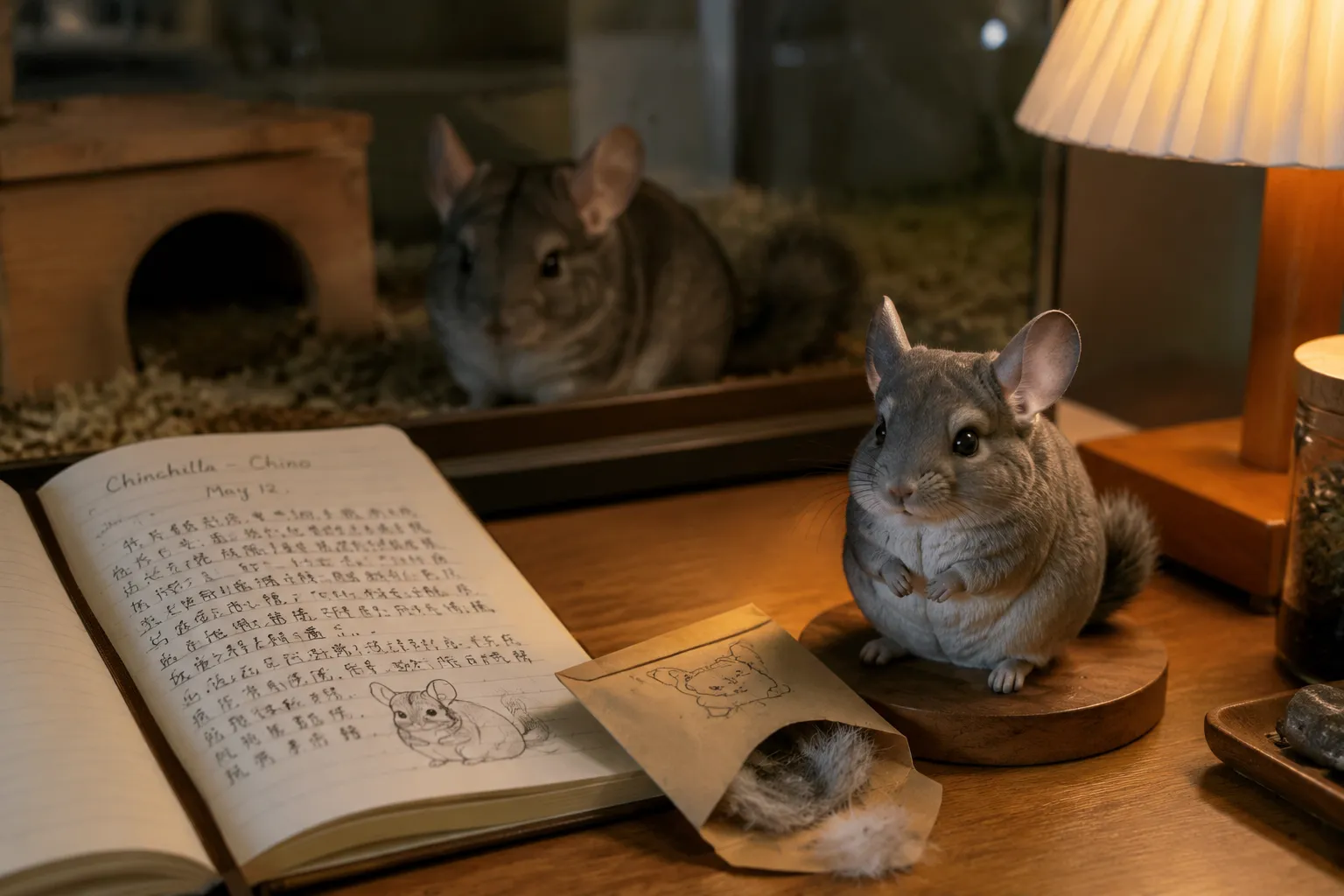
A chinchilla's dust bath sounds like rain hitting a tin roof — that frantic, joyful scrabble at 6 a.m. When that sound starts to slow, anticipatory grief for a small pet arrives quietly, weeks or months before the actual goodbye. You feel it. You just don't have a name for it yet.
Quick Takeaways
- Anticipatory grief is real grief — the mourning often starts while your chinchilla is still alive and breathing.
- Build the ritual now, not later — a journal and a fur clipping are easier to gather while your pet is here.
- Secular rituals work — you don't need religion to create meaning; you need structure and intention.
- Document the sounds, not just the photos — record the squeaks, the wheel, the dust bath while you still can.
- Tangible keepsakes anchor memory — many families pair their journal with custom pet figurines that capture their pet's exact markings and posture.
The Grief That Shows Up Early (And Nobody Warns You About)
Here's something most pet loss guides skip entirely.
You can grieve a pet who is still curled up in your lap.
That's anticipatory grief — the deep, disorienting sadness that arrives when you realize your chinchilla is aging, slowing, or sick, but hasn't died yet. It's the grief of the future arriving early. And for small pet owners, it carries a strange extra weight nobody talks about.
Because when you tell a coworker your dog is dying, they get it. When you say your eight-year-old chinchilla is starting to lose weight and sleeps more than she used to, you might get a polite nod. Maybe a "Aw, isn't that just a hamster?" (It is not. Chinchillas can live 15 to 20 years. Many owners bond with them longer than they keep some friendships.)
That gap — between what you feel and what others recognize — has a name. Researchers call it disenfranchised grief: mourning that society doesn't fully validate. And small pet owners live in that gap constantly.
"The size of the animal has nothing to do with the size of the hole they leave behind."
So let's be clear about the counterintuitive truth here: starting to grieve while your chinchilla is alive doesn't mean you're giving up on her. It means you're paying attention. The slowing dust baths, the longer naps, the way she takes the raisin from your fingers a little more gently now — your body is reading the data your heart doesn't want to process.
The mistake most people make is trying to suppress that early grief because "she's still here, I should just enjoy the time." But suppressed anticipatory grief doesn't disappear. It just waits, and then hits twice as hard later.
What actually helps more than pretending you're fine is building a secular grief ritual — a repeatable, meaningful practice you do now, with your hands, while your chinchilla is still scrabbling in her dust.
That's where the journal and the fur clipping come in.
Why "Secular" Matters Here
A lot of grief guidance assumes you believe in something — a heaven, a rainbow bridge, a soul that goes somewhere.
And if you do, beautiful. Hold onto it.
But plenty of pet owners don't, and they're left feeling like all the comfort rituals out there require a belief system they can't access. So they end up with nothing. No structure. No container for the feeling.
A secular grief ritual solves this. It doesn't require faith in an afterlife. It only requires that you believe this: this small life mattered, and the act of marking it changes how I carry the loss.
That's it. That's the whole theology. Meaning is something you make, not something you have to receive.

The Journal: Writing as a Container for the Unbearable
Let's get practical, because this is where the real work happens.
Pet grief journaling isn't keeping a diary. It's not "Dear Diary, today was sad." It's a specific, structured practice that gives your anticipatory grief somewhere to live so it doesn't live in your chest 24/7.
Here's the system we've seen work best, built around three types of entries.
1. The Sensory Log (Do This First, Do This Now)
This is the most time-sensitive part, and almost nobody does it until it's too late.
Write down the sounds.
Not the photos — you probably have a hundred photos. The sounds. The things you will forget within months of her being gone, and grieve forgetting.
- The specific pitch of her contentment squeak when you scratch behind her ear
- The 2 a.m. thunder of the exercise wheel
- The chittering "kacker" warning when you moved her food dish
- The soft tooth-grinding when she was relaxed and half-asleep
- The skitter of her feet on the cage shelf when she heard the fridge open
Write these in concrete, almost embarrassing detail. "The wheel squeaked on the third rotation, always the third." That specificity is the gift you're giving your future self.
So what? Because the cruelest part of grief, months down the line, is the fear of forgetting. You'll lie awake terrified that you can't quite remember the sound of her anymore. A sensory log is insurance against that fear. You're not being morbid. You're being kind to the version of you who comes later.
If you can, record actual audio on your phone, too. Thirty seconds of her dust bath. The wheel at night. You don't have to listen to it now. You're just banking it.
"Photos capture what your pet looked like. Sound recordings capture what your home felt like."
2. The Unspoken Things Log
This is where the hard emotions go. And we mean the ones you'd be embarrassed to say out loud.
Anticipatory grief breeds guilt like nothing else. You start doing math you hate yourself for. Wondering how much longer. Wondering what the vet bills will be. Feeling a flicker of something that looks suspiciously like relief when you imagine your life being a little simpler.
That relief mixed with sadness? It doesn't make you a monster. It makes you a human being whose nervous system has been on quiet alert for months, bracing. Write it down. Naming it on paper drains about half its power. The guilt you feel about feeling relief is one of grief's nastiest tricks — it convinces you that love and exhaustion can't coexist. They absolutely can.
Other things that belong in this log:
- The decisions you're second-guessing (the diet change, the vet you didn't switch from sooner)
- The anger — at the short lifespans of small animals, at yourself, at the unfairness of loving something that was always going to leave first
- The resentment of having to keep functioning at work while this is happening privately
- The fear that you didn't do enough
You don't show this log to anyone. That's the point. It's the one place you don't have to perform being okay.
3. The Gratitude Inventory (The Counterweight)
If the journal were only the hard stuff, it would become a place you dread. So you balance it.
Once a week, write three specific things your chinchilla did that delighted you. Not "she's cute." Specific. "She stole the corner of my book and ran." "She popcorned sideways off the shelf when I came home."
These entries do double duty. Right now, they remind you to be present with the time you have left. Later, they become the warmest pages in the whole journal — the ones you'll actually want to reread.
Here's a simple weekly structure to keep the practice sustainable:
| Journal Entry Type | How Often | Time Needed | What It Protects Against |
|---|---|---|---|
| Sensory Log | 2-3x per week | 5 minutes | Fear of forgetting details |
| Unspoken Things | As needed | 10 minutes | Bottled guilt, anger, isolation |
| Gratitude Inventory | Weekly | 5 minutes | Missing the present moment |
| Audio Recording | Monthly | 2 minutes | Losing the sound of home |
The whole thing takes maybe 20 minutes a week. That's the trade-off: a small, consistent practice in exchange for a record that becomes priceless the moment it can't be added to anymore.
The Fur Clipping: A Tangible Anchor for an Intangible Loss
Now the part people find unexpectedly powerful.
A small, saved clip of your chinchilla's fur.
This sounds simple, almost too simple, until the day comes when you're holding it and realize it's one of the only physical things left that was actually part of her. Not a representation. Her.
There's a reason cultures across human history have kept locks of hair from the people they loved — the Victorians turned it into elaborate mourning jewelry, and the practice goes back much further than that. We're wired to find comfort in something we can physically hold. Grief is abstract; a soft tuft of fur is not.
How to Do It (The Practical Steps)
Chinchilla fur is extraordinary — the densest of any land mammal, with 50 to 80 hairs growing from a single follicle. That density is exactly why a clipping feels so substantial in your hand.
A few real-world tips:
- Use small, sharp scissors and take fur from an area she won't notice — the back, near the base of the tail. Never near the face or feet.
- Take it during a calm moment, ideally right after a dust bath when she's relaxed and the fur is at its cleanest and fullest.
- Don't pull or grip her — chinchillas can "fur slip," releasing a patch of fur when stressed or grabbed. Work gently and stop if she's agitated.
- Store it in a small glass vial or a sealed locket, not a plastic bag (static and moisture are the enemies of keeping fur soft over years).
- Label it with the date. Future-you will want to know.
A word of honesty: some people find this practice deeply comforting, and some find it makes them too sad to continue. Both reactions are completely valid. If clipping fur while she's alive feels wrong to you, you can wait, or skip it entirely. There's no failing this. The ritual serves you — you don't serve the ritual.
"Grief needs something to hold. A vial of fur turns an ache into an object you can keep."
Why a Clipping and a Journal, Together
Here's the insight that ties it all together, and it's the thing we'd most want you to take away.
The journal holds the story. The fur clipping holds the substance. One is meaning, one is matter. Grief needs both.
A journal alone can start to feel like it's all in your head — words about words. A fur clipping alone is just a tuft without context. But put them in the same small box, and you've built something complete: a self-contained memorial you made with your own hands, for a being most of the world never even noticed you loved.
That's the secular ritual. No church required. Just attention, scissors, and a pen.
Myth vs. Reality: What People Get Wrong About Small Pet Grief
We hear the same misconceptions over and over. Let's bust the big three.
Myth #1: "It's just a small animal, the grief should be smaller too."
Reality: Grief intensity tracks with bond strength, not body weight. Small pets like chinchillas are often more dependent on you, kept indoors and interacted with daily for over a decade. The bond is frequently stronger, not weaker. Your grief is correctly sized.
Myth #2: "You should wait until after they pass to start memorializing them."
Reality: This is backward. The most meaningful records — sounds, fur, present-moment observations — can only be gathered while your pet is alive. Anticipatory ritual isn't pessimistic. It's the only window that exists for certain keepsakes.
Myth #3: "Feeling relief when a sick pet passes means you didn't love them enough."
Reality: Relief after prolonged caregiving and worry is one of the most documented, most normal grief responses there is. It coexists with profound love. The relief is about the suffering ending, not the pet leaving.
That second-guessing about whether you'd love them "correctly" — most pet owners carry some version of it. It rarely reflects reality.
When the Hardest Decision Comes
We're not veterinarians, so anything medical goes straight to your exotic vet — and finding one who actually specializes in small mammals matters enormously, because not every clinic does. For general support around pet loss, the Association for Pet Loss and Bereavement offers resources specifically built for this.
But we can speak to the emotional terrain, because we've walked alongside thousands of pet families through it.
If euthanasia becomes part of your chinchilla's story, you may find yourself trapped in a particular kind of torment: second-guessing the timing. Too soon? Too late? Did I let her suffer? Did I give up early?
Here's what we've learned from families who've been through it: there is almost never a clean, obvious "right day." You're making a loving decision with incomplete information, under emotional duress, trying to weigh a quality of life you can't fully measure. The fact that you're agonizing over the timing is itself proof of how carefully you loved.
"We've watched families heal by holding something real. Anticipatory grief is heavy, and it needs an anchor you can keep."
— The PawSculpt Team
The journal helps here, too. When the doubt comes at 3 a.m. — and it will — your gratitude entries and your sensory log become evidence. Evidence that you were present. That you noticed. That the life was full. Doubt is loud; documentation is louder.
The Soundtrack That Goes Quiet
Let's talk about the specific thing nobody prepares you for.
The silence afterward isn't really silence. It's the absence of specific sounds.
The wheel that doesn't turn at 2 a.m. The dust bath that doesn't happen at dawn. You'll catch yourself listening for the skitter of feet when you open the fridge, and the not-hearing of it will stop you cold in your kitchen.
This is why the audio recordings matter so much. Not so you'll listen to them constantly — most people don't, at least not for a while. But knowing they exist changes things. The sound of your home with her in it isn't gone forever. It's saved. You decide when, or whether, to press play.
Turning the Ritual Into Something Lasting
So you've got a journal filling with entries. A vial of fur on the shelf. Audio clips banked on your phone.
What happens when the time actually comes?
The ritual doesn't end at death. It transforms. Here's how families typically extend it.
Create a Memorial Container
Take a small wooden or glass box. Inside: the fur vial, a printed photo or two, maybe the last raisin bag, her favorite chew. The journal lives next to it. This becomes a physical "place" for your grief — somewhere you can go, instead of grief being everywhere and nowhere.
So what? Disenfranchised grief is especially prone to isolation — feeling like you have to hide it because others won't understand mourning a chinchilla. A memorial container gives your grief legitimacy in your own home. It says: this was real, this mattered, and I refuse to pretend otherwise.
Commission a Figurine That Captures Her Exactly
Photos fade and flatten. A two-dimensional image can't quite hold the specific tilt of how she sat, the exact pattern of gray-and-white along her back, the particular roundness of a well-loved chinchilla.
This is where a growing number of pet families turn to 3D memorial keepsakes. PawSculpt creates museum-quality figurines that are digitally sculpted by master 3D artists and then precision 3D printed in full color — meaning your chinchilla's exact markings and posture are reproduced directly in the resin, not added as a surface layer. The color is part of the material itself, finished with a protective clear coat for sheen and durability.
For a chinchilla specifically, that full-color 3D printing matters more than you'd think. Their fur has subtle gradients — the slate gray fading to the white belly, the dark tipping on the tail. Advanced 3D printing technology reproduces those fur patterns and color transitions far more faithfully than a flat photo ever could. You can explore the full process and current options at pawsculpt.com.
Here's the honest part: this isn't for everyone, and it isn't urgent. Some people aren't ready to look at a likeness for a long time. Others want it the week after. Both are fine. We mention it as one option among several, not the answer.
Compare Your Memorial Options Honestly
Different memorials serve different needs. Here's a realistic comparison to help you choose what fits you — not what you think you're supposed to want.
| Memorial Option | Effort | Cost Range | Emotional Strength | Best For |
|---|---|---|---|---|
| Grief journal | Low, ongoing | Free | Processing & memory | Everyone, start now |
| Fur clipping vial | Very low | Minimal | Tangible connection | Those who want to "hold" something |
| Memorial box | Low | Low | A "place" for grief | Combating isolation |
| Custom 3D figurine | Low (we do the work) | Varies, see site | Lasting daily presence | Wanting an exact, lasting likeness |
| Photo book | Medium | Low-medium | Storytelling | Visual memory-keepers |
There's no hierarchy here. The journal and the fur clipping cost almost nothing and do enormous emotional work. The figurine is for when you want her present in the room again, in three dimensions, not tucked in a box.
What to Expect If You Commission a Keepsake
If you do decide on a figurine, a few practical notes from our side of the work:
- Best photos: clear, well-lit, taken at the chinchilla's eye level. A few angles — side profile, front, and one showing her back markings — help our 3D artists capture the real proportions.
- Natural light beats flash, which flattens fur detail and washes out those gray gradients.
- Posture photos help: if she has a signature sit or a way she holds her tail, send that. The personality lives in the posture.
- For specifics on turnaround, revisions, and guarantees, check the website directly, since those details get updated over time.
One thing we'll be real about: a figurine has the natural texture of a full-color 3D print — a fine grain under the clear coat. It's authentic, not glossy-plastic-perfect. A lot of families tell us that slight texture makes it feel more real, more like fur, less like a toy. That surprised us at first. It doesn't anymore.
Building Your Ritual: A Simple Starting Sequence
If all of this feels like a lot, here's the truth: you don't do it all at once. You start small, today, and let it build.
- Tonight: Open a note on your phone or grab a notebook. Write down one sound she makes. Just one.
- This week: Record 30 seconds of audio. Dust bath, wheel, squeaks — whatever's easiest to catch.
- This month: Take the fur clipping during a calm post-bath moment, if it feels right. Store it properly.
- Ongoing: Add a gratitude entry once a week. Add an "unspoken things" entry whenever the hard feelings need somewhere to go.
- When you're ready: Gather everything into one memorial container, and consider whether a lasting 3D pet sculpture belongs in your home.
That's the entire secular ritual. Accessible, repeatable, no faith required. Just your hands and your attention, applied consistently to a small life that earned every bit of it.
The pet care community at large is finally catching up to what small-pet owners have always known — that the human-animal bond doesn't scale down with body size. Resources like PetMD's guidance on pet loss and grief increasingly recognize this, and that recognition matters. It chips away at the disenfranchisement.
When You're Ready to Love Again (And the Guilt That Comes With It)
One more emotional nuance, because it ambushes people.
Months later, you might feel ready for another chinchilla. And then — wham — guilt about moving on. A sense that wanting a new pet is a betrayal of the one you lost.
It isn't. The capacity to love another small creature is the direct result of how well the first one taught you to love. You're not replacing her. You're honoring what she made you capable of.
The journal helps here too. You can read back through it and feel the fullness of what was, which paradoxically frees you to open the door to what's next. Closure isn't forgetting. It's carrying the love forward in a form that no longer only hurts.
The Sound Returns
Remember that dust bath that sounds like rain on a tin roof?
Months from now, in a too-quiet apartment, you'll miss it with a sharpness that surprises you. But you'll have something most grieving pet owners never thought to gather in time — a journal thick with her specific sounds, a vial holding the actual softness of her, an audio clip of that 6 a.m. scrabble saved on your phone.
You built that. While she was still here, in the slowing days, you chose attention over avoidance. You named the anticipatory grief for a small pet instead of pretending it wasn't there. And in naming it, you made something that outlasts the loss.
So start tonight. One sound, written down. That's the whole first step. The ritual doesn't ask you to be brave or spiritual or even ready. It just asks you to notice — and to keep, with your own hands, what the world was too quick to call small.
She was never small to you. Now there's proof.
Frequently Asked Questions
Is anticipatory grief for a small pet actually normal?
Completely normal. Anticipatory grief is the mourning that begins before your pet has died — when you notice them aging, slowing, or facing illness. It's well-documented in grief research and applies just as much to a chinchilla as to a dog or cat. Feeling it doesn't mean you're giving up. It means you're paying close attention to a life you love.
How do I start a secular grief ritual without any religious beliefs?
You don't need faith in an afterlife to create meaning. Start with two things: a journal and a fur clipping. Write down the specific sounds and moments you want to remember, save a small tuft of fur in a sealed glass vial, and record short audio clips of daily life. The ritual's only requirement is the belief that this life mattered and that marking it changes how you carry the loss.
Is it strange to keep a clipping of my chinchilla's fur?
Not even a little. Humans have kept locks of hair from loved ones for centuries — the Victorians even made mourning jewelry from it. A fur clipping turns abstract grief into something physical you can actually hold. Just clip gently from the back near the tail base during a calm moment, and store it in a glass vial rather than plastic.
What's the best way to journal through pet grief?
Use three types of entries. A sensory log captures specific sounds and details (the pitch of a squeak, the squeak of the wheel). An "unspoken things" log holds the hard emotions like guilt, anger, and relief that you can't say out loud. And a weekly gratitude inventory records specific moments that delighted you. Together they take about 20 minutes a week.
Is it normal to feel guilty or relieved when my pet passes?
Yes, and both at once is extremely common. Relief after months of worry and caregiving reflects the end of suffering, not the end of love. The guilt that often follows relief is one of grief's cruelest tricks — it convinces you that exhaustion and love can't coexist. They can, and they usually do.
How do I memorialize such a small pet in a meaningful way?
Combine the intangible and the tangible. Keep the journal for the story and the fur clipping for the substance. Many families also gather everything into a small memorial box, and some commission a custom 3D-printed figurine that captures their chinchilla's exact markings and posture. Choose what fits you, not what you think you're supposed to want.
Ready to Celebrate Your Pet?
Every pet has a story worth preserving. Whether you're walking through anticipatory grief for a small pet right now or honoring a beloved chinchilla who's already crossed the rainbow bridge, a custom PawSculpt figurine captures the exact markings, posture, and personality that made your companion one-of-a-kind — digitally sculpted by master 3D artists and brought to life through full-color 3D printing.
Visit pawsculpt.com to learn more about our process, turnaround, and quality guarantee.