
The First Hour Without Answers: Why Art History's 'Unfinished Works' Mirror Losing a Shiba Inu Unexpectedly
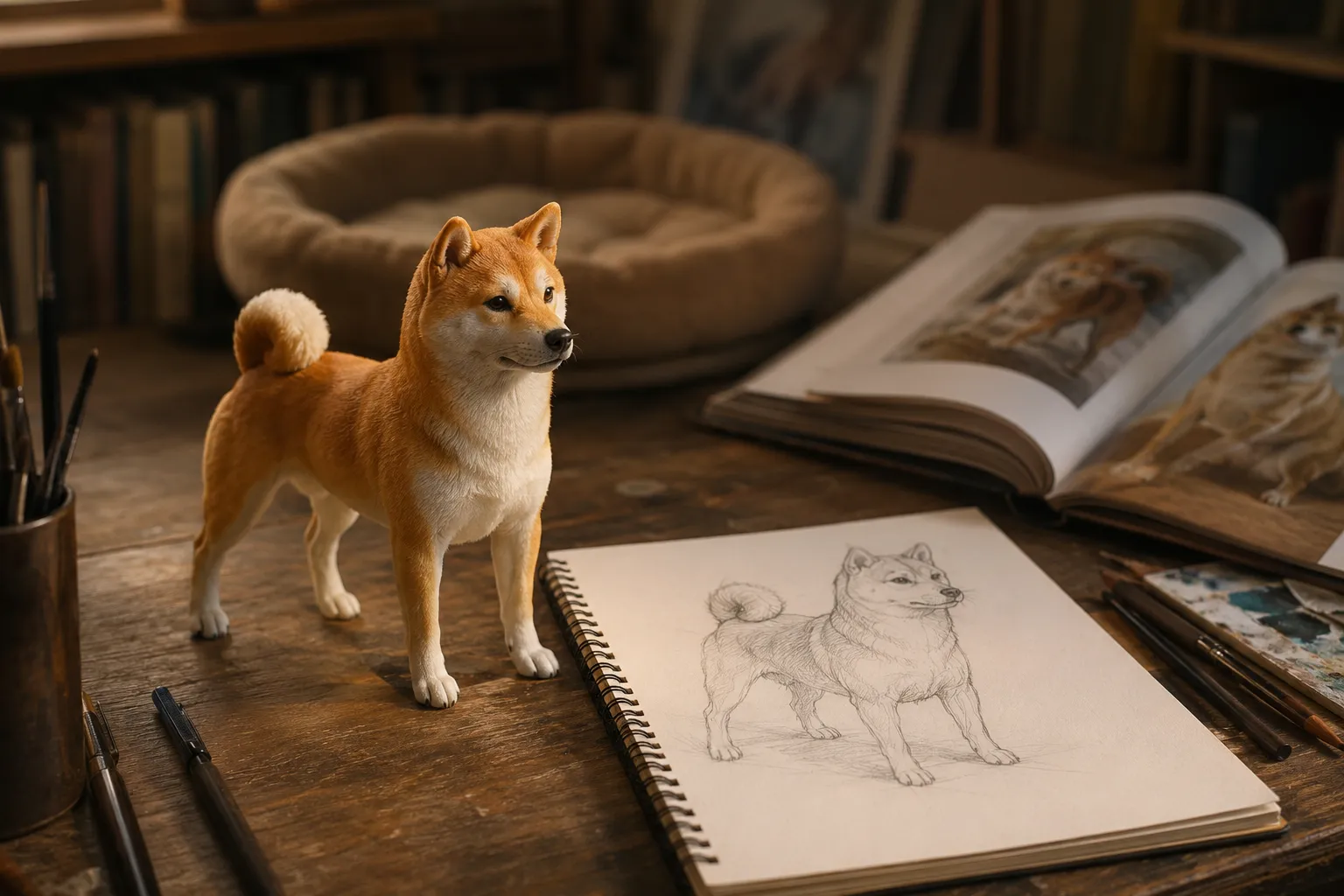
There's a dent in the couch cushion the exact shape of a curled Shiba Inu, and three days into unexpected pet loss grief, you still step around it like she's lying there in the late afternoon light. The fur on the armrest. The water bowl you can't bring yourself to empty.
Quick Takeaways
- Sudden loss freezes you mid-sentence — the bargaining isn't about logic, it's about a story that stopped too soon.
- Art history is full of unfinished masterpieces — incompleteness doesn't erase beauty, it reframes it.
- The relief tangled with grief is normal — feeling both at once doesn't mean you loved them less.
- A tangible keepsake gives grief somewhere to land — many families find comfort in custom pet figurines that hold the small details memory blurs.
- The empty spaces speak loudest — the corners, the chair, the doorway are where healing slowly begins.
The First Hour, When the Frame Is Still Wet
Nobody prepares you for the geography of it. The way a single room rearranges itself around an absence. One hour into a Shiba Inu's sudden departure, you're not thinking in stages of grief or coping mechanisms. You're standing in the kitchen holding a measuring cup of kibble, and there's no clatter of nails on the hardwood coming to meet you.
Unexpected pet loss grief has a particular texture, different from the slow grief of a long illness. When you've had weeks to watch a body fail, your heart starts the goodbye early. You memorize the gray around the muzzle. You take the extra photos. The ending, however brutal, has a shape you can see approaching.
Sudden loss has no shape. It's a sentence cut off mid-word.
A family we worked with described it perfectly. Their Shiba, Yuki, was eight years old and chasing a tennis ball across the backyard one Saturday morning. By that afternoon, a cardiac event nobody saw coming had taken her. "She was fine," the owner kept saying, weeks later, when she reached out to us. Not crying. Just stuck on that word. Fine.
That's the first hour. The disbelief that wears the mask of a single repeated word.
Here's the thing most grief resources skip right past: the first hour without answers is its own distinct kind of pain, separate from the grief that follows. Grief, eventually, accepts the loss. The first hour refuses it. Your brain runs the morning back on a loop, searching for the frame where it could have gone differently. There is no such frame. But you'll look anyway.
Why your mind keeps rewinding
There's a reason for the loop, and understanding it helps. When death arrives slowly, your mind builds a narrative bridge from "alive" to "gone." Each hard day lays another plank. Sudden loss burns the bridge before it's built, so your mind keeps trying to construct it retroactively, frantically, in the wrong direction.
This is not weakness. It's your brain doing what brains do with stories. It wants a middle. It wants the part between the beginning and the end. With a Shiba Inu's unexpected loss, there is no middle. There's a vibrant, opinionated, side-eye-giving dog, and then there's a quiet that arrived without warning.
"Sudden grief isn't missing a chapter. It's the book closing while your hand is still turning the page."
The Shibas make this harder, honestly. Their personality is so present. So loud in its quiet way. A Shiba doesn't fade into the furniture. They preside over the room like a small orange monarch, judging your life choices, refusing the bath, leaning against your leg only when they've decided you've earned it. The absence of that presence is louder than the absence of almost any other breed we've encountered in our work.
Why a Shiba Inu's Sudden Loss Feels Like a Canvas Torn From the Easel
Walk through any major museum and you'll find them eventually. The unfinished works. They're often tucked in side galleries, less crowded than the famous completed pieces. And they will undo you if you let them.
Michelangelo left a series of sculptures we now call the Prisoners or the Slaves. Figures half-emerging from raw marble, one arm fully formed and lifelike, the rest still trapped in stone. He never finished them. For centuries, viewers have stood in front of these figures feeling something they can't quite name. The figures seem to be struggling to be born, frozen forever in the act of becoming.
That's what a Shiba Inu's sudden loss feels like. A creature still mid-emergence. Still becoming who they were going to be at ten, at twelve. The arm reaches out of the marble and the rest stays locked in stone, and you stand there knowing exactly what it was meant to become and never will.
The unfinished work is the most honest mirror for sudden grief because it refuses the comfort of completion. We're told that grief should move toward "closure," toward a tidy finished thing we can set on a shelf and admire from a distance. But sudden loss doesn't grant closure. It grants a half-carved figure and a chisel you no longer get to hold.
The art history grief metaphor that actually helps
Here's the counterintuitive insight, the one you won't find in the first five articles you read about pet loss. We treat "unfinished" as a tragedy, a failure, a lesser thing. But art historians don't.
Schubert's Symphony No. 8 is one of the most beloved symphonies ever written. It has two complete movements instead of the traditional four. He simply stopped. Nobody fully knows why. And here's the part that matters for you, sitting on that couch beside the dent: we don't call it "Schubert's Incomplete Symphony." We call it the Unfinished Symphony, and we treasure it precisely as it is.
The incompleteness became part of its identity. Part of its beauty. People don't listen to those two movements feeling cheated. They listen and feel the ache of all that was possible, and that ache is woven into the experience of the music itself.
Your Shiba's life was not a failed long life. It was a complete short one. The distinction sounds small. It is not small.
"An unfinished life is not a broken thing. It's a different shape of whole."
We've come to believe, after working with thousands of grieving pet families, that one of the cruelest lies grief tells is that a short life is an incomplete life. A life is not a quota of years to be filled. Your dog was not running out of time toward some "real" full life that got cut off. Every day she lived was the whole thing. The morning with the tennis ball was not the prelude to a life. It was the life, in full, in color.
Let's put the parallel plainly, because seeing it laid out sometimes loosens something in the chest:
| The Unfinished Masterpiece | The Suddenly-Lost Shiba | What It Teaches |
|---|---|---|
| Michelangelo's Prisoners, half-emerged from marble | A young dog still becoming who they'd be | Beauty exists in the becoming, not only the finished form |
| Schubert's Unfinished Symphony | A short life cut off mid-melody | We treasure the work as it is, not for what's missing |
| Da Vinci's Adoration of the Magi, abstract underdrawing | Memories that feel like sketches, not portraits | The unresolved can be more moving than the polished |
| Klimt's unfinished final canvases | The years you imagined and won't get | What we project onto incompleteness is its own kind of love |
Notice the right-hand column. None of it says "get over it" or "find closure." Because the lesson of the unfinished work is the opposite of closure. It's the permission to keep the open ending open, and to find it beautiful anyway.
The Shiba-specific grief nobody talks about
Shiba Inus are famously independent. Cat-like, people say. They're not the dog that smothers you with affection. They're the dog whose affection you earn, and that changes the grief.
If your relationship with your Shiba was complicated, if there were years of stubbornness and the great escape attempts and the refusal to come when called, you might be carrying something heavier than simple sadness. You might be carrying a guilt that whispers you didn't appreciate them enough while they were here. That you got frustrated. That the last interaction was you scolding them for digging up the yard.
This complicated grief, the kind that comes from a difficult or prickly relationship, is real and it is normal. Loving a Shiba is sometimes a negotiation. And when the negotiation ends abruptly, you're left holding all the terms you never got to settle. The American Veterinary Medical Association acknowledges that the human-animal bond is a mutually beneficial relationship that profoundly shapes our emotional health, and that bond doesn't have to be uncomplicated to be devastating to lose.
The Bargaining Stage Nobody Warns You About
You know the stages. Denial, anger, bargaining, depression, acceptance. They're printed on every grief pamphlet and they're mostly misunderstood. People think they're a staircase you climb in order. They're not. They're more like rooms you wander between in the dark, sometimes returning to the same one three times in an afternoon.
But the bargaining stage of pet grief hits differently after a sudden loss, and almost nobody explains why.
Bargaining with a past you can't reach
With most grief, bargaining happens before the loss. "If she pulls through this, I'll never skip a walk again." It's a negotiation with the future, with God, with the universe, with the vet.
Sudden loss has no "before." So the bargaining curdles inward and aims at the past, which is the one direction no bargain can travel. You start trading with a closed door.
If I'd taken her to the vet for that one weird cough last month.
If I'd been home that morning instead of running errands.
If I'd noticed she was slowing down.
A customer once told us she spent two full weeks convinced that if she'd fed her Shiba a different brand of food, the heart condition would have been caught. There was no medical basis for this. Her vet gently told her so. It didn't matter. The bargaining mind doesn't want facts. It wants a version of events where you had power. Because the alternative, that some losses arrive with no warning and no preventable cause, is almost unbearable to sit with.
Here's what we've learned, and it's the part that actually helps: the bargaining isn't really about finding the mistake. It's grief's attempt to finish the unfinished painting. Your mind is trying to add the missing brushwork, to fill in the marble, to compose the third movement Schubert never wrote. It wants to author an ending that makes sense. And it can't. So it loops.
"Bargaining after sudden loss is love with nowhere to go, knocking on a door that's already closed."
How to actually move through it (not "be patient")
Vague advice helps no one. So here's what we've seen genuinely work for families navigating the bargaining stage after a Shiba Inu's sudden loss:
- Write the "if only" down, then write what you'd tell a friend. Take the exact bargain looping in your head. Put it on paper. Then write the response you'd give a grieving friend who said the same thing to you. You'd never tell them they killed their dog by buying the wrong kibble. The double standard is the medicine.
- Ask your vet the hard question, once. Many people avoid asking "was there anything I could have done?" because they fear the answer. Ask it. In our experience, the answer is almost always "no, this was not preventable, and you couldn't have known." Hearing it from a professional, one time, gives the looping mind something factual to push against.
- Set a "bargaining window." Sounds clinical, but it works. Give yourself ten minutes a day to think every if-only thought you want. When the thoughts come outside that window, you tell them: not now, we have a time for this. It sounds too simple. It isn't.
- Name what the bargain is protecting. Under "if only I'd noticed" is usually "I can't stand that I had no control." Naming the real fear loosens the bargain's grip more than arguing with the facts ever will.
The bargaining stage of pet grief typically loosens within the first three to six weeks, though it can resurface on anniversaries, on the morning you find a forgotten toy under the couch, on the day you finally move the water bowl. That's not regression. That's the room you wander back into. You leave it again.
The Empty Spaces: What the Corners and Chairs Are Telling You
Grief lives in space before it lives in time.
Before you can grieve the years you won't have, you have to survive the rooms you're standing in right now. And the rooms have changed. Not the furniture. The meaning of the furniture.
The corner by the window where she did her morning loaf. The specific square of carpet that caught the sun at 4 p.m. where she'd migrate like a small solar-powered creature. The bottom of the stairs where she'd wait, ears up, the instant she heard your keys. These places don't just remind you she's gone. They actively expect her. The house is still set for a guest who won't arrive.
This is the part of grief that ambushes people, and it's worth naming directly: it's not the big moments that break you. It's the spatial habits. The way you still open the back door and stand there holding it for two extra seconds. The way your eyes drop to the floor beside your chair at dinner. Your body learned the map of a life that included her, and the map doesn't update just because the territory changed.
We had a customer who couldn't sit in her own living room for a month. Not because of overwhelming sadness in some dramatic sense. Because her Shiba's spot was right there, beside the armchair, and her peripheral vision kept filling it in. She started eating dinner standing at the kitchen counter. She didn't even realize she was doing it until her sister pointed it out.
If this is you, here's something concrete: don't rush to erase the spaces, and don't preserve them as shrines either. Both extremes tend to prolong the rawest part. Instead, give one space a new small purpose. The 4 p.m. sun spot becomes where you put a plant that loves light. The waiting spot at the stairs becomes where a framed photo lives. You're not pretending she wasn't there. You're letting the space carry her differently, so it stops ambushing you and starts holding her.
A grief-and-space map
Sometimes it helps to see that what you're feeling has a logic to it. This is the rough emotional terrain we've observed families move through, organized by the spaces that tend to hurt and what tends to help:
| The Space | What It Triggers | Roughly When It Eases | What Genuinely Helps |
|---|---|---|---|
| The favorite resting spot | Peripheral-vision ambushes | 3–8 weeks | Repurpose gently, don't shrine or erase |
| The feeding area | Habitual routine reflexes | 2–5 weeks | Move bowls together, deliberately, when ready |
| The doorway/greeting zone | The missing welcome | 4–10 weeks | A keepsake placed where you used to be greeted |
| The bed or your bed | Nighttime quiet | Often the longest | A worn toy or blanket kept nearby |
| The yard / walk route | Open-air absence | Varies widely | A new route, then slowly returning to the old |
These timeframes are not promises. Grief doesn't read tables. But seeing that the pain is located, that it has addresses inside your home, helps many people stop feeling like they're losing their minds. You're not. You're living inside a space that was built for two.
What We Wish We Knew Sooner
A candid sidebar from our team, the things we've learned working alongside grieving families that we wish someone had told us early:
- The relief is not betrayal. If your Shiba had been declining and part of you felt relief when it ended, that relief doesn't cancel your love. It often is your love, finally exhaling. We've watched too many people punish themselves for a feeling that simply means they cared about suffering more than their own need to hold on.
- Grief intensity is not a measurement of love, and neither is its absence. Some people sob for weeks. Some feel oddly numb and then fall apart at the grocery store two months later. Neither is doing it wrong. We stopped, long ago, judging the shape of anyone's grief.
- People will say the wrong thing, and they mean well. "It was just a dog" lands like a slap. "You can always get another one" makes you want to scream. Most of these people have simply never grieved an animal. Their failure to understand is not a measure of your loss.
- Waiting to memorialize is fine, but waiting too long has a cost. The details fade faster than you expect. The exact orange of the coat. The particular crook of the tail. We'll come back to this, because it matters more than most people realize in the first raw weeks.
- Getting another pet is not replacing them. The anxiety and guilt around this is enormous and almost universal. We'll be real: there's no perfect timing, and the new dog is never a copy. They're a new chapter, not an erasure of the old one.
Holding the Light: Turning the Unfinished Into Something You Can Keep
Back to the museums for a moment, because the artists figured out something we're still learning.
When a master died with a canvas unfinished, the work wasn't thrown away. It was kept. Framed. Hung. Studied. Loved. The unfinished state was honored as part of the story, not hidden as a failure. The incompleteness was given a frame and a wall and a place in the light.
That's the instinct worth borrowing. Sudden grief leaves you with something that feels unfinished, and the healing move is not to force it into completion. It's to give it a frame.
Why tangible matters more than people expect
There's a reason cultures across history have made physical objects to hold the dead. Photos, lockets, carved stones, woven cloth. The grieving mind struggles with pure abstraction. It needs an anchor, something with weight and edges that says this was real, this mattered, this stays.
A digital photo album is wonderful, but it lives behind glass, summoned and dismissed with a swipe. It has no weight in the hand. For a lot of the families we work with, the turning point in the rawest grief came when they had something physical to hold. Something that occupied space in the room, the way she used to.
"We've learned that grief needs somewhere to land. A photo lives behind glass. A figure you can hold gives the love a place to rest."
— The PawSculpt Team
This is where some families turn to memorial keepsakes, and it's worth being honest about the options, because no single path is right for everyone:
| Memorial Option | What It Offers | Effort Required | Best For |
|---|---|---|---|
| Memorial garden / planting | Living, seasonal remembrance | Ongoing care | People who find comfort in nature and ritual |
| Photo book or album | A narrative of their life | Moderate, one-time | Storytellers who want the whole arc |
| Paw print / clay impression | A direct physical trace | Low (if done early) | Those wanting something intimate and literal |
| Cremation urn / jewelry | Keeping them physically near | Low | People who need closeness above all |
| Custom 3D pet figurine | A dimensional likeness to hold and display | Low (you provide photos) | Those who want to see their pet's form again |
When the unfinished gets a form
Here's where we do our quiet part of this work. At PawSculpt, what we make are full-color resin figurines, digitally sculpted by master 3D artists and then precision 3D printed in full color. The color isn't a coating applied on top. It's printed into the material itself, voxel by voxel, so your Shiba's specific markings, the cream of the chest, the rust of the back, the white of the socks, are part of the figure rather than a finish that can chip away. The only thing our hands add at the end is a protective clear coat for sheen and durability.
We mention the how because grieving families ask, and because the truth matters. The result isn't plastic-perfect. It has a fine natural grain, a real texture, the way a real object should. The advanced 3D printing technology reproduces the fur patterns and the particular tilt of a Shiba's pricked ears with a fidelity that catches people off guard. More than one customer has gone quiet when they first held theirs, because the form in their hand finally matched the form their peripheral vision kept searching for in the empty corner.
That's the whole point, really. The unfinished painting gets a frame. The absence in the room gets a presence again. Not the dog, never the dog. But a faithful keeping of her shape, set in the 4 p.m. light where she used to be.
If you're considering it, the practical part is simple: clear, well-lit photos from a few angles work best, especially ones that capture her real expression rather than a stiff posed shot. The candid photo where she's mid-side-eye on the couch usually makes a better figure than the formal one. You can see how the whole process works and what's possible over at pawsculpt.com, at your own pace, whenever the rawest part has loosened enough to look.
A gentle, honest note: there's no rush, and a figurine is not a requirement for healthy grieving. Plenty of people heal beautifully with a single framed photo and a story they tell on the anniversary. We only suggest it because, for a particular kind of griever, the one who keeps reaching for a shape that isn't there, having the shape back changes something. If that's you, you'll know.
Don't wait too long to capture the details
This is the practical insight from our earlier sidebar, and it deserves its own moment. Memory is not a photograph. It's a sketch that fades.
Within the first few months, the precise details start softening. Not the love, never the love, but the specifics. The exact way one ear flopped slightly while the other stood at attention. The particular pattern of the tail curl. People are often startled, a year later, to realize they can no longer quite picture the face they thought they'd never forget.
"Memory keeps the love and loses the details. Capture the details while they're still vivid."
This is the fear of forgetting, and it's one of the most common anxieties we hear. It's not vanity or morbidity to want to preserve the specifics. It's a deeply human impulse to keep what's slipping. Gather the best photos now, even if you're not ready to do anything with them yet. Future-you, the one who can finally smile at the memory, will be grateful that present-you, even drowning, thought to keep the colors before they faded. The APLB's pet loss support resources are a good companion for the emotional side of this, if you need somewhere to be heard while you do.
When You're Ready, the Frame Is Yours to Choose
Circle back to that dent in the cushion. The one you've been stepping around.
One day, and there's no schedule for it, you'll sit down in that exact spot. Not because you've forgotten, but because you've finally let the space mean something new. The dent was never really her. It was the shape she left in the soft places. And you get to decide what fills it now.
The unfinished masterpieces are not the museum's failures. They're some of its most quietly visited works, the ones people return to and stand before the longest, because incompleteness has its own gravity. Your Shiba's short, sudden, complete life is one of those. Not a story that got cut off. A story whose ending you can hold rather than solve.
The next step is small and it's yours alone: find the three photos that most look like her, the real her, side-eye and all. Put them somewhere safe today. Not for any grand purpose yet. Just so the colors don't fade while you're not looking. The rest, the garden or the album or the memorial figurine set in the afternoon light, can wait until the weight in your chest has shifted from drowning to carrying.
Because that's what healing from unexpected pet loss grief actually is. Not the weight leaving. The weight becoming something you can carry, and eventually, something you're almost glad to. The love was never the unfinished part. The love was always the whole, complete, finished work. It's just yours to keep now.
Frequently Asked Questions
Why does the bargaining stage feel worse after a sudden pet loss?
Because sudden loss has no "before" to bargain with. Most bargaining happens before a death, negotiating with the future. When the loss is instant, that energy curdles backward toward a past you can't change. Your mind loops on "if only" thoughts trying to locate a mistake, because the alternative, that the loss was unpreventable, feels unbearable. It's normal, and it typically eases within three to six weeks.
Is it normal to feel relief mixed with grief?
Completely. If your Shiba had been suffering, or if the situation was complicated, relief is one of the most common and most hidden feelings in grief. It doesn't mean you loved them less. Often that relief is your love, finally able to exhale because their pain is over. The guilt that chases the relief is grief playing a cruel trick. Try not to believe it.
How do I stop replaying the last day in my head?
Give the thoughts a container. Set a "bargaining window," ten minutes a day where you let every if-only thought run freely, and when they come outside that window, tell them gently that there's a time for this and it isn't now. Also ask your vet, once, whether anything could have been done. Hearing "no, this wasn't preventable" from a professional gives the looping mind a fact to push against.
Why do I keep seeing my pet in the corners of the room?
Your body memorized the map of a life that included them, the sun spot at 4 p.m., the waiting place at the stairs. Your peripheral vision keeps filling those spaces in. This spatial ambush is one of grief's most common and least-discussed features. It usually eases over several weeks, especially if you gently give those spaces a new small purpose rather than turning them into shrines or erasing them.
When should I create a memorial figurine or keepsake?
There's no deadline for making a keepsake, and grieving healthily doesn't require one. But do gather your best, clearest photos early, because the fine details of their face and markings fade from memory faster than people expect. You can decide later, when the rawest weeks have passed, whether a figurine, a photo book, or a memorial garden feels right for you.
Is it wrong to feel this devastated over a dog?
No. The bond between people and their animals is profound and well documented, and a Shiba Inu's strong, present personality makes their absence especially loud. Anyone who says "it was just a dog" likely hasn't grieved one. The depth of your grief is a measure of the depth of the bond, nothing more and nothing to apologize for.
Ready to Honor Your Pet's Story?
Every pet leaves a shape in the soft places of your life. When a Shiba Inu's sudden loss leaves the rooms feeling set for a guest who won't arrive, a tangible keepsake can give that love somewhere to land. A custom PawSculpt figurine captures the specific markings, the pricked ears, the side-eye, the details that unexpected pet loss grief blurs over time, in faithful full-color 3D-printed resin you can hold and keep in the light.
Visit pawsculpt.com to explore our process, revision options, and quality guarantee.