
Why Walking the Same Route Five Years Later Still Matters: Attachment Science and Your Lost Border Collie
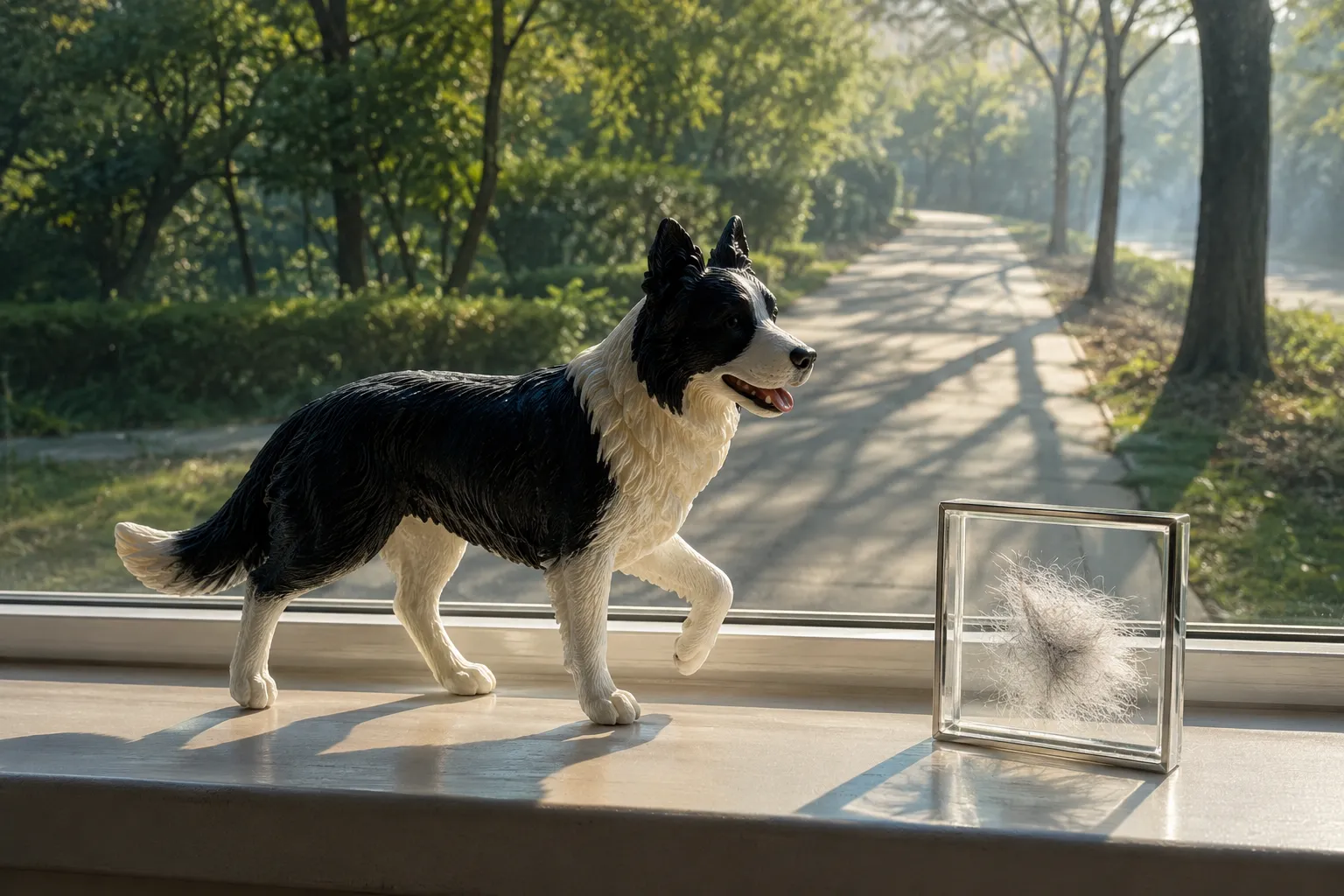
"What we have once enjoyed we can never lose," wrote Helen Keller. "All that we love deeply becomes a part of us."
Five years gone, and your hand still drifts toward the leash hook by the door. Pet loss grief years later isn't a malfunction. It's that border collie wove herself into your nervous system, and the route you two walked every morning still hums with her.
Quick Takeaways
- Grief that resurfaces years later is attachment doing its job — not a sign you're stuck or broken.
- Repeated routes and rituals retrain your nervous system gently — revisiting the walk can soothe rather than wound.
- Border collies bond through shared work and motion — which is exactly why walking, not sitting, helps you process.
- Tangible anchors hold memory steady when minds blur — some families find comfort in custom pet figurines that keep a face sharp.
- Relief, guilt, and anger belong in grief too — naming the messy feelings shrinks them down to size.
The Walk That Won't Let You Go
Here's something we hear constantly from the pet families we work with: "It's been years. Why does the same loop around the block still wreck me?"
Short answer? Because you didn't just lose a dog. You lost a co-author of your daily life.
Think about what a walk with a border collie actually was. Not a chore. A negotiation, a conversation, a moving meditation between two animals who'd learned each other's pace. She knew which corner you'd pause at. You knew which fence hid the cat that made her freeze, ears up, whole body a coiled question.
That route became a shared text. And grief, at its core, is the experience of a text suddenly missing its other reader.
The psychology of attachment explains why this lingers. Attachment isn't sentiment. It's a biological bonding system, the same one that links infants to caregivers, repurposed across species. When you walked the same path daily for ten, twelve, fifteen years, your brain encoded that environment as a "secure base" — a place where a specific relationship lived.
So when you walk it now, your brain runs the old program. It expects her. The expectation fires before grief can intervene. That's the gut-punch at the third lamppost.
"Grief is just love with nowhere to land. The walk gives it somewhere to go."
Most articles will tell you to "create new routines" and "avoid painful triggers." We're going to argue something close to the opposite. The walk isn't the wound. The walk might be the medicine. Stay with us.
Why Border Collies Hit Differently
Let's be specific, because breed matters more than the generic grief guides admit.
Border collies don't bond the way a lap dog bonds. A lap dog attaches through proximity and warmth. A border collie attaches through shared purpose and motion. They're working dogs bred for hundreds of years to read a human's intent and move in sync with it. According to the American Kennel Club's breed profile, they're among the most trainable and work-driven breeds on earth.
What that means for grief: your bond wasn't built on the couch. It was built in motion. On the walk. In the field. In that uncanny eye contact where she seemed to know your next move before you did.
So sitting quietly with a photo album might do almost nothing for you. The memories aren't stored there. They're stored in your legs, your gait, the rhythm of the route. This is the counterintuitive insight most grief resources miss entirely: for a working-breed owner, motion is memory. You may need to move to mourn.
One family we worked with told us they tried for two years to "move on" by avoiding the trail where they'd hiked with their collie, Juno. The grief didn't fade. It calcified. The day they finally walked it again — terrified, crying by the trailhead — something loosened. Not closure. Just flow.
The Science of Why Five Years Feels Like Yesterday
Long-term pet grief coping starts with understanding that grief was never meant to "end." That framing sets you up to feel broken when year five arrives with its own ambush.
Here's the model that actually fits the evidence. Grief doesn't shrink. You grow around it. Picture a marble in a jar. The marble (the grief) stays the same size. But over years, the jar (your life) gets bigger. The marble touches the walls less often. When it does — an anniversary, a similar dog at the park, that one slant of autumn light — it feels exactly as big as it always did. Because it is.
That's not regression. That's the architecture of a deep bond.
What's Actually Happening in Your Brain
When you smell wet grass on the old route, your olfactory memory activates faster than any other sense. Smell bypasses the brain's usual processing and routes almost directly to the regions handling emotion and memory. It's why the scent of a particular rain — the kind that used to soak her coat into that warm, earthy, slightly-too-doggy smell you secretly loved — can drop you to your knees half a decade later.
You can't think your way around that pathway. It's older than language.
This is why we tell people: stop fighting the smells. The damp-leaf scent of October. The specific musk of a wet collie. The fabric softener on the blanket she claimed as hers. These aren't your enemies. They're the last few threads of a connection your body refuses to file as "over."
"Your body grieves in a language older than words. Let it speak."
Here's a table we put together from patterns we've observed across hundreds of grieving families. Not a clinical timeline — grief refuses schedules — but a map of what tends to resurface and when.
| Time Since Loss | What Often Resurfaces | What Tends to Help |
|---|---|---|
| 0–6 months | Phantom routines, reaching for the leash | Keeping (not erasing) small rituals |
| 6–18 months | "I should be over this" shame | Reframing grief as ongoing love |
| 2–4 years | Ambush waves on anniversaries, smells | Intentional return to shared places |
| 5+ years | Quiet ache, fear of forgetting their face | Tangible anchors, retold stories |
Notice that last row. Fear of forgetting is the quiet terror of long-term grief, and almost nobody warns you about it.
The Fear Nobody Warns You About
Around year three or four, a new dread shows up. You realize you can't quite recall the exact pitch of her bark. The precise pattern of white on her chest goes fuzzy when you close your eyes. And you panic — because if the memory fades, does the love fade too?
It doesn't. But the fear is real, and it's one of the most common things grieving owners confess to us, usually in a lowered voice, like it's shameful. It isn't.
This is partly why memory anchors matter so much in the long arc of grief. A photo helps. A video helps more — the motion, again, the motion. And some families find that a physical object they can hold steadies the memory in a way flat images can't. We'll come back to that.
The Messy Emotions You're Not Supposed to Feel
Let's talk about the feelings that don't make it onto the sympathy cards.
Guilt is the big one. Specifically, guilt about timing. If your collie's final years involved illness or a euthanasia decision, you've probably replayed it a thousand times. Was it too soon? Too late? Did she suffer one day longer than she had to because you weren't ready?
We need to name this plainly: second-guessing the timing of euthanasia is one of the most universal experiences in pet loss, and it is not evidence that you did wrong. It's evidence that you loved a creature so much that no exit could ever feel clean. The American animal welfare and pet-loss communities, including resources like the Association for Pet Loss and Bereavement, exist largely because this specific guilt is so widespread and so heavy.
Here's the reframe that's helped families we've talked to: you made the best decision available with the information and love you had in that moment. Hindsight invents options that didn't exist at the time. You weren't choosing between her living and her dying. You were choosing between two kinds of goodbye.
"You didn't choose to lose her. You chose to spare her. Those are not the same."
And then there's the feeling people whisper about with their eyes down: relief. If those last months were a blur of vet visits, midnight accidents, medication schedules, and watching a once-electric dog struggle to stand — there was probably a moment, right after, where you felt the weight lift. And then you hated yourself for it.
That relief doesn't cancel your love. It confirms it. You were carrying her suffering as your own, and when it ended, your body exhaled. Caring for a declining working dog — an animal whose entire identity was built on movement — is its own specific exhaustion. Relief is the natural aftermath of sustained devotion. Let it be.
Anger Counts Too
Some of you are angry. At the vet who missed something. At yourself. At the unfairness of a twelve-year lifespan for a soul that felt eternal. At people who said "it was just a dog."
That last one — feeling judged or minimized by others — isolates people more than the loss itself sometimes. When the world expects you to bounce back in a weekend, your year-five grief can feel like something to hide. So you grieve in private. On the walk. Alone.
You're not alone, though. Not even close. The fact that you're reading this means you're part of a quiet, enormous community of people who walk the same loops, who slow at the same corners, who still talk to a dog who isn't there. We see you. There are a lot of you.
A Day-in-the-Life: Walking It Forward
Let's make this concrete, because abstract comfort doesn't lace up your shoes in the morning.
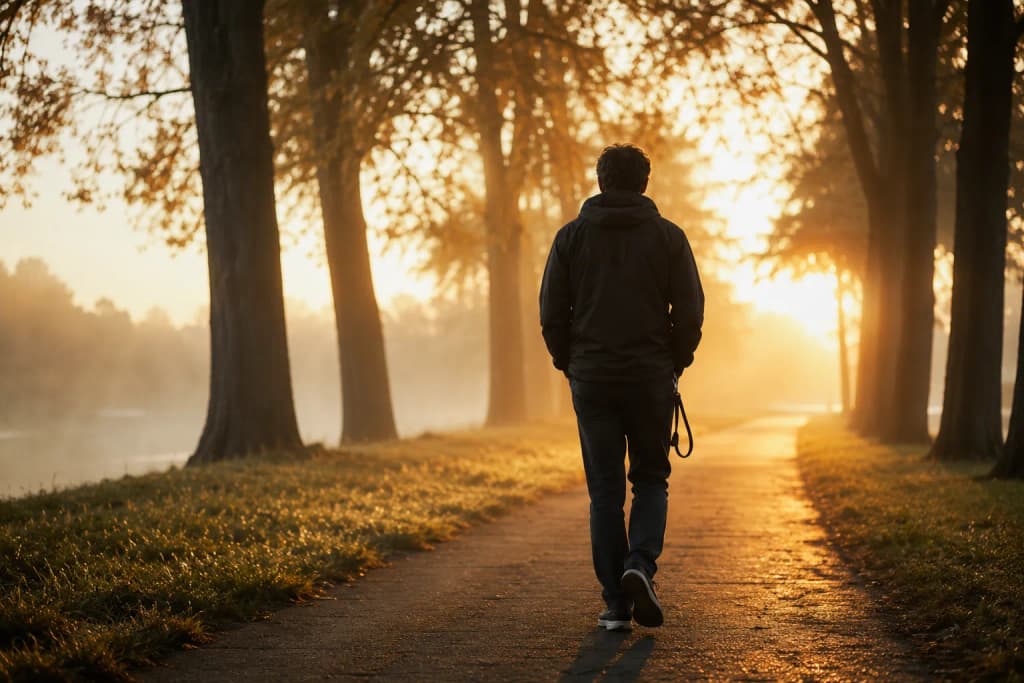
It's 6:40 a.m. The coffee's going, and your hand does the old thing — reaches for the leash that's still on the hook because you couldn't bring yourself to move it. Instead of flinching, you take it down. You loop it once around your wrist, the worn nylon familiar against your skin, and you walk the route. Her route.
At the corner with the cat-fence, you pause. Out of habit. And this time, instead of the pause cracking you open, it feels like a small hello.
That's the practice. Not avoidance. Not white-knuckle endurance. A gentle, repeated return that lets the route slowly transform from a place where she's missing into a place where she's remembered.
How to Actually Do It
If you want to try walking the route as a grief practice rather than a grief trap, here's a structure that's worked for people:
- Go at the original time. The light, the temperature, the smells — they're keyed to that hour. Honor the ritual fully or it won't unlock.
- Bring one sensory anchor. Her collar in your pocket. A specific scent. Something that says "this is intentional," not accidental.
- Talk to her if you want. Out loud or not. There's no clinical downside, and many people report it helps more than journaling.
- Stop at the old stopping points. The bench, the corner, the tree. Let the muscle memory complete its sentence.
- End with one good memory, said aloud. Not the death. A specific, alive moment. The zoomies in the snow. The way she herded the kids.
The "so what" here: you're not trying to feel better in one walk. You're retraining your nervous system to associate the route with continued connection instead of raw absence. Repetition is the mechanism. Three weeks of this, most people tell us, and the walk stops being an ambush and starts being a visit.
Building an Anchor for the Long Haul
Memory is unreliable hardware. That's not a flaw in you — it's just biology. And as the years stack up, the fear of losing her face becomes one of grief's sharpest edges.
This is where physical keepsakes earn their place. Not as a replacement. As an anchor. Families across the country build them in all kinds of ways:
| Memorial Option | Effort Level | What It Anchors | Best For |
|---|---|---|---|
| Memorial garden / tree | High, seasonal | Place & growth | Outdoor-loving families |
| Photo book or video reel | Medium | Moments in motion | Visual storytellers |
| Paw print / clay impression | Low | A single physical trace | Immediate aftermath |
| Custom 3D figurine | Low (you send photos) | Their face, posture, presence | Long-term, fear of forgetting |
| Engraved walking marker | Medium | The shared route itself | Walkers and hikers |
That figurine row is where our work at PawSculpt lives, so let us be honest and specific about what it is and isn't.
We don't hand-paint anything. There are no brushes involved. Instead, your dog is digitally sculpted by master 3D artists, then precision 3D printed in full color, where the color is part of the resin itself — printed into the material rather than coated on top. The result captures a border collie's specific markings: that asymmetric blaze, the merle dappling, the exact set of the ears. It has a real, honest texture to it — fine print grain protected by a clear coat for sheen and durability — not a slick, fake plastic perfection.
Why does that matter for grief specifically? Because a figurine gives your hands something to do with the love. When the fear of forgetting hits at year five, you can pick it up. Hold the posture you'll otherwise lose. We've watched people steady themselves with that simple physical act.
"We've learned that grief needs something to hold onto. Memory fades, but a face you can cradle in your palm stays."
— The PawSculpt Team
If a tangible keepsake feels right for you, you can explore the full process and see how the full-color 3D printing handles a collie's coat over at our site. And if it doesn't feel right? That's completely valid too. A memorial tree or a worn collar on a hook is no less of a tribute. The best anchor is the one that actually comforts you.
We'll be real about the limits here: we're a figurine studio, not grief counselors. For grief that's making it hard to function — months of sleeplessness, isolation, inability to work — please reach out to a professional. The Association for Pet Loss and Bereavement maintains support resources specifically for this. A figurine helps with the ache. It's not a treatment for clinical grief, and we'd never pretend otherwise.
When the Route Itself Changes
Here's an angle almost no one writes about: what happens when you can't walk the route anymore?
You move. The trail gets developed into condos. Your knees give out. The specific place where the bond lived becomes inaccessible. For people whose grief is tied to a route, this is a second loss layered on the first, and it can reopen everything.
If this is you, the work shifts. You're not returning to a place — you're carrying it. Walk a new route at the old time. Bring the same anchor. The ritual transfers even when the geography doesn't, because the deepest part of the walk was never the pavement. It was the attention. The companionship. The act of moving through the world with her in mind.
One customer told us she walks a completely different city now, two thousand miles from where her collie ran. But she still walks at 6:40. Still pauses at a corner. Different corner, same love. The route, it turns out, was always portable.
What Five Years Actually Teaches You
The pet families we've worked with the longest tend to arrive at the same quiet realization. The grief that returns at year five isn't a wound that failed to close. It's proof of a bond that was worth having.
You walk the route because she's still partly on it. Because attachment, the real kind, doesn't expire on a vet's schedule. Because a border collie taught you to find meaning in motion, and you're still finding it — just with an empty leash now, looped once around your wrist.
That's not pathology. That's love continuing to do the only thing it knows how to do: show up at 6:40, lace up, and walk.
So tomorrow morning, if your hand reaches for the hook — let it. Take the leash down. Walk her route. Pause at the corner. Say her name out loud if you want to. And notice, maybe for the first time in five years, that the walk doesn't have to be where you lose her again. It can be where you keep her.
The smell of wet grass at the third lamppost will still find you. Let it. That's just her, saying she's still on the walk too.
Frequently Asked Questions
Is it normal to still grieve my dog years later?
Yes, completely. Grief that returns years after a loss isn't a sign you're stuck — it's a measure of how deeply you bonded. Deep attachments don't run on a clock, and certain triggers like anniversaries, smells, or familiar routes can bring the feeling back at full intensity even half a decade later.
Why does walking our old route still make me emotional?
Because your brain stored that route as a "secure base" where a specific relationship lived. When you walk it, your nervous system runs the old expectation of your dog being there. That expectation fires before conscious thought, which is why a particular corner or lamppost can catch you off guard years later.
Is it normal to feel relief after my pet died?
Yes, and it's far more common than people admit. If your dog was ill or declining, you were carrying their suffering alongside your own. Relief when it ended is your body exhaling after sustained devotion. It doesn't diminish your love — it reflects how much you were holding.
How do I cope with the fear of forgetting my pet's face?
This fear tends to surface around years three to four and is deeply common. Videos preserve motion and personality better than still photos. Many families also find that a tangible keepsake — something you can physically hold, like a custom 3D figurine — keeps the details sharp when memory blurs.
Should I avoid places that remind me of my lost pet?
Avoidance often calcifies grief rather than easing it, especially for owners of working breeds whose bond was built in motion. Gently and intentionally returning to a shared route — at the original time, with a small anchor — can slowly turn it from an ambush into a visit.
Does breed affect how we grieve a pet?
It can shape how you grieve. Border collies and other working breeds bond through shared activity and motion rather than proximity alone, so their owners often find that movement-based rituals like walking help more than sitting quietly with photos. The memories are stored in the routine itself.
Ready to Celebrate Your Pet?
Every pet has a story worth preserving. Whether you're navigating pet loss grief years later or want to honor a border collie who walked every route by your side, a custom PawSculpt figurine captures the markings, posture, and presence that made your companion impossible to replace.
Visit pawsculpt.com to learn more about our full-color 3D printing process, preview turnaround, revision flexibility, and quality guarantee.