The First Night Without Your First Chihuahua: Journaling Through a Kept Fur Clipping
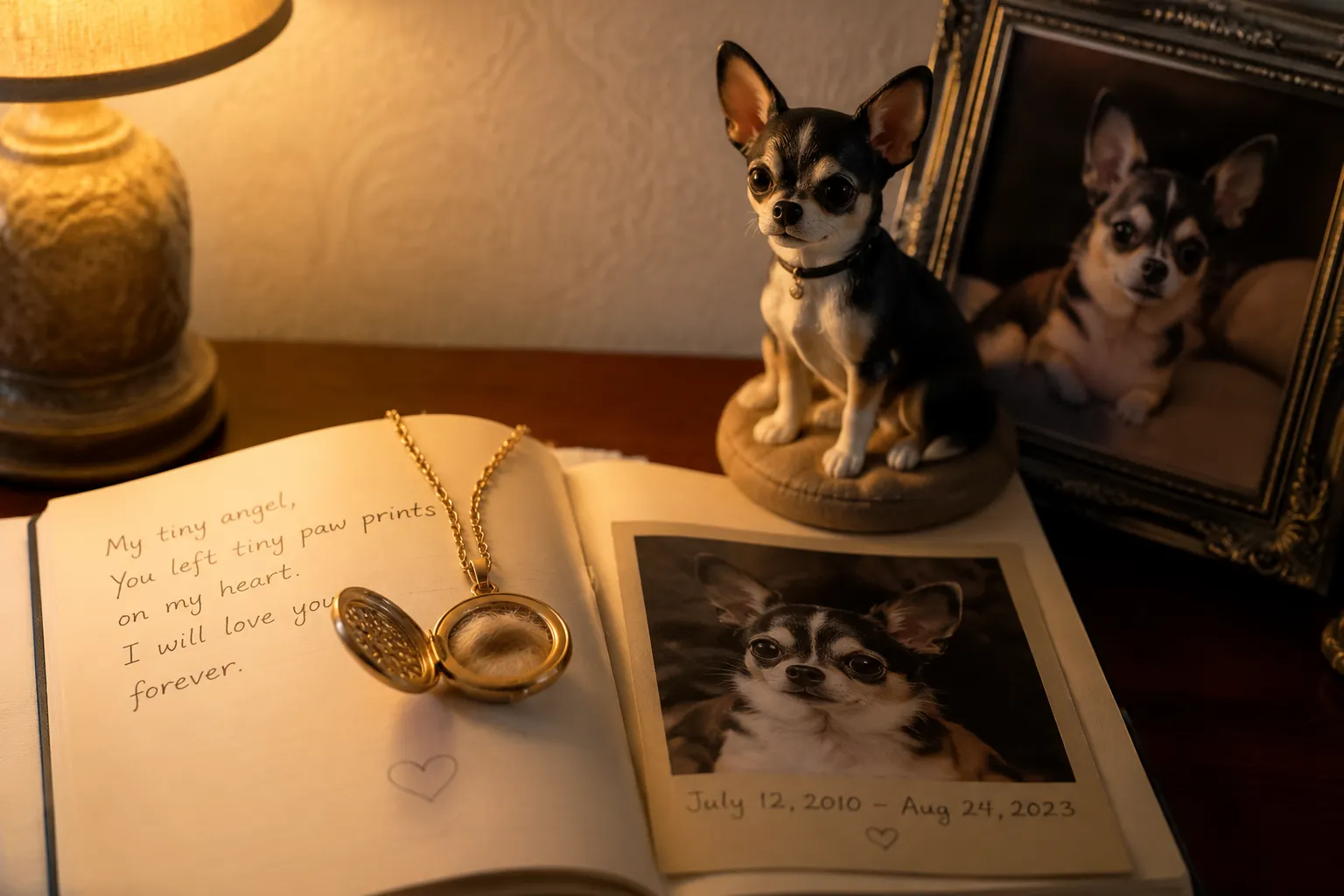
The leash still hangs by the door, and tonight—your first night facing chihuahua loss—you kneel in the park where she used to dig her ridiculous little trenches, a folded paper envelope of fur pressed into your palm. The porch light throws your shadow long across the grass. The collar in your pocket has no jingle anymore.
Quick Takeaways
- The first night feels loudest because your senses expect her — the missing weight, the absent click of nails on floor.
- A kept fur clipping works as a sensory anchor — it gives grief something physical to hold onto.
- Journaling with the clipping in hand slows the spiral — write what you touch, not just what you think.
- The fear of forgetting is normal and fixable — record specific sensory details now, before memory softens them.
- Turning a keepsake into lasting form helps some families heal — explore custom pet figurines alongside photo books and memory boxes.
Why the First Night Without Your Chihuahua Hits Differently
Here's something we've learned from thousands of pet families: the first night is rarely the saddest. It's the strangest.
Grief researchers describe early loss as a series of sensory contradictions. Your body still runs on a schedule built around another creature. Your ears are tuned to a frequency—the tick of tiny nails, the sigh at the foot of the bed—that suddenly returns nothing. That mismatch between expectation and reality is what makes the chihuahua loss first night feel less like sadness and more like disorientation.
Chihuahuas amplify this. They're velcro dogs. They burrow. Most weigh between three and six pounds, which means for years your nervous system logged their exact heat signature against your leg, your chest, the crook of your knee under the blanket. When that warmth vanishes, your skin notices before your mind catches up.
"Grief doesn't arrive as an emotion first. It arrives as a body that keeps reaching for something no longer there."
One customer we worked with—we'll call her Renée—told us the hardest moment of her first night wasn't crying. It was reaching down at 2 a.m. to adjust a blanket over a dog named Pip who wasn't there. Her hand moved on its own. That reflex, she said, undid her more than the vet's office ever had.
The three-signal disruption
We think about the first night in terms of three sensory signals your brain is still hunting for. Naming them helps, because a named thing is easier to sit with than a nameless ache.
- The sound signal — the ambient noises of a living dog: breathing, shifting, the tag against the water bowl.
- The weight signal — the physical pressure of a small body against yours, or the dip in the mattress.
- The routine signal — the last-walk-of-the-night ritual, the treat, the "go to bed" cue you've said a thousand times.
When all three go quiet at once, the silence isn't peaceful. It's a question your body keeps asking. So what do you do with that? You give at least one of those signals something to hold. That's where the fur clipping comes in.
The Fur Clipping as an Anchor: What You're Actually Holding
A lot of people feel a flicker of embarrassment about keeping fur. Like it's morbid, or too much. We want to gently push back on that, because there's real logic behind why it helps.
A fur clipping is the one keepsake that engages touch. Photos are visual. Voice recordings are auditory. Collars carry memory but feel like hardware. Fur is the only thing that recreates the tactile signal—the softness against your fingertips—that your grieving body is actively searching for on that first night.
Chihuahua coats come in two varieties, and this matters for what you're preserving. The smooth coat clips into a sleek, satiny wisp that catches light almost like silk. The long coat holds a softer, feathery texture that keeps its shape. Under a lamp, you'll notice colors you might've missed in daylight—the faint fawn undertone, the single stripe of cream, the way black fur throws a blue sheen. Look closely. You're going to want to write these down.
"The fur clipping is not a piece of the past. It's a doorway you can open with your hands whenever the memory feels far."
Renée kept Pip's fur in a small glass vial her daughter gave her. She told us she didn't understand why it mattered until night three, when she couldn't sleep, unscrewed the cap, and pressed a few strands between her fingers. "It was the first time," she said, "that my hands stopped looking for him and found him instead."
How to preserve a fur clipping so it lasts
If you took a clipping and you're not sure what to do with it, here's the practical part. Fur is keratin—it's stable and durable, but it can scatter, yellow with oils, or pick up moisture if you're not careful.
- Store it dry and sealed. A small glass vial, a locket, or an acid-free envelope tucked in a memory box.
- Keep it out of direct sunlight. UV exposure can fade lighter coats over months.
- Don't wash it. The natural scent fades fast enough on its own, and for the first weeks, that faint familiar smell can be part of what comforts you.
- Handle it with clean, dry hands. Skin oils are the main thing that dulls fur over time.
The American Kennel Club's guidance on the human-animal bond reinforces something we see constantly: the physical rituals around a pet's memory aren't sentimental excess. They're part of how people process attachment and loss in a healthy way.
Grief Journaling Through Pet Loss: A Method That Uses Your Hands
Most grief journaling advice tells you to "write your feelings." Honestly, on the first night, that's like being told to describe a color you've never seen. Your feelings are a storm. Staring at a blank page and being asked to name the storm often just makes the storm worse.
Here's what actually works better: write what you touch, not what you feel. Hold the fur clipping. Describe it. Let the physical object pull the memories out of you sideways, instead of demanding you summon them head-on.
We call this anchored journaling, and it's the specific reason a fur clipping and a notebook belong on the same nightstand that first night.
The five-prompt sequence for your first night
Do these in order. Keep the clipping in your non-writing hand the whole time. You don't need to finish all five. Getting through two is enough.
- Describe the fur. Color, texture, length, how it catches the light. This is a warm-up that requires zero emotional courage.
- Locate this fur on their body. Was it from the chest? The ear? The soft belly they let almost no one touch? Naming the place unlocks a memory of the moment.
- Write one thing their coat did. Stood up when they were startled. Went staticky in winter. Smelled like corn chips on their paws (chihuahua owners know).
- Write the last ordinary moment. Not the goodbye—the last normal Tuesday. The dull, beautiful, forgettable stuff is what fades first.
- Write one thing you'd tell them tonight. No rules here. This is the door you open only when you're ready.
"Don't write to feel better. Write to remember better. The feeling-better part follows on its own."
The "so what" behind this method: grief that stays purely internal tends to loop. The same three thoughts circle for hours. When you externalize a memory onto paper—especially a concrete, sensory one—you interrupt the loop and file the memory somewhere it won't degrade. You're not just coping. You're archiving.
A quick reference for what to journal, and when
Different nights call for different prompts. This is a rough map, not a prescription—move at your own pace.
| Timeframe | What your grief is doing | Journaling focus | Anchor to hold |
|---|---|---|---|
| First night | Sensory disorientation, reflexive reaching | Physical description, small ordinary memories | Fur clipping |
| First week | Waves triggered by routines (feeding time, walks) | The rituals you miss most | Collar or leash |
| Weeks 2–6 | Quieter, ambushing sadness | Fuller stories, funny moments, their quirks | Photos, favorite toy |
| Months 2–6 | Integration, meaning-making | What they taught you, how you've changed | A lasting keepsake or figurine |
Notice the arc. You start with the fur because it's the gentlest entry point, and you graduate toward memory and meaning as the acute shock softens. Skipping ahead rarely works. Grief has an order it prefers.
The Emotions Nobody Warns You About
We're going to name something directly, because too few grief resources do: the fear of forgetting.
It usually shows up around night two or three, and it's brutal. You'll be lying there and realize you can't perfectly recall the exact pitch of their bark, or which side they always slept on, or the precise pattern of the fur on their face. And a cold panic sets in—I'm losing them a second time.
This is one of the most common feelings pet owners carry and one of the least discussed. It is completely normal. It does not mean you loved them less. Memory is reconstructive by design; the brain compresses details to save space, and it does this to everyone, regardless of how deep the love was.
Here's the concrete fix, and why the fur clipping matters even more because of it. Memory fades fastest in the first 30 to 60 days. The specific, sensory details—smells, textures, small sounds—go first, while the big emotional beats stay. So the single most useful thing you can do on your first night isn't to feel your way through the grief perfectly. It's to capture the details before they blur.
The fur clipping does this physically. Your journal does it in language. Together they form a record that outlasts the natural softening of memory. Renée later told us that rereading her first-night entries months down the line gave her back a version of Pip she'd already started to lose—the corn-chip paws, the way his ears rotated toward the front door before anyone else heard the car.
"We've seen families steadied by holding something real. Grief spirals without an anchor, and an anchor can be as small as a lock of fur."
— The PawSculpt Team
The other feelings you're allowed to have
Fear of forgetting isn't the only visitor. A few others show up that people rarely admit to, and we want to name them so you know you're not alone or broken.
- Relief, tangled with guilt. If your chihuahua was sick or in pain, part of you may feel relieved the vigil is over. That relief doesn't cancel your love—it is love, the kind that put their comfort ahead of your need to keep them.
- Anger. At the vet, at yourself, at the timing, at nothing in particular. Anger is grief with nowhere to go yet.
- Feeling foolish for grieving "just a dog." You're not. The human-animal bond is real, measurable, and, for many, as significant as any relationship. Anyone who makes you feel small about it simply hasn't had what you had.
The Association for Pet Loss and Bereavement offers support resources if the weight feels like more than you can carry alone. Reaching out isn't weakness. It's what the rest of us wish we'd done sooner.
Turning a Fur Clipping and a Journal Into Something Lasting
Somewhere in the first few weeks, a question tends to surface: what do I actually do with all of this? The vial of fur, the notebook filling up, the photos on your phone you can't stop scrolling.
There's no single right answer. But there's a useful way to think about it. Keepsakes fall along two axes: how much effort they take, and how present they stay in your daily life. Here's how the common options compare.
| Memorial option | Effort | Daily presence | Best for |
|---|---|---|---|
| Fur clipping in a vial or locket | Very low | Medium (wearable) | Immediate comfort, keeping them close |
| Grief journal | Low, ongoing | Low (private ritual) | Processing, preserving memory |
| Photo book | Medium | Low (occasional) | Storytelling, sharing with family |
| Memorial garden | High | Medium (seasonal) | Families with outdoor space |
| Custom figurine | Low (you send photos) | High (displayed daily) | A tangible form you see every day |
The reason we mention figurines here—and we'll be real about our own bias as we do—is that they solve a specific problem the other options don't. A journal is private. A vial is small and hidden. A photo lives behind glass or in a phone. But a custom figurine sits in the room with you, at eye level, catching the same lamplight your dog used to nap in.
Some families find that turning to a tangible keepsake once the acute grief eases gives their memory a home. PawSculpt's 3D pet sculptures are digitally modeled by our artists from your own photos, then precision 3D printed in full-color resin—so your chihuahua's actual markings, the fawn undertones, that single cream stripe, come through in the material itself rather than sitting as a coating on the surface. The only finishing step is a protective clear coat that gives it a gentle sheen and guards the color over time.
We're not going to pretend it's the right choice for everyone or every budget. For some, the fur clipping and journal are enough, and that's completely valid. But if you're the kind of person who needs to see them to feel them near, a figurine can be the anchor that graduates you out of the hardest weeks.
What actually makes a good figurine (the honest version)
If you do go this route—now or months from now—the quality of the result comes down almost entirely to the photos you provide. Here's what our artists tell us matters most.
- Natural light beats flash. Soft daylight near a window shows true coat color; flash flattens texture and washes out those subtle chihuahua undertones.
- Eye-level angles win. A photo taken from your dog's height captures their real proportions. Overhead shots distort those big, expressive chihuahua eyes.
- Send multiple angles. Front, both sides, and a face close-up give the modeling team the full picture of their markings and structure.
- Personality shots help. That one photo where their ears are perked or their head is tilted—that's the pose that makes a figurine feel like them and not just a dog.
For the full picture on process, turnaround, and revisions, it's worth visiting the site directly, since those details are best explained where they stay current. What we can tell you is that the goal is always the same: the small, specific things—the whisker set, the ear angle, the coat you just clipped a piece of—rendered in a form you can hold.
"A photo remembers how they looked. A figurine remembers how it felt to have them in the room."
A Framework for the Nights That Follow
The first night is one night. It ends, even when it feels like it won't. What we've observed across countless pet families is that the grief doesn't disappear so much as it changes shape—and knowing the shape ahead of time makes it less frightening.
Think of it as three broad phases. The acute phase (roughly the first two weeks) is sensory and disorienting; this is where the fur clipping and anchored journaling do their heaviest lifting. The wave phase (weeks two through six or so) brings ambushes—grief triggered by an empty food bowl, a squeaky toy under the couch, the vet's reminder text that slipped through. The integration phase (months two through six and beyond) is when the memory stops cutting and starts warming.
There's no clean finish line, and anyone who gives you a fixed timeline is guessing. Some people feel steadier in weeks. For others it's seasons. Grief roughly tracks the depth of the bond, and a chihuahua who slept on your chest for a decade earned a long goodbye.
What stays constant through all three phases is this: the details you capture early become the treasure you keep late. The person who journals through their fur clipping on night one is doing a kindness for the person they'll be at month six—the one who wants to remember, and can, because they wrote it down while it was still sharp.
Frequently Asked Questions
Why is the first night without my chihuahua so hard?
Because your body is still running on a schedule built around them. Your ears listen for the click of nails, your skin expects their warmth, and your evening routine still has a dog-shaped gap in it. When those three signals go silent at once, the first night feels less like sadness and more like disorientation—which can be its own kind of pain.
Is it weird to keep a fur clipping from my dog?
Not even a little. Of all the keepsakes people keep, fur is the only one that engages touch, which happens to be the exact sense your grieving body keeps reaching for. Holding a small clipping gives your hands somewhere to go. Many owners describe it as the first thing that made them feel their pet was still near rather than simply gone.
How do I start grief journaling after losing my pet?
Skip the "describe your feelings" advice for now. Instead, hold your pet's fur clipping and describe it first—color, texture, how it catches the light. Then let small, concrete memories surface on their own. Writing what you touch is far easier than writing what you feel, and the emotions tend to follow gently once the details start flowing.
How long does grief after pet loss usually last?
There's no fixed timeline, and anyone who offers one is guessing. Acute grief often softens within the first two to six weeks, though waves of sadness can return for months, triggered by an empty bowl or a familiar sound. Grief roughly tracks the depth of your bond, so a long, close relationship earns a longer goodbye. That's not a flaw—it's a measure of love.
Is it normal to feel relief when my sick pet passed away?
Yes, and it's one of the least-talked-about feelings in pet loss. If your chihuahua was suffering, part of you may feel relief that the vigil is over—and then feel guilty for that relief. Please hear this: that relief is love. It's the part of you that prioritized their comfort over your own need to keep them close. The guilt is grief's cruel trick, not a verdict on your character.
Ready to Celebrate Your Pet?
Every pet has a story worth preserving. Whether you're getting through the chihuahua loss first night with a fur clipping in your hand, or you're ready months later to give that memory a lasting form, a custom PawSculpt figurine captures the details that made your companion one-of-a-kind—the true coat colors, the ear angle, the expression you'd know anywhere.
Visit pawsculpt.com to learn more about our process, turnaround, and quality guarantee.