The First Night Without Your First Maine Coon: A Fur Clipping Becomes Peace
Your hand slides under the pillow at 3 a.m. and finds it: a single tuft of fur, still soft, caught in the seam of the sheet. First pet loss does this. It hides the reminders exactly where your body reaches before your mind has time to wake up and brace itself.
Quick Takeaways
- The first night is hard because of missing weight, not silence — your body grieves the absence of pressure on the bed.
- Take a fur clipping even days later — undercoat fur holds its texture for years if kept dry and dark.
- Relief after euthanasia is not betrayal — it often means you loved them enough to choose their comfort.
- Touch outlasts sight in grief — a keepsake you can hold matters more than one you only see.
- Tangible memorials anchor the early weeks — some families turn a clipping or photos into custom pet figurines they can keep close.
Why the First Night Without a Maine Coon Hits Differently
Here's something nobody warns you about. The hardest part of that first night isn't the quiet. It's the weight.
A Maine Coon is not a small cat. Twelve, sixteen, sometimes twenty pounds of muscle and that famous shaggy coat, draped across your shins or pressed into the curve behind your knees. Your body learned that pressure. It memorized the specific dip in the mattress, the warmth radiating through the blanket, the way the bed shifted when they resettled at 4 a.m.
So when you lie down that first night, your nervous system goes looking for something that isn't there. You don't think it. You feel it. A hollowness at the foot of the bed where gravity used to gather.
"Grief doesn't always speak in memories. Sometimes it speaks in the weight your body still expects."
This is why so many people describe the first night as physical. Restless legs. Reaching out in half-sleep. A strange lightness that feels wrong. You're not imagining it, and you're not being dramatic. The body keeps its own grief, separate from the mind, and it grieves in the language of touch, temperature, and weight.
Maine Coons make this sharper than most breeds. Their size means their absence is large. Their coat means they left texture everywhere: on the armrest, in the laundry, woven into the throw blanket you keep meaning to wash and keep not washing. (Don't wash it yet. We'll come back to that.)
The absence you can measure
Other pets leave a quiet. A Maine Coon leaves a measurable void. Owners of these cats often talk about the "chirp" going silent, that distinctive trill these cats make instead of a standard meow. The slow blink from across the room. The way they followed you between rooms like a small, opinionated shadow.
But the thing that ambushes you on night one is almost always tactile. The missing heat. The missing heft. You roll over expecting resistance and find only sheet.
If you're reading this at 2 a.m. with your phone too bright and your chest too tight, we want you to know the strangeness of that feeling is normal. The American Veterinary Medical Association recognizes pet loss as genuine bereavement, and the AVMA's guidance on pet loss and grief treats the human-animal bond as real and worth honoring. Your body is not malfunctioning. It's mourning.
The Fur Clipping Keepsake Nobody Tells You to Take
Let's talk about the fur. Because this is the part where grief and craft quietly meet, and almost no one prepares you for how much it will matter later.
A fur clipping keepsake is exactly what it sounds like: a small lock of your pet's fur, saved and preserved. People keep them in lockets, in tiny glass vials, in folded squares of acid-free paper tucked into memory boxes. It sounds almost old-fashioned until the moment you're holding the only soft thing left.
Here's the counterintuitive part. Most grief articles, if they mention fur at all, frame it as something you must do immediately, in the first raw hours, often at the vet's office. That pressure can make an already unbearable moment worse. So we'll be real with you: you usually have more time than you think.
When to take a clipping (and why later can be okay)
If your Maine Coon has already passed and you didn't think to take fur, check the places their coat collected. The brush you haven't emptied. The blanket. The back of the couch. That fur is still theirs. It carries the same texture, the same undercoat softness, the same faint warmth-memory in your fingers.
For a clipping taken directly from the coat, the gentlest spots are areas with dense, long fur:
- The ruff (the lion-like mane around the neck) — thick, long, and unmistakably Maine Coon
- The plumed tail — those long guard hairs hold their shape beautifully
- Behind the shoulders — soft undercoat that keeps its loft
Take more than you think you need. A pinch looks like nothing once it's sealed away. A small lock feels like enough when you open the box a year later.
"Keep the fur you can't bring yourself to wash off the blanket. That, too, is them."
How to preserve fur so the texture survives
This is where the craftsman's mindset helps, because preservation is really about protecting texture from time. Fur degrades from three enemies: moisture, light, and handling oils. Beat those three and a clipping can stay soft and intact for decades.
Here's a comparison of common fur-keeping methods and what each actually protects against, based on what we've seen hold up over the years.
| Method | Protects Texture | Protects Color | Best For |
|---|---|---|---|
| Acid-free paper fold + memory box | Excellent | Good | Larger clippings, the ruff and tail |
| Small glass vial (sealed) | Good | Excellent | Daily-handle keepsakes you'll touch often |
| Locket or pendant | Fair (compression) | Good | Wearing them close, small pinch only |
| Resin-cast keepsake | Permanent | Permanent | "Forever" preservation, no future access |
| Left on the blanket (unwashed) | Excellent (short term) | Good | The transition weeks, before you decide |
A few specifics that matter:
- Make sure the fur is fully dry before sealing it. Any moisture trapped in a vial invites mildew, which destroys both scent and texture.
- Handle it as little as possible. The oils on your fingers break down fur over time. Use the paper fold to move it.
- Keep it dark. Light fades color, and a Maine Coon's coat color, those tabby swirls or that smoke undercoat, is part of what makes the keepsake theirs.
The "so what" here is simple but important: the texture is the memory. Sight fades in the mind faster than touch does. You will forget the exact shade of their eyes before your fingers forget how their fur felt. Protecting that texture is protecting the most durable version of your goodbye.
Euthanasia Grief and the Feelings You're Not Supposed to Say Out Loud
We need to sit with the hard part now, because euthanasia grief has its own particular shape, and pretending otherwise doesn't help anyone.
If you made the decision to let your Maine Coon go, you are probably running the timeline backward in your head. Was it too soon. Was it too late. Did you read the signs right. Should you have tried the other treatment, waited one more week, called a second vet.
That second-guessing? It's almost universal, and it's one of grief's cruelest loops. Here's what we've learned from thousands of pet families: the people who agonize most over timing are almost always the ones who were paying the closest attention. The worry itself is evidence of how carefully you loved.
The relief you're afraid to admit
Now the feeling nobody puts on a sympathy card. After a long illness, after months of medications and subcutaneous fluids and watching a once-enormous, bounding cat grow thin and tired, there can be a flicker of relief when it's over.
And then the guilt arrives like a wave, because how dare you feel anything but devastation.
Listen. That relief doesn't make you cold. It makes you someone who carried a heavy thing for a long time and finally set it down. You can feel relief that their suffering ended and shattering grief that they ended, in the very same breath. Both are true. Both are love. The relief was never about wanting them gone. It was about not wanting them to hurt.
"You can be grateful their pain stopped and heartbroken that they're gone. Grief holds both without contradiction."
The fear underneath all of it: forgetting
There's one more feeling that drives a lot of the 2 a.m. spirals, and people rarely name it directly. The fear of forgetting.
You're afraid the chirp will fade from memory. That you'll stop being able to summon the exact weight of them on your chest. That one day you'll reach for the feeling and come up empty. This fear is exactly why tactile keepsakes matter so much, and why a fur clipping or a memorial you can physically hold does more for the long grief than a photo on a screen ever will.
Here's a rough map of how this grief tends to move. Not a rulebook, because timelines lie, but a gentle sense of the terrain. The Association for Pet Loss and Bereavement offers grief support resources, and the APLB's pet loss support can help if any stage feels like more than you can carry alone.
| Phase | Typical Window | What It Often Feels Like | What Genuinely Helps |
|---|---|---|---|
| The first nights | Days 1–7 | Physical, sleepless, the missing weight | Keep their blanket; take or find a fur clipping |
| Raw waves | Weeks 1–6 | Ambushes triggered by texture, sound, routine | A tangible keepsake to hold; routine anchors |
| The quiet ache | Weeks 6–16 | Duller, but the "firsts" still sting | Begin a memorial project; talk about them openly |
| Integrated love | 4+ months | Memory more warm than sharp | A lasting memorial you return to, not flee from |
If your grief doesn't match this table, you're not doing it wrong. Some people feel the rawest wave at week six, not week one. Complicated histories, sudden loss, or a cat who was your companion through a hard chapter of your own life can all stretch and twist the shape. We're not vets or grief therapists, and if the weight becomes unmanageable, please reach out to one. There's no medal for carrying it alone.
"We've watched grief soften the moment someone has something real to hold. The hands need an anchor before the heart can rest."
— The PawSculpt Team
From a Fur Clipping to a Maine Coon Memorial You Can Hold
So how does a clipping become peace? This is the part we think about most, because it's where the work we do quietly lives.
Grief needs somewhere to go. Early on it lives in your hands, in the reaching and the fidgeting and the fur you keep finding. A Maine Coon memorial gives that energy a destination. It turns the restless, searching grief into something you tend rather than something that ambushes you.
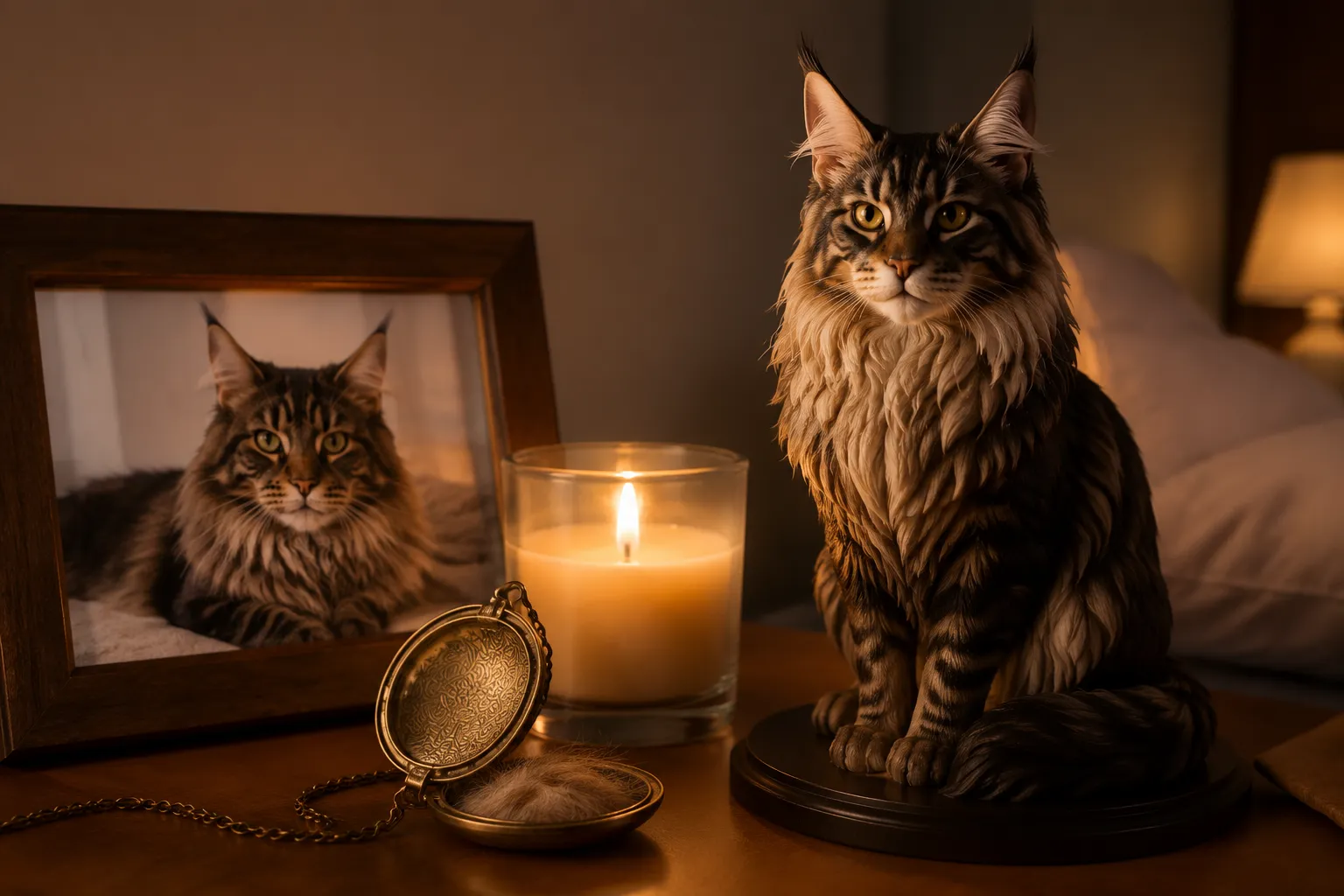
Families do this in dozens of ways, and there's no hierarchy of "right." Some plant a tree and watch it grow heavy with the seasons. Some build a small shelf with the collar, a candle, and a framed photo. Some commission a portrait. Some keep the fur clipping in a vial they hold while they fall asleep.
Why tactile memorials outperform photos
Here's the insider observation, the thing we've learned from years of this work: the memorials that help most are the ones with weight and texture. A photo lives behind glass, untouchable, frozen. But something you can pick up, turn over in your palm, feel the cool surface warming to your skin, that engages the same tactile memory your body is desperate to keep.
That's the principle behind a custom figurine, and it's why an increasing number of grieving families choose one. A good 3D pet sculpture gives your hands the heft and form they're missing. Not a replacement, nothing replaces a Maine Coon, but an anchor. A point of contact.
At PawSculpt, the figurines are digitally sculpted by master 3D artists, then precision printed in full color, so the resin itself carries your cat's actual markings: the tabby swirls, the smoke undercoat, the white spill on the chest. The color isn't a coating that can chip away. It's printed directly into the material, voxel by voxel, then sealed with a protective clear coat for sheen and durability. What you hold has a genuine, slightly textured surface with the fine grain of the print, protected and lasting. Authentic, not glossy-plastic perfect.
What photos actually capture your Maine Coon best
If you decide to go this route, the source photos matter more than anything, and Maine Coons have specific features worth capturing. We've reviewed countless submissions, and here's what consistently makes the difference.
| What to Capture | Why It Matters | Quick Tip |
|---|---|---|
| The ruff and ear tufts | These define the breed's silhouette | Shoot at eye level, not from above |
| Full body in natural light | Shows true coat color and markings | Window light beats flash every time |
| A signature pose | Personality is in the posture | The loaf, the stretch, the regal sit |
| Tail plume from the side | The plumed tail is a Maine Coon signature | Get it fully extended if you can |
| A clear face, eyes open | Expression is everything | Avoid heavy backlighting |
The "so what": the more angles and the better the light, the more the sculptors can reproduce the details that made your cat unmistakably yours rather than a generic orange tabby. A blurry photo gives a blurry likeness. A clear one captures the specific tilt of the head that meant feed me or I missed you.
What to expect from the process
We won't quote you specific timelines or prices here, because those things change and you deserve current information rather than a number that's wrong by the time you read it. You'll find the real details, including preview turnaround, revisions, and the quality guarantee, on pawsculpt.com.
But in general terms, the path looks like this:
- You share your photos and any notes about pose, expression, or specific markings that matter to you.
- 3D artists digitally model your pet, paying attention to the breed-specific features above.
- You see a preview and can ask for adjustments so the likeness feels right.
- The approved model is printed in full-color resin and finished with a protective clear coat.
The reason we built it around a preview step is grief-specific. When you're mourning, getting it "wrong" stings far more than usual. Seeing your cat before the piece is final means the thing that finally arrives feels like recognition, not approximation.
What We Wish We Knew Sooner
A candid sidebar from our team, the things we'd tell a grieving friend over the kitchen table if they asked us privately.
We wish we'd known the blanket matters. So many people wash everything in the first days, desperate to clean and control something. Then they grieve the lost scent and texture for years. Our honest advice: seal one unwashed item in a bag before you wash anything. You can always wash it later. You can never un-wash it.
We wish we'd known grief shows up in the hands. We used to think memorial keepsakes were about looking. They're not. The customers who tell us a figurine helped almost always describe holding it, not displaying it. The weight in the palm does something the eye can't.
We wish we'd known relief is normal. We've talked to so many people drowning in guilt over a feeling that's universal and human. If we could put one sentence on every order: the relief doesn't cancel the love. It coexists with it.
We wish we'd known there's no deadline. People apologize to us for ordering a memorial "so late," sometimes a year or two on. There's no late. Some grief needs time before it's ready to become something you can hold.
"There is no late when it comes to honoring them. Grief keeps its own calendar, and it's never wrong."
Turning the First Night Into the First Step
Let's go back to that tuft of fur in the bedsheet at 3 a.m.
The first night you find it by accident, and it guts you. But somewhere down the line, something shifts. You start keeping it on purpose. You move it to the little box, the vial, the folded paper. The thing that ambushed you becomes the thing you reach for. That's the quiet alchemy of grief: the same object that opened the wound becomes the thing that helps it close.
The missing weight at the foot of the bed won't fill back in. We won't insult you by pretending it does. But the searching can soften. The reaching can find something to land on. A fur clipping. A blanket you finally chose not to wash. A small, full-color likeness with the right tilt of the head, warming in your palm.
Tonight, do one small thing. Find a clipping or save the blanket. Don't display it. Just hold it. Let your hands have what they've been looking for.
First pet loss teaches you something brutal and beautiful at once: love doesn't end when the weight leaves the bed. It just changes what it asks of you. It stops asking you to care for them, and starts asking you to carry them. And that, it turns out, you already know how to do.
Frequently Asked Questions
Is it normal to feel relief after my pet's euthanasia?
Completely normal, and far more common than people admit. After a long illness, relief that their suffering ended is a natural human response. It doesn't mean you wanted them gone. It means you loved them enough to not want them to hurt, and it lives right alongside your grief, not in place of it.
How long does grief last after losing a pet?
There's no fixed answer, and anyone who gives you a tidy number is guessing. The rawest waves often hit hardest in the first six weeks, then soften into a duller ache over the following months. Some people feel ambushed again at the "firsts," a birthday, a season change. A longer grief isn't a sign you're doing it wrong.
When is the best time to take a fur clipping?
Sooner preserves the most options, but later is genuinely fine. If your Maine Coon has already passed, check their brush, favorite blanket, or the spot on the couch. That fur holds the same softness and is just as much theirs. Take more than feels necessary, since a small lock looks like very little once it's sealed away.
What photos work best for a custom memorial figurine?
Clear, eye-level shots in natural window light, ideally several angles. For a Maine Coon, capture the ruff, ear tufts, and plumed tail, plus a signature pose that shows their personality. Sharp photos let the sculptors reproduce the specific markings and expression that made your cat unmistakably yours. You'll find detailed photo guidance on pawsculpt.com.
Will I forget what my pet felt like?
This fear drives a lot of late-night grief, and it's why tactile keepsakes help. Touch memory fades slower than visual memory, which is exactly why a preserved fur clipping or something you can physically hold matters. You give your hands an anchor for the thing your mind worries about losing.
Ready to Celebrate Your Pet?
Every pet has a story worth preserving. Whether you're navigating your first pet loss and honoring a Maine Coon who crossed the rainbow bridge, or celebrating a furry friend who's still filling your bed with warmth, a custom PawSculpt figurine captures the details that made them one-of-a-kind: the ruff, the plumed tail, the exact tilt of the head you'd know anywhere.
Visit pawsculpt.com to learn more about our preview process, flexible revisions, and quality guarantee.