
Impermanence and the Empty Bed: Making Peace With Losing Your First Rabbit
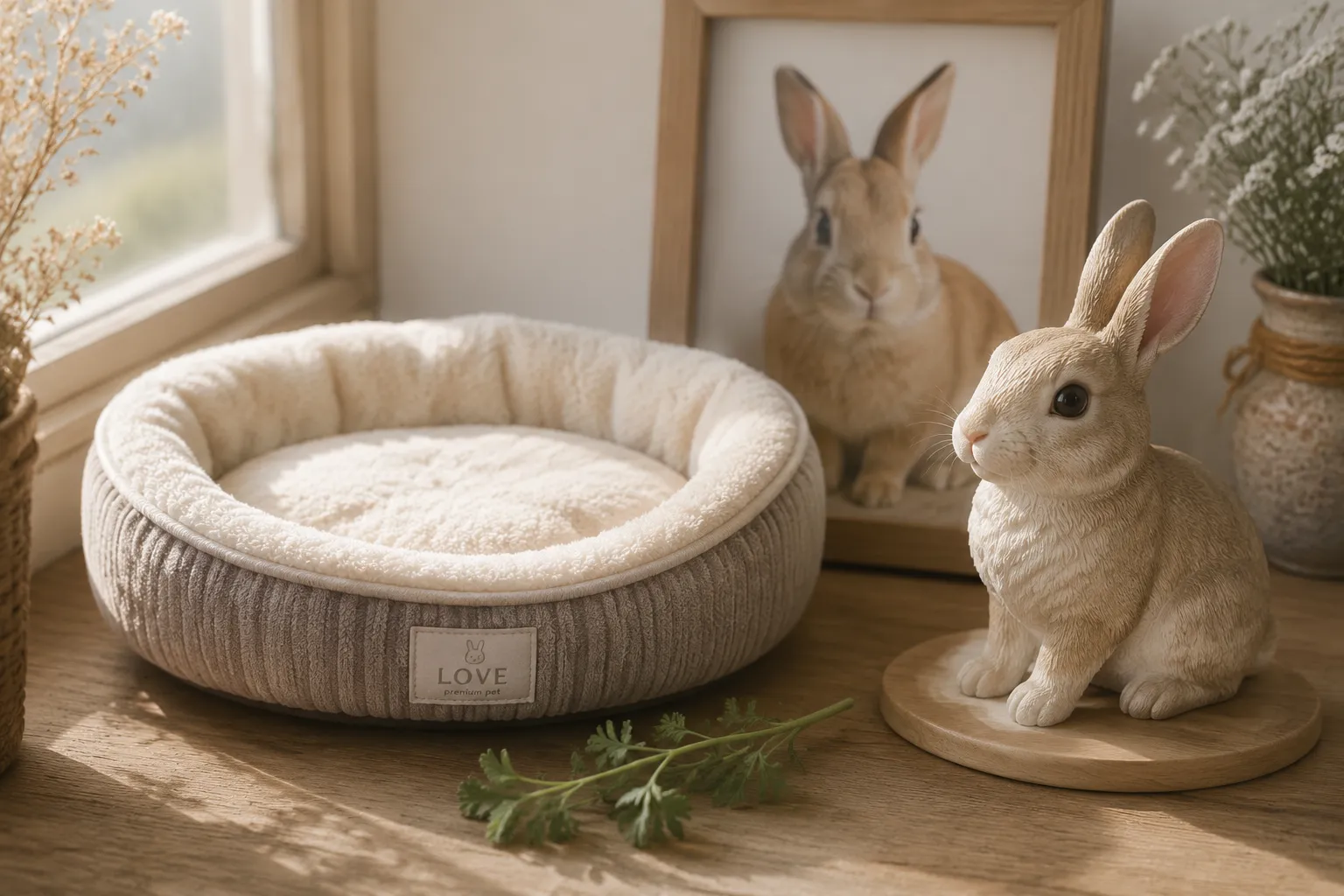
"Everything that has a beginning has an ending. Make your peace with that and all will be well." — Jack Kornfield
The empty hay rack still swings a little when the heater kicks on. Your first pet loss arrives like that, in the smallest movements, in the corner where a rabbit used to fold herself into a loaf of warm fur and shadow.
Quick Takeaways
- Rabbit grief feels disproportionate to outsiders — it isn't, and you don't owe anyone an explanation.
- The "empty bed" ambush is normal — sensory triggers hit hardest in ordinary domestic moments, not big ones.
- Guilt and second-guessing are part of love — they signal devotion, not failure, especially after euthanasia decisions.
- Rituals give grief somewhere to live — from memorial gardens to custom pet figurines that hold a familiar silhouette.
- Impermanence isn't the enemy — it's the thing that made every quiet evening together matter in the first place.
Why Your First Pet Loss Hits Like the Tide Going Out
Here's the thing nobody warns you about. You expect the big cry. You brace for the day it happens. What you don't brace for is the way the grief comes back in with the tide, three days later, while you're refilling a water bottle that doesn't need refilling anymore.
Picture a customer we worked with last spring. She told us she made it through the vet visit, through the burial in the backyard, through the phone calls. Then she walked into the kitchen at 6 a.m. out of pure muscle memory, reached for the bag of greens, and her hand closed on air. That was the moment that put her on the floor.
Rabbits live in the margins of a home. They're not loud. They don't greet you at the door the way a dog does. So their absence is a quiet kind of loud, if that makes sense. The space they occupied was small and specific, and now that small specific space is just... open.
And if this is your first real loss of an animal you loved, the whole experience can feel oversized. Like you've been handed a grief two sizes too big for the relationship the world thinks you had. You catch yourself wondering if you're allowed to hurt this much over a rabbit.
You are. Let's just put that on the table right now. The size of your grief is a receipt for the size of your love, and nobody gets to audit it.
"The size of your grief is a receipt for the size of your love."
There's a spiritual truth buried in this that often gets missed. The bond you had wasn't built on grand gestures. It was built on presence — thousands of ordinary minutes where two different species chose to share the same quiet room. That kind of bond doesn't announce itself until it's gone, and then it's everywhere.
The Tuesday-Morning Phenomenon
Grief researchers and pet-loss counselors talk about how the worst moments aren't scheduled. They ambush. The American Veterinary Medical Association has acknowledged that pet loss can trigger genuine grief responses comparable to losing a human family member, and that includes the strange timing of it all.
You'll be fine at the funeral, so to speak, and undone by a Tuesday morning. By the sound of the heater. By a stray piece of timothy hay you find under the couch in November.
What actually helps here isn't "staying busy." That's the advice everyone gives and it mostly just delays the bill. What helps more is naming the triggers out loud before they catch you. Walk your home. Find the hay rack, the favorite hiding spot, the worn patch on the rug. Say it: "This is going to hurt for a while." Pre-grieving the objects takes some of their ambush power away.

The Philosophy of Impermanence Isn't a Consolation Prize
Most grief articles reach for impermanence as a Band-Aid. "Everything ends, so try to feel better." Honestly? That's a little insulting, and it doesn't work.
The deeper, weirder truth is this. Impermanence isn't the thing that ruined your bond with your rabbit. It's the thing that created it.
Think about it. A rabbit's lifespan runs short and bright — many companion rabbits live somewhere between 8 and 12 years, though plenty leave sooner. You knew, somewhere in the back of your mind, that you were on a clock. And that quiet awareness is exactly what made you stop and watch her do a binky across the living room. It's why you noticed the way the late afternoon light turned her fur a kind of amber-gold against the floor.
Permanent things, we ignore. We assume they'll be there tomorrow. It's the things we know are passing that we actually see.
"We don't cherish what lasts forever. We cherish what we know is leaving."
So the empty bed isn't proof that love was pointless. It's the other half of a sacred contract you signed the day you brought her home — a contract that said: I will love this small, soft, temporary creature precisely because she is temporary.
That's not a consolation prize. That's the whole point.
A Different Way to Hold the Math
There's a reframe we've heard from families that stuck with us. Instead of counting the years you lost, count the days you were chosen. Rabbits are prey animals. Trust isn't their default setting — it's earned, slowly, over months. The fact that yours flopped over on her side next to you and closed her eyes? That's a prey animal declaring, with her whole body, I am safe with you.
You didn't just have a pet. You had the complete, hard-won trust of an animal whose instincts told her to be afraid. That doesn't end. That's a legacy of safety you built, and it lives in the shape of who you became while caring for her.
The Feelings You're Not Supposed to Admit
Okay, real talk. Coffee's getting cold, so let's get into the stuff nobody puts in the sympathy cards.
Guilt That Outlasts the Grief
Guilt is the uninvited guest at every pet funeral. Did I feed her the right pellets? Should I have caught the GI stasis sooner? Was that lump there last month and I just didn't check?
For rabbit owners specifically, the guilt has razor edges, because rabbits hide illness until it's often very advanced. That's an evolutionary survival trait — a sick prey animal that looks sick gets eaten. So by the time you noticed something was wrong, the window may have already been closing. That isn't negligence. That's biology working against you.
We worked with a family whose rabbit died of stasis within 36 hours of the first symptom. The dad kept saying, "I should have known sooner." But there was no sooner. The rabbit's entire design was built to hide it from him. His guilt wasn't a verdict. It was just love with nowhere to go.
"Guilt is often just love that hasn't figured out where to land yet."
Second-Guessing the Euthanasia Decision
If you had to make the call, you're probably replaying it on a loop. Too soon? Too late? Should I have tried one more treatment?
Here's something pet-loss support organizations like the Association for Pet Loss and Bereavement talk about constantly: the timing of euthanasia is the single most common source of complicated grief. And the cruel part is that there's no "right" moment that announces itself. You're making a decision with incomplete information, on behalf of a creature who can't talk, under enormous emotional pressure.
That relief you felt when her suffering finally stopped? It doesn't make you cold. It makes you someone who loved her enough to put her comfort above your own desperate wish to keep her one more day. The guilt that floods in right behind that relief is one of grief's nastiest tricks — punishing you for the most selfless thing you've ever done.
The Isolation of Grieving "Just a Rabbit"
This one stings in a particular way. You go back to work, and someone asks why you look off, and you say your rabbit died, and you watch their face do that small thing. That polite recalibration. Oh. A rabbit.
The lack of cultural permission to grieve a "small" pet is real, and it leaves a lot of rabbit owners feeling like they're mourning in a locked room. You start to wonder if you're being dramatic. You're not. You're just grieving a relationship that the world doesn't have a category for.
Find the people who get it. Online rabbit communities, pet-loss hotlines, a friend who's lost a small animal. You need at least one person who, when you say "she used to grind her teeth when I pet her forehead," understands that you just described the sound of being loved.
Myth vs. Reality: What Everyone Gets Wrong About Pet Grief
We hear the same misconceptions over and over. Let's bust a few.
Myth: "It was just a rabbit, so the grief should be smaller and shorter."
Reality: Grief intensity tracks the bond, not the body size or species. Some of the most profound losses we've witnessed were over animals that fit in two hands. Your nervous system doesn't measure love in pounds.
Myth: "If you really loved them, you won't be ready for another pet for a long time."
Reality: There's no moral timeline. Some people honor their grief by waiting years. Others heal by loving again sooner. Neither is a betrayal. Anxiety about getting another rabbit "too soon" is incredibly common, and wanting to love again is not the same as replacing.
Myth: "Memorializing a pet is morbid or excessive."
Reality: Ritual is how humans have processed loss for all of recorded history. Creating a sacred space for your rabbit isn't clinging — it's the healthy, ancient work of integrating a loss into your life story.
Here's a quick comparison of how the common memorial paths tend to feel, based on what families tell us.
| Memorial Option | Effort Involved | Emotional Texture | Best For |
|---|---|---|---|
| Memorial garden / planting | Moderate, ongoing | Living, seasonal, growing | People who find comfort in tending something |
| Photo book or album | Low to moderate | Nostalgic, story-based | People who process through narrative |
| Custom figurine keepsake | Low (after photos) | Tangible, present, daily | People who miss physical presence |
| Donation in their name | Low | Outward, purpose-driven | People who heal through giving |
| Paw print / fur clipping | Very low | Intimate, raw | People early in acute grief |
There's no winner in that table. The right ritual is the one that fits how you metabolize loss.
Building a Sacred Space: Rituals That Actually Help
Let's get specific, because "find closure" is useless advice and you deserve better.
The 15-Minute Goodbye Ritual
Within the first week, set aside fifteen uninterrupted minutes. Light a candle. Put her favorite blanket or a photo where you can see it. And then — this is the part people skip — say the things out loud. Thank her. Apologize for whatever you're carrying. Tell her what she taught you.
Why does this matter? Because grief that stays trapped in your head loops. Spoken grief moves. There's a reason nearly every human culture has a spoken funeral rite. You're not being silly talking to an empty room. You're doing something your ancestors knew was necessary.
The Memory Anchor
Pick one physical object that holds her presence and decide, intentionally, that this is the thing you keep. Not everything. One thing. A grooming brush. The little ceramic food dish. When you choose one anchor on purpose, you free yourself from the paralysis of feeling like you have to preserve every single item or betray her memory.
This directly targets the fear of forgetting — that specific midnight panic where you realize you can't quite remember the exact pitch of her teeth-grinding purr anymore. An anchor object holds the memory so your brain doesn't have to white-knuckle it.
"You won't forget her. You'll just carry her differently than you did when she was warm."
Capturing the Silhouette While It's Still Sharp
Memory is a watercolor left out in the rain. The specific details — the exact tilt of one ear, the particular brown-and-white map of her markings — start to soften within weeks. This is the part of grief that scares people most, and it's worth getting ahead of.
Some families gather photos into albums. Some commission a portrait. And increasingly, pet parents are turning to tangible keepsakes like custom pet figurines that hold the three-dimensional shape of who their rabbit actually was — the loaf pose, the lop ears, the unrepeatable pattern of color.
We'll talk more about that in a moment, because the how matters as much as the what.
What to Expect When You Memorialize in 3D
Full disclosure: this is what we do, so we know it well. But we'll be straight with you about the process and where it fits, because a figurine isn't right for everyone and we'd rather you find the ritual that actually serves you.
At PawSculpt, a memorial figurine starts with your photos. Master 3D artists digitally sculpt your rabbit's form — the proportions, the pose, the ears, the set of the eyes — and then that digital model is brought to life through full-color 3D printing. The color isn't a coating sitting on top. It's printed directly into the resin itself, voxel by voxel, so your rabbit's markings are part of the material, not a layer that can chip away. A clear protective coat goes on at the end for durability and a gentle sheen.
What you get is honest. It has the vibrant full color of your actual rabbit, with a fine natural print texture and a real sense of dimension. It's not trying to be a glossy mass-produced toy. It's trying to be her.
"A figurine can't bring them back. But it can give your hands something to hold when your arms forget they're empty."
— The PawSculpt Team
What Photos Work Best
Since the whole thing is built from your photos, the photos do the heavy lifting. Here's what we've learned actually matters.
| Photo Element | What Helps | Why It Matters |
|---|---|---|
| Lighting | Soft, natural daylight | Reveals true fur color and markings |
| Angles | 3-5 shots: front, side, top | Lets artists build accurate 3D form |
| Pose | Their signature pose (loaf, flop) | Captures personality, not just looks |
| Focus | Sharp, in-focus details | Preserves markings and ear shape |
| Resolution | Highest available, uncropped | More detail to sculpt from |
If you only have a few blurry phone pictures, don't panic. Our team has worked from imperfect photos plenty of times. But if your rabbit is still with you and you're reading this as a "someday" reader — go take the side profile and the top-down shot today. Your future self will exhale with relief.
The Honest Tradeoffs
A figurine is a daily, physical presence — you'll see it on the shelf every morning. For some people, that's profound comfort. For others, especially in raw early grief, a constant visual reminder is too much, too soon. There's no shame in waiting months before you're ready. Grief has its own clock.
For specific details on turnaround, revisions, and guarantees, it's best to check pawsculpt.com directly, since those details are best explained in full there rather than half-remembered here.
Helping Other Pets — and Yourself — Through the Shift
If your rabbit had a bonded companion, brace yourself, because rabbits grieve too. A surviving bunny may stop eating, sit listlessly, or search the home. This is real, and it's one of the more heartbreaking secondary losses people don't see coming.
Here's a quick reference for what grief can look like in the animals and people left behind.
| Who's Grieving | Common Signs | What Tends to Help |
|---|---|---|
| Surviving bonded rabbit | Reduced appetite, lethargy, searching | Vet check, extra attention, gradual routine |
| Children in the home | Questions, regression, big feelings | Honest simple language, included in rituals |
| The primary caregiver (you) | Ambush grief, guilt, insomnia | Naming triggers, ritual, support community |
| Other household pets | Behavior changes, clinginess | Maintained routine, patience |
A note on the surviving rabbit: many vets recommend letting the bonded partner see and smell their companion's body after passing, when possible. It sounds grim, but it can help them understand the loss rather than search endlessly. We're not vets, though — so please run anything health-related past yours.
And for the kids? Don't reach for "she went to sleep" or "we lost her." Young children take that literally and it breeds anxiety about sleep and getting lost. Use plain words. Let them help with the ritual. A child who plants a flower over a rabbit's grave is learning, in the gentlest possible classroom, that love and loss are stitched together — and that's a lesson that will serve them their whole lives.
When Grief Doesn't Lift: Knowing the Difference
Most acute grief begins to soften within 6 to 12 weeks, not because you've "moved on," but because you've started integrating the loss into your daily life. The empty bed becomes a familiar ache instead of a fresh wound.
But sometimes it doesn't. If after several months you're still unable to function, withdrawing completely, or feeling stuck in the same raw place, that may be complicated grief, and it deserves real support. Pet-loss hotlines and grief counselors exist precisely for this. Reaching out isn't weakness — it's the same instinct that made you a good rabbit parent: noticing when something needs care, and acting on it.
If you ever feel like you don't want to be here anymore, please reach out to the 988 Suicide and Crisis Lifeline (call or text 988). Grief can get heavy enough to need a human voice on the other end, and that's okay.
The Empty Bed, Revisited
Go back to that hay rack swinging in the heater's breath. The dent in the bed. The piece of hay you'll find in November.
Here's what changes, given time. That empty space stops being a wound and starts being a kind of altar. The dent in the bed becomes proof that someone soft and trusting once chose your home as the safest place in her short, bright world. The absence stops shouting and starts whispering — and what it whispers is thank you.
Impermanence gave you a rabbit for a season, not forever. That was always the deal. And the first pet loss you survive teaches you the thing that every spiritual tradition has tried to say: that love and letting go aren't opposites. They're the same gesture, held at two different moments.
Your one specific, actionable next step? Tonight, write down three things she taught you. Not three things you miss — three things you learned. That list is her legacy, and it's the part of her that the tide can never pull back out.
She was here. You loved her well. The empty bed is the price of that, and it was always, always worth paying.
Frequently Asked Questions
How long does grief after losing a first pet last?
Acute grief typically begins easing within 6 to 12 weeks, but waves can resurface for months or even years, especially around anniversaries. There's no "correct" timeline, and the goal isn't to stop missing them — it's to slowly integrate the loss into your daily life.
Is it normal to feel guilty after my rabbit dies?
Completely normal, and especially common with rabbits. They instinctively hide illness until it's advanced, so owners frequently feel they "should have known sooner." That guilt is love with nowhere to go, not evidence that you failed.
Why does losing a rabbit feel so overwhelming when others see it as "just a pet"?
Because grief tracks the depth of your bond, not the animal's size or species. Rabbits are prey animals whose trust is earned slowly, so their companionship represents a hard-won connection. The world's lack of a category for it doesn't make your grief any less valid.
Is it wrong to feel relief when their suffering ended?
Not at all. Relief means you loved them enough to prioritize their comfort over your own wish to keep them longer. The guilt that often follows relief is one of grief's cruelest tricks, and feeling both at once is deeply human.
How can I preserve my rabbit's memory before the details fade?
Memory softens within weeks, so capturing details early helps. Many families gather photos, create albums, keep a memory anchor object, or commission a keepsake like a 3D pet sculpture that holds their pose and markings in physical form.
When is it okay to adopt another rabbit?
There's no universal timeline. Some people honor their grief by waiting; others heal by loving again sooner. Anxiety about getting another pet "too soon" is common, but loving a new companion never erases or replaces the one you lost.
Ready to Celebrate Your Pet?
Every pet has a story worth preserving. Whether you're making peace with your first pet loss or honoring a rabbit who taught you what quiet, trusting love feels like, a custom PawSculpt figurine captures the details that made them unmistakably them — the pose, the markings, the silhouette your hands still remember.
Visit pawsculpt.com to learn more about our process, preview turnaround, revisions, and quality guarantee.