
That First Sleepless Night: Writing to the Persian Whose Photo You Can't Put Down
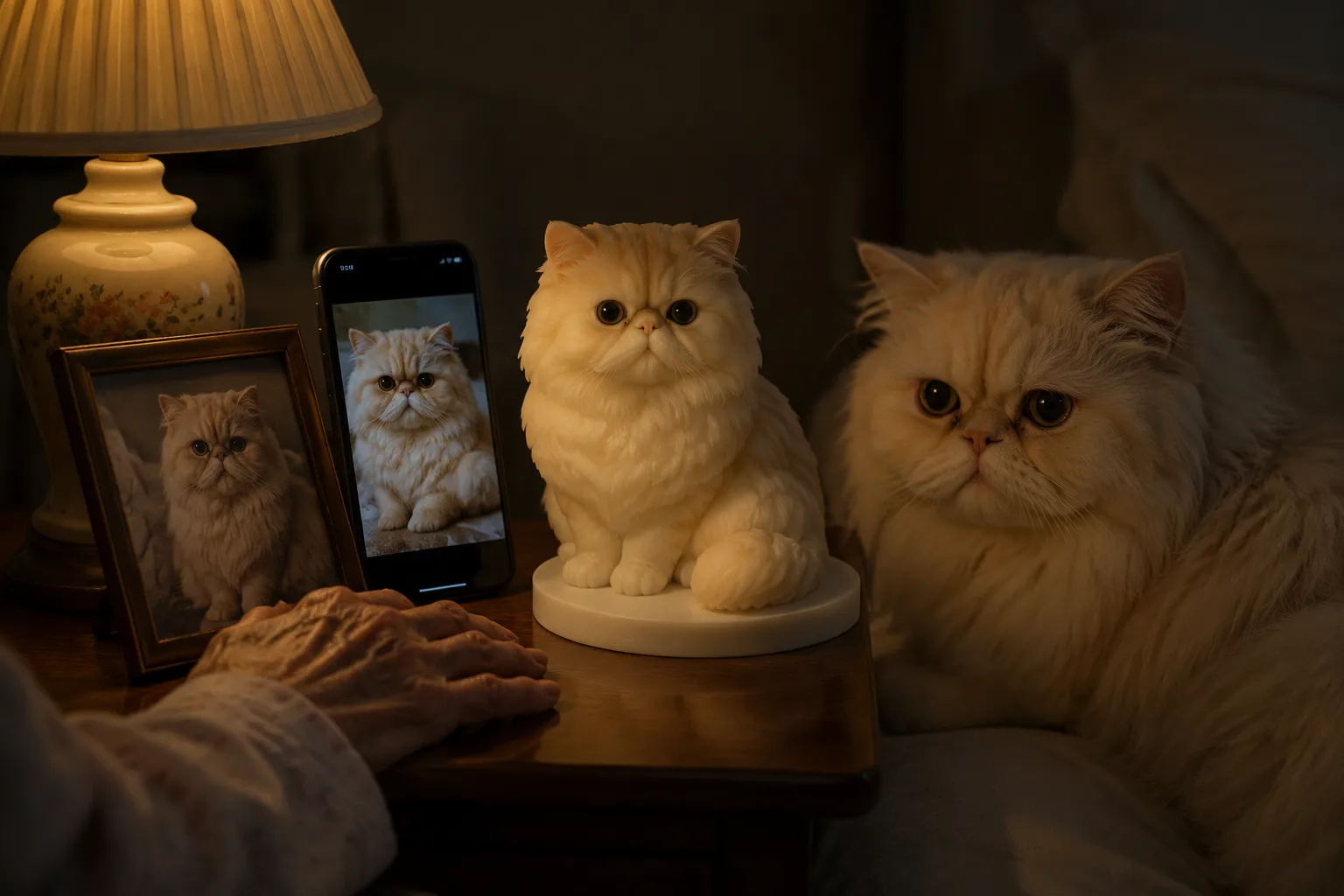
Your phone lights up the dark porch, and there she is — that silver Persian who used to pour herself across your lap like warm fog. Persian cat loss does something cruel: it turns a photo you can't put down into the longest night of your life.
Quick Takeaways
- Write a letter to your cat tonight — naming what you can't say out loud loosens grief's grip faster than scrolling photos
- The 3am photo loop deepens the wound — looking is passive; writing gives the ache somewhere to go
- Guilt and relief can live in the same breath — both are normal, neither makes you a bad person
- Turn a favorite photo into something you can hold — many families find comfort in custom pet figurines that bring a treasured image into three dimensions
- The first night is the worst night — it gets quieter, not because you forget, but because you learn to carry it
Why That First Night Hits Different
Here's the thing nobody mentions when they hand you the condolence card. The first night after Persian cat loss isn't sad in the way you expect. It's loud.
Not loud with sound. Loud with absence.
You notice the spot at the foot of the bed where her weight used to settle around midnight. The little chirp she'd make when she jumped down for water — gone, and somehow the not-hearing-it is louder than the chirp ever was. Persians do this to you. They're presence cats. They don't hide under furniture; they install themselves into the center of your days, all that long fur and slow blinking and the way they breathe a little heavier than other cats. So when they go, the shape of the missing is enormous.
And then there's the phone.
You've got hundreds of photos. We know, because almost every family we've worked with tells us the same thing — they spent that first night scrolling. The video where she's batting at a ribbon. The one where she's asleep in the laundry basket, one paw over her face. You zoom in. You stare. You play it again.
Here's the counterintuitive part: that scrolling, the thing that feels like staying close to her, often makes the first night harder, not softer.
"The photo on your phone keeps her frozen. A letter lets you keep talking to her."
We're not saying put the phone away. We'd never tell a grieving person to stop looking at their cat. But there's a difference between receiving her image over and over and reaching toward her with your own words. One is a loop. The other is a door.
The looping is what keeps you up. You watch, the ache spikes, you watch again to soothe it, the ache spikes again. By 4am you're raw and you haven't moved an inch through the grief. You've just been pressing on the bruise.
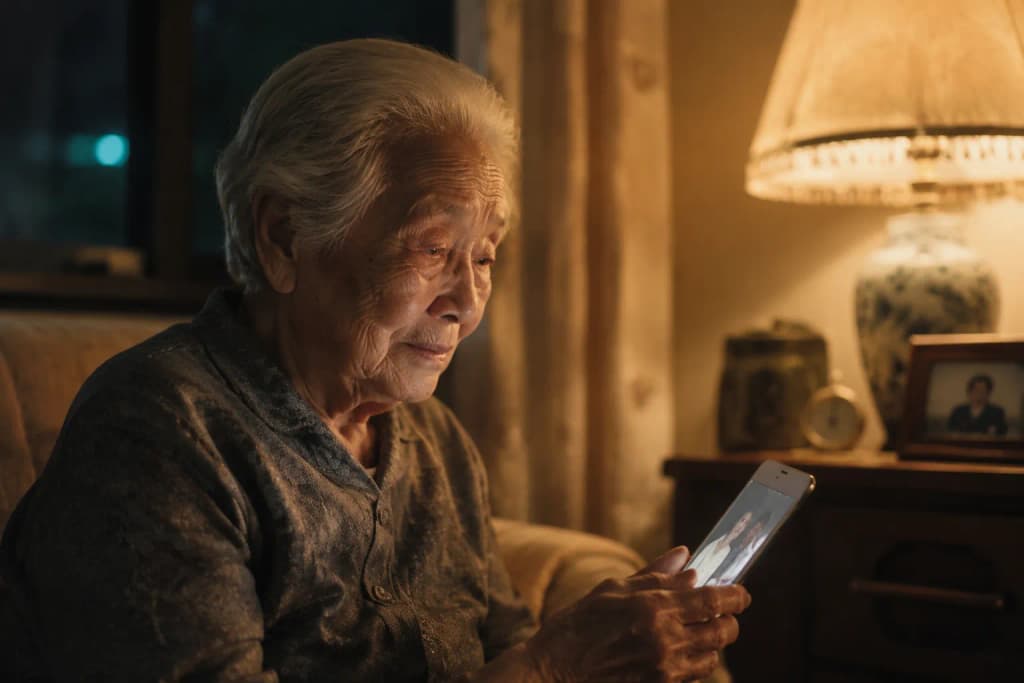
Writing to the Persian Whose Photo You Can't Put Down
So put the photo beside you — don't hide it — and write to her instead.
This isn't a journaling trick from a wellness blog. It's older and simpler than that. People have written to the dead for as long as people have buried them. Grief journaling on the first night works because grief is energy that needs a direction, and a blank page gives it one.
You don't need to be a writer. You don't need full sentences. One family we worked with showed us a page their grandmother had written the night her Persian, Sasha, died — it was three lines, the handwriting shaky, and it said more than any eulogy. "You were warm. The bed is cold now. I would do it again, every single year, even knowing this part."
That's it. That's the whole practice.
What to actually write (when your mind is blank)
Staring at a blank page at 2am is its own kind of cruelty. So here are prompts that tend to crack things open. Pick one. You don't need all of them.
| Prompt | What it helps with | Best for |
|---|---|---|
| "The thing I'll miss most about your fur is..." | Anchoring grief in the body, in touch | When the ache feels too big to name |
| "I need to tell you about the day you..." | Returning to a specific, happy scene | When you're stuck in the death and can't reach the life |
| "I'm sorry for..." | Releasing guilt safely, without judgment | When you keep replaying decisions |
| "Thank you for the morning you..." | Shifting from loss to gratitude | When you're ready, usually after the worst of it |
| "I'm angry that..." | Giving anger a place to land | When grief feels like rage and you feel ashamed of it |
Notice that last one. We'll come back to it.
The point of these isn't to feel better by morning. The point is to move the grief from a loop into a line — to give it a beginning and a middle, even if the end is a long way off. When you write "I'll miss your fur," your brain does something it can't do while scrolling: it tells a story. And stories, unlike loops, have somewhere to go.
So what? So you might actually sleep. Maybe not tonight. But the families who write tend to tell us the nights got walkable faster than the ones who only scrolled.
The Feelings Nobody Warns You About
Let's be real about what's swimming around in you tonight, because some of it is going to feel shameful, and almost none of it should.
The relief you're not supposed to feel
If your Persian was old, or sick, or if the last weeks were a blur of medications and litter box accidents and that terrible math of "is today the day" — you might have felt something when it ended that you'd never say out loud.
Relief.
That wave of relief when the suffering stopped doesn't make you cold. It makes you someone who loved her enough to want her pain over more than you wanted her here. The guilt that comes chasing after that relief is one of grief's nastiest tricks. It tells you that being glad the hard part is done means you wanted her gone. It's lying to you.
You can be devastated she's gone and relieved she's no longer struggling in the very same breath. Grief doesn't run on one track. It runs on six at once.
The second-guessing that won't quit
Did you wait too long? Did you not wait long enough? Should you have tried the other treatment, the second opinion, the specialist three towns over?
Second-guessing the timing of euthanasia is nearly universal, and it almost never reflects a real mistake. It reflects love that has nowhere to go now that the decision is made. The Association for Pet Loss and Bereavement has built entire support networks around exactly this kind of replaying, because it's that common — you can find their resources through the APLB if the loop gets loud.
Here's what we've learned from thousands of families: the people who agonize over whether they chose the right moment are, without exception, the people who chose out of love. The ones who don't think twice are rarely the ones grieving this hard.
The anger
Maybe you're not sad right now. Maybe you're furious. At the vet. At yourself. At the cat, even, for getting old, for getting sick, for leaving. At people who still have their pets curled up beside them.
Anger is grief wearing armor. It's allowed. Write it down (remember that prompt?). Better the page than your own chest.
When it's complicated
And sometimes — this one's rarely said — the relationship was hard. Maybe she scratched the furniture to ribbons, sprayed when she was anxious, kept you up for years. Maybe you loved her and were also exhausted by her. Grieving a difficult pet is its own tangled thing, and the love is no less real for being complicated. You're allowed to miss something that also drove you crazy. Most of the deepest loves are like that.
"Grief isn't proof you did everything right. It's proof you loved at all."
A Counter-Point: When Writing Isn't the Answer
We'd be doing you a disservice if we pretended the letter fixes everything. It doesn't. And for some people, on some nights, it's the wrong tool entirely.
If putting words to the loss makes you spiral — if the page becomes another loop, each sentence sharper than the last — close the notebook. Some grief is pre-verbal. It lives in the throat and the hands, not in language, and trying to force it into sentences can feel like prying open a wound that needs to stay closed for now.
On those nights, the body knows better than the page. Wrap up in the blanket that still holds her smell (yes, smell it — we'll talk about that). Sit on the porch. Let the cold air do the work words can't. Movement and touch and plain old crying are not lesser forms of grieving than journaling. They're just the ones that don't ask you to narrate your pain while you're drowning in it.
The letter is a tool, not a prescription. If it helps, beautiful. If it doesn't tonight, try it next week. Grief isn't a test you can fail.
For the Elderly Owner: When the House Goes Quiet
Some of you reading this are alone in a way that's hard to say plainly. Your Persian wasn't just a pet. She was the reason you got up. The warm body in a house that's been too quiet since the kids moved out, since your husband passed, since the phone stopped ringing as often.
Elderly owner grief after losing a pet is uniquely heavy, and it's chronically underestimated by everyone around you. People say "it was just a cat," not understanding she was the structure of your entire day. She was the morning routine, the lap during the news, the small living warmth in the bed at night.
We worked with a gentleman in his eighties — we'll keep his name to ourselves — who told us his Persian had been the only one who heard him talk for the last four years. The vet, the figurine, the photo on his phone: those were the only times anyone listened to him describe her. That undid us a little.
If this is you, here's the most concrete thing we can offer: don't let the routine collapse entirely in the first week. Keep the morning coffee on the porch even though the lap is empty. Keep the 6pm feeding time as a 6pm something — a walk, a call, a cup of tea. The structure she gave you was real and good for you, and losing it all at once is its own second grief. Hold the scaffolding even after the building is gone.
And reach out. Pet loss support lines exist specifically for people who feel they can't tell anyone "it was just a cat." Because it was never just a cat. It was your whole quiet world.
"It was never just a cat. It was the warm center of an entire ordinary life."
The Smell Is the Last to Leave
Let's talk about the thing that ambushes you when you least expect it.
You'll open a closet, or pick up a sweater, or press your face into her favorite blanket, and her scent will hit you — that particular warm, slightly dusty, faintly sweet smell that only Persians seem to have, all that fur holding the heat of her. And you'll come undone in the cereal aisle of your own memory.
Smell is wired directly into the oldest, most emotional parts of the brain — it skips the rational mind entirely and goes straight for the heart. That's why a scent can drop you to your knees when a photo only makes your eyes sting. The scientists at the NIH have studied this human-animal bond and the way our senses anchor it; the short version is that your body remembers her in ways your conscious mind can't reach.
Here's our gentle, hard-won advice: don't wash the blanket yet. Seal it in a bag if you have to, to make the scent last. There's no rush. One day, months from now, you'll open it and instead of grief you'll feel something closer to a hug. The scent becomes less of a wound and more of a visit. But that takes time, and you can't rush it, and you definitely shouldn't scrub it away in the raw first week because someone told you to "clean up and move on."
The texture of memory is physical. It's the weight of her at the foot of the bed, the smell in the blanket, the specific softness of that ridiculous Persian fur. These are the things we're really mourning — not an abstraction, but a body we loved.
From a Photo on Your Phone to Something You Can Hold
So here's where the photo you can't put down becomes something more than a loop.
There's a reason humans have made objects of their lost loved ones for thousands of years — lockets, portraits, urns shaped like the thing we miss. Grief needs an anchor. Something with weight. Something your hands can hold at 3am when your hands are the part of you that misses her most.
A photo is light. It glows and then it's gone when the screen sleeps. But a tangible keepsake stays. You can set it on the porch table where she used to sun herself. You can hold it. You can feel its weight, and weight is the thing grief is starving for.
Families find that anchor in different places. Some plant a memorial garden. Some keep a paw print in clay. Some commission a small painting. And increasingly, pet parents are turning a beloved photo into a custom pet figurine — bringing that exact image, the one you can't stop looking at, into three dimensions you can hold in your palm.
At PawSculpt, that's the thing we actually do. We take your favorite photo and our master 3D artists digitally sculpt your cat from it, then bring it to life through full-color 3D printing — the color is printed directly into the resin, voxel by voxel, so her silver fur and her specific markings live in the material itself, not as a coating on top. The result has a real, authentic texture, finished with a protective clear coat. It's not plastic-perfect. It's her.
"We've watched grief soften the moment someone's hands close around the shape of their cat. The page heals the mind. Weight heals the hands."
— The PawSculpt Team
We won't pretend an object fixes the hole. Nothing does. But we've seen what it gives people — a place to put the love now that the lap is empty.
What makes a photo work for a keepsake
If you do decide to turn that photo into something you can hold, here's what we've learned actually matters, from working with thousands of pet families:
| What helps | Why it matters | The fix if you don't have it |
|---|---|---|
| Good, even light | Shadows hide the markings that make her her | A few photos in different light beat one perfect one |
| Eye-level angle | A shot from above flattens her face | Crouch to her level — even an old phone shot works |
| Her natural pose | Captures personality, not just appearance | The "drape across the lap" pose says more than a posed one |
| Clear view of fur patterns | Persian markings are the whole story | Multiple angles let the artists fill in what one photo can't |
| Sharp focus on the face | The eyes are everything | A slightly blurry full-body shot is fine if the face is clear |
The honest truth? Don't agonize over having the perfect photo. The families who worry they don't have a good enough image almost always do. A handful of ordinary phone pictures from different angles usually tells our artists everything they need. The point was never studio quality. The point was her.
What to expect, without the fine print
We get asked about turnaround, revisions, and cost a lot, and here's our straight answer: those details shift, and we'd rather you see the current specifics than trust a number in a blog post that might be out of date. You can find all of that on pawsculpt.com.
What we can tell you about the process, in general: you share your photos, our artists digitally model your cat, you get to see a preview before anything is finalized, and there's room to refine the details until it feels right. The technology means her colors won't fade the way a print might — the resin is UV-resistant and the color is part of the material. That's the part that matters for a keepsake meant to outlast the grief.
A Rough Map of the Nights Ahead
You want to know when this gets easier. We can't give you a date — nobody honest can — but we can tell you the shape of it, based on the families who've walked it before you.
| When | What it tends to feel like | What helps |
|---|---|---|
| The first night | Loud absence, the photo loop, no sleep | Write the letter; keep the blanket; don't be alone if you can help it |
| First week | Routine collapse, ambush moments, guilt waves | Hold the daily scaffolding; tell someone "it wasn't just a cat" |
| Weeks 2–6 | Quieter but heavier; the "firsts" hurt (first vet bill not coming, first empty bed) | Let the scent visits come; consider a tangible keepsake |
| Months 2–6 | Grief becomes carryable; smell brings comfort more than pain | Memorial rituals; the figurine on the porch table |
| Beyond | She's woven in, not gone; you smile before you ache | Talk about her; the love outlives the loss |
This is a map, not a schedule. Some people loop back. Some skip ahead. Grief is not a staircase — it's weather. Some days the sun comes out and you forget to brace, and then a smell or a song rolls a storm back in. That's not backsliding. That's just how love behaves when it has nowhere left to land.
The Porch, Again
Go back to the porch. The phone, the photo, the longest night.
Months from now — and we promise you this, because we've watched it happen to family after family — you'll be sitting in that same chair. Maybe there's a small figurine of her on the table, catching the late light the way she used to. Maybe it's just the blanket, still holding the faintest trace of her warm fur. The morning coffee is still there. The 6pm something is still there.
And one morning you'll realize you smiled before you ached. That the photo on your phone makes you laugh now, at the ribbon, at the laundry basket, before it makes you cry. That the letter you wrote on the worst night is something you can read without falling apart.
The love didn't go anywhere. It just changed shape, the way warm fog does when the morning sun hits the porch — there, then everywhere, then part of the air you breathe. Tonight is the longest night. Write to her. Keep the blanket. Hold something with weight in your hands. And know that the silver Persian whose photo you can't put down isn't asking you to stop looking. She's just waiting for you to remember that she was always more than an image on a screen.
She was warm. And you loved her. And that doesn't end tonight.
Frequently Asked Questions
Is it normal to feel relief after my cat dies?
Yes, completely. If your Persian was sick or elderly, that wave of relief when the suffering ended means you loved her enough to put her comfort above your own need to keep her close. The guilt that chases that relief is one of grief's cruelest tricks — it's lying to you. You can be heartbroken and relieved in the same breath.
How does writing a letter to my deceased pet actually help?
Grief is energy that needs a direction. Scrolling photos keeps you in a loop — the ache spikes, you look again, it spikes again. Writing gives that ache a line instead of a loop, a beginning and a middle. It won't fix the loss, but the families who write tend to find the nights become walkable sooner.
Why is that first night without my cat so unbearable?
Because it's loud with absence. The weight that used to settle at the foot of the bed, the chirp at midnight, the warmth — all of it is suddenly a shaped hole. And the phone, full of photos, often makes it worse by keeping you in a loop rather than letting you grieve forward.
Should I keep my cat's blanket without washing it?
If the scent brings you comfort, keep it — seal it in a bag if you need the smell to last. Smell is wired straight into the emotional brain, so while it may level you in the raw early days, it often becomes more of a visit than a wound as months pass. There's no rush, and no one should pressure you to "clean up and move on."
I'm elderly and lived alone with my cat. How do I cope with this quiet?
Don't let your whole routine collapse in the first week. Keep the morning coffee, keep the 6pm feeding time as a 6pm something. The structure your cat gave your day was real and good for you, and losing all of it at once is a second grief. Reach out to a pet loss support line — your loss was never "just a cat."
What photo should I use to remember my Persian?
Don't agonize over finding the perfect one. A handful of ordinary phone photos from different angles, at eye level with good light, almost always captures more than one posed studio shot. If you're turning a photo into a keepsake, clear views of her face and fur markings matter most.
Ready to Honor Your Persian's Memory?
That photo you can't put down deserves to be more than light on a screen. After Persian cat loss, many families find that holding something with real weight — a keepsake that brings their cat's exact markings and personality into three dimensions — gives their love a place to rest. A custom PawSculpt figurine takes your favorite photo and brings it to life through full-color 3D printing, capturing the details that made her unmistakably hers.
Visit pawsculpt.com to explore our process, preview options, revisions, and quality guarantee