
How Full-Color Resin Printing Captures What a Photograph of Your Boxer Cannot
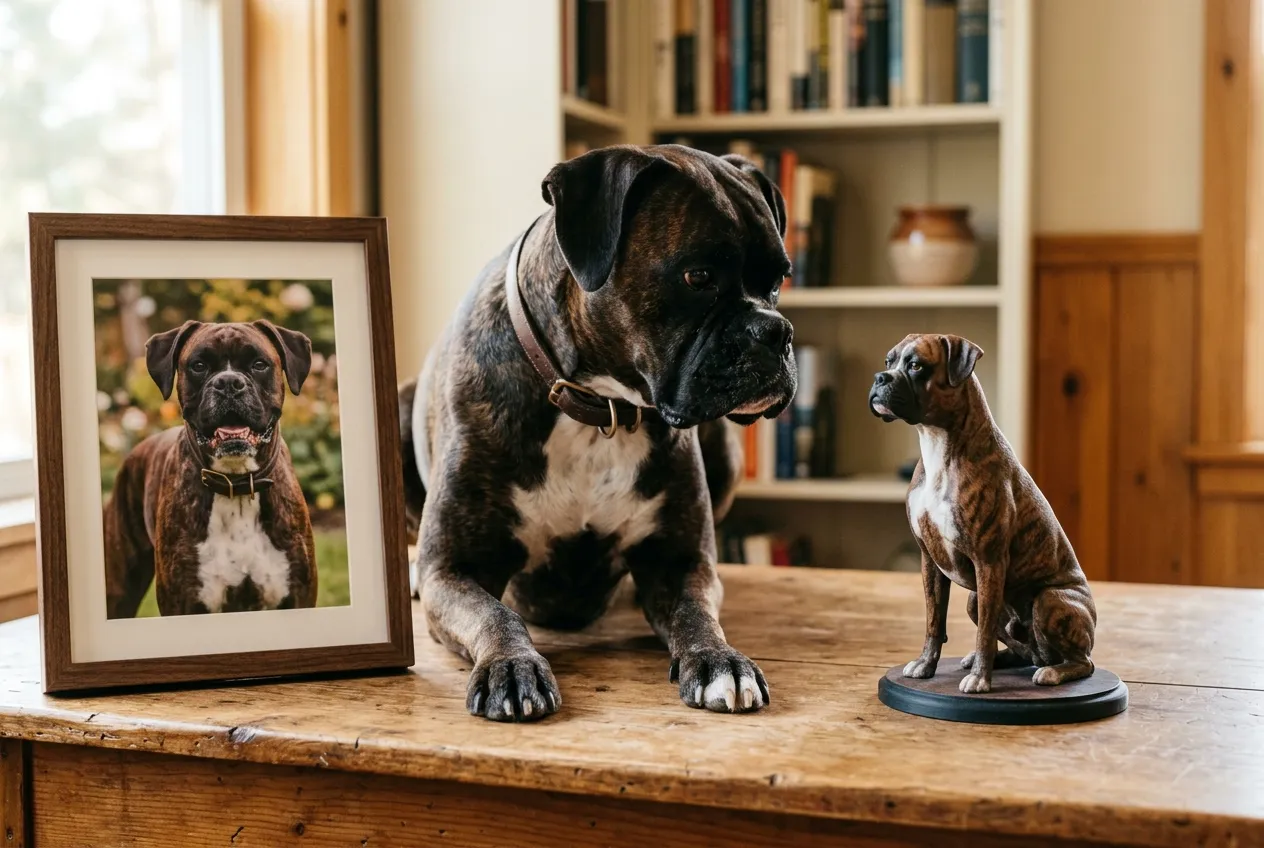
The worn rubber grip of a tennis ball, still damp, sitting on the counter of a pet store—you pick it up without thinking, and your thumb finds the exact groove your Boxer's teeth carved into it. That texture holds more of her than any photograph on your phone ever could. And that gap between what a camera captures and what your hands remember is exactly where a full-color 3D printed pet figurine starts to make sense.
Quick Takeaways
- Photographs flatten your Boxer into two dimensions — a figurine restores the volume, weight, and physical presence your hands remember
- Full-color resin 3D printing embeds pigment directly into the material — colors won't chip, peel, or fade the way surface-applied paint does
- The best reference photos aren't the prettiest ones — slightly imperfect, well-lit shots from multiple angles produce the most accurate figurines
- A custom figurine activates touch-based memory pathways that flat images can't reach — explore the process at PawSculpt to see how it works
- Digital sculpting allows infinite revision before printing — proportions, ear set, and even coat wrinkle patterns get refined before a single drop of resin cures
Why Your Brain Knows the Difference Between a Photo and a Physical Object
Here's something most people don't think about. When you look at a photograph of your Boxer, your visual cortex does the heavy lifting. It processes color, contrast, composition. But when you hold an object—when your fingers wrap around something with weight and texture and dimension—your brain recruits an entirely different network. Somatosensory cortex. Motor memory. The same pathways that fire when you scratch behind her ears or rest your palm on the warm barrel of her ribcage.
Neuroscientists call this haptic perception, and it's not a minor footnote in how we form emotional bonds. Touch-based memories are encoded differently than visual ones. They're stickier. More resistant to decay over time. This is why you can forget what a room looked like but still remember exactly how a doorknob felt in your hand twenty years later.
A photograph gives you one channel: sight. A 3D printed resin pet sculpture gives you three: sight, touch, and spatial presence. Your Boxer occupied space. She had mass. She displaced air when she walked into a room. A flat image on a screen or in a frame can never replicate that, no matter how many megapixels you throw at it.
And this is the counterintuitive part—the thing you won't find in most articles about pet keepsakes. The emotional value of a figurine isn't primarily about how it looks. It's about how it feels in your hand. The weight. The texture of the cured resin under your thumb. The way it sits on a shelf and catches light differently depending on where you're standing. These are the qualities that trick your limbic system into a moment of recognition. Not "that looks like her." Something deeper. Something closer to "she's here."
How Full-Color Resin 3D Printing Actually Works (No, It's Not What You Think)
Most people hear "3D printed" and picture a cheap plastic trinket from a mall kiosk. Let's fix that, because the technology behind a custom dog figurine process like PawSculpt's is genuinely fascinating—and understanding it helps you appreciate why the results look the way they do.
Stage One: Digital Sculpting
Everything starts with your photos. A skilled 3D artist opens software like ZBrush or Blender—tools used in Hollywood visual effects and AAA video games—and begins building your Boxer from scratch in digital space. Not tracing. Not running a photo through a filter. Actually sculpting, vertex by vertex, the topology of your dog's face.
This is where breed knowledge matters enormously. Boxers have specific anatomical signatures that a generic "dog modeler" might miss:
- The brachycephalic muzzle with its characteristic underbite and visible lower canines
- Deep-set wrinkles across the forehead that shift depending on expression
- The broad, flat skull with a distinct stop (the angle where forehead meets muzzle)
- Muscular, square-jawed proportions that can easily tip into looking like a Bulldog or Pit Bull if the artist isn't careful
- Cropped vs. natural ears, which dramatically change the silhouette
The artist cross-references your photos constantly. They're checking proportional ratios—is the distance from eye to ear correct relative to muzzle length? Does the chest depth match the leg length? Boxers are deceptively tricky because their musculature is so visible under that short coat. Get the deltoid wrong by a few millimeters and the whole stance feels off.
This digital sculpting phase is where most of the artistry lives. And here's what makes it powerful: everything is adjustable before any physical material is committed. Don't like the ear set? Move it. Want the tail slightly higher? Done. This flexibility is something traditional sculpture can't match without starting over.
Stage Two: Full-Color Printing
Once the digital model is approved, it goes to the printer. And this is where things get technically interesting.
Full-color resin 3D printing (sometimes called PolyJet or multi-jet fusion style printing) doesn't work like your home inkjet printer scaled up. It deposits microscopic droplets of UV-curable photopolymer resin—think of it as liquid plastic that hardens when hit with ultraviolet light—in layers often in the 25–50 micron range. That's roughly half the width of a human hair per layer.
Here's the critical part: the color is mixed into the resin itself. Each tiny voxel (a 3D pixel) can be a different color. The machine isn't printing a white shape and then painting it afterward. It's building your Boxer's brindle pattern, her black mask, the pink of her tongue, and the warm brown of her eyes simultaneously, from the inside out. The pigment is literally part of the structural material.
| Feature | Full-Color Resin 3D Print | Traditional Painted Figurine | Photograph |
|---|---|---|---|
| Color Method | Pigment embedded in resin during printing | Surface paint applied after sculpting | Light captured by sensor |
| Dimensionality | Full 3D with accurate volume | Full 3D with accurate volume | Flat 2D |
| Tactile Experience | Textured resin surface, weighted | Smooth painted surface | None (glass/screen) |
| Color Durability | Color is structural—won't chip or peel | Paint can chip, fade, or yellow | Prints fade; screens degrade |
| Customization | Infinite digital revision before printing | Limited by sculptor's manual skill | Fixed at moment of capture |
| Captures Movement | Can freeze any pose digitally | Can freeze any pose manually | Limited to shutter speed |
This matters for longevity. Surface-applied paint can chip. It can yellow. It can flake if the figurine gets knocked off a shelf (and if you have a Boxer, you know things get knocked off shelves). With full-color resin printing, the color goes as deep as the material itself. There's nothing to peel away.
Stage Three: Post-Processing
After printing, the figurine goes through several steps that separate a raw print from a finished piece:
- Support removal — During printing, the machine builds temporary scaffolding to hold overhanging features (think: a lifted paw or a tail mid-wag). These supports get carefully removed, and any small marks—called support pitting—are cleaned up.
- Washing — Uncured resin gets rinsed away, typically with isopropyl alcohol or a specialized cleaning solution.
- UV curing — The piece goes into a curing chamber where additional UV light fully hardens the resin. Under-curing leaves the surface tacky and weak. Over-curing can make it brittle and cause yellowing or bloom (a hazy white film on the surface). Getting this right is a calibration game.
- Clear coat application — This is the one manual finishing step. A protective clear coat gets applied to seal the surface, add a subtle sheen, and protect against UV degradation over time. Think of it like the varnish on a painting—it doesn't add color, it preserves what's already there.
No brushes. No acrylics. No hand-painting. The color you see is the color the machine printed.
"Every wrinkle on a Boxer's face tells a different story. Our job is making sure the resin remembers each one."
— The PawSculpt Team
The Photograph Problem: What Your Camera Actually Loses
You've got hundreds of photos of your Boxer on your phone. Maybe thousands. And yet—be honest—how many of them actually look like her?
This isn't a failure of your photography skills. It's a fundamental limitation of the medium. Cameras make decisions your eyes don't. They compress dynamic range. They flatten depth. They freeze a single instant from a single angle and call it a representation.
Your Boxer's brindle coat is a perfect example. In person, those stripes shift and shimmer as she moves. The dark stripes catch shadow differently than the fawn base. The pattern wraps around her ribcage in three dimensions, following the contour of muscle underneath. In a photograph, all of that collapses into a flat pattern. The stripes become decoration rather than topology.
What Photographs Flatten
- Muzzle depth — A Boxer's face is dramatically three-dimensional. The underbite, the jowls, the way the nose sits forward of the eyes. Front-facing photos make this look compressed. Side profiles lose the symmetry. Neither captures the actual volume.
- Ear texture — Whether cropped or natural, Boxer ears have a specific thickness and curl. Velvet-soft on the inside, slightly coarser on the back. A photo shows you the shape. It can't show you the feel.
- Muscle definition — Boxers are athletes. Their shoulders, haunches, and chest have visible musculature under that short coat. Photographs flatten this into shading. A figurine preserves it as actual surface topology.
- The "Boxer lean" — If you know, you know. That full-body lean they do against your leg. The weight distribution, the slight curve of the spine. A photo might catch the pose, but it can't convey the physics of it.
"A photograph is a souvenir of a moment. A figurine is a souvenir of a presence."
And here's where attachment theory gets interesting. Psychologist John Bowlby's work on attachment bonds showed that physical proximity and touch are foundational to how we form and maintain emotional connections—not just with other humans, but with animals too. When that physical presence is removed (through loss, distance, or simply the passage of time), we experience what Bowlby called proximity-seeking behavior. You reach for the leash. You glance at the spot by the couch. Your hand drops to your side expecting to find a head there.
A photograph doesn't satisfy that seeking behavior. It's visual only. But an object with weight, texture, and three-dimensional form? It gives your hands somewhere to land. It doesn't replace her. Nothing does. But it occupies physical space in a way that acknowledges she did too.
What Makes a Great Reference Photo (And Why Your Favorite Picture Probably Isn't It)
This is the section where we challenge what you think you know. Because the photo you'd frame and hang on the wall? It's probably not the best photo for creating a Boxer dog figurine custom piece. And the reason comes down to what a 3D artist actually needs versus what makes a good Instagram post.
The Photographer's Best vs. The Sculptor's Best
A beautiful photograph often relies on shallow depth of field (that blurry background effect), dramatic lighting, and a single flattering angle. These are exactly the things that make a 3D artist's job harder.
What a digital sculptor actually needs:
- Even, diffused lighting — Natural daylight on an overcast day is ideal. Harsh shadows hide surface detail. Flash washes out color accuracy.
- Multiple angles — Front, both sides, three-quarter view, top-down, and rear. Yes, the butt shot matters. The way your Boxer's tail set connects to her spine affects the entire rear silhouette.
- Sharp focus across the entire body — That gorgeous bokeh portrait where only the eyes are sharp? Useless for modeling the ear shape or paw structure.
- Neutral background — Not for aesthetics, but because colored backgrounds cast reflected light that shifts your dog's apparent coat color.
- Natural, relaxed posture — Action shots are fun but blurry. Posed show-stack positions look stiff. The sweet spot is your dog just... being herself. Standing in the yard. Sitting on the porch. The pose she defaults to when she's comfortable.
| Photo Quality Factor | What Looks Good on Instagram | What a 3D Sculptor Needs |
|---|---|---|
| Lighting | Golden hour, dramatic shadows | Even, diffused, no harsh shadows |
| Focus | Shallow depth of field (blurry background) | Sharp focus across entire body |
| Angle | Single flattering angle | 5-8 angles covering all sides |
| Background | Aesthetic, colorful settings | Neutral (avoids color cast on coat) |
| Pose | Action shots, dramatic moments | Natural resting posture, relaxed stance |
| Expression | Tongue out, mid-bark, playful | Calm, neutral face (easier to match anatomy) |
The Brindle Challenge
Boxers present a specific challenge that, honestly, most figurine articles never mention. Brindle patterning is not symmetrical. The stripe pattern on your Boxer's left side is different from her right side. It wraps uniquely around her chest. It fades differently near her belly.
For a full-color 3D print to capture this accurately, the digital artist needs clear reference for both sides of the body. One side photo isn't enough. And because the printing process embeds color directly into the resin voxel by voxel, the accuracy of that brindle mapping directly determines how recognizable the final figurine will be.
This is also why the digital sculpting phase matters so much. The artist isn't just modeling a generic Boxer shape and slapping a brindle texture on it. They're mapping your specific dog's pattern onto the 3D geometry, adjusting for how the stripes stretch over the ribcage, compress in the wrinkles, and thin out along the legs.
If you're considering a custom pet figurine from PawSculpt, the single most impactful thing you can do is invest ten minutes in taking deliberate reference photos. Not your best photos. Your most informative ones.
A Quick Photo Checklist
- Phone camera is fine—just clean the lens (seriously, this matters more than you think)
- Shoot at your dog's eye level, not from above
- Take at least 8-10 photos from different angles
- Include one close-up of the face showing wrinkle pattern and eye color
- If your Boxer has white markings on the chest, get a clear front-on shot of the pattern
- Capture any unique features: scars, a torn ear, a crooked tooth, a specific collar you want included
The Counter-Point: When a Figurine Isn't the Right Choice
We'll be real with you. A figurine isn't always the answer. And we think it's important to say that, because trust matters more than a sale.
If you're in the acute phase of grief—those first raw days or weeks after losing your Boxer—a figurine might not land the way you hope. Grief counselors often talk about the concept of "continuing bonds," the idea that maintaining a connection with someone (or some pet) you've lost is healthy and normal. But the timing of how you build those bonds matters.
In the immediate aftermath, some people find that a physical representation is comforting. It gives them something to hold. Others find it intensely painful—too close to real, too far from alive. There's no wrong response. Both are valid expressions of the same love.
Here's what we'd suggest: if you're grieving, don't rush. Gather your photos. Think about the pose that feels most like her. But give yourself permission to wait until the figurine will bring comfort rather than fresh pain. The photos aren't going anywhere. The technology isn't going anywhere. Your love for her certainly isn't going anywhere.
And if a figurine isn't your thing at all? That's completely fine too. Some people plant trees. Some get tattoos. Some donate to Boxer rescue organizations (the American Kennel Club maintains a good list of breed-specific resources). The goal isn't a specific product. The goal is finding the form of remembrance that fits your particular heart.
"Grief doesn't need a product. It needs a witness. Sometimes that witness is made of resin."
What Happens Between Your Photos and the Finished Figurine
Let's walk through the actual workflow, because understanding the process demystifies the result. And honestly, the engineering behind full-color resin printing is genuinely cool once you see how the pieces connect.
The Digital Sculpting Deep Dive
After you submit your reference photos, a 3D artist begins what's essentially a digital autopsy of your dog's anatomy. That sounds clinical, but it's precise. They're analyzing:
- Skeletal proportions — Boxers have a specific length-to-height ratio (they're a square breed, meaning body length roughly equals height at the withers). Getting this wrong by even 5% makes the figurine look like a different breed.
- Coat flow direction — Even on a short-coated breed like a Boxer, fur has direction. It flows backward along the body, forward on the chest, and in whorls around the shoulders. The digital sculptor models this as surface texture, and it affects how light plays across the finished print.
- Facial topology — The wrinkles. Oh, the wrinkles. A Boxer's face is a topographic map. Each fold has depth, direction, and shadow. The artist models these as actual geometry in the 3D file, not as a flat texture overlay. This means when light hits the printed figurine, the wrinkles cast real shadows—just like they do on your actual dog.
The sculpting process involves constant proportional checking. The artist will overlay the 3D model against your reference photos, comparing silhouettes from matching angles. Does the head-to-body ratio match? Is the chest deep enough? Are the legs the right length relative to the torso? These checks happen dozens of times before the model moves to printing.
Print Orientation and Why It Matters
Here's a detail that separates someone who's actually done this work from someone who's read about it: print orientation dramatically affects surface quality, and it's one of the trickiest decisions in the entire process.
Every resin 3D print is built layer by layer, bottom to top. The orientation of the model on the build plate determines where layer lines are most visible, where supports attach, and where the highest detail resolution lands.
For a Boxer figurine, the face is the priority. You want the finest possible layer resolution on the muzzle, eyes, and wrinkles—because that's where your eye goes first. This typically means orienting the model so the face is angled away from the build plate, minimizing layer stair-stepping on those critical features.
But here's the tradeoff: orienting for face detail might mean the belly or inner legs need more support structures, which can leave small marks (support pitting) that need cleanup. It's a constant negotiation between detail where it matters most and clean surfaces everywhere else.
Experienced print technicians also think about suction forces. Large flat areas parallel to the build plate create suction during the peel step (when each cured layer separates from the resin vat). Too much suction can warp thin features or even pull the model off its supports mid-print. For a Boxer's broad, flat skull, this means the head almost never faces straight down.
The Curing Window
Post-print UV curing is where things can go subtly wrong if you're not paying attention. The resin needs enough UV exposure to fully crosslink the polymer chains (making it hard and durable), but too much causes problems:
- Over-curing makes the resin brittle. Drop the figurine and it shatters rather than surviving with a scuff.
- Under-curing leaves the surface slightly soft and tacky. It can also cause the piece to warp over time as it continues to slowly cure under ambient light.
- Bloom—that chalky white haze that sometimes appears on cured resin—is often a sign of moisture exposure during curing or incompatible resin chemistry.
The sweet spot depends on the specific resin, the layer thickness, the ambient temperature, and even the humidity. It's the kind of thing that looks simple on paper but takes real experience to get consistently right.
Clear Coat: The Invisible Armor
The final step is applying a clear protective coat. This serves three purposes:
- UV protection — Resin can yellow or become brittle with prolonged UV exposure. The clear coat acts as sunscreen for your figurine.
- Surface sealing — It smooths over the micro-texture of the print layers, giving the surface a more unified feel under your fingers.
- Color enhancement — Similar to how wetting a stone makes its colors pop, the clear coat deepens and enriches the printed colors slightly.
This is the only step where human hands directly touch the figurine's surface. Everything else—the sculpting, the color, the form—comes from digital tools and precision machinery.
Holding What You Can't Photograph: The Neuroscience of Tangible Memory
Let's come back to the science for a moment, because this is the part that genuinely surprised us when we first dug into it.
Research on embodied cognition—the idea that our physical bodies and sensory experiences shape how we think and feel—suggests that tangible objects activate memory networks that purely visual stimuli don't reach. When you hold a figurine of your Boxer, your brain isn't just processing "this looks like my dog." It's processing weight, temperature, surface texture, and spatial orientation simultaneously.
This multi-sensory activation creates what memory researchers call encoding specificity—the more sensory channels involved in forming a memory, the more robust and accessible that memory becomes. It's why the smell of a specific shampoo can transport you back to childhood more powerfully than a photograph of your old house.
A 3D printed resin pet sculpture leverages this principle, whether intentionally or not. The cool weight of the resin in your palm. The slight texture of the cured surface. The way your thumb naturally finds the curve of the Boxer's back. These tactile experiences create new memory anchors that connect to your existing memories of the real dog.
And here's the part that gets us: over time, the figurine develops its own patina of memory. The spot on the shelf where it lives. The way morning light hits it. The habit of touching it as you walk past. It becomes part of your daily landscape in a way that a photo in a drawer or an image on a phone never quite achieves.
This isn't about replacing your dog. Nothing does that. It's about giving your love somewhere physical to live.
| Memory Type | Trigger | Durability | Emotional Intensity | Activated By |
|---|---|---|---|---|
| Visual Memory | Photographs, videos | Moderate — fades and distorts over time | High initially, decreases | Sight only |
| Tactile Memory | Physical objects, textures | Very high — resistant to decay | Sustained over years | Touch, proprioception |
| Multi-Sensory | 3D objects with color + texture | Highest — multiple encoding pathways | Deepest, most stable | Sight + touch + spatial awareness |
| Olfactory Memory | Scents (collar, blanket) | Extremely high but scent fades | Intense but brief | Smell |
What to Expect When You Commission a Custom Figurine
If you're thinking about moving forward—whether for yourself or as a gift for someone who loves their Boxer—here's a general sense of how the process works. (For specific details on timelines, pricing, and revision policies, PawSculpt's FAQ page has the most current information.)
The General Flow
- Photo submission — You send your reference photos. More is better. Different angles, different lighting, different days if possible.
- Digital sculpting — An artist builds the 3D model, checking proportions and details against your references.
- Preview and revision — You see a digital preview of the model before anything gets printed. This is your chance to request adjustments—ear position, head tilt, expression, pose.
- Full-color printing — Once approved, the model goes to the printer. Colors are embedded in the resin during this step.
- Post-processing — Support removal, curing, surface cleanup, and clear coat application.
- Quality inspection — Dimensional checks, symmetry verification, and surface inspection under raking light (angled light that reveals any imperfections invisible under direct illumination).
- Shipping — Carefully packaged and sent to you.
What "Quality Inspection" Actually Means
This is a step most companies gloss over, but it matters. After the clear coat cures, the figurine gets examined under raking light—a technique borrowed from art conservation where light hits the surface at a steep angle. This makes even tiny surface defects visible: support scars that weren't fully smoothed, areas where the clear coat pooled, or spots where layer lines are more prominent than expected.
The figurine also gets checked for dimensional accuracy against the digital model. Did it shrink uniformly during curing? (Resin shrinks slightly as it crosslinks—typically 1-3% depending on the chemistry.) Are the proportions still correct? Is the base level so it sits flat?
These aren't glamorous steps. But they're the difference between a figurine that feels "right" when you pick it up and one that feels slightly off in a way you can't quite articulate.
Caring for Your Figurine (Because Resin Has Opinions)
Full-color resin is durable, but it's not indestructible. A few practical notes:
- Keep it out of direct sunlight for extended periods. The clear coat provides UV protection, but no coating lasts forever under constant sun exposure. A shelf that gets indirect light is ideal.
- Dust with a soft, dry cloth. Microfiber works great. Avoid anything abrasive.
- Don't submerge it in water. The resin itself is water-resistant, but prolonged soaking can compromise the clear coat over time.
- Handle the base, not the details. Thin features like ears (especially cropped Boxer ears) and tails are the most vulnerable to breakage. Pick it up from the base.
- Temperature stability matters. Resin can become slightly more brittle in very cold environments and slightly softer in extreme heat. Normal room temperature is perfect.
If you do get a chip or scratch, reaching out to PawSculpt's team is your best bet for repair advice specific to the resin and clear coat used on your piece.
Coming Back to the Tennis Ball
Remember that tennis ball from the pet store? The one with the tooth groove your thumb found without thinking?
That's proprioception. Muscle memory. Your body remembering something your conscious mind had filed away. And it happened because of texture, weight, and three-dimensional form—not because of how the ball looked.
Your Boxer was never a flat image. She was a warm, heavy, muscular, wrinkle-faced, lean-against-your-legs, steal-your-spot-on-the-couch, snoring-so-loud-the-walls-shake presence. She took up space. She had gravity.
A photograph remembers what she looked like. A full-color 3D printed pet figurine remembers what she felt like to be around. Not perfectly. Not completely. But in a way that gives your hands somewhere to go when they reach for her and find empty air.
That's not a small thing. That might be everything.
Frequently Asked Questions
How does full-color 3D printing differ from hand-painted figurines?
With full-color resin 3D printing, pigment is embedded directly into the resin material during the printing process—voxel by voxel, layer by layer. The color is structural, meaning it's part of the figurine itself rather than a coating applied to the surface. This means colors won't chip, peel, or fade the way surface-applied paint can over time. The only manually applied layer is a protective clear coat.
What photos work best for a custom Boxer dog figurine?
Skip the artistic shots and focus on informational ones. You want 8-10 photos taken in even, natural lighting (overcast days are ideal) from multiple angles: front, both sides, three-quarter, top-down, and rear. Keep the entire body in sharp focus. For Boxers specifically, make sure to photograph both sides of the body separately—brindle patterns aren't symmetrical, and the artist needs clear reference for each side.
How durable are full-color resin 3D printed figurines?
UV-cured photopolymer resin with a protective clear coat is quite durable for display purposes. It handles normal handling well, but treat it like you would a ceramic collectible. Avoid prolonged direct sunlight, extreme temperature swings, and water submersion. The most vulnerable points are thin features like cropped ears or extended tails—always pick up the figurine from its base.
Can I request changes before my figurine is printed?
Absolutely. The digital sculpting phase exists specifically for this. You'll receive a preview of the 3D model before any resin is committed, and you can request adjustments to pose, expression, ear position, head tilt, and proportions. This is one of the biggest advantages of the digital-to-print workflow—revisions in software cost time, not materials.
Why does a figurine feel more meaningful than a photograph?
It comes down to how your brain processes sensory information. Photographs activate visual processing only. A physical object with weight, texture, and three-dimensional form engages your somatosensory cortex, motor memory, and spatial awareness simultaneously. This multi-channel encoding creates stronger, more durable emotional memories—a concept neuroscientists call encoding specificity.
What is the clear coat on a 3D printed figurine for?
The clear coat serves three functions: it protects the resin from UV degradation (which can cause yellowing over time), it seals and slightly smooths the micro-texture of the printed surface, and it enhances color depth—similar to how wetting a stone makes its colors more vivid. It's the only step in the entire process where human hands directly touch the figurine's surface.
Ready to Hold What a Photo Can't Capture?
Your Boxer wasn't two-dimensional. She was weight and warmth and texture and presence. A custom figurine won't bring her back—but it gives your hands somewhere to land and your memories somewhere physical to live. Through advanced full-color 3D printing, every brindle stripe, every forehead wrinkle, and every detail that made her her gets preserved in resin that you can actually hold.
Visit pawsculpt.com to see the process, explore options, and learn about current service details and guarantees.